
Business
Share market declines in the wake of ‘negative reporting’


By Hiran H.Senewiratne
CSE trading activities were negative throughout yesterday due to unfavourable reports by a foreign media organization that certain economic strategists had recommended domestic debt restructuring, which report had the effect of painting a gloomy picture of the local share market, stock market analysts said.
CSE shares slipped in mid- day trade on profit- taking because of the holiday season, apart from the media report, an analyst said. Further, investors are booking profits because of the holidays, while some are taking profits ahead of earnings reports, an analyst said.
The stock market began the fresh week on a negative note on the previous day though net foreign inflow continued to set new records. Thanks to continued buying into Expolanka Holdings by parent SG Holdings of Japan, net foreign inflow amounted to Rs. 809 million, propelling the year-to-date figure to be over Rs. 25.4 billion, a 10-year high.
Amid those developments both indices moved downwards. The All- Share Price Index went down by 140.9 points and S and P SL20 declined by 61.2 points. Turnover stood at Rs 2.8 billion with four crossings. Those crossings were reported in Expolanka Holdings, which crossed 5.4 million shares to the tune of Rs 1.1 billion, its shares traded at Rs 210, JKH one million shares crossed to the tune of Rs 140 million, its shares trading at Rs 140, Lanka IOC 250,000 shares traded to the tune of Rs 52.5 million, its shares fetched Rs 210 and CIC Holdings 250,000 shares crossed for Rs 21.3 million, its shares fetched Rs 85.
In the retail market top seven companies that contributed to the turnover were; Lanka IOC Rs 336 million (1.6 million shares traded), Expolanka Holdings Rs 274 million (1.3 million shares traded), Browns Investments Rs 143.3 million (20.7 million shares traded), First Capital Holdings Rs 83.8 million (2.9 million shares traded), Softlogic Life Insurance Rs 74.3 million (1.2 million shares traded), CIC Holdings Rs 73.6 million (865,000 shares traded) and Softlogic Capital Rs 47.8 million (7.5 million shares traded). During the day 70.7 million shares changed hands in 15000 transactions.
It is said high net worth and institutional investor participation was noted in Expolanka Holdings, CIC Holdings and JKH. Mixed interest was observed in Lanka IOC, Richard Pieris & Company and First Capital Holdings, while retail interest was noted in Browns Investments, Softlogic Capital and LOLC Finance.
The Transportation sector was the top contributor to the market turnover (due to Expolanka Holdings) while the sector index lost 0.24 per cent. The share price of Expolanka Holdings decreased by 50 cents to close at Rs. 206.75.
The Energy sector was the second highest contributor to the market turnover (due to Lanka IOC) while the sector index decreased by 5 per cent. The share price of Lanka IOC lost Rs. 12 (5.18 per cent) to close at Rs. 219.50.
Yesterday, the Central Bank- announced US dollar parity rate was Rs 371.77.










Business
Inflation curbed by govt. fuel subsidy introduction and surcharge on vehicle import tax – CBSL Governor

By Hiran H. Senewiratne
The government’s decision to introduce the fuel subsidy and the surcharge on the vehicle import tax helped curb inflation to a great extent, Central Bank Governor Dr. Nandalal Weerasinghe said.
‘The government this week approved a Rs. 40 billion fuel subsidy for the next three months on top of Rs. 57 billion provided from April-June, Governor Weerasinghe told the media yesterday at the Central Bank head office in Colombo at the CBSL’s monthly monetary policy review meeting.
‘If not for fuel subsidy and surcharge on the vehicle import tax, the inflation would have been higher than the current level, the Governor said.
‘There could have been higher imports and reserve building up would have been difficult. Inflation has risen beyond the Central Bank’s upper band of 7 percent since July, he said.
‘The country’s inflation hit a 37-month high of 8 percent in August after the government raised fuel prices more than 50 percent following the Middle Eastern escalation by end February, Dr Weerasinghe said.
The Central Bank’s inflation target for the past three years have been 5 percent with lower band of 3 percent and higher band of 7 percent, Governor said.
The Governor added: ‘The government provided Rs.57 billion as a fuel subsidy mainly for diesel. The latest Rs.41 billion has been allocated only for diesel as it is used for public transport.
‘The government also imposed a temporary 50 percent surcharge on Customs Import Duty on new personal vehicles on May 16 and has extended it until December 31, a move that will help to prevent outflow of foreign currency.
‘The Central Bank also tightened the monetary policy in May, raising the key monetary policy rate by 100 basis points, to curb excess demand in the economy to control demand-driven inflation.’
Meanwhile, head of the CBSL’s Economic Research Department L.R.C. Pathberiya said, ‘Credit growth has slowed to 24.5 percent year on year in August from a higher level of 30 percent a few months ago, after the Central Bank’s monetary policy tightening in May.
‘However, the Central Bank is optimistic about the current credit growth, he explained.
Pathberiya added: ‘The credit to the private sector from commercial banks has slowed, but we believe it is sufficient for economic growth.
‘The nation’s economic growth slowed to 4.2 percent year-on-year, its lowest in 11 quarters’’.
By Ifham Nizam
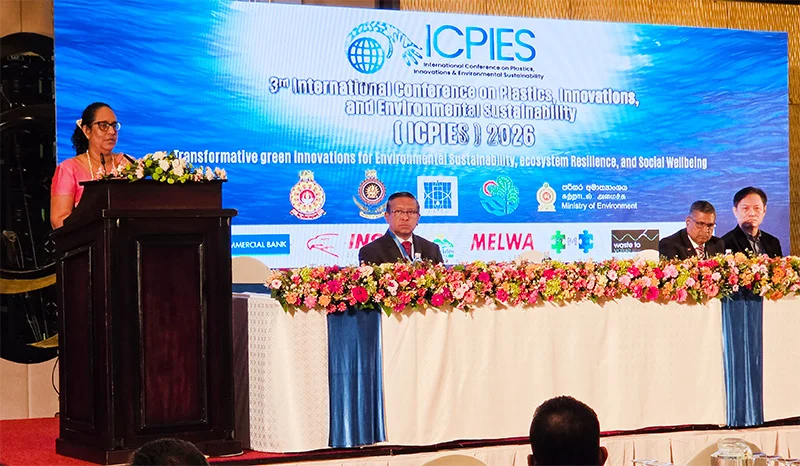
Prime Minister Dr. Harini Amarasuriya warned that Sri Lanka’s worsening waste-management crisis, particularly the uncontrolled accumulation of plastic waste and poorly managed landfills, was a “disaster waiting to happen”, urging scientists, researchers and policymakers to help the government find practical solutions before the problem reaches a critical point.
Addressing the launching of the Open University of Sri Lanka organized, ‘International Conference on Plastics, Innovations and Environmental Sustainability’ (ICPIES 2026) as Chief Guest, at the Cinnamon Lakeside Hotel yesterday she said waste management, waste reduction and recycling had become national priorities, with the government placing greater emphasis on the issue in its preparations for the 2027 Budget.
‘This is becoming a critical issue and something that, at any moment, if we don’t manage it properly, could become a huge disaster. It’s a disaster waiting to happen, Dr. Amarasuriya said.
She said unregulated and poorly managed landfills, particularly in and around Colombo, posed serious environmental and public risks, while increasing urbanisation was extending the waste-management challenge beyond the capital to other parts of the country.
‘As a member of Parliament for the Colombo District, I can tell you that one of the biggest challenges we are facing is waste management and actually managing the recycling of waste, and particularly of plastic products. This is something that we are battling every day, she said.
The Prime Minister said the government could not regard economic development as meaningful if it came at the expense of the country’s environment and natural resources.
‘If we are to speak of a beautiful life, we must first ensure that the air we breathe, the water we drink, the soil on which we live, the food we eat is clean and secure, she said.
She pointed to the scale of the global plastics crisis, noting that around 400 million tonnes of plastic waste are generated worldwide each year, while between 19 and 23 million metric tonnes of plastic waste enter natural ecosystems annually.
Plastic waste eventually breaks down into microplastics, which can enter aquatic organisms and subsequently the human food chain, she said.
Dr. Amarasuriya also linked plastic consumption and environmental degradation to the wider climate crisis, warning that the consequences of climate change were already being experienced by communities around the world.
She referred to devastating floods and landslides in the Himalayan region and said the impacts of climate change demonstrated that environmental damage could have consequences far beyond national boundaries.
Coastal clean-up projects and other waste-separation and recycling initiatives are also being implemented, while the government is working with the Western Provincial Council on a refuse-derived fuel project at Karadiyana.
The third ICPIES, held under the theme “Eco-Driven Innovations,” brings together researchers, policymakers, industry representatives and other stakeholders to examine plastic pollution, microplastics, circular-economy approaches, waste-management policy, technological innovation, artificial intelligence and smart environmental monitoring. The conference ends today.
Senior Professor P. M. C. Thilakarathne, Vice Chancellor of the Open University of Sri Lanka, was the Guest of Honour.

By Hiran H. Senewiratne
Stock investors were worried yesterday following Central Bank Governor Dr. Nandalal Weerasinghe’s mention at the CBSL monthly monetary policy review meet of possible future inflation pressures that may impact the economy.
The All Share Price Index went down by 4.89 points, while the S and P SL20 rose by 16.1 points. Turnover stood at Rs 1.55 billion with four crossings.
Those crossings were; Access Engineering crossed 1.5 million shares to the tune of Rs 119.8 million; its shares traded at Rs 79.60, Sampath Bank 450,000 shares crossed tfor Rs 63 million; its shares sold at Rs 140, Sunshine Holdings 750,000 shares crossed to the tune of Rs 21.4 million; its shares traded at Rs 28.50 and Softlogic Life 290,000 shares crossed for Rs 20.4 million; its shares sold at Rs 70.40.
In the retail market companies that mainly contributed to the turnover were: Access Engineering Rs 150 million (1.9 million shares traded), JKH Rs 113 million (six million shares traded), Softlogic Life Rs 80 million (one million shares traded), Softlogic Capital Rs 64.7 million (6.7 million shares traded), Lanka Realty Rs 64.3 million (1.3 million shares traded), Colombo Dockyard Rs 53.7 million (452,000 shares traded) and Sierra Cables Rs 50 million (1.43 million shares traded). During the day 58.9 million share volumes changed hands in 13536 transactions.
It is said that mixed market reactions were noted especially in manufacturing while banking, insurance and FMCG sectors performed well. Further, construction sector counters, especially Access Engineering, and banking sector counters, especially Sampath Bank, performed well.
People’s Leasing & Finance PLC announced its allotment basis for 100 million listed debentures it issued to raise Rs 10 billion, after receiving applications for the full amount.
Yesterday the rupee was quoted at Rs 330.68/75 to the US dollar in the spot market from Rs 330.70/90 the previous day, while bond yields were quoted steady to lower, dealers said.
An auction of Rs 80,000 million Treasury bills was ongoing.

ICC introduces pink-ball daytime Test trial, new time-wasting penalties

Discussion on Anuradhapura Sacred City Development Plan

India enter Asian Games final after Kishan and Bumrah ride roughshod over Sri Lanka

I extend my heartfelt wishes to all the sons and daughters of our country for a Happy World Children’s Day – President

Sri Lanka bowl first in semi final clash against India

Trump hints US could strike Iran, warns time coming

‘Dates have the highest sugar content to fight Coronavirus’

Sunday Island 27 December – Headlines

#SundayIsland 17th December – Headlines

Sunday Island – 28th March

Sunday Island Headlines – 21 March

Sunday Island – 21st February – Headlines
-

 Editorial6 days ago
Birth of a bad law
-

 Features7 days ago
Beyond traditional jobs: Why Sri Lanka needs to facilitate the gig economy
-

 News4 days ago
Police remove Thileepan statue in Jaffna
-
 Latest News7 days ago
Kusal, Wellalage star as Sri Lanka defend 322 in Headingley thriller
-

 News6 days ago
TIN mandatory for key transactions from Nov. 1
-

 Features4 days ago
The 22nd Amendment, constitutional recovery and illiberal slippage
-

 Features4 days ago
Of foreigners as CEOs of Lankan ventures
-

 News4 days ago
Sajith rejects Jt. Opp. protest sabotage claim; SJB TU chief demands remedial action