
News
‘Sethusamudram a stupid project…’: BJP TN chief Annamalai points out ‘multiple’ objections


New Delhi [India], January 26 (ANI): The BJP’s Tamil Nadu chief K Annamalai has reiterated his claim that the ‘Sethusamudram’ waterway project ‘fails on multiple fronts’, one of which is the potential damage to the ‘Ram Setu’ (bridge), which according to the epic ‘Ramayana’ was created to rescue Sita from the clutches of Ravana.
In ANI Podcast with Smita Prakash, Annamalai said, “When the UPA government was in power, the DMK government wanted the ‘Setu Samudram’ project to be implemented. Under this project, ships can avoid a longer route around Sri Lanka and reach the Toothukudi port directly. The DMK said it (the project) will save money and attract cargo traffic towards India.”
The Sethusamudran project aims at creating a continuous, navigable route around the Indian peninsula, so that ships, instead of going around Sri Lanka because of the shallow water, can reach the Tamil Nadu coast directly, resulting in siginificant economic benefits to India, according to reports.<br />”It is the Adam’s Bridge in English and Ramarpalam in Tamil. It means Ram’s Bridge. Also called the ‘Ram Setu’ in Hindi, the 58-km-long landmass bridge connects India and Sri Lanka,” the BJP’s Tamil Nadu chief said.
He said the primary objection to the project is the potential damage to the ‘Ram Setu’.
“The DMK presented a drawing of an alignment ‘4A’ for the Setu Samudran project, which breaks through the Ram Setu. In 2018, the central government submitted an affidavit in the Supreme Court, saying that it had an objection to the ‘4A’ alignment as it will destroy the Ram Setu and the Union government was considering other alignments where the ‘Ram Setu’ won’t even be touched,” he said.
He further alleged that the stand of the DMK and the Congress-led UPA has been that there is ‘nothing like’ Ram Setu and it is all a figment of imagination. The central government has been saying that it is not against the project, but will find some other alignment for it, he added.
“In January 2021, PM Modi set up a committee to scientifically study Ram Setu and the committee is functioning as of date,” he said.
The BJP’s Tamil Nadu chief also pointed to Union Minister Jitendra Singh’s reply in the Parliament regarding the Ram Setu.
“Recently in Parliament, Union Minister Jitendra Singh replied to a question on whether the connection of Ram Setu with Ramayana is confirmed. He replied that ‘structures’ do exist, but since they are 18,000 years old, as of now, the Ram Setu ‘bridge’ is not confirmed. But the structures do exist. The committee is functioning and will submit a report,” he said.<br />Targeting the DMK government further, Annamalai said, “The Tamil Nadu government picked one line of minister Jitendra Singh’s speech, saying that since the central government is itself saying that Ram Setu does not exist, we are implementing the project.”
“Even then, our members in the Assembly said we don’t have an objection to the project, but they should not go for alignment ‘4A’ as it will damage the Ram Setu bridge, and opt for other alignments,” he added.
The Tamil Nadu BJP chief said another objection to the project is that it will benefit only a few big DMK leaders and not the fisherfolk of the state.
“This 4A is a very stupid project. I am using the word ‘stupid’, because former CM Jayalalithaa had also used the same word,” he said.
“The sea between Sri Lanka and Tamil Nadu is a very peculiar and shallow area. We have coral reefs and ‘Ram Setu’ there. In some areas, you can see the land below the water for kilometres. Every time, a ship has to come, the sand will come and close the route. So, a dredging operation has to be done for the ships to pass through the area,” he said.
Further citing former CM Jayalalithaa, Annamalai said as the dredging operation has to be continuous, huge ships won’t be able to come from this route and the project will fail.<br />”She said that it will only benefit two people — (DMK leader) TR Balu, who owns a shipping company and (fellow party leader) Kannimozhi, who owns the logistics. No fisherman will benefit from this. She also challenged them to put on record that they don’t have any stake in the shipping business. Today, Kannimozhi is the Toothukudi MP, and TR Balu-ji is an MP in Chennai. But, they are yet to answer if they have any stake in the shipping business,” he further said.
Raising another objection, the BJP’s Tamil Nadu chief said the shallow water in the region protects the coast from tsunamis.
“A recent study says that when Tsunami came, a lot of damage happened, but the coastline between India and Sri Lanka didn’t get damaged because the shallow water absorbed all the energy. Technically, it protects us from tsunamis because the Indonesian plate is also very fragile,” he said.
He further highlighted the RK Pachauri report which called the project ‘unsustainable’.
“The RK Pachauri report called the report ‘unsustainable’. For an INR 25000 crore project, it will be sustainable only if it provides a 12 per cent rate of return. But, the project does not get even 4 per cent. There is no saving of cost and no saving of fuel. The cost of dredging will offset the saving that will be done by skipping Sri Lanka and coming inside,” he said.
Annamalai said the reason behind their objections to the project is that it fails on multiple fronts.
“So, far we can see that the project fails on multiple fronts. So, if you want to go ahead with the project, you will have to work completely out of the box, along with the central government,” he added.
On January 14, Annamalai alleged that the Sethusamudram waterway project straddling India and Sri Lanka would benefit only a few shipping companies owned by leaders of the ruling DMK.
A grand waterway project straddling India and Sri Lanka, the Sethusamudram project proposes to connect the Palk Strait with the Gulf of Mannar. The project is seen as key to bringing economic prosperity to the state and the country.
Commissioned in 2005, the project came to a halt in light of protests by rightwing groups claiming that the project may harm the ‘Ram Setu’ bridge, which is believed to have been built by Lord Ram to reach Sri Lanka.
Environmentalists and activists, too, had claimed it might pose a potential threat to the environment in Rameswaram, the southernmost tip of the country.In the resolution, the DMK government had promised to complete the project while campaigning for the upcoming Assembly elections.

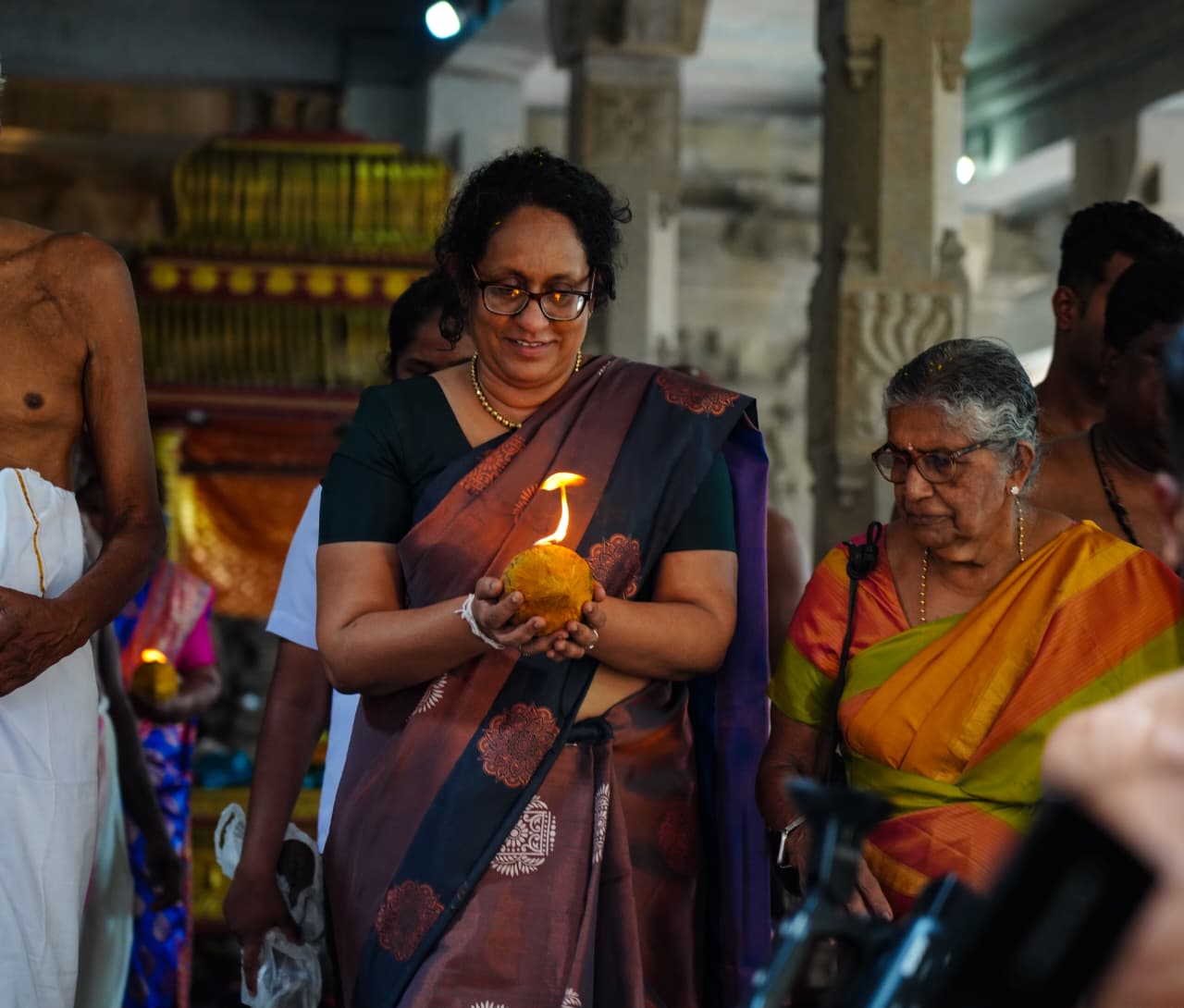
The Prime Minister Dr. Harini Amarasuriya participated in the special Shiva pooja held on at the Thiruketheeswaran Kovil in Mannar, in observance of Maha Shivaratri, a day celebrated with deep devotion by Hindu devotees
Latest News
“Sri Lanka Set to Become the First South Asian Country to Enter the Global Charter on Children’s Care Reform”


Today (17), Sri Lanka officially expressed its Intent to Enter into Global Charter on Children’s Care Reform at the United Nations Compound, Bauddhaloka Mawatha, Colombo 07.
The event was attended by the David Lammy, Member of Parliament, Lord Chancellor and Secretary of State for Justice and Deputy Prime Minister of the United Kingdom. On behalf of Sri Lanka, the official Expression of Intent was made by the Minister of Women and Child Affairs, Saroja Savithri Paulraj.
Sri Lanka has long been a State Party to the United Nations Convention on the Rights of the Child (UNCRC) and remains committed under international law to protecting and promoting children’s rights. The Global Charter for on Children’s Care Reform has been developed based on existing international commitments, including the 2009 United Nations General Assembly Guidelines for the Alternative Care of Children; the 2019 UN General Assembly resolution focusing on the rights of children without parental care (A/RES/74/133); the CRPD/C/5: Guidelines on de-institutionalization, including in emergencies (2022); the 2022 Kigali Declaration of Commonwealth States; and the 2024 1st Global Ministerial Conference on Ending Violence Against Children, which called for action. To date, 34 countries around the world have endorsed this Charter.
As no South Asian country has yet joined this Charter, Sri Lanka is set to become the first South Asian nation to do so.
The primary objective of joining this Charter is to further strengthen Sri Lanka’s national child Care policies and align their implementation with international standards.
The event was collaboratively organized by UNICEF and the British High Commission in Sri Lanka. Among those present were the British High Commissioner to Sri Lanka, Andrew Patrick; British Deputy High Commissioner to Sri Lanka, Theresa O’Mahony; UN Resident Coordinator in Sri Lanka, Marc-André Franche; UNICEF Representative to Sri Lanka, Emma Brigham; Secretary to the Ministry of Women and Child Affairs, Tharanganie Wickramasinghe; government officials; representatives of non-governmental organizations; and civil society representatives.


Convenor of the Samagi Joint Trade Union Alliance affiliated with the Samagi Jana Balawegaya, Ananda Palitha, yesterday (16) said that the Ceylon Electricity Board was seeking to raise electricity tariffs by 13.56% percent although it had earned a profit of more than Rs 22,000 mn.
The CEB recently submitted its proposal to the Public Utilities Commission of Sri Lanka (PUCSL) for an electricity tariff revision for the second quarter of this year – the period effective from April 1 to June 30.
Palitha alleged that the PUCSL, in spite of knowing the massive profit earned by the CEB, at the expense of the hapless public, had chosen to allow the state enterprise to propose an additional burden.
The economic, technical and safety regulator of the electricity industry, and the designated regulator for petroleum and water services industries, should exercise its powers in terms of the PUCSL Act No. 35 of 2002 and the Sri Lanka Electricity Act No. 20 of 2009 to provide relief, the veteran trade unionist said.
Palitha emphasised that the PUCSL had the right to intervene on behalf of electricity consumers but, unfortunately, chose to facilitate the CEB’s despicable strategy. “The proposal to increase tariffs by 13.56% was meant to divert attention. The real issue at hand is the percentage of electricity tariff reduction,” Palitha said. The former UNPer found fault with the Opposition for failing to expose the CEB.
Taking into consideration the Rs 22,000 millionplus profit, the PUCSL could order the CEB to grant relief to consumers, Palitha said, adding that the CEB and PUCSL, together, deprived electricity consumers tariff reduction in the first quarter of this year, too.
In January this year, the CEB asked for a 11.59% tariff increase though it was enjoying Rs 22,000 mn profit at that time, the trade unionist said.
Palitha said that as the PUCSL received all data available to the CEB it was fully aware of the finances of the state enterprise.
In January, 2025, regardless of the NPP government floating the idea regarding as much as a 37% tariff increase, the PUCSL granted a 20% tariff reduction (25% of Rs 22,000 mn profit), Palitha said.
According to him, as a result of relief granted to the consumers, the profits had been reduced to Rs 16,000 mn but by June 2025 profits had increased to Rs 18,000 mn and there was a need to grant tariff reduction. But, the NPP, having always lashed out at the International Monetary Fund (IMF) in the run up to the presidential election, held in September 2024, started playing a different tune.
Responding to The Island queries, Palitha said that contrary to claims that the CEB proposed a 13.56% tariff increase to cover up losses caused by the importation of low-quality coal for the Norochcholai Lakvijaya coal-fired power plant, the current strategy seemed to have been adopted at the behest of the IMF.
Instead of granting tariff reduction for the third quarter in 2025, the PUCSL ordered an 18% increase, Palitha said. The trade unionist claimed that the Finance Ministry, at the behest of the IMF, directed both the CEB and the PUCSL to increase electricity tariffs by 20% in violation of the relevant Acts, he said.
Then in Oct, 2025, the CEB proposed a 6.8 % tariff increase at a time its profits were around Rs 22,000 mn. The CEB and PUCSL staged a drama over that proposal and finally, on the false pretext of the CEB’s failure to furnish its proposal on time, the revision was dropped, Palitha said. The SJB activist pointed out that the Opposition failed to highlight that consumers had been deprived of downward revision in spite of massive profits earned by the Board. “In fact, when Energy Minister Kumara Jayakody met trade unions, he very clearly declared that they were considering electricity power reduction, perhaps by 10%, 12% or 15%. But in the end nothing happened.”
Now the same drama is being enacted by the government, the CEB and the PUCSL, Palitha said.
By Shamindra Ferdinando

‘Treat him with dignity’ – Gavaskar, Chappell among 14 former captains to come out in support of Imran Khan

PM participates in special Shiva Pooja held at the Thirukedeswaran Temple in Mannar

Rain ends Ireland and Australia’s T20 World Cup hopes

“Sri Lanka Set to Become the First South Asian Country to Enter the Global Charter on Children’s Care Reform”

Incoming Bangladesh PM Tarique Rahman, lawmakers sworn into parliament

Samra’s record 110 in vain as Phillips and Ravindra put New Zealand in Super Eights

‘Dates have the highest sugar content to fight Coronavirus’

Sunday Island 27 December – Headlines

#SundayIsland 17th December – Headlines

Sunday Island – 28th March

Sunday Island Headlines – 21 March

Sunday Island – 21st February – Headlines
-
 Life style3 days ago
Marriot new GM Suranga
-

 Business2 days ago
Ministry of Brands to launch Sri Lanka’s first off-price retail destination
-

 Features3 days ago
Monks’ march, in America and Sri Lanka
-
 Midweek Review7 days ago
A question of national pride
-
 Business7 days ago
Autodoc 360 relocates to reinforce commitment to premium auto care
-
 Opinion6 days ago
Will computers ever be intelligent?
-
 Features3 days ago
The Rise of Takaichi
-
 Features3 days ago
Wetlands of Sri Lanka: