
Latest News
Seifert, Ravindra and Sodhi keep New Zealand’s 100% record intact

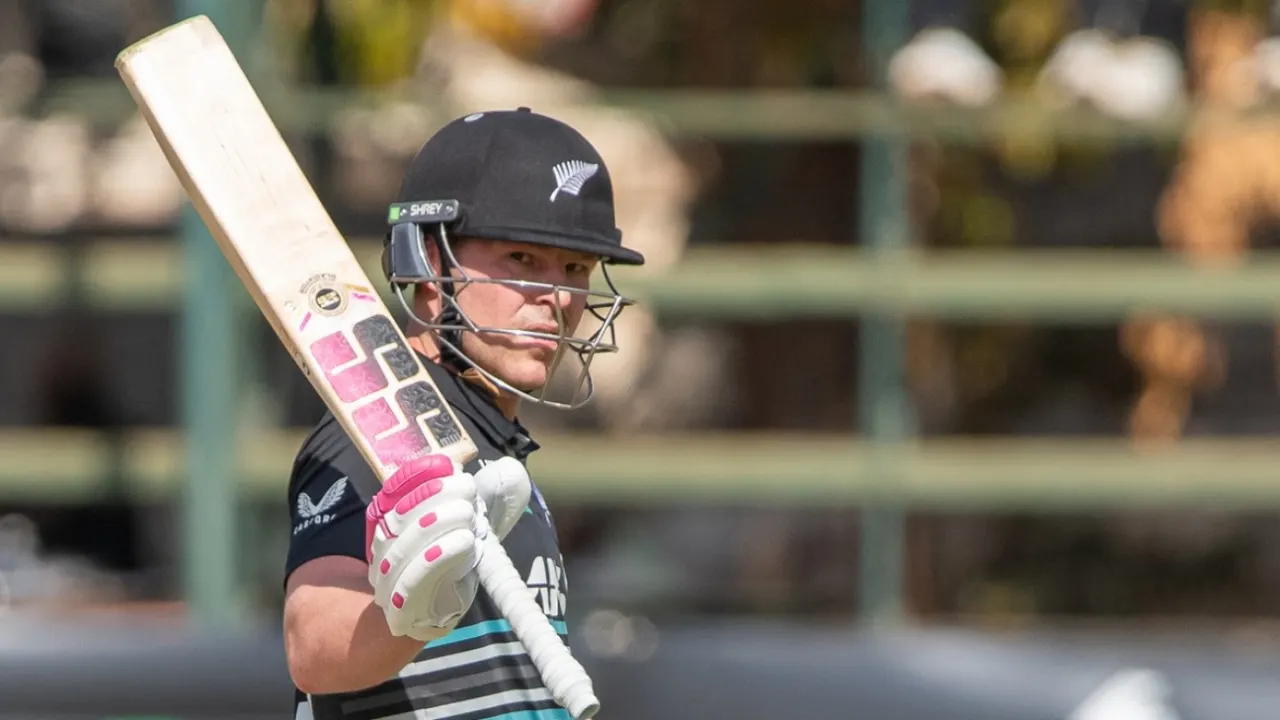
New Zealand smashed the highest score of the tri series and any hope of Zimbabwe earning a consolation win as they laid down a marker ahead of Saturday’s final against South Africa.
After choosing to bat first – despite captains in this tri-series usually bowling – a second-wicket stand of 108 between Tim Seifert and Rachin Ravindra set New Zealand up well. Both went on to score half-centuries before a Michael Bracewell cameo of 26 of 16 balls pushed New Zealand to 190. They bowled Zimbabwe out in 19 overs, as only three Zimbabwean batters got into double figures.
As dominant as New Zealand were, Zimbabwe will be particularly unhappy with their lapses in the field. They put down three catches – Tim Robinson on 0, Seifert on 13 and Bracewell on four – and bowled seven wides and a no-ball in a messy display which left them needing to complete their second-highest successful chase to win.
Any chance of that happening was blown away when Zimbabwe were reduced to 44 for 5 in the eighth over. Ish Sodhi took three of those wickets, bowling in the powerplay, and proved too much to handle for Zimbabwe’s top-order. A sixth-wicket stand of 51 between Tony Munyonga and Tashinga Musekiwa leant the innings some respectability Sodhi’s career-best 4 for 12 scripted a simple win for New Zealand. With 150 T20I wickets, he also climbed to third on the all-time wicket taker’s list in the format.
Zimbabwe will be spectators on Saturday and have no more fixtures scheduled before they host the Africa Region T20 World Cup Qualifiers in September.
Richard Ngarava has been Zimbabwe’s most successful bowler of the series and almost struck with his second ball when Robinson chased a delivery that angled away and got a thick outside edge. Ryan Burl at wide slip could not hold on. There was not too much damage done from that miss as Ngarava had Robinson caught at deep third off the second ball of his next over. Ngarava was brought back at the death and though he was hit for three successive by Seifert, he eventually foxed him with a slower ball that he feathered through to Clive Madande. Two balls later Bevon Jacobs tried to hit a short, wide ball out of the ground but was done for pace and sliced it to backward point.
Ngarava’s change-ups worked again when he had Mitchell Santner caught behind off a slower ball in an over that lasted 10 balls. His next challenge is to enhance his wicket-taking skills with a bit more discipline in order to truly lead Zimbabwe’s attack.
Don’t drop Seifert. He was put down on 0 by South Africa in the previous match and went on to score 66* in a clinical run-chase. In this match, he was on 13 and had already hit two fours when Munyonga, at deep backward square, put him down off Tino Maposa and Seifert didn’t need a second invitation.
Two overs later, he smacked Dion Myers into the leg side for his third four and the runs kept coming. Wellington Masakadza was sent through extra cover, Myers through the slip area and Sikandar Raza past short fine. Seifert brought up his 12th T20I fifty off 33 balls and went on to score his first six when he deposited Raza over long-on. He was especially good in a wide ‘v’ down the ground with 50 of his runs coming between extra cover and mid-wicket before he eventually fell to Ngarava for 75.
In search of a solid start, Zimbabwe asked Myers to open the batting, ahead of Wessly Madhevere, for the first time in his T20I career and he was off to a flier. He drove and cut Matt Henry for back to back boundaries to give Zimbabwe a blazing start and then showed off his pull shot to end the first over on 14 without loss. Myers was less in control against Zakary Foulkes, who he inside-edged over the keeper but showed intent against legspinner Sodhi, albeit without success.
He walked across his stumps off the second ball he faced from Sodhi and tried to flick him fine but gave himself too much room and was bowled. A score of 22 from 18 balls is not much to write home about but given how poorly Zimbabwe have batted through this series, it could be an option worth exploring in future.
They got to 130 but were never in the hunt to chase down the target and have serious questions about their batting depth.
Brief scores:
New Zealand 190 for 6 in 20 overs (Tim Seifert 75, Tim Robinson 10, Rachin Ravindra 63, Michael Bracewell 26*; Richard Ngarava 4-34, Tinotenda Maposa 2-33) beat Zimbabwe 130 in 18.5 overs (Dion Myers 22, Tony Munyonga 40, Tashinga Musekiwa 21; Ish Sodhi 4-12, Matt Henry 2-34, Zakary Foulkes 1-14, Will O’Rourke 1-19, Michael Bracewell 1-16) by 60 runs
[Cricinfo]


US President Donald Trump has threatened to fire Federal Reserve Chair Jerome Powell if he does not step aside at the end of his term in May.
The two have been embroiled in a bitter spat over Powell’s reluctance to cut the central bank’s interest rate, despite Trump’s repeated calls.
Powell’s term expires on 15 May, but he is planning to remain in post until his successor, Kevin Warsh, is confirmed by the Senate.
“Then I’ll have to fire him,” Trump told Fox Business, when asked about Powell’s plans to stay on in the job.
“I’ve held back firing him. I’ve wanted to fire him, but I hate to be controversial,” Trump said.
Thom Tillis, an influential Republican senator on the committee which oversees nominations for the Federal Reserve chair, has threatened to block Warsh’s confirmation. If Warsh is not confirmed before Powell’s term expires, he plans to stay on temporarily in the post.
“That’s what the law calls for. That’s what we’ve done on several occasions,” Powell has said.
Tillis has warned Trump he will not let Warsh’s appointment go ahead unless a criminal investigation into Powell, linked to the renovation of the Federal Reserve building, is dropped.
[BBC]

Royal Challengers Bengaluru (RCB) bowled Lucknow Super Giants (LSG) out for 146 and chased it down with nearly five overs to spare as they moved to the top of the IPL 2026 points table.
This win was thanks to the defensive bowling skills of Josh Hazelwood and Krunal Pandya. They took three wickets between them. Others were more successful on the night but it was very much a case of pressure created at one end resulting in mistakes at the other. Rishabh Pant had a chastening night, taking a blow to his left elbow, retiring hurt in the fifth over, coming back in the 16th with LSG in dire straits and being dismissed for 1 off 6.
With Hazlewood back in the team, and bowling three of the first seven overs, RCB gained an early stranglehold over the game. On a pitch which was dry and holding up a bit, he made life extremely hard for the batters by never giving them a chance to free their arms. When Pant tried, he suffereed a blow on the left elbow and had to retire hurt. When Nicholas Pooran tried, he dragged the ball onto his stumps. RCB’s quicks conceded runs at just over seven an over in the first 10. When they focused on keeping the ball around the off stump, runs would only come at just over three an over during this same period. Hazlewood was running so hot he merited a slip and a short leg at one point.
There are now 12 spinners with 100 wickets in the IPL. It is a list dominated by wristspinners and mystery spinners. For Krunal to end up there shows just how well he works within his limitations though lately he has been pushing against them, bowling bouncers and, on Wednesday, a crouched, low-arm delivery that did for Mitchell Marsh. The Australian had made 40 of LSG’s 71 runs at that point and thought he had a short ball he could put away, but the change in Krunal’s action made sure it didn’t bounce as much as expected.
Marsh was bowled off an inside edge. Together, Hazlewood and Krunal bowled 23 dot balls. The pressure they put resulted in wickets for Rasikh Salam (4 for 24) and Bhuvneshwar Kumar (3 for 27). Pant came back to bat again with his left arm strapped up but was one of five wickets that fell in the death overs (17 to 20).
Playing for the first time in his IPL career as an Impact Sub, Virat Kohli hit six fours and a six in his first 14 balls, showing once again a willingness to manufacture shots and hitting in the air. LSG helped his cause as well by bowling too full. These were not the conditions to go searching for conventional help. RCB hit the deck. Even a swing bowler like Bhuvneshwar didn’t bother pitching the ball too far up.
LSG didn’t get the memo. They were a distant second in this game tactically. Kohli was 32 off 14 as RCB put on 60 in the powerplay. Once the field spread, and LSG hit better lengths, runs became harder to come by. Kohli made 17 off his last 20 balls and fell for 49 off 34.
Rajat Patidar came in and played a very sixy innings. He has cleared the boundary 21 times this season, more than anybody else. His balls-per-six ratio is under five. RCB could have knocked these runs over and taken the game. But they kept putting pressure on the LSG bowlers. They felt no need to take a backwards step. The win came in the end, at the cost of maybe one or two more wickets, which seems a reasonably price to pay to stay true to your identity.
Brief scores:
Royal Challengers Bengaluru 149 for 5 in 15.1 overs (Virat Kohli 49, Devudutt Padikkal 10, Rajat Patidar 27, Jitesh Sharma 23, Tim David 14*, Romario Shepherd 14*; Prince Yadav 3-32, Avesh Khan 2-23) beat Lucknow Super Giants 146 in 20 overs (Mitchell Marsh 40, Aiden Markram 12, Ayush Badoni 38, Mukul Choudhary 39; Bhuvneshwar Kumar 3-27, Josh Hazelwood 1-20, Rasikh Salam 4-24, Krunal Pandya 2-38) by five wickets
[Cricinfo]
Latest News
Heat Index at Caution Level in the Northern, North-central, North-western, Western, Sabaragamuwa, Eastern and Southern provinces and in Monaragala district

Warm Weather Advisory
Issued by the Natural Hazards Early Warning Centre
Issued at 3.30 p.m. on 15 April 2026, valid for 16 April 2026.
The Heat index, the temperature felt on human body is likely to increase up to ‘Caution level’ at some places in the Northern, North-central, North-western, Western, Sabaragamuwa, Eastern
and Southern provinces and in Monaragala district.
The Heat Index Forecast is calculated by using relative humidity and maximum temperature and this is the condition that is felt on your body. This is not the forecast of maximum temperature. It is generated by the Department of Meteorology for the next day period and prepared by using global numerical weather prediction model data.
Effect of the heat index on human body is mentioned in the above table and it is prepared on the advice of the Ministry of Health and Indigenous Medical Services.
ACTION REQUIRED
Job sites: Stay hydrated and takes breaks in the shade as often as possible.
Indoors: Check up on the elderly and the sick.
Vehicles: Never leave children unattended.
Outdoors: Limit strenuous outdoor activities, find shade and stay hydrated.
Dress: Wear lightweight and white or light-colored clothing.
Note:
In addition, please refer to advisories issued by the Disaster Preparedness & Response Division, Ministry of Health in this regard as well. For further clarifications please contact 011-7446491

Babar Azam 71* helps Peshawar Zalmi extend lead at top

Trump threatens to fire Fed chair Jerome Powell if he doesn’t leave in May

Royal Challengers Bengaluru top the table after bowlers help thump Lucknow Super Giants

Showers expected in the Western, Sabaragamuwa, Southern, Central, Uva and North-western provinces

Heat Index at Caution Level in the Northern, North-central, North-western, Western, Sabaragamuwa, Eastern and Southern provinces and in Monaragala district

Pakistani army chief in Tehran amid bid to restart US talks

‘Dates have the highest sugar content to fight Coronavirus’

Sunday Island 27 December – Headlines

#SundayIsland 17th December – Headlines

Sunday Island – 28th March

Sunday Island Headlines – 21 March

Sunday Island – 21st February – Headlines
-

 News4 days ago
CEB orders temporary shutdown of large rooftop solar systems
-
 Features4 days ago
From Royal College Platoon to National Cadet Corps: 145 years of discipline, leadership, and modern challenges
-

 Business6 days ago
Israeli attack on Lebanon triggers local stock market volatility
-

 Business6 days ago
HNB Assurance marks 25 years with strategic transformation to ‘HNB Life’
-

 Latest News3 days ago
PNS TAIMUR & ASLAT arrive in Colombo
-

 News5 days ago
Anura Solomons passes away
-

 Features4 days ago
CIA’s hidden weapon in Iran
-
 Latest News3 days ago
Prasidh, Buttler set up comfortable win for Gujarat Titans