
Latest News
Sciver-Brunt’s maiden WPL ton lifts Mumbai Indians to second despite Ghosh heroics

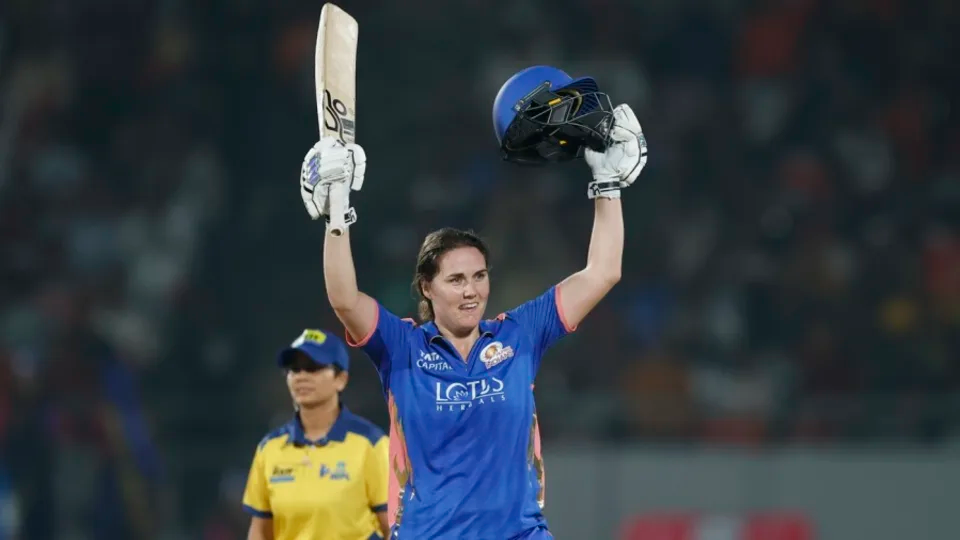
The most prolific batter of the WPL and the ever-so reliable Nat Sciver Brunt has finally broken the century drought in the tournament, 1059 days and 82 matches since the league started in 2023. Even though the conditions continued to be slow in Vadodara, Sciver-Brunt switched gears after the powerplay with a 32-ball half-century to pick the gaps and middle the ball in unparalleled fashion.
She powered Mumbai Indians (MI) to 199, the highest total on this ground this season, and the scoreboard pressure told on the Royal Challengers Bengaluru (RCB) batters who collapsed to 35 for 5. They were given a late lift by Richa Ghosh’s bludgeoning 90 off just 50 balls that tried to rescue a sinking ship but the asking rate and lack of partners kept the task too stiff and they went down by only 15 runs in the end after her stunning assault.
Sciver-Brunt’s maiden T20 century could have hardly come at a better time for MI; they were fourth on the table after losing their last three games and needed to win this game to keep their knockouts fate in their own hands. They did it by taking down the table-toppers to go second and RCB have now lost two in a row after kicking off the season with five wins on the bounce that had taken them to the knockouts.
MI’s powerplay woes continued as S Sajana fell early to Lauren Bell’s swing for 7, and they trudged along against the moving ball to reach 38 for 1 in the powerplay, with just four fours and no sixes.
The experienced duo of Sciver-Brunt and Hayley Matthews then lifted MI with a rapid partnership that raced from 50 to 100 in just 21 balls. Sciver-Brunt was the first to cut loose when she made room against Nadine de Klerk to smash her down the ground. As the pitch again lacked pace, Sciver-Brunt and Matthews rocked onto the back foot to collect boundaries. Sciver-Brunt slapped two through the covers off Shreyanka Patil in the eighth over, Matthews went behind square off Arundhati Reddy for two more fours in the next, and the fifty stand was up.
Soon after she topped the run charts for this WPL, Sciver-Brunt increased RCB’s headaches by piercing the gaps all around the park. After smacking de Klerk for a six, she punished Shreyanka for three consecutive fours – the first two off sweeps that brought up her 32-ball fifty, her fourth of the season. Matthews ended the 18-run over with another boundary before Sciver-Brunt carved Radha Yadav for three fours in the next, bringing up their century stand off just 61 balls.
Matthews soon got to her 35-ball fifty – her first of this WPL – and the dominating partnership ended only when Bell returned and rattled Matthews’ stumps after the ball ricocheted off both pads. Harmanpreet Kaur lasted 12 balls for 20 runs before holing out to long-off, and Sciver-Brunt ended the 19th over by carving a wide yorker for four to move to 99, the highest individual score in the WPL until Monday.
She went past the barrier after holding the record for the most runs (8,883) and fifties (57) without a hundred in women’s T20s, across 348 innings. Shreyanka bowled a tidy last over for just five runs, keeping MI just short of 200.
After she missed the first few games with a shoulder niggle and then struggled for rhythm with both bat and ball, Matthews turned the tide against the best side of this WPL. Her offspin match-up worked instantly against Smriti Mandhana, who top-edged to backward square leg for 6, not long after Grace Harris had edged Shabnim Ismail behind. No. 3 Georgia Voll also handed a catch to the wicketkeeper when Matthews erred with her line down leg and Rahila Firdous took a sharp catch off the bottom edge.
Two balls later, Ismail hit the stumps off an almost-frozen Gautami Naik to reduce RCB to 31 for 4, which soon became 35 for 5 in the last over of the powerplay when Radha Yadav found long-on off Matthews.
Ghosh was the only bright spot for RCB, who had been bundled out for their lowest WPL score in their previous match. She made the most of getting two lives: the first was a tough chance for the keeper off a spinner, while the second was a sitter for Matthews, who put down a skier running in from long-off and covered her mouth in disbelief.
Ghosh also lost de Klerk in the 12th over but started to hit out even as RCB needed 120 from 48 with six wickets down. She dispatched anything with width or length and went after anyone who came her way. The big charge came in the 16th over when she clobbered three consecutive fours off Amelia Kerr. Amanjot Kaur fought back with a wicket in a six-run over next, but she was at the receiving end of a stunning assault in the 19th.
RCB needed 59 from 12, and Ghosh went 6, 6 and 6, starting by putting away a full toss before relying on brute force. When she managed only a single on the fourth ball, Shreyanka carved two fours to keep RCB in the game, with 32 needed from six.
Ghosh started the final over with a four, but Kerr bowled a dot next that virtually sealed MI’s victory unless there was an illegal delivery. Ghosh, however, executed an unbelievable six off the next ball when Kerr looped it well outside off; Ghosh came down the track, reached out, and sent it sailing over the covers before ending up flat on the ground. She miscued the last ball of the game and was finally caught, as MI breathed a sigh of relief.
Brief scores:
Mumbai Indians Women 199 for 4 in 20 overs (Nat Sciver-Brunt 100*, Hayley Matthews 56, Harmanpreet Kaur 20; Lauren Bell 2-21, Nadine de Klerk 1-40, Shreyanka Patil 1-34) beat Royal Challengers Bengaluru Women 184 for 9 in 20 overs (Grace Harris 15, Richa Ghosh 90, Nadine de Klerk 2, Arundhati Reddy 14, Shreyanka Patil 12*; Shabnim Ismail 2-25, Hayley Matthews 3-10, Amanjot Kaur 1-51, Amelia Kerr 2-37) by 15 runs
[Cricinfo]

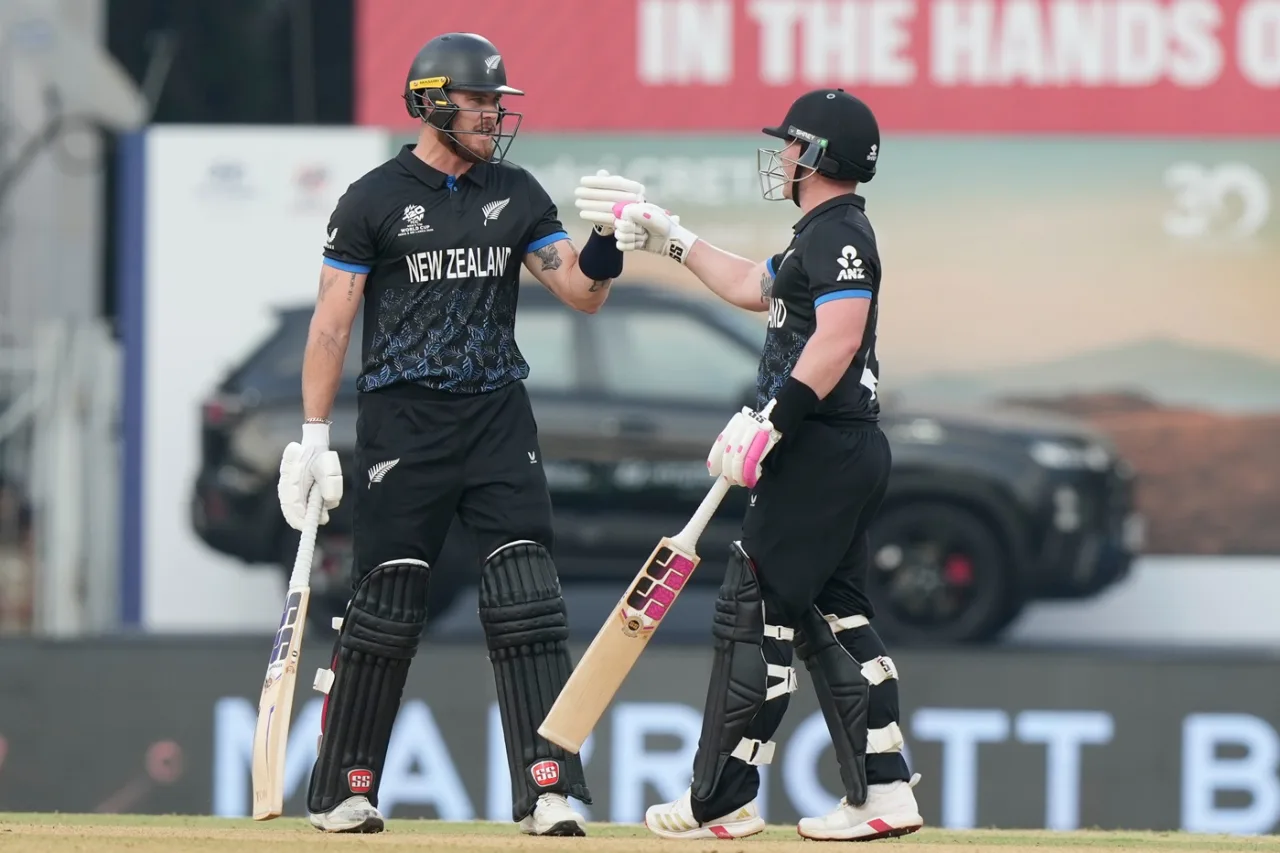
A win against Canada in their first T20I against them on Tuesday will firm up New Zealand’s spot in the Super Eight. This result will also knock out Canada; South Africa have already qualified for the next round from Group D with three wins in as many games.
New Zealand have faced Canada just three times in international cricket so far – each time in ODI World Cups. Their most recent meeting coming in the 2011 edition in Mumbai. They have won all three games and are poised to make it 4-0 against Canada in World Cups, despite the absence of Lockie Ferguson. The fast bowler has returned home for the birth of his first child and is expected to link up with the side ahead of the Super Eight. In Ferguson’s absence, Kyle Jamieson, who wasn’t even in the main squad in the first place, is set to make his T20 World Cup bow.
As for Canada, they had their moments against South Africa and UAE but they have failed to convert those into wins. On Friday in Delhi, they had UAE at 66 for 4 in the 13th over in a chase of 151, but they left the door ajar for Aryansh Sharma and Sohaib Khan to sneak home. Canada can’t afford such slip-ups against New Zealand – and then Afghanistan – if they are to notch up a win in this World Cup.
Kyle Jamieson doesn’t quite have Ferguson’s express pace, but can bang it away on a hard length and stifle the opposition batters. He also has some slower variations in his repertoire and his high-arm release could pose a big threat, especially to batters who are facing him for the first time.
Once known as “Vettori” in Canada’s club cricket circuit, Saad Bin Zafar will run into the team that was once captained by one of his heroes. The Canada left-arm spinner often attacks the stumps and keeps it tight, as his economy rate of 6.02 across 67 T20Is suggests. At 39, Saad knows he won’t be playing the game for long and will be eager to cause a few upsets on the big stage.
Jamieson is set to slot in for Ferguson unless New Zealand want to give veteran legspinner Ish Sodhi a game.
New Zealand (probable): Tim Seifert (wk), Finn Allen, Rachin Ravindra, Glenn Phillips, Daryl Mitchell, Mark Chapman, Mitchell Santner (capt), Jimmy Neesham, Kyle Jamieson, Matt Henry, Jacob Duffy
Canada are likely to play the same XI that lost to South Africa and UAE.
Canada (probable): Dilpreet Bajwa (capt), Yuvraj Samra, Navneet Dhaliwal, Nicholas Kirton, Shreyas Movva (wk), Harsh Thaker, Saad Bin Zafar, Jaskaran Singh, Dilon Heyliger, Kaleem Sana, Ansh Patel
[Cricinfo]
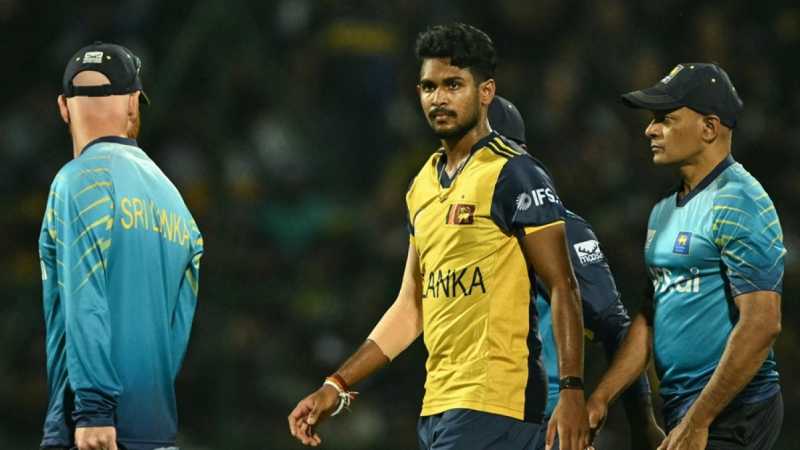
Sri Lanka fast bowler Matheesha Pathirana left the field four balls into his first over, after collapsing to the ground clutching his left calf, and did not return to the field during Sri Lanka’s bowling innings against Australia. Having briefly received treatment from the Sri Lanka physiotherapist immediately after sustaining the injury, Pathirana hobbled off the field with assistance from support staff.
He then spent the majority of the innings being treated in the dressing room. Sri Lanka will likely send him off for scans as soon as the match finishes.
“Matheesha Pathirana experienced discomfort in his left leg calf while bowling during the match and was unable to continue,” a statement read. “He will not bowl further in this game. A scan will be conducted tomorrow to determine the extent of the injury.”
Pathirana had begun well against Australia, bowling two dot balls and giving away three runs (including a wide) in those first four deliveries. The last two balls of the over were delivered by Dasun Shanaka, who gave away a four and bowled a dot.
Pathirana is the quickest bowler in Sri Lanka’s attack, and a key part of their death-bowling plans for the tournament in particular. He is also the second Sri Lanka bowler to come under an injury cloud, with Wanindu Hasaranga already having been ruled out of the World Cup with a hamstring injury of his own.
After this game against Australa, Sri Lanka have another group match to play, against Zimbabwe. They have not earned qualification for the Super Eights yet.
(Cricinfo)
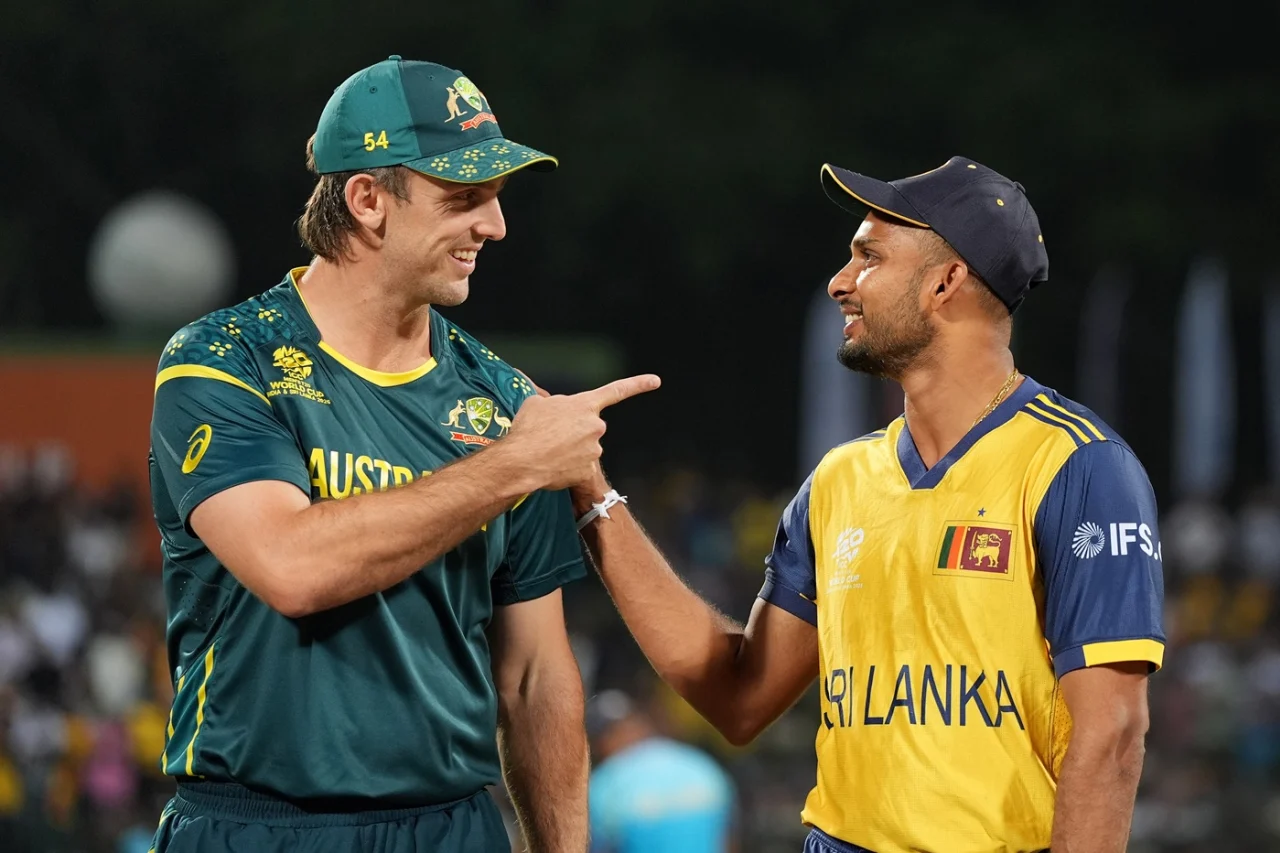
Mitchell Marsh came back to captain Australia, but called late at the toss in practically a must-win match for them. Dasun Shanaka decided to field, a decision Australia lived to regret against Zimbabwe. However, in a night match, dew must have been on the mind when Sri Lanka made that call.
Australia made three changes in all, but none of them involved Steven Smith. Also out went Matt Renshaw, their highest run-getter in the tournament. Australia also brought in Cooper Connolly and Xavier Bartlett for Matthew Kuhnemann and Ben Dwarshius. The structure of the side, though, remained the same perhaps with Connolly providing more batting as the left-arm spinner.
Sri Lanka’s structure remained the same as well with only one change. Kusal Perera replaced Kamil Mishara at the top of the order.
This was a huge match for Australia after they lost to Zimbabwe in Colombo. Even a win against Sri Lanka was not certain to assure progress into the next round. Their best bet was to win this match and hope for Zimbabwe to lose to Ireland. In case Zimbabwe won against Ireland and lost to Sri Lanka, it would cause a three-way tie. In case of a defeat, they would be left needing defeats for Zimbabwe against Sri Lanka and Ireland.
Sri Lanka were better placed, but a defeat could prove catastrophic for them, making their match against Zimbabwe crucial.
Playing XIs
Australia Mitchell Marsh (capt.), Travis Head, Cameron Green, Josh Inglis (wk), Tim David, Marcus Stoinis, Glenn Maxwell, Cooper Connolly, Xavier Bartlett, Nathan Ellis, Adam Zampa
Sri Lanka Pathum Nissanka, Kusal Perera, Kusal Mendis (wk), Pavan Rathnayake, Dasun Shanaka (capt.), Kamindu Mendis, Dunith Wellalage, Dushan Hemantha, Dushmantha Chameera, Maheesh Theekshana, Matheesha Pathirana
[Cricinfo]

New Zealand eye Super Eight spot against Canada

Pathirana under injury cloud as he leaves the field early

Kusal Perera in as Sri Lanka bowl; Marsh returns for Australia

Jacks the star as England qualify for Super Eights with nervy win

Navy seizes 02 Indian fishing boats poaching in northern waters

Ramadan 2026: Fasting hours around the world

‘Dates have the highest sugar content to fight Coronavirus’

Sunday Island 27 December – Headlines

#SundayIsland 17th December – Headlines

Sunday Island – 28th March

Sunday Island Headlines – 21 March

Sunday Island – 21st February – Headlines
-

 Life style2 days ago
Marriot new GM Suranga
-

 Features2 days ago
Monks’ march, in America and Sri Lanka
-

 Midweek Review6 days ago
A question of national pride
-

 Business6 days ago
Autodoc 360 relocates to reinforce commitment to premium auto care
-
 Opinion5 days ago
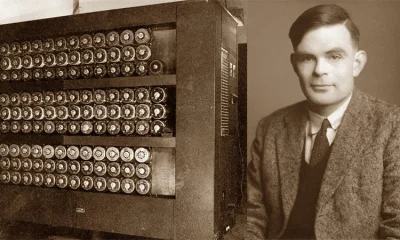
Will computers ever be intelligent?
-

 Business17 hours ago
Ministry of Brands to launch Sri Lanka’s first off-price retail destination
-

 Features2 days ago
The Rise of Takaichi
-

 Features2 days ago
Wetlands of Sri Lanka: