
Sports
School teams ready to throw everything at ‘gladiator style’ rugby challenge

By A Special Sports Correspondent
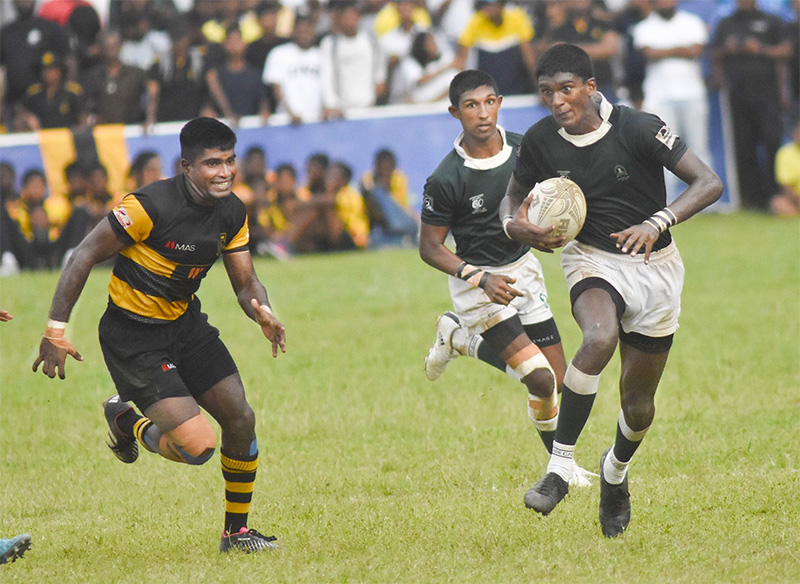
The inter-school league rugby tournament is expected to draw the crowds for yet another season as the sport of ‘rugby union’ is set to prove that it’s the most popular discipline practised here in the island next to cricket.
The Division 1 Segment A of the league rugby tournament will be worked off this season with 16 teams instead of the14-team line-up adopted last season. The tournament is expected to commence on June 10 and conclude on August 18; according to the rugby calendar released by the Sri Lanka Schools Rugby Football Association (SLSRFA). So far the school’s section of Sri Lanka Rugby (SLR) has not indicated of any changes to the starting date of this tournament.
The SLSRFA increasing the teams contesting the Division 1 segment of the tournament to 16 teams-eight in each group- is a bold move. But it has its pros and cons. The two teams that ended at the bottom of the group last season don’t see themselves being relegated. This type of decision by the school rugby authorities doesn’t force teams to be on the edge of their seats when the chips are down and they have not fared well. This means teams performing poorly can hang in there without being forced to drop to the bottom of the ‘league’ tournament. Instead the SLSRFA has promoted two teams from the Division 1 Segment B to contest the Division 1 Segment A of the tournament. These two teams which have earned promotions are Thurstan and Sri Sumangala Kandy. Both these teams did well last season in the Division 1 Segment A of the tournament. Thurstan has a long history in the sport of rugby and it would be a welcome return to Segment A; where the cream of the teams fight for the school rugby plum. However all eyes would be on new entrant Sri Sumangala which has to settle itself among the giants of school rugby.
The Division 1 Segment A of the schools tournament is hotly contested and players are forced to think and play the game like semi-professionals. It would be interesting to see how these two teams survive the big knocks in this segment where only the very best will survive. But luckily for the game all teams have taken this school rugby ‘challenge’ very seriously and have employed the best of coaches and support staff. Like its big brother, club rugby, school rugby also attracts massive media attention with games being telecast ‘live’ on a website dedicated to this sport. Most schools have more than one sponsor to back them and last year the main sponsor of the tournament-Dialog-pumped in much money to keep school rugby running like a Swiss made wristwatch.
Reigning champions St. Peter’s are grouped along with Isipatana, D.S Senanayake, St. Anthony’s, Trinity, S.Thomas’, Dharmaraja, Science and Sri Sumangala in Segment A while the other group (Segment B) comprises St. Peter’s, Royal, Zahira, St. Joseph’s, Vidyartha, Wesley, Kingwood and Thurstan.
Reigning champions St. Peter’s stared this season (2024) with two impressive performances. One was winning the Zahira International Invitations Sevens and the other was the School Elite Sevens. The Peterites were in a class of their own and gave enough signs that they will continue from where they stopped last season. Last season the lads from Bambalapitiya bagged the ‘league tournament’ and later the president’s trophy knockout tournament. The only team that posed a threat to St. Peter’s was Isipatana, which was breathing down their backs during the entire season. The two schools initially met in the super round of the league tournament where the Peterites beat the Green Shirts 22-17. The two teams then met again in the school’s knockout final where St. Peter’s ran away winners with a score of 25 against 16. Clearly St. Peter’s was the better side compared to Isipatana; this is despite the crowds wanting to witness an upset towards the end of the league tournament and during the knockouts.
Bradby ‘boys’ Royal and Trinity have already announced the dates for their annual encounter which is played as a home and away two-legged series. The first leg of the encounter will be played on August 24 in Colombo while the return will be played up in Pallakele on September 7. Last year Royal won the ‘Shield’ with an aggregate of 37 points against 30 by Trinity. Royal were led last year by lock forward Randul Senanayake. Trinity had a season of mixed fortunes and even won the first leg of the Bradby Shield, but the side led by Atab Manzil just couldn’t maintain the sharpness on the field need to produce a champion side. Trinity’s last glorious season in school rugby was recorded in 2014 under Tharinda Ratwatte. Trinity last won the Bradby Shield that year.
Last season the schools’ rugby segment continued smoothly without any hiccups; thanks to a sporting attitude displayed by all teams. There was a heart-warming incident last season when an Isipatana College player chose to make himself available for his school’s First XV rugby team despite there being a bereavement in the family. Back division player Heshan Randimal chose to wear the school jersey and play for his team while his loved ones were moaning the death of his mother at home. It later came to light that the player’s mother was one person who nurtured the dream of Heshan reaching great heights in rugby. Isipatana played against St. Joseph’s that evening and the Green Shirts won the encounter with a score of 28 against 18 by the Joes. And after the match, members of the Josephian team visited the funeral house where the remains of Heshan’s mother were kept. Rugby is a brutal game which demands one to be heartless; especially when the tempo in a game is high and no quarter is asked nor given. But rugby produces moments to remember when players show the softer side of human beings.














Sri Sumangala College, Panadura secured a convincing five-wicket victory over Sri Dharmaloka College, Kelaniya in their Under-19 Division I Tier ‘B’ cricket quarter-final at Kuruvita on Friday, sealing a place in the semi-finals with two sessions to spare.
All-rounder Mevindu Kumarasiri played a decisive role in the win, following up his outstanding bowling performance with a vital knock of 44 runs to guide his team to the target of 157.
Sri Sumangala’s run chase was anchored by Kumarasiri and Neksha Iddamalgoda, who shared a crucial 85-run partnership for the fourth wicket after the early setbacks. The stand effectively put the Panadura side on course for victory.
Kumarasiri’s brisk 44 came at just under a run-a-ball and included five boundaries, while Iddamalgoda top-scored with 49, striking seven fours in a fluent innings. Although both batsmen were dismissed before the target was reached, their partnership had already taken the sting out of the chase.
Bihanga Silva and Sadika Damyuru then completed the formalities, steering Sri Sumangala past the target to wrap up an impressive victory.
The win was particularly remarkable considering Sri Sumangala had been bowled out for 144 in their first innings. However, Kumarasiri turned the game dramatically in their favour with a superb six-wicket haul that dismantled Sri Dharmaloka for just 89 in the second innings.
His match-winning all-round performance proved to be the turning point as Sri
Sumangala capitalised on the opportunity to book their place in the tournament’s semi-finals.
Scores
Sri Dharmaloka 211 all out in 76.3 overs
(Kaveen Deneth 106, Senuka Pehesara 29, Koshitha Adithya 19; Mevindu Kumarasiri 5/82) and 89 all out in 35 overs (Tharusha Mihiranga 24; Mevindu Kumarasiri 6/41, Methum Fernando 4/42)
Sri Sumangala 144 all out in 48.4 overs
(Neksha Iddamalgoda 47, Bihanga Silva 36, Mavindu Kumarasiri 21; Tishan Nipun 4/43, Sathindu Prabhoda 3/44, Koshitha Adithya 2/27) and 160 for 5 in 34.3 overs (Vidura Basuru 33, Sandeep Wijerathna 19, Neksha Iddamalgoda 49, Mevindu Kumarasiri 44; Koshitha Adithya 4/64) (RF)


Shaheen Shah Afridi and Marnus Labuschagne, captains of Lahore Qalandars and Hyderabad Kingsmen, walked out with two team sheets each for the toss ahead of the opening matchof PSL 2026 and selected their final XIs based on which way the coin fell.
This was in accordance with a new regulation in the PSL playing conditions, which permits the captains to submit two team sheets to the match referee before the toss and finalise one of the submitted line-ups after the toss.
The clause 1.2.1 in the “Nomination and Replacement of Players” section reads: “Before the toss, each captain may submit two (2) different XI lineups in writing to the PSL Match Referee. Each lineup must include 11 players and a maximum of 4 substitute fielders (subject to Clause 1.2.5). After the toss, each captain must finalise one of the two submitted lineups by signing the selected team sheet. Once the final lineup has been nominated, no player listed in the selected playing eleven may be changed before the start of the match without the consent of the opposing captain.”
Tosses can play a significant role in this part of the world in night matches as a result of dew. The ball often gets wet and difficult to grip for the spinners, making them ineffective in the second innings. This change in the playing conditions is expected to provide a level playing field – a team batting first can add a fast bowler instead of a spinner while a team batting second can look to add depth to their batting.
There were no signs of dew in the first match of the season however because of the wind throughout the day and cloud cover.
[Cricinfo]

The Japan Premier League (JPL) T20 competition is cricket’s unlikely outpost – a self-sustaining though struggling-to-survive tournament far away from cricket’s traditional centres. It’s on a growth path just over a decade into its existence, starting to connect local players to those outside, and looking to create a cricketing community in the country.
It was founded in 2015 with four regions – North, South, East and West Kanto (Tokyo region) – in the fray, with games held at the home venues of each of the teams. That model was scrapped owing to low turnouts, and the tournament has since been played at one or the other venue, while Kansai (Osaka region) has come in as the fifth team.
In 2026, the JPL will be a three-day competition – May 2 to 4 – with 12 games at the Sano International Cricket Ground. All the buzz in the lead-up is about the participation of former Sri Lanka captain Dimuth Karunaratne, BBL winner Josh Brown, and Nepal allrounder Karan KC.
“A major goal,” Alan Curr, the Japan Cricket Association (JCA) chief operations officer, says, “is to showcase a good standard of cricket for Japanese fans so that they can really see and understand what the sport looks like.”
The challenge there is that despite being played in Japan since 1863, cricket hasn’t found a niche. There has been some systemic progress, with the formation of the JCA in the 1980s, five-year plans running up to 2032, and the presence of men and women’s leagues for juniors and seniors – including the JPL, which struggled to find traction early on.
One of the reasons for excitement recently was that a significant majority of the 15 players in Japan’s squad at the 2020 Under-19 World Cup came through the Cricket Blast, the junior participation programme. However, that’s not translated to mass acceptance or participation.

“Often, for us, cricket in itself isn’t enough to attract people to the ground,” Curr says. “We have to be creative and come up with other things – dance, music, food, drinks and Japanese commentary. But the hope is that if they see the game, it’s of a high standard because when fans see players doing special things, it’s easier to be impressed.”
When it comes to the players, not everyone is too ambitious. Those that are have rewards to aim for as the JPL can have a significant effect on selection for the national side. Having said that, those in the national side are not professionals – they are students or are employed – and use their annual leaves for international assignments. Making time can be a challenge.
“A lot of the players here play recreationally,” Curr says. “Cricket is a recreational hobby to them rather than a high-performance pursuit. For us, concentrating the talent, getting players together at once to give local players the opportunity to play at a higher standard, and going overseas and playing cricket isn’t a feasible option. [So] to be able to bring high-level cricket here is really important.”
The last bit is why Brown, especially, coming to JPL in 2024 was critical. Brown is a “pro player” – each team gets one – and will be returning for his third year in a row.
“He signed up quite a long time in advance – that year he had a breakthrough year in the Big Bash,” Curr says. “He scored 140 off 57 balls against Adelaide Strikers. We had him locked in when he did that, but we hadn’t announced it. Then his profile went up, and he started playing leagues around the world. Fair play to him, he still came.
“That year, people were pretty excited when we made that announcement, and people did come and the live-streaming certainly got up. It was the first time we had someone of genuine stature coming over and being involved.”
Other than pro players, the 14-player squads have four retained from the previous year’s teams. All of them find their teams in a draft – this year’s draft took place on March 24.

Where do these players come from, and how do they make their way? “Inside Japan is through domestic performances and trials at the start of the year for any new players,” Curr says. “The overseas talent right now comes from our own contacts as we want to make sure we get players who really understand what the tournament is about. It’s a development league; there’s no salary for these players. We just cover their costs.”
As for the future, there are different avenues for expansion. One is getting more pro players into teams, which, according to Curr, could squeeze out local players, making it a less-than-ideal option. Having more teams is more appealing, as is the prospect of having a nine-day tournament than one only over a long weekend.
“All of those things require funding. At the moment, we are relying heavily on the goodwill of people, who are happy to come out and play for no payment and out of the kindness of their heart,” Curr says. “We know that’s not sustainable. If we can get financial backing, getting a sponsor on board will really make a big difference.”
So far, cricket in Japan made news when the national team did anything of note, like qualifying for the 2020 and 2026 men’s Under 19 World Cups. If the JPL can take the next steps towards becoming bigger and better, maybe it will start attracting interest from other parts of the world in a more significant way. And that in turn could mean the next step for cricket in Japan as a whole.
[Cricinfo]

SC finds Keheliya, others, guilty of violating FRs of public through corrupt drug procurement deal

Sajith nudges govt. to follow India’s example in giving relief to consumers by slashing taxes on fuel

Expect hot weather until end of May

SLRCS steps in to help Lankans to reconnect with loved ones in West Asia

Minister Jayakody indicted in Colombo High Court over alleged corruption

Court of Appeal orders fresh trial into the murder of TNA MP Raviraj

‘Dates have the highest sugar content to fight Coronavirus’

Sunday Island 27 December – Headlines

#SundayIsland 17th December – Headlines

Sunday Island – 28th March

Sunday Island Headlines – 21 March

Sunday Island – 21st February – Headlines
-

 News3 days ago
Senior citizens above 70 years to receive March allowances on Thursday (26)
-

 Features5 days ago
Trincomalee oil tank farm: An engineering marvel
-

 News1 day ago
Energy Minister indicted on corruption charges ahead of no-faith motion against him
-

 News2 days ago
US dodges question on AKD’s claim SL denied permission for military aircraft to land
-

 Features5 days ago
The scientist who was finally heard
-

 Business2 days ago
Dialog Unveils Dialog Play Mini with Netflix and Apple TV
-

 News3 days ago
CEB Engineers warn public to be prepared for power cuts after New Year
-

 Sports1 day ago
SLC to hold EGM in April