
Sports
Sam Curran becomes most expensive player in IPL history

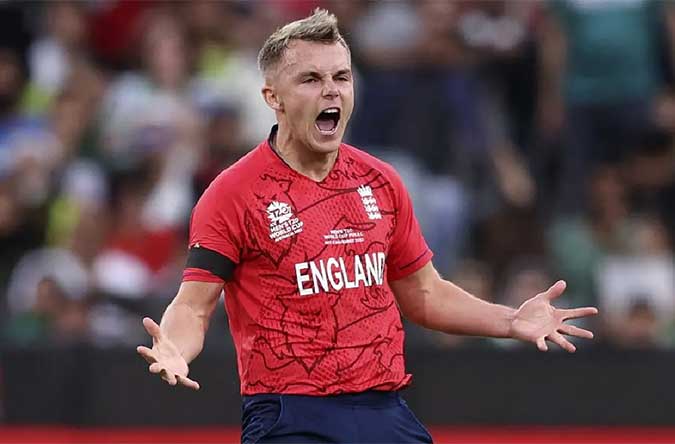
Sam Curran broke Chris Morris’ record (INR 16.25 crore) to become the most expensive buy at an IPL auction, when Punjab Kings outbid five other teams to sign him for INR 18.50 crore (USD 2.25 million approximately).At that price, Curran is also the most expensive player in IPL history – even more than retained players like Virat Kohli and KL Rahul – and he was reunited with the franchise that first brought him into the IPL with an INR 7.2-crore bid in 2019.
The England allrounder was the Player of the Final and the Tournament at the 2022 T20 World Cup in Australia, and since September this year he has taken 25 wickets in 14 T20s at an economy rate of 7.08. He has also improved his batting, especially against spin: in 31 T20 innings since 2020, he has an average of 27.07 and a strike rate of 154.69.
“Absolutely overwhelmed and incredibly humbled to receive that bid,” Curran told Star Sports. “Punjab is where I did my debut season a few years ago … It will be very different but I know the stadium at Mohali pretty well, and surely our team-mates will help me … Incredibly excited to come to India for this big opportunity. So many things running through my mind. At 9am this morning I was struggling to find a stream, it [the auction] wasn’t on TV in England. ?I sat with my girlfriend and her dad to watch it. I actually turned my phone off because I thought I was behind and didn’t want to see any messages saying congrats. I saw the bids coming from Mumbai, then Chennai, having played for Chennai earlier it was cool to see them [bidding].”
Mumbai Indians went as far as INR 18.25 crore to try and line-up Curran alongside Jofra Archer, their other big-ticket England signing at the previous auction, but they were eventually outbid by Punjab, who had begun the auction with the second-largest purse. Shortly after failing to buy Curran, Mumbai got their hands on Cameron Green for INR 17.50 crore, making the 23-year old Australian allrounder the second most expensive player in IPL auction history.
“I’m pinching myself that this has all happened. It’s such a weird feeling watching an auction for yourself. I can’t believe how nervous I was, and I was shaking like anything when the final call was confirmed,” Green said. “I’ve always been a huge fan of the IPL and it’s going to be so cool to be a part of it. The Mumbai Indians are one of the powerhouses of the competition, so I feel very humbled to be joining them. I can’t wait to get there next year.”
Green’s T20 stocks have risen significantly in the last six months. Not part of Australia’s T20 World Cup squad initially, he was a last-minute inclusion after Josh Inglis picked up an injury while playing golf. Green attracted the attention of IPL team scouts in a big way after a prolific T20I series in India this year, where he made 118 runs, including two half-centuries, at a strike rate of 214.54 at the top of the order. His ability to bat anywhere in the order and bowl at a lively pace went in his favour at the auction.
Ben Stokes then became Chennai Super Kings’ costliest signing in an auction at INR 16.25 crore, which also made him the joint-third most expensive player ever at an auction. Stokes will line up alongside MS Dhoni in the IPL once again, after a brief stint together at Rising Pune Supergiants.
Royal Challengers Bangalore and Rajasthan Royals also bid for Stokes, but it soon became clear that their limited budgets would be a constraint. Having come into the auction with INR 20.45 crore, Super Kings spent nearly 80% of their budget on Stokes alone. He is also a viable captaincy candidate as the franchise begins to explore the idea of succession planning after Dhoni.
Sunrisers break the bank for Brook and Agarwal
Harry Brook also made a splash when Sunrisers Hyderabad staved off aggressive bidding from Rajasthan Royals to buy the England batter for INR 13.25 crore (USD 1.6 million approx.), the most a franchise has paid to sign an overseas batter at an auction.
Brook, 23, is set to feature in his first IPL season following a breakout year in international cricket. Only two months ago in Pakistan – his first international overseas trip – Brook impressed with his power-hitting to win the Player-of-the-Series award after hitting 238 runs at a strike rate of 163.01, in a T20I series that England won 4-3.
Brook’s superior record across all T20s in Asia – 581 runs in 16 innings at a strike rate of 167.43 – may have been an attractive proposition for teams. More recently, Brook put behind a disappointing T20 World Cup campaign to blast three centuries in the three-Test series that England won 3-0 in Pakistan.
Having signed Brook, Sunrisers also went hard to secure opening batter Mayank Agarwal for INR 8.25 crore (USD 1 million approx.), thereby spending nearly 51% of their auction purse of INR 42.25 crore on back-to-back buys. This meant Sunrisers, who went as high as INR 14.75 crore to try and get Stokes, eventually missed out on a marquee allrounder.
Pooran takes home more than a million dollars again
Nicholas Pooran began the year by becoming the most expensive West Indian ever sold at an IPL auction, and he broke that record again when Lucknow Super Giants spent INR 16 crore (USD 2 million approx.) to buy him.For a while, the fight for Pooran seemed to be a contest between Delhi Capitals and Rajasthan Royals, but once Super Giants swooped in with a bid nearing a million dollars, it became a two-team race between them and Capitals.
Pooran’s endured a mixed year as far as his international career is concerned. He was named Kieron Pollard’s successor as West Indies’ T20I captain but stepped down following a dismal T20 World Cup campaign where West Indies failed to make it out of the first round after losses to Scotland and Ireland. He had a decent IPL 2022, though, being among the few notable performers in a disappointing season for Sunrisers. He made 306 runs including two fifties at an average of 38.25 and a strike rate of 144.33.
His power-hitting ability was most recently seen in the Abu Dhabi T10, where he was adjudged Player of the Tournament for his 345 runs, which came at an average of 49.28 and a phenomenal strike rate of 234.69.
The bargain buys
Sikandar Raza broke an eight-year barren run when he became the first Zimbabwean to be bought at an IPL auction since Brendan Taylor in 2014. At his base price of INR 50 lakh, Raza could be a steal for Punjab, given the form he’s been in. Raza was the top run-getter (219 at a strike rate of 147) and second highest wicket-taker (ten wickets) for Zimbabwe at the T20 World Cup.
“As a friend, I wish someone picks him,” Hardik Pandya said with a laugh, when asked about Kane Williamson at a press conference prior to India’s T20I series against New Zealand last month. Now, they will team up at Gujarat Titans, who secured Williamson’s services at his base price of INR 2 crore. At Titans, Williamson will also be reunited with his one-time Sunrisers team-mate Rashid Khan.
Having played just one IPL game so far, in 2021 for Punjab Kings, Adil Rashid will hope for a happier second stint. At INR 2 crore, the England legspinner was a steal for Sunrisers, who may have perhaps been surprised at the lack of competition. A key member of England’s T20 World Cup-winning squad, Rashid has an excellent wrong’un, bowls ripping legbreaks, and he can bowl in the powerplay too. And he’ll probably be among the most explosive batting options at No. 10.
Royal Challengers’ new signing Reece Topley had missed out on England’s T20 World Cup squad because of injury but he had a run of impressive performances in the lead-up to the tournament. Topley’s height allows him to extract steep bounce even on docile surfaces and he has the ability to move the ball both ways. With Josh Hazlewood’s workload likely to be monitored, given Australia have potentially the World Test Championship final and Ashes coming up after the IPL, Topley is an excellent back-up option for Royal Challengers at a base price of INR 1.5 crore.
“We wanted to have a like-for-like replacement for Jason Behrendorff,” RCB head coach Sanjay Bangar said. “We’ve kept tab on most of the left-armers available. Josh isn’t going to be available for the first few games, so we looked at availability of players and that’s where Topley fit in really well. To get a high-quality performer like him adds strength to our squad.”
Knight Riders – the silent spectators
Having come into the auction with the smallest purse (INR 7.05 crore), Knight Riders patiently watched proceedings; they entered the bidding just once – for South Africa batter Heinrich Klaasen – as the other franchises snapped up the first 38 players.Curiously, Knight Riders were willing to spend INR 2.4 crore on the uncapped Jammu & Kashmir allrounder Vivrant Sharma, who was eventually bought by Sunrisers.
They came alive when they made aggressive bids to get an Indian wicketkeeper, having let B Indrajith and Sheldon Jackson go. They eventually got in-form N Jagadeesan for INR 90 lakh. Jagadeesan has been in the form of his life recently, having racked up a record five List A centuries last month.
After buying Jagadeesan, Knight Riders bought back allrounder Vaibhav Arora and tried hard to buy back fast bowler Shivam Mavi. Having released Mavi to free up INR 7.75 crore for this auction, Knight Riders went as far as INR 1 crore before bailing out. Mavi eventually went to the Titans for INR 6 crore.Towards the end of the auction, KKR snapped up overseas allrounders Shakib Al Hasan and David Wiese, and Bangladesh opener Litton Das to strengthen their squad.
At a trial held to scout for talent in Jammu & Kashmir, one player – Vivrant Sharma – made a mark with his composure and shot selection against pace. On Friday, those impressions translated into an IPL contract for the 23-year-old allrounder when Sunrisers signed him for INR 2.6 crore, having been part of their camp as a net bowler for IPL 2022. In addition to his big hitting, Vivrant also bowls fast legbreaks and googlies.
Eight years ago, Mukesh Kumar was told he couldn’t play cricket. He was anaemic and the bone edema in his knees was supposed to make bowling impossible. Yet, he persevered and made a mark in Bengal’s competitive club circuit and also the Ranji team.
A stellar performance in 2019-20, when Bengal made the Ranji Trophy final, proved to be the turning point as Mukesh built on his breakout season to earn an India A and a national call-up earlier this year. He was meant to come in as a replacement player in 2021 for RCB but missed out after contracting Covid-19. Earlier this year, he was a net bowler for Delhi Capitals and now he’s part of their squad for a price of INR 5.5 crore, the second-highest amount spent on an uncapped Indian player this auction.
Last-minute shopping
There was a flurry of activity right at the end of the auction, as teams filled up slots with players during the accelerated phase. Delhi picked up South African batter Rilee Rossouw – who was unsold earlier – for INR 4.6 crore; KKR got Shakib and Royals got Adam Zampa for INR 1.5 crore each; And England’s Joe Root secured a maiden IPL contract – also with the Royals – at his INR 1 crore base price.
(ESPN)





Sometimes all you need is a little push.
The 2024 Asia Cup was a watershed for this young Sri Lanka outfit. Prior to that exhilarating climax in Dambulla , Sri Lanka’s flashes of international brilliance were almost exclusively engineered by Chamari Athapaththu. Sure, they could occasionally trade heavy blows with the world’s elite, but they lacked the collective capacity for a sustained fight. This was a queendom, one where removing Athapaththu early meant the game was as good as won.
That lopsided dynamic had been there ever since Athapaththu’s debut back in 2009. So it was impossible not to share her heartbreak when she bemoaned her team’s failure to make the T20 World Cup semi-finals earlier this year – “It’s a sadness beyond words… I could never get a chance to take my team into a semi-final of a World Cup… I think I’m a failure as a captain.”
The tragedy of that lament lay in the irony of its timing. For the first time in Athapaththu’s career, she wasn’t actually marooned by herself. The world had already been treated to a glorious glimpse of the team’s ceiling in 2024, when Harshitha Samarawickrema and Kavisha Dilhari struck the winning runs against a heavily favoured India side.
But keeping the progress going is rarely that straightforward – think less ladder and more hiking path with troughs and peaks. And it was a truth that Sri Lanka quickly learned. The euphoria of Dambulla was swept aside by a winless group stage exit at the T20 World Cup in 2024, followed by a barren 2025 devoid of series wins.
The year ended in structural upheaval as the team parted ways with head coach Rumesh Ratnayake, whose calming influence and fatherly reassurance had been foundational to their initial breakthrough.
So was it any surprise that in the last throes of an astonishing career, Athapaththu might have felt her time was up? At 36, with retirement on the not-so-distant-horizon, Athapaththu could be forgiven for thinking her last chance had come and gone.
But women’s cricket has shown in recent times that traditional career timelines, calibrated on the men’s game, might not necessarily make sense. Athapaththu has only grown stronger with age. After a quiet 2025 where she scored just 190 T20I runs at a strike rate of 113.77, she has struck 476 at 143.80 in 2026 – her best strike rate in a calendar year.
And if it was motivation that she needed, her younger colleagues are playing their part in keeping the queen locked in for as long as possible.
Imesha Dulani, 24, has had a breakthrough year, becoming the first Sri Lanka woman not named “Chamari Athapaththu” to score a T20I century, while centuries from Vishmi gunerathne, 21, and Samarawickrama, 28, led a successful chase of 275 – Sri Lanka’s third highest in ODIs – against Pakistan earlier this year, with Athapaththu watching on like the rest of us.
This was also the first year that Sri Lanka Cricket’s annual awards, had Athapaththu going without a nomination in the best women’s ODI batter category, as Samarawickrama won over the electric Nilakshika Silva. Athapaththu was still the big winner overall, though. In fact, there is now genuine competition for places at the top of the batting order, with the likes of Dulani, Gunaratne and Hasini Perera all vying for top-order berths.
The arrival of Jamie Siddons as head coach earlier this year has helped. Since he took over in March, Sri Lanka have made a noticeable shift to a more aggressive brand of cricket – something Siddons had signposted upon arrival. Whereas boundary-hitting had taken a back seat previously, Siddons has sought to bring the team’s approach in line with modern practices.
“We win in singles and twos, but we don’t score more boundaries than the opposition, and that’s why we lose against the best teams,” Siddons had said when he took over.
All this is to say that, this Sri Lanka is not the same Sri Lanka that entered the Asia Cup two years ago, nor is it even the one that won it. While they remain distinct underdogs against a formidable India, this is now a side equipped with multiple match-winners and a swelling sense of belief.
It’s also a side that is yet to touch its ceiling. There have been times when Athapaththu has not clicked and others have bailed the team out, but it’s those scintillating periods when it has all come together that this unit has shown its true fire. If they can put together more of those days, then a consecutive Asia Cup crown might well be within their reach.

Summer has come early to the southern hemisphere and not just because of climate change. In Australia, where they have never played Tests in August before, a two-match series has already been completed, and it’s not even the end of the month. In South Africa, the international season officially starts next door – in Namibia, where a T20I tri-series kicks off a packed season.
Zimbabwe are the other participants, having long abandoned the idea of a conventional home season so they can host teams during their mild winters. It also gives next year’s men’s ODI World Cup co-hosts an opportunity to get cosy ahead of the main event.
The tri-series is a precursor to a mooted Africa T20 Cup, a continental tournament in the mould of the Asia Cup, aimed at growing the game in this region. The likes of Uganda, who played at the 2024 T20 World Cup, and recent men’s Under-19 World Cup participants Tanzania (2026) and Nigeria (2020) are likely to be involved in future editions. For now, the organisers have kept it to the continent’s heavyweights, to raise awareness and, crucially, funds. All proceeds from this tournament will go to the Africa Cricket Association.
How much the total earnings will be remains to be seen. The new Namibia Cricket Ground has world-class high-performance facilities and a seating capacity of 7,500. Ticket prices are reasonable enough to attract full houses, but that does not mean there are millions to be made. General seating has gone on sale for between 50 and 100 Namibian dollars (US$3.12 and 6.25) while premier seating is 200 Namibian dollars (12.50 USD). There is no major broadcast deal in place and on the eve of the tri-series, a television partner was yet to be announced. Cricinfo understands the games may be available on the streaming service of the continent’s biggest sports broadcaster, SuperSport , but not on their regular bouquet of channels. The series may consequently fly slightly under the radar, but it will still serve as an exercise in relationship-building for the three boards and self-discovery for their teams.
Namibia: Desperate to level up
Hosts Namibia have not progressed as they’d have liked after making the Super 12s of the 2021 T20 World Cup. They played in the next three events but had their worst outing earlier this year when they lost all four matches in their group. More game time against Full Members is what many Associates ask for and over the next three weeks Namibia will get that, in both white-ball formats as South Africa will stay on for three ODIs.
It’s exactly the kind of challenge they want as they enter the latter stages of Cricket World Cup League 2 (the progression pathway to 2027 World Cup qualification) and with the 2028 T20 World Cup qualification process not far away. “It’s sort of a question that we always get in the associate world. How do you bridge the gap to the next level? You only bridge it by winning against teams at the next level,”Gerhard Erasmus, Namibia’s captain said at the pre-tournament press conference. “The Associate teams over the years have made that happen more frequently. Lots of the Associate nations have gone away from the tag of just competing and games are actually started on very equal footing these days, especially the T20 format. It gives you that ability to impact the game or use a bit of momentum on your side. If you have two star performers on the day, it could swing the result your way.”
Erasmus is Namibia’s stand-out, as their leading run-scorer and third-highest wicket-taker in the format but it is important that they unearth others. For this series, Namibia have two 18-year-olds, Waldo Smith and Max Heingo, in the squad and three 21-year-olds. Alexander Busing-Volschenk, Junior Taanyanda and Jack Brassell are all being seen as players for the future and the last of those has impressed Erasmus most.
“A guy that comes to mind for me is Jack Brassell. Not only has his skillset gone up by the amount of overs that he’s bowled and the loads that he’s got behind him but he’s made a conscious decision to get stronger and bowl faster,” Erasmus said. “He’s now the fastest member of our side, which is something that he wants to do. They take their careers very personally and professionally. That’s what we as management or leadership also have to always do.”
South Africa: Mining their depth
Namibia will open the tri-series against South Africa, who they have bragging rights over after beating them at their only T20I meeting last year. The naysayers will point out that the South Africa XI was experimental, but so is this one and Lhuan-dre Pretoripus, Rubin Hermann and Bjorn Fortuin, as stand-in captain, are back to try and set the record straight. “It wasn’t a fun experience,” Fortuin said. “We got beaten by the better team on the day. If you take things for granted, you will definitely feel it.”
The current South African squad, which welcomes Quinton de Kock back into the fold, will be wary of making the same mistake. It is made up largely of players on the fringes of the first-choice side who will be hoping to strengthen their cases for future selection.
Fortuin occupies a slightly different position. Though capped 43 times in white-ball formats for South Africa, his entire career has run parallel to frontline left-arm spinner Keshav Maharaj and it’s difficult to see how Fortuin will get a sustained run but that gives him a different role. “Kesh has obviously been exceptional for quite a few years and he’s taken those talents all across the world. I’ve tried to emulate that as much as I can,” Fortuin said. “My opportunities have been limited, but as a player, all I can do is try and make the best of it. With regards to the squad that we’ve got here, it’s a fairly inexperienced squad, but really talented. And they’ve all done some special things around the world. Hopefully I can just impart some knowledge to them and let their natural game flow.”
In line for debuts are Duan Jansen and Ethan Bosch, but everyone from Lhuan-dre to Dewald Brevis to Kwena Maphaka is worth keeping an eye on, especially in a season with eight Tests, nine ODIs, three T20Is and the SA20.
Zimbabwe: Chasing consistency
The middle of the sandwich are Zimbabwe, who stunned the cricket world by reaching the Super Eight of this year’s T20 World Cup and are finally on an upward trajectory. Three chastening T20Is against India aside, Zimbabwe’s progress has been steady but now it’s about how long they can make it last.
They’ve kept some of their senior core in captain Sikandar Raza and soon-to-be-40 Graeme Cremer to “handle all the youth,” in Raza’s words. But they are starting to transition too.
Briam Benett, Brad Evans and Blessing Muzarabani are the names that will dominate their future but they need the likes of Newman Nyamhuri, Dion Myers and Tadiwanashe Marumani to show they can do a job more often than not in order to build the core of a future side. That’s something on Raza’s mind and this series could go some way to showing him, and Zimbabwe, what they have to work with.
“For Zimbabwe to go forward and for us to be competing and winning at the top level, we need to have a big pool of players. I’ve been very vocal about that,” he said. “I’m very hopeful that the guys we have picked will grab this opportunity because one, will grow our pool of players and two, that means Zimbabwe has more depth in different fields of play and that could only mean that Zimbabwe is going up. That’s what I want to see. My personal ambition, one of them is that before I call time, I want to make sure this country is still going on the upward trajectory and that can only happen if we have a big pool of players to choose from.”
Is Raza’s time coming to an end soon? Even at 40, it doesn’t sound like it. “Unfortunately, to handle all this youth that we have in the team, I don’t think one old guy was enough. So to get another old guy is certainly helpful,” he joked, referring to himself and Cremer. “These Gen Zs are a bit difficult to handle at times.”
Ultimately, it is the Gen Zers for whom a series like this has been created. The tournament should be fast-moving and, ideally, high-octane. Seven matches will be played in 10 days before the winner will walk away with a trophy, which incidentally is a cross-section of a tree trunk.
The rings that reveal the tree’s age, and the environment it grew in, are all clearly visible in a living record of its history. The symbolism is fitting as African cricket takes another step towards a future in which the sport can grow across the continent and establish itself as a stronger force on the global stage.
[Cricinfo]

World-leading javelin thrower Rumesh Tharanga underlined his status as the man to beat in world athletics with another sensational performance, winning the men’s javelin at the prestigious Weltklasse meeting in Zurich with a massive 92.07 metres.
Tharanga’s best effort came in the final round and left him just 21 centimetres short of the meeting record of 92.28m, which has stood for three decades.
The 23-year-old first overcome first round challenge from two-time world champion Anderson Peters of Grenada. Peters took the early lead with a first-round throw of 86.93m, but Tharanga responded in the second round with 88.23m to move ahead.
He then increased his advantage in the third round before producing his best effort of the night in the final round, sending the javelin soaring to 92.07m.
Peters had to settle for second with 86.93m, while Poland’s Dawid Wegner was third with 85.16m. Trinidad and Tobago’s Keshorn Walcott finished fourth with 83.02m, followed by Kenya’s Julius Yego (81.66m) and American Marc Anthony Minichello (80.38m).
The Zurich victory further strengthens Tharanga’s position at the top of the world javelin hierarchy at a crucial stage of the season. With the Wanda Diamond League Final in Brussels just a week away and the World Athletics Ultimate Championship looming, he has emerged as the athlete everyone will be watching.
Tharanga’s latest 92-metre-plus throw also provides a timely reminder of his extraordinary consistency at the highest level, as he continues his remarkable rise among the world’s elite javelin throwers. (RF)

‘Dates have the highest sugar content to fight Coronavirus’

Sunday Island 27 December – Headlines

#SundayIsland 17th December – Headlines

Sunday Island – 28th March

Sunday Island Headlines – 21 March

Sunday Island – 21st February – Headlines
-

 Business7 days ago
SriLankan Airlines makes ShakthiSAT Mission possible for talented Sri Lankan student
-

 Features6 days ago
My secondary schooling after Royal Primary
-

 Features6 days ago
From the First to the 22nd: A short history of Amendment Politics and Reform Frustrations
-

 News4 days ago
Missing doctor’s body found in Mahiyanganaya
-

 Latest News7 days ago
Tharanga edges out Chopra in 88m javelin battle
-

 Features6 days ago
How Shelton Kodikara became first Professor of International Relations
-

 Features6 days ago
How St. John’s College Shaped Panadura for 150 Years
-
 News4 days ago
Australia declines to release Finance Secy Suriyapperuma’s citizenship details