
Business
Russian Carlsberg staff arrested after business seized


The boss of Carlsberg’s Russian business and a top manager have been arrested after the Kremlin took control of the beer company in the country.
Denis Sherstennikov and Anton Rogachevsky, bosses at Carlsberg’s Russian subsidiary Baltika Breweries, were detained on Wednesday. The pair are accused of fraud, but Carlsberg branded the allegations fake
It comes after Carlsberg terminated its business in Russia last month due to the state taking over Baltika in July.
“It is appalling that the efforts of the Russian state to justify their illegal takeover of our business in Russia has now evolved into targeting innocent employees,” the company said in a statement. It added the safety of its employees, including those in Russia, “has always been our main priority” and said it would “do what we can to help the employees under these difficult circumstances”.
Last month, the boss of Carlsberg, Jacob Aarup-Andersen, said the Kremlin had “stolen our business in Russia”.
The Danish brewer was in the process of selling Baltika Breweries as it looked to leave the Russian market, before the government seized control of the company.
Following the arrests, Carlsberg said: “Up until the introduction of external management by the Russian state, Baltika has acted in accordance with the law and the policies guiding all companies in the Carlsberg Group.”
The BBC understands that investigators alleged that Mr Sherstennikov and Mr Rogachevsky acquired intellectual property rights for the companies Carlsberg Kazakhstan and Vista BWay Co, which previously belonged to Baltika, “through deception”.
According to their LinkedIn profiles, Mr Sherstennikov is Baltika Breweries’ chief executive and previously worked for the Carlsberg Group for eight years. Mr Rogachevsky’s profile says he is the vice president legal.
Investigators in St Petersburg claim the rights, which are estimated to be worth more than 295 million roubles (£2.65m), enabled Baltika to supply its products to Kazakhstan, Kyrgyzstan, Uzbekistan, Turkmenistan, Tajikistan, Mongolia and Belarus. Baltika produces some of the most recognisable beer brands in Russia, with 8,400 employees across eight plants, according to Carlsberg’s website.
Brands owned by the group include Kronenbourg 1664, Tuborg, Brooklyn and Somersby cider.
But since the invasion of Ukraine in February last year, many Western companies have come under pressure to leave Russia and shut down operations. As Carlsberg looked to sell its Russian business, the Kremlin took control of Baltika in July under an order signed by President Vladimir Putin. Moscow introduced rules earlier this year allowing it to seize the assets of firms from “unfriendly” countries.
Carlsberg announced in October that it had informed Baltika that it had terminated all of its licence agreements to produce, market and sell its products in the country, but added there would be a run-off period until 1 April 2024 while existing stock is used up.
However, the BBC understands Baltika appealed to the arbitration court with a request to prohibit Carlsberg from terminating the licensing agreement. Mr Aarup-Andersen previously said the company refused to enter into a deal with the Russian government that “somehow justifies them taking over our business illegally”.
(BBC)



Ceylinco Life’s Ambalantota branch agent AIP Manjula has been named one of three global finalists for the prestigious Insurance Agent of the Year award at the 11th Asia Trusted Life Agents & Advisers Awards (ATLAA) 2026.
The recognition places a Sri Lankan insurance professional among the finalists in a regional field spanning South Asia, Southeast Asia, East Asia and the wider Asia-Pacific region.
Ceylinco Life said the achievement reflected the calibre and customer-focused approach of its agency force, while recognising Manjula’s professionalism and commitment to policyholders.
The award evaluates insurance agents on criteria extending beyond sales performance, including ethical conduct, client service, policy persistency, digital adoption, innovative practices and contributions to the insurance industry and community.
The awards are organised by Asia Advisers Network and Asia Insurance Review, with LIMRA as co-organiser. An independent judging and balloting process is monitored by KPMG as the official scrutineer. The judging panel comprises senior insurance executives, association presidents and industry experts from across the Asia-Pacific region.
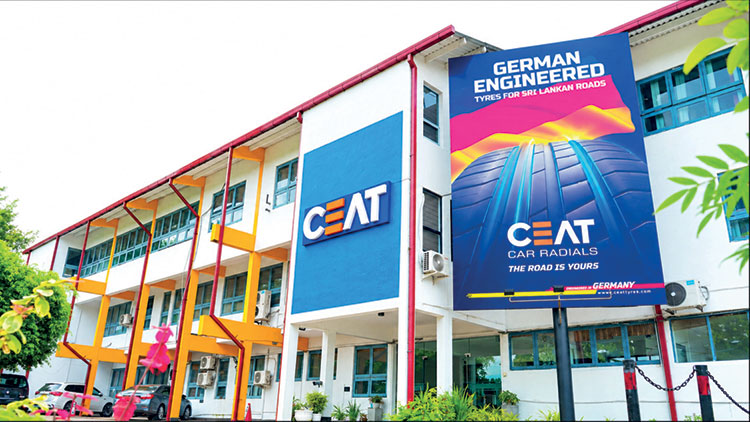
CEAT Kelani Holdings (CKH) has retained its National Long-Term Rating of ‘AA+(lka)’ with a Stable Outlook from Fitch Ratings for the sixth consecutive year, reflecting the company’s financial resilience and leading position in Sri Lanka’s pneumatic tyre market.
The ‘AA+(lka)’ rating, the second-highest on Fitch’s national scale, indicates a very strong capacity to meet financial commitments.
Fitch said CKH’s established market leadership and resilient financial profile remained key strengths, while noting its exposure to price-sensitive, cyclical and highly competitive markets.
The Stable Outlook reflects expectations that the company will maintain its market position despite rising input costs and increasing competition from imported tyres, while preserving adequate credit metrics during periods of weaker earnings and higher investment.
Fitch expects CKH’s established brand, extensive dealer network and adaptive pricing strategies to support its market position. Planned production facility upgrades are also expected to improve product quality, particularly in the radial tyre segment.
The rating agency expects near-term pressure on margins from higher raw material and energy costs but said the company’s low leverage and sound liquidity would provide a cushion.
CKH Chairman Chanaka De Silva said the rating reinforced the company’s focus on disciplined financial management, operational adaptability and long-term investment.

SLT-MOBITEL Enterprise, the enterprise services arm of Sri Lanka Telecom PLC, has launched its Premium Cloud service powered by Nutanix, aimed at helping Sri Lankan businesses modernise their IT infrastructure and accelerate digital transformation.
The service was unveiled at the Lanka Tech Summit 2026 held recently at ITC Ratnadipa, Colombo.
The Premium Cloud combines hybrid multi-cloud capabilities with enterprise-grade performance, enabling businesses to run mission-critical workloads, scale cloud deployments and strengthen business continuity through disaster recovery capabilities.
Hosted on SLT-MOBITEL’s Tier III data centre infrastructure, the platform is designed to provide enhanced security, reliability and flexibility while supporting the growing technology requirements of enterprises.
SLT-MOBITEL Enterprise said the platform would also support organisations seeking to adopt AI-ready capabilities and improve the management and performance of IT workloads.
A key feature of the launch was SLT-MOBITEL Enterprise joining the Nutanix Elevate Service Provider Program (NESPP), which the company said made it the first service provider in the region to join the programme.
Powered by Nutanix’s hybrid multicloud platform, the service enables application and data mobility across on-premises environments, public clouds and edge locations.
The company said the partnership combined Nutanix’s cloud technology with SLT-MOBITEL’s local expertise and support, strengthening its multi-cloud portfolio.

Buttler out of Oval decider as Lawrence earns ODI call-up

Showers will occur in the Western, Eastern, Uva and Sabaragamuwa provinces and in Galle, Matara, Kandy and Nuwara-Eliya districts.

Nor’easter brings flooding as New York and New Jersey declare emergency 2 hours ago

Trump rejects Iran deal to reopen Strait of Hormuz in seven days

Govt plans to hire 121,000 state workers, redistribute tax revenue

Parliament clears 22A amid protests

‘Dates have the highest sugar content to fight Coronavirus’

Sunday Island 27 December – Headlines

#SundayIsland 17th December – Headlines

Sunday Island – 28th March

Sunday Island Headlines – 21 March

Sunday Island – 21st February – Headlines
-

 News4 days ago
Mastermind Naufer Moulavi among 15 found guilty
-

 News6 days ago
Hatton youth protest against reported death sentence for Lankan in Saudi Arabia
-
 News5 days ago
Protest against setting up of cement factory in highly populated area near BIA
-

 News6 days ago
Mahaweli rises as heavy rain triggers flood, landslide fears
-

 Latest News7 days ago
Landslide Red Alerts issued to the districts of Kandy, Kegalle and Nuwara Eliya
-

 Midweek Review4 days ago
Thileepan’s fast unto death: An authentic narrative that many missed
-

 Editorial4 days ago
Big Bad Bills
-
 Latest News3 days ago
Showers above 100 mm are likely at some places in the Western, Sabaragamuwa, Central and North-western provinces and in Galle and Matara Districts