
News
Row around Lanka’s holiest tree shows how fake news travels


(Al Jazeera) When social media was inundated with rumours that Sri Lanka’s holiest tree was being harmed by 5G mobile signals, Colombo’s cash-strapped government pulled out all the stops.President Ranil Wickremesinghe dispatched a high-powered team of experts to the 2,300-year-old Sri Maha Bodhi tree in the sacred city of Anuradhapura.
The team included the head of the telecom regulator, his technical chief and the director of the National Botanical Gardens, along with university professors and district administrators.Several visits were made, surveys were carried out, and the centuries-old tree was examined and monitored before a conclusion was reached: there were no 5G signals in the area in the first place.
The episode highlighted the speed with which fake news travels in Sri Lanka – but even more so, it illustrated the reverence in which the country holds the Sri Maha Bodhi.
The tree is believed to have been grown from a cutting of the bodhi tree in India that sheltered the Buddha when he attained enlightenment more than 2,500 years ago.It is both an object of worship and a symbol of national sovereignty on the majority Buddhist island of 22 million people.
The first claims it was under threat appeared on a local website: 5G radiation from towers near the tree was supposedly turning its leaves black, and it was at “great risk” of eventually shedding them all and dying.Memes were shared widely on Facebook and WhatsApp groups, and a television presenter repeated the theories on his YouTube channel.
The chief monk of the Bomaluwa Temple that houses the tree in Anuradhapura, 200km (125 miles) north of Colombo, was accused of taking bribes from phone operators to let them set up 5G base stations nearby.
“I am not a scientist, nor a botanist, so I raised the issue with the president in February,” monk Pallegama Hemarathana, 68, said. “He immediately appointed a panel of experts.”
“The government and the Buddhists will do whatever it takes to protect the Sri Maha Bodhi.”
There are four older base stations within 500 metres (1,640 feet) of the tree, but Telecommunications Regulatory Commission Director General Helasiri Ranatunga said there was “no 5G coverage in the sacred area as rumoured”.
Radiation in the area was well below World Health Organization thresholds, he said, and botanical experts had ruled there was no threat from existing 2G, 3G or 4G coverage.
The panel did, however, recommend banning mobile phone use to preserve the temple’s tranquility, he added.
While there are already signs in place to that effect, they are widely ignored by the hordes of visitors to the site.
At the moment, fresh heart-shaped, purple-green leaves are sprouting on the tree.Botanically a “ficus religiosa” – also known as a “bo” – the tree is worshipped by thousands of Buddhists daily as a symbol of the “living Buddha”.
Comparatively small despite its long history, it is propped up by 10 gold-plated iron supports and dwarfed by another bodhi a short distance away.First-time visitor G Kusumalatha travelled 400km from Walasmulla with more than 60 other pilgrims to pay homage to the sacred tree.
“I feel ecstatic to be so close to the Sri Maha Bodhi,” she said, thanking the “good karma” that had given her the opportunity.
But no one is allowed within an arm’s length.The original tree in India is said to have died centuries ago.Its Sri Lankan descendant was the scene of an attack in March 1985 by separatist Tamil Tigers, who killed more than 120 people.
Since then, the tree has been provided with airport-style security, with visitors going through metal detectors and pat-downs. It is surrounded by two gold-plated fences and protected round the clock by monks, police and armed troops.Several men are also deployed to clap their hands and chase away squirrels, birds and monkeys that could threaten the tree.Sashika Neranjan, 39, visited the site recently with his extended family.








The government, under heavy Opposition fire over inclusion of a sex website in the Grade 6 English module, as well as overall education reforms, has decided to put on hold reforms in respect of Grade 6.
Cabinet Spokesman and Media and Health Minister Dr. Nalinda Jayatissa announced the government decision yesterday (13) at the post-Cabinet media briefing at the Information Department.
According to him, the decision had been taken at the previous day’s Cabinet meeting, chaired by President Anura Kumara Dissanayake. Dr. Jayatissa said that education reforms pertaining to Garde 6 had been put on hold until 2027.
The Minister said that other proposed education reforms would be implemented as planned. The Minister said that action would be taken against those responsible for the inclusion of a link to a sex website following investigations conducted by the Criminal Investigation Department and the National Education Institute.
The SJB and several other political parties, as well as civil society groups, have accused the government of promoting an LGBTQ agenda, through the proposed education reforms.
The Opposition grouping Mahajana Handa, on Monday, made representations to the Mahanayake Thera of the Malwatta Chapter regarding the controversial reforms, while urging their intervention to halt the project.
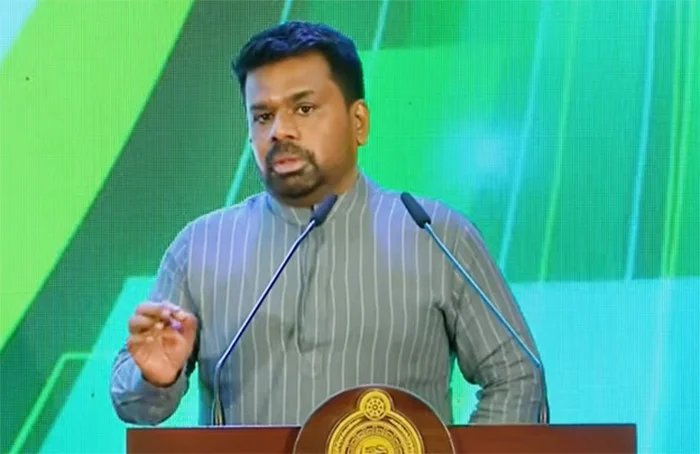
President Anura Kumara Dissanayake yesterday (13) vowed to go ahead with his government’s agenda, regardless of the destruction caused by Cyclone Ditwah.
Emphasising the responsibility on the part of all to contribute to the post-Ditwah recovery efforts, President Dissanayake said that he would have complete faith in the public service.
The President said so at the launch of the re-building Sri Lanka project at the BMICH yesterday.
The JVP and NPP leader said that he wouldn’t take advantage of the death and destruction caused by the cyclone or use the situation as an excuse to reverse their agenda or weaken it.
President Dissanayake said that in spite of many calling for amending the then Budget, in view of the cyclone, the government presented the proposals that were agreed before the disaster struck.

The United States has announced that it will provide the Sri Lanka Air Force with 10 US Navy TH-57 helicopters free of charge.
The announcement was made by outgoing US Ambassador Julie Chung, who stated, on social media, that the helicopters would be transferred under the United States’ Excess Defence Articles programme. The aircraft are Bell 206 Sea Ranger helicopters previously operated by the US Navy.
US sources said that the transfer was intended to strengthen Sri Lanka’s disaster response capabilities, following the devastating cyclone that struck the island at the end of 2025 and killed more than 600 people. US officials have framed the move as a humanitarian measure aimed at improving aerial rescue and relief operations.

Showery condition over the island is expected to reduce from tomorrow (15th)

USA’s Ali Khan claims having been ‘denied’ India visa ahead of T20 World Cup

At least 28 dead as crane collapses onto train in Thailand

Fair weather will prevail except for a few showers in the Uva, Eastern, Western and Central provinces and in Galle, Matara and Rathnapura districts

Trump cancels US-Iran meetings, urges protesters to take over institutions

Govt. bows to pressure, shelves Grade 6 reforms

‘Dates have the highest sugar content to fight Coronavirus’

Sunday Island 27 December – Headlines

#SundayIsland 17th December – Headlines

Sunday Island – 28th March

Sunday Island Headlines – 21 March

Sunday Island – 21st February – Headlines
-

 Business4 days ago
Dialog and UnionPay International Join Forces to Elevate Sri Lanka’s Digital Payment Landscape
-

 News4 days ago
Sajith: Ashoka Chakra replaces Dharmachakra in Buddhism textbook
-

 Features4 days ago
The Paradox of Trump Power: Contested Authoritarian at Home, Uncontested Bully Abroad
-

 Features4 days ago
Subject:Whatever happened to (my) three million dollars?
-

 News4 days ago
Level I landslide early warnings issued to the Districts of Badulla, Kandy, Matale and Nuwara-Eliya extended
-

 Business23 hours ago
New policy framework for stock market deposits seen as a boon for companies
-

 Opinion6 days ago
The minstrel monk and Rafiki, the old mandrill in The Lion King – II
-

 News4 days ago
65 withdrawn cases re-filed by Govt, PM tells Parliament