
Latest News
Rodrigues’ maiden international hundred seal series win for India


India notched up a series win that never appeared to be in any doubt, but in batting out 50 overs for a second straight game in Rajkot, Ireland ticked off a few boxes as part of their preparations for the World Cup qualifiers.
India stormed to their highest ever ODI score, fuelled by Jemimah Rodrigues’ maiden ODI century, and then saw Ireland’s top order deny a young Indian pace attack. Christina Coulter Reilly brought up a maiden half-century in her fourth innings, while Laura Delany made a 36-ball 37 to frustrate India’s spinners. Ireland eventually surpassed the 238 for 7 they made two days ago, to take away plenty of batting positives.
The crux of India’s win lay in how their own set of youngsters, outside of Smriti Mandhana batted and put up runs on the board. Pratika Rawal hit a third half-century in five innings, but would’ve been disappointed at missing out on a century for a second-game running.
After making 89 two days ago, Rawal exhibited outstanding offside stroke play against the seam bowlers in particular, during the course of a 156-run opening stand with Mandhana. Rawal was out lbw for 67 off the very next ball after Mandhana mistimed a pull off Orla Prendergast at midwicket for 73.
India’s urgency in the powerplay wasn’t accompanied by blind slogging but pristine stroke play, even as Mandhana initially fiddle in what seemed like a role reversal from the series opener two days ago. That day, Mandhana charged off the blocks, playing her signature pulls, while Rawal buckled down.
This fusion helped the pair put together their third opening stand of 100 or more in five innings, with Mandhana quickly overtaking Rawal. There seemed a sense of inevitability to two impending centuries, but lapses in concentration led to a double-strike.
This brought Harleen and Rodrigues together as the pair took a while to play their strokes on the face of some really slow bowling. Harleen struggled for momentum early on, pottering to 5 off 21 deliveries; Rodrigues was a tad more industrious at the other end, attempting to move around the crease and thwart the seamers by playing the pulls and paddles.
The pair took 75 deliveries to raise their half-century stand which Harleen raised with a superb, lofted hit over mid-off. Rodrigues didn’t want to be left too far behind as she hit Arlene Kelly for back-to-back fours, with overs 32-34 fetching India five boundaries. Harleen possibly played the shot of the day when she exhibited incredible control in whipping a full ball from fourth-stump to bisect the gap between deep midwicket and long-on.
Ireland let themselves down when they missed running out Rodrigues for 34 in the 35th over when Prendergast missed a direct hit at the non-striker’s end from mid-on. Rodrigues was let off a second time when keeper Coulter Reilly put down a tough chance off an attempted late cut off Canning.
Harleen got to her fifty off 58, and accelerated towards her second hundred in four ODIs, before falling for 89. Rodrigues got her half-century a tad slower, off 62 deliveries, before she shifted gears sensationally in the last ten overs. The purity of her stroke play stood out, with her signature lofted hit by moving leg side of the ball making repeated appearances.
Rodrigues took just 28 balls to move from a half-century to her maiden ODI ton, much to the applause of the entire team on the balcony, before she celebrated by mimicking playing a song on her guitar with her bat. India ended with 370 for 5, 102 off those coming in the last ten as Ireland walked back relieved that their morning toil was over.
Ireland were slow off the blocks and never equally went for the target. But Coulter Reilly overcame two blows on her helmet, both times missing a bumper from Sayali Satghare. She overcame the early jitters to exhibit a sense of fearlessness against spin, particularly enterprising off Priya Mishra, the legspinner, whom she swept into different arcs on the leg side.
Delany, who came in at No. 4, showed urgency from get-go, hitting her second ball through the covers for a boundary, and was equally formidable when Deepti Sharma tried to lull her in flight after an early reprieve when the offspinner put down a tough return catch on 7.
As it turned out, this passage – an 83-run fourth-wicket stand – was the only period where in India felt challenged by Ireland’s batters, even as the rest tried to get their eye in. Leah Paul, who struck a half-century in the previous game, made an unbeaten 22-ball 27, to add the finishing touches as Ireland surpassed the 238 for 7 they made two days ago.
Brief scores:
India Women 370 for 5 in 50 overs (Jemimah Rodrigues 102, Harleen Deol 89, Smriti Mandhana 73, Pratika Rawal 67; Orla Prendergast 2-75, Arlene Kelly 2-82) beat Ireland Women 254 for 7 in 50 overs (Christina Coulter Reilly 80, Sarah Forbes 38, Lauraa Delany 37, Leah Paul 27; Priya Mishra 2-53, Deepti Sharma 3-37) by 116 runs
[Cricinfo]

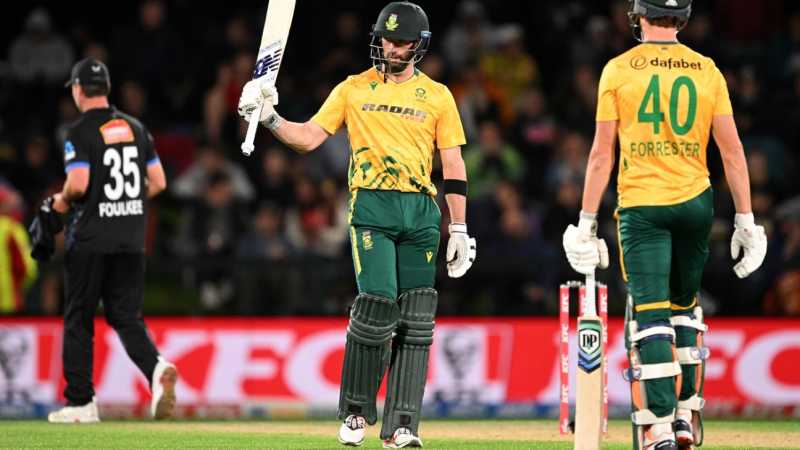
South Africa won their first away T20I series under Shukri Conrad, and second successive bilateral series, with a convincing performance over New Zealand in Christchurch. Put in to bat, they posted the highest total of the series of 187 for 4- and defended it with a six-player attack to seal the series 3-2.
After poor batting performances in the second and third T20Is,2 South Africa went from good to better in the next two. Three of South Africa’s four highest partnerships of the series came in this match, and they have unearthed a potential future star in Connor Esterhuizen. He scored back-to-back fifties in matches four and five and anchored their efforts in the decider. While Zak Foulkes and Josh Clarkson were economical, the rest of their attack conceded at over nine runs an over. Offspinner Cole McConchie’s 0 for 48 was the most expensive.
New Zealand were without their first choice top five and also had to do without Tom Latham, who was due to lead them but fractured his thumb in the third T20I. They were never really in the chase against a disciplined South African effort. None of their batters scored more than Bevan Jacobs’ 36 and they only had one partnership which threatened: 52 between Jimmy Neesham and Jacobs for the fifth wicket.
Overall it was a messy affair on both sides, with nine dropped catches in the game, the most for any men’s T20I as per ESPNCricinfo’s ball-by-ball data logs since June 2018
Rubin Hermann has been involved in half of South Africa’s top stands and looked set for a big one today. Early in his innings, Hermann took down Ben Sears no matter what length he bowled and took 14 runs off four balls. Later, he showed his strength against spin when he joined Esterhuizen in targeting McConchie. But then Hermann did not hit a boundary for 12 balls and needed to take it on. When Sears went hard length, Hermann pulled but got his timing wrong and skied the ball towards mid-off. Nick Kelly ran from mid-on, made his ground and then stuck out one hand to take a superman catch, flying low to the ground. Hermann was out for 39, and the second-wicket partnership was broken on 59.
While Hermann’s promise only peeped through, Esterhuizen went from excellent to exceptional and topped up his maiden international half-century from game four with a new career-best: 75 off 33 balls in the finale. His on-side dominance was on display, as he scored 52 runs in that half of the ground, including five of his six sixes. The biggest ones came off McConchie who he hit back over his head, then over midwicket and over square leg. In total, Esterhuizen scored 21 runs off 8 balls but wasn’t shy to show what he could do against the quicks either. In the last two overs, he took 25 runs off Kyle Jamieson and Sears. His innings ended when he tried to send a Sears full toss to Neesham with two balls to go and he ended the series with a total of 200 runs, 100 more than his nearest competitor, Devon Conway.
It’s been a tough few months for Jason Smith. He only played one game at the T20 World Cup, despite being a first-choice pick in the squad and has not managed to get one score over 20 in five innings on this tour. And then things seemed to become tougher. Smith was at extra cover when Dane Cleaver, on 1, backed away from a Gerald Coetzee ball and smashed it to him. It was hit hard and could have taken some holding onto but Smith let it burst through his hands. Luckily for him, three overs later, the chance to do better came. Ottneil Baartman drew a leading edge from a Cleaver and the ball looped to him at point. He made no mistake and Cleaver was dismissed for 22. New Zealand were 46 for 2 after the powerplay and well behind the chase.
Contrastingly, Coetzee has had a wonderful 10 days after missing out on T20 World Cup selection and recovering from a torn pec muscle. He finished as the joint leading wicket taker, and the one with the lowest economy rate in the series. In today’s match, he didn’t concede a boundary until the final ball he bowled, and by then New Zealand were out of the game. Coetzee bowled two overs with the new ball, for 11 runs, and should have Cleaver’s wicket and then returned for the 17th and 19th overs. His penultimate over was a mix of quick short balls with the odd change of pace and cost two runs. Reward came in his last over, when he had Josh Clarkson caught off a leading edge at cover and McConchie caught at long-on trying to clear the ropes off a cross seam ball. Coetzee finished with 2 for 21 in four overs.
Brief scores:
South Africa 187 for 4 in 20 overs (Tony de Zorzi 12, Wiaan Mulder 31, Rubin Hermann 39, Connor Esterhuizen 75, Dian Foresster 21*; Zak Foulkes 1-22, Ben Sears 2-37, Josh Clarkson 1-14) beat New Zealand 154 for 8 in 20 overs (Tim Robinson 25, Dane Cleaver 22 , Nick Kelley 14, Bevan Jacobs 36, James Neesham 24, Josh Clarkson 13; Gerald Coetzee 2-21, Wiaan Mulder 2-28, Ottneil Baartman 2-33, Keshav Maharaj 1-35)by 33 runs
(Cricinfo)


Russia has launched the largest aerial attack on Ukraine over a 24-hour period since the war began, hitting cities across the country with 948 drones.
Ukraine’s Air Force said 556 drones had been fired since 09:00 local time (07:00 GMT) on Tuesday, in an unusual daytime attack which killed at least three people and injured dozens.
In the western city of Lviv, the 16th century Bernardine monastery – part of a Unesco World Heritage site in the city centre – was damaged, local officials said.
In the neighbouring Ivano-Frankivsk region, a maternity hospital was hit.
Those strikes came after an overnight Russian attack left five people dead. Ukraine said 392 drones and 34 missiles were fired.
In his video address on Tuesday evening, Ukrainian President Volodymyr Zelensky said the scale of the latest attacks “clearly shows that Russia has no intention of really ending this war”.
Russia’s military has not publicly commented on the attacks.
A video posted earlier on Tuesday by Lviv authorities showed a fire burning through the roof of a residential building near the Bernardine monastery.
Separate footage posted on social media showed a drone flying lower over the city and hitting the residential building.
Lviv regional head Maksym Kozytskyi said 32 people were injured in the Russian attack.
In the city of Ivano-Frankivsk, two people were killed and another four – including a six-year-old child – were injured, local officials said.
Various buildings – including a maternity hospital – were damaged in the regional capital.
Ternopil – another western Ukrainian city – was also targeted on Tuesday. A number of direct hits were reported by regional authorities, but no casualties.
In the central Ukrainian city of Vinnytsia, one person was killed and 13 injured, regional head Nataliya Zabolotna said.
In the overnight Russian attacks, five people were killed when Russia targeted 11 Ukrainian regions.
Ukraine’s Air Force said it had managed to shoot down most of the Russian drones and missiles – but admitted that there were multiple direct hits across the country.
Yurii Ihnat, spokesman of the Ukrainian Air Force, said late on Tuesday that a “large number of drones” had entered Ukrainian airspace from the north of the country, “effectively moving in columns”.
“The geography of the strikes during the daytime was broader than at night… It can be said this was one of the largest attacks within a 24-hour period,” he said.
While more than four years of war have left virtually no corner of Ukraine untouched, the west of the country has been hit comparatively less intensely and frequently than other areas nearer the Russian border in the east.
Russia launched a full-scale invasion of Ukraine in February 2022, and the war continues unabated, with Moscow launching near-daily attacks on cities across the country.
Also on Tuesday, the governor of Russia’s western Kursk region said one man was killed and 13 people were injured in a Ukrainian drone attack on an agricultural enterprise.
Talks brokered by the US and aimed at reaching at a peace settlement have stalled since the start of the US-Israeli war with Iran in late February.
“Amid the news the world is drowning in every day, we will not let Ukrainian grief get lost, become just another statistic, a headline that will be casually skipped over,” wrote Ukraine’s First Lady Olena Zelenska on social media.
(BBC)

Esterhuizen, bowlers lead South Africa to 3-2 series win

IPL captains’ meeting: What’s on the agenda?

Russia launches 948 drones at Ukraine in largest attack over 24-hour period

Oil at $150 will trigger global recession, says boss of financial giant BlackRock

Showers will occur at several places in the Western and Sabaragamuwa provinces and in Galle and Matara districts after 2.00 pm

Senior citizens above 70 years to receive March allowances on Thursday (26)

‘Dates have the highest sugar content to fight Coronavirus’

Sunday Island 27 December – Headlines

#SundayIsland 17th December – Headlines

Sunday Island – 28th March

Sunday Island Headlines – 21 March

Sunday Island – 21st February – Headlines
-

 Features3 days ago
Trincomalee oil tank farm: An engineering marvel
-

 News7 days ago
Bailey Bridge inaugurated at Chilaw
-

 News6 days ago
CIABOC tells court Kapila gave Rs 60 mn to MR and Rs. 20 mn to Priyankara
-

 News7 days ago
Pay hike demand: CEB workers climb down from 40 % to 15–20%
-

 Features6 days ago
Science and diplomacy in a changing world
-

 News5 days ago
Colombo, Oslo steps up efforts to strengthen bilateral cooperation in key environmental priority areas
-

 Features3 days ago
The scientist who was finally heard
-

 News3 days ago
Substandard coal deepens energy crisis, warns former CEB Chief