
Latest News
Rizwan, Jamal lead Pakistan’s resistance amid another Cummins show

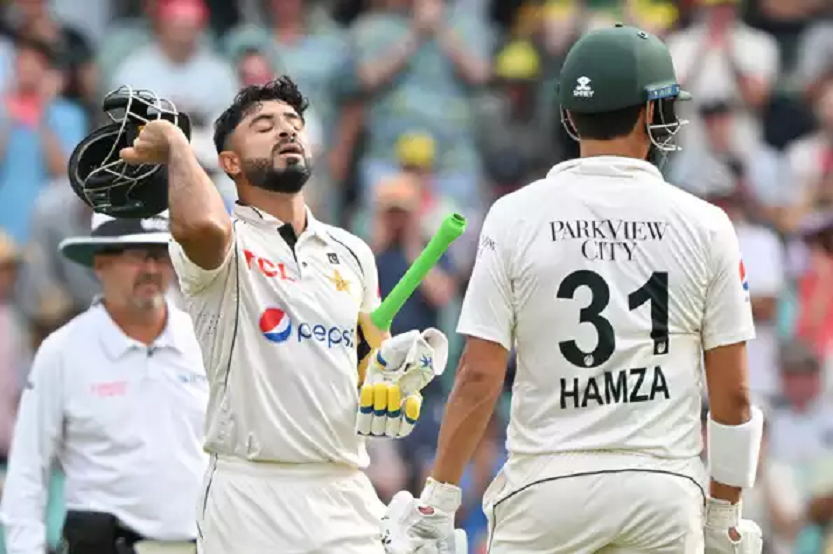
A see-sawing opening day of the third and final Test in Sydney saw Pakistan recover from a perilous 47/4 to post a fighting 313 on the board despite a Pat Cummins fifer. After the Australian pacers ran through their top-order, Pakistan looked in control of proceedings only twice in the batting innings. First, through the middle session where they piled on 124 runs, led by a strokeful 88 from Mohammad Rizwan. And then at the fag end, when a counterattacking maiden half-century from Aamer Jamal frustrated the hosts in their pursuit for that final wicket. In between was Cummins’ third straight fifer, losing its sheen ever so slightly only because of the grind the hosts were put through in the final session.
Playing his farewell Test, David Warner was made to wait until the very final over as the visitors opted to bat first on a sunny morning at the SCG having shockingly rested Shaheen Afridi. However, it was nothing like the start they would have hoped for. Mitchell Starc and Josh Hazlewood struck with their second deliveries of the morning and Cummins in his second over to leave Pakistan reeling at 39/3.
Starc lured Abdullah Shafique into an expansive drive on the second ball of the innings and the Pakistan opener paid the price for attempting a reckless shot so early. On debut and replacing an out-of-form Inam-ul-Haq, Saim Ayub then nicked a good length ball from Hazlewood that nipped away slightly to take the edge. Amidst the torrid start, Babar Azam looked at ease and even teased with a few impressive drives but Cummins used DRS to overturn the LBW decision after pinging the former captain on the pads with a full ball that swung in sharply. In his opening spell Cummins also got Saud Shakeel to nick a length ball that held its line in the channel outside off, compounding Pakistan’s woes and reducing them to 47/4.
Rizwan joined Shan Masood in the middle, taking Pakistan safely to Lunch without any further damage at 75/4 but the skipper didn’t last long after the break. Caught at second slip by Steve Smith, Masood got a life on 32 only because Mitchell Marsh had overstepped. But the same pair combined again in an identical dismissal for Masood, who could add only three more to his score.
Joining hands at a precarious 96/5, Rizwan and Salman Agha helped Pakistan overcome the wobbly position with a 94-run stand that became the face of their revival after Lunch. Rizwan got moving early in the afternoon with a couple of fours as he took his team past the 100 mark. Even though Salman was cautious at the start, Rizwan kept busy and showcased his full range of shots by driving and sweeping Nathan Lyon to the fence before bringing up his ninth Test fifty with a pull off Hazlewood first ball after drinks.
Lyon in particular wasn’t allowed to settle in in his second spell as both Salman and Rizwan used their feet to good effect to keep fetching frequent boundaries. Rizwan even slog-swept the spinner for his second six to enter the 70s. As the boundaries continued to flow freely Cummins returned into the attack and, for the umpteenth time in the series, provided the breakthrough his team sought almost immediately. A well-directed short ball had Rizwan miscuing a pull – a shot he played so well throughout his knock – to Hazlewood at the ropes, falling 12 short of a deserving hundred.
If Australia seemed to be wresting back control at the stroke of Tea with that vital scalp, Cummins hammered home their advantage by completing his fifer early in the final session. He continued to deploy the short ball ploy and had both Sajid Khan and Hasan Ali departing cheaply. Salman also fell prey to a similar short ball from Starc, but not before reaching a half-century of his own.
The collapse of 4 for 37 had Australia firmly in the driver’s seat before Jamal decided to flip the script one more time. He frustrated the home side for 22.1 overs, combining for last-wicket stand of 86 with Mir Hamza who played the ideal second fiddle, making only seven off the 43 deliveries he faced.
Jamal, who picked up a sixfer on debut earlier in the opening Test of the series, showed great resolve with the bat in his 97-ball knock. He got a couple of reprieves with Australia failing to grab tough chances, but took the home team’s short-ball strategy head on as Hazlewood and Cummins all came in the line of fire. Mixing caution with aggressive, Jamal slammed four sixes in his counter-attacking 82, sparing neither Lyon nor part-timer Marnus Labuschagne. He reached a 71-ball fifty with the second of the three fours in an expensive 13-run over from Starc, before tearing into Lyon with two sixes and and many fours in his succeeding overs to get into 80s.
Jamal eventually holed out to long-on, having skipped down the track to take on the offie, but walked off to a standing ovation after taking Pakistan to a respectable first innings score despite missing out on a personal milestone.
Warner walked out to a rousing applause from the crowd and a guard of honour from the opposition. He got off the mark with a lovely boundary through the covers first ball and then survived a close shave on the penultimate ball, nearly chopping it back onto his stumps as Australia went to stumps at six without loss.
Brief scores:
Australia 6/0 in 1 over (David Warner 6*) trail Pakistan 313 in 77.1 overs (Mohammad Rizwan 88, Shan Masood 35, Aamer Jamal 82, Babar Azam 26, Salman Agha 53; Pat Cummins 5-61, Mitchell Starc 2-75) by 307 runs.




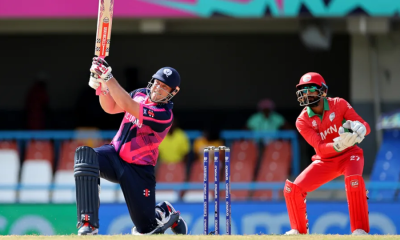




Three Lebanese journalists were killed in a targeted Israeli strike in southern Lebanon on Saturday, their employers have said.
Ali Shoeib, a reporter for the Hezbollah-affiliated Al Manar TV, was killed in the town of Jezzine alongside reporter Fatima Ftouni and her brother, cameraman Mohamed Ftouni, both from the channel Al Mayadeen, according to the stations.
The strike reportedly hit the journalists’ car just before noon local time (10:00 GMT).
The Israel Defense Forces (IDF) confirmed it had killed Shoeib, describing him as a “terrorist” from Iranian-backed Hezbollah’s elite Radwan Force who had “operated for years under the guise of a journalist”.
It said he had worked to “expose the locations of IDF soldiers operating in southern Lebanon and along the border”, including during the current fighting, and had used his position “to disseminate Hezbollah propaganda materials”.
The IDF provided no evidence to support its claim that Shoeib had a military role. It did not comment on the deaths of Fatima or Mohamed Ftouni.
Hezbollah denounced the strike as the “deliberate criminal targeting of journalists”.
(BBC)
Latest News
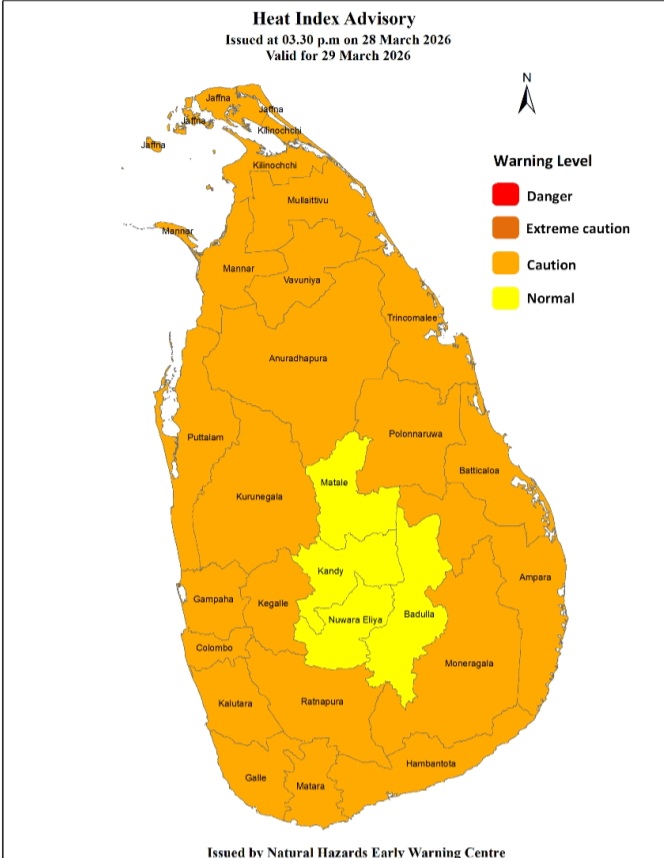
Heat Index likely to increase up to ‘Caution level’ at some places in the Western, Sabaragamuwa, Southern, Eastern, North-western, Northern and North-central provinces and in Monaragala district
Warm Weather Advisory
Issued by the Natural Hazards Early Warning Centre of the Department of Meteorology
Issued at 3.30 p.m. on 28 March 2026, valid for 29March 2026.
Heat index, the temperature felt on the human body is likely to increase up to ‘Caution level’ at some places in the Western, Sabaragamuwa, Southern, Eastern, North-western, Northern and North-central provinces and in Monaragala district.
The Heat Index Forecast is calculated by using relative humidity and maximum temperature and this is the condition that is felt on your body. This is not the forecast of maximum temperature. It is generated by the Department of Meteorology for the next day period and prepared by using global numerical weather prediction model data.

Effect of the heat index on human body is mentioned in the above table and it is prepared on the advice of the Ministry of Health and Indigenous Medical Services.
ACTION REQUIRED
Job sites: Stay hydrated and takes breaks in the shade as often as possible.
Indoors: Check up on the elderly and the sick.
Vehicles: Never leave children unattended.
Outdoors: Limit strenuous outdoor activities, find shade and stay hydrated.
Dress: Wear lightweight and white or light-colored clothing.
Note:
In addition, please refer to advisories issued by the Disaster Preparedness & Response Division, Ministry of Health in this regard as well. For further clarifications please contact 011-7446491.
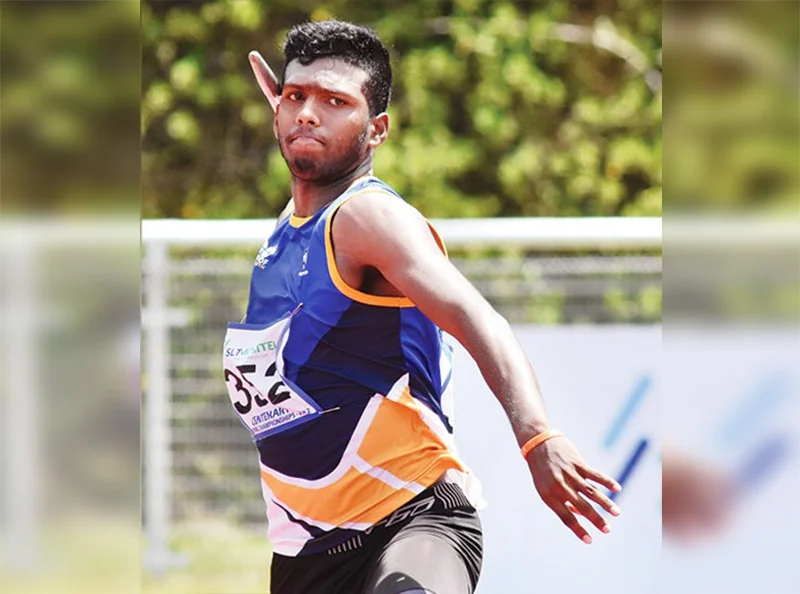
Rumesh Tharanga created history with yet another world leading throw that shattered his own national javelin record at the Champions Track and Field event at Diyagama on Saturday.
The massive 89.37 metres throw, when recognized by World Athletics is set to become the fourth furthest throw in the history of the Asian region.
Despite little competion from his rivals, Tharanga rose like a champion of an entirely different league when he delivered the record breaking feat in his final attempt.
Tharanga had a world leading mark of 83.07 metres for the year coming into this meet. His national record of 86.50 metres was from August 2025. (RF)

One ant for $220: the new frontier of wildlife trafficking

Three Lebanese journalists killed in Israeli strike, say broadcasters

Showers will occur at a few places in the Sabaragamuwa province and in Colombo, Kaluthara, Galle, and Matara districts after 2.00 pm

War-linked power crunch pushes Lanka to four-day week

Lanka to swelter through April and May, Met Dept warns

Pathfinder Foundation launches Proposal for a National Security Strategy for Sri Lanka

‘Dates have the highest sugar content to fight Coronavirus’

Sunday Island 27 December – Headlines

#SundayIsland 17th December – Headlines

Sunday Island – 28th March

Sunday Island Headlines – 21 March

Sunday Island – 21st February – Headlines
-

 News4 days ago
Senior citizens above 70 years to receive March allowances on Thursday (26)
-

 Features1 day ago
A World Order in Crisis: War, Power, and Resistance
-

 Features6 days ago
Trincomalee oil tank farm: An engineering marvel
-

 News2 days ago
Energy Minister indicted on corruption charges ahead of no-faith motion against him
-

 News3 days ago
US dodges question on AKD’s claim SL denied permission for military aircraft to land
-

 Features6 days ago
The scientist who was finally heard
-

 Business3 days ago
Dialog Unveils Dialog Play Mini with Netflix and Apple TV
-

 Sports2 days ago
SLC to hold EGM in April