
Features
Return of the Galle Literary Festival

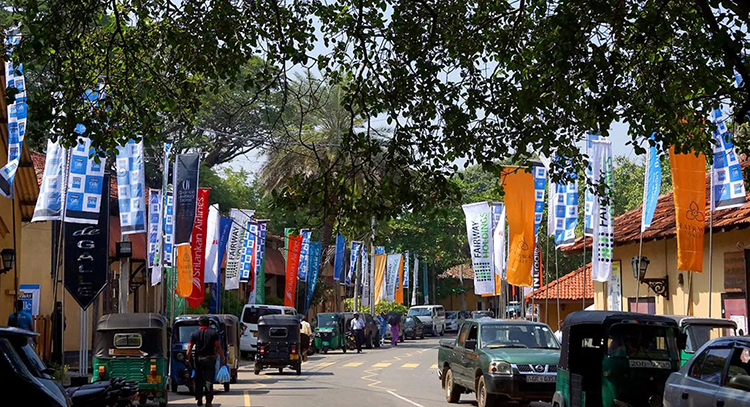
 The Galle Literary Festival (GLF) came back to the country this January 2024. It has been typical of Sri Lanka and matters Sri Lankan with a chequered career, the annual sequence interrupted twice; the name changed and most significantly to me, declined in organization, arrangement and literary luminaries sharing their talents. Again typical of the character of the country, numbers attending have not decreased – maybe increased – of both local and foreign, but them not praising fulsomely as before. Even the Sunday print media carried adverse comments, complaints really. The invited speakers were fulsome in their praise as reported in the press but I was privy to negative comments made by attendees who had been at previous GLFs. I make bold to write this article as I was present throughout at all previous festivals but could not make it this year. Consequently I kept close interested tabs on it.
Lineage
Anglo-Australian hotelier Geoffrey Dobbs who settled in Galle bravely founded the event in 2005. I attended and found events and organization moved smoothly with Dobbs all over the place all day. Annually the festival was smooth sailing till 2011 when certain prestigious writers such as Booker Prize winners, Kiran Desai and Orhan Pamuk declined attending as a protest against the government’s coming down hard on journalists and curtailing media freedom. Fortunately we had heard Kiran the precious year.
In 2013 political disaster struck the GLF over trivia. Commonwealth Heads of Government Meeting (CHOGM) was held in Sri Lanka with Mahinda Rajapaksa as President. Dobbs saw the British flag flying upside down in Galle. He informed the govt VIP in Galle – Provincial Governor or whoever. That lady did not order the flag be hoisted correctly. So Dobbs hoisted a Lion Flag with the animal standing on its head.
Umbrage was taken and Dobbs declared persona non grata. He left for Australia and was denied entry to SL until 2016 when sponsorship of the GLF was taken over by Fairway Holdings with the extremely generous investment of Rs 30 m in the operational costs of the festival. That was not only fantastic but gave Geoffrey Dobbs the fillip to restart the annual literary festival now famous throughout the world and even dubbed the best.
One instance of extra generosity was the inauguration of the Fairway Literary Prizes for the best local novel of the year in English and most promising writer. Fantastic prizes of Rs 500,000/- for winners and Rs 100,000/- for each of the four short listed novelists was offered. Fairway Holdings Chairman, Hemaka de Alwis, was present all through that festival with the name changed to Fairway Galle Literary Festival – FGLF, and subsequent festivals up until 2019. Then Covid took the world by its throat as it were, and stifled it.

I have stayed in Galle all through the festivals, enjoying the serene antiquity of the Fort, spruced up, and the lively ambience of the festival grounds; the very happy and informal mixing with peoples, local and foreign, of all ages, races and even temperaments. I was completely satisfied with the running of the festival which was truly excellent, particularly in the two years that Shyam Selvadorai curated and was chief organizer – 2017 and 2018, I believe. Bits of chaos were evident in 2019. The long awaited festival was revived this January after a hiatus of four years, as the previous GLF.
The Festival improved each year until 2018 in every way. Halle de Galle was the main venue and large audiences were accommodated opposite it in a temporary building where the Fairway Literary Awards were presented, almost always with Ranil Wickremasinghe as Chief Guest and his wife seen at most events. Really famous writers, actors, culinary experts are far too many to list.
I make mention of only a few who made indelible impressions on me: Picor Iyer, Vikram Seth, Kiran Desai, Sashi Tharoor, Sebastian Faulks, Tom Stoppard, Dame Maggie Smith, Germaine Greer, Gore Vidal, Katherine Frank (biographer) and Nayantara Segal (cousin of Indira Gandhi). Events too were varied, ranging from dance and drumming items to theatre. The Chamber Music Society of Sri Lanka played at the ancient Dutch Reformed Church in the Fort, and later the choir of the Cathedral of Christ the Living Savoir performed in the Anglican Church.
Side sessions catered to those seeking exposure to Tamil and Sinhala literature. Architecture and cultural excursions, cookery demonstrations and having meals with the famous were additional events. Prices were considered rather high but a festival pass started around 7000/-, then climbed to 10, 12 and in 2019 it was 15.000/-. Day passes and tickets for single events were available and media persons were free.
This year’s GLF
Held from 25 through 28 January, participation was massive. Hotel bookings were from August 2023. A season ticket cost Rs 45,000/- ; a day pass Rs 12,000/-; and attending a lecture/event was priced at Rs 3000/- . The programme did not list many outstanding foreign writers. I did not find out who the main organizer and curator was/were. Presumption is that Geoffrey Dobbs did not lend his name nor expertise to the event. (I am open to correction).
The negatives listed by three experienced GLF attendees were thus: Some venues selected were totally inadequate in space and amenities. For example in the Chambers Restaurant there were around 30 chairs but more than double that number had bought tickets. Result: very many were left standing within the room and outside. The speaker’s seat was flush with the audience so he/she had to stand throughout the presentation.
The room in No 30, Leyn Baan Street was large and sufficient seats were provided but the roof being metal, it was hot and stuffy with only four coolers on the side. Additionally, the sound system was totally inadequate or faulty, so much so that what was said emerged garbled. My friends left the venue after a couple of minutes.
The Amangalle Hotel provided venues for events. Surprisingly I heard that two presentations in this hotel had inadequate seating and the speaker was sans a microphone. A hotel of such prestige having its basic structure built in 1784 and named New Oriental Hotel (NOH) and its new management and name in 2004, should and could have remedied the remiss of the GLF supervisors/organisers. Fort Bazaar Court had lounge chairs for the panel of speakers and on level with audience seating. Many a listener could not see the speakers even with strained necks.
The Halle de Galle was excellent, my friends said. I remember air conditioning was installed a couple of years into the Festival but even earlier it was comfortable with adequate fans. The only blemish was the lack of toilets – only three attached to the hall and two squatting. Toilets could not be built by the GLF, the hall belonging to the Divisional Secretariat or whatever. Remedied the following year by discreet installation of portable toilets.
Another complaint of a few I spoke with was that changes of venues etc were announced via email. “All did not have access, nor accessed email. So confusion and annoyance resulted.” This friend and another were early at each event and thus got seating up front. At one event after the room was almost full, a young volunteer helper approached three women seated in front of my friends and asked them to shift as the seats they occupied were reserved for the sponsors of the event. I echo my reporting friend by asking wasn’t it possible to place an even scribbled ‘reserved’ board and not inconvenience guests who had paid much.
These major and minor shortcomings could be attributed to carelessness and remises in organization. They were remedial. Tickets sold indicate audience to be expected so how come adequate seating was not provided. I was also told that many of the setbacks were corrected.
From early on I used to write about that year’s GLF to the Sunday Island. I once wrote “Always a lively, interactive and engaging five days of listening, discussion and debate, as some of the world’s most articulate and thought-provoking writers stimulate us to look anew upon the world around. We could also just relax and savour a festival of the arts set in a stunning setting.”
I quote American author Ursula le Guin who wrote some years ago: “There have been societies that did not use the wheel, but there have been no societies that did not tell stories. The GLF occupies such an integral and compelling space in Sri Lanka’s cultural calendar and in our collective imagination. This opportunity to share the narrative instinct so distinctive to humanity has become an eagerly anticipated and much discussed event played out annually in the historically charged and delightfully evocative maritime city of Galle.”
The GLF has a fine reputation to maintain. Hence this article, not of blame and complaint but feedback to eliminate the ‘coffee stains’ and bring it to back to excellence.


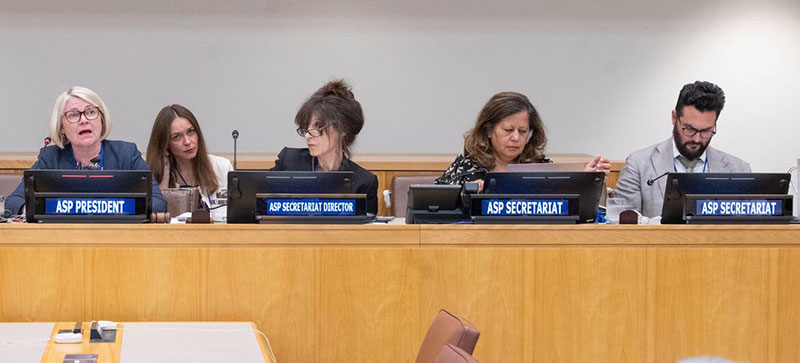
 US Secretary of State Marco Rubio’s warning to the International Criminal Court (ICC) was stark: ‘Either the ICC will end its threats, or we will end the ICC.’ It followed US central administration accusations that the court was unfairly targeting Americans on the basis of trumped-up war crimes charges.
However, a new plethora of sanctions has been clamped on the ICC by the US, which in turn has spurred accusations by sections of the world that the latter has unleashed an ‘assault’ on the international legal order.
What some of the sanctions would mean for the ICC was outlined by Rubio: ‘We will ban transactions with this rogue court, cutting off their resources and crippling their ability to operate against us.’
The ICC has shown consistency of purpose over the years. Despite some operational constraints it has indicted a large number of political strongmen from around the world, accused of war crimes and other governance excesses that come under its purview. Two such recent figures are: Russian President Vladimir Putin and Israeli Prime Minister Benjamin Netanyahu.
Rather than enjoy a mere nominal presence in the world community, the ICC has proved its effectiveness by detaining and bringing to justice scores of VIP politicians and others of their ilk who have been found guilty of human rights abuses and kindred excesses that come within the terms of reference of the ICC.
Accordingly, the international justice system would be stymied considerably as a result of the ICC being dis-empowered, particularly financially. Needless to say, potential and real perpetrators of the species of crime coming under the jurisdiction of the ICC would stand to gain most from such anarchic tendencies. That is, political repression globally would be enabled to enjoy a new lease of life.
A detailing of the types of crime coming under the purview of the ICC provides an idea of what it would cost the international community if the ICC’s operations are gravely hampered. They are mainly: genocide, war crimes, crimes against humanity and the crime of aggression.
That is, the part of the world to be worst affected would be the global South, since the latter is awash with the mentioned crimes. Needless to say, a chronically-disaffected South will sooner rather than later undermine the well being of the world dangerously. The world is already being put through these paces.
At the time of writing, ‘illegal migrants’ from the South, for example, are aggravating many a Western economy’s woes, besides creating for them acute law and order issues. The fact that these migrants’ presence goes on to become a virtual test of the migrant receiving states’ ability to forge domestic social inclusion in the face of jingoistic protests by mainly white supremacist groups is evidence of the latter. As is known, the US, to take just one example, has been up against this crisis for quite a while.
Accordingly, it will be in the best interests of the West if ‘illegal’ migrant arrivals on their shores are stemmed. If the socio-political and economic problems assailing the South are effectively managed through North-South collaborative, ‘trouble-shooting’ efforts the causes leading to ‘illegal’ migration and connected issues could be resolved at source as it were. For, it is the aggravation of the South’s material questions that lays the basis for the emergence of repressive and anti-democratic regimes in the hemisphere.
Until such time that the aforementioned issues in North-South relations are visited afresh and addressed urgently, a vibrantly functioning ICC would be needed. For, the latter would prove a deterrent to Southern political and military strongmen, highly prone to power abuse and like excesses, from coming into being in the wake of the South’s chronic material woes and the wars and conflicts that result from them.
It stands to reason then that the US would be acting in its own interests by enabling the ICC to perpetuate its mandate without hindrance. For a crop of issues that impinges negatively on internal law and order would be defused.
Meanwhile, there needs to be a meeting of minds among the rest of the West to put back in place a North-South dialogue process aimed at reducing some of the economic pressures that are weighing on the South.
Since economics usually drives politics it will be in the interests of the world community to scrutinizingly re-visit North-South issues of the past and put in place economic relief packages for Southern publics that would enable them to tide over their material hardships rather than permit the latter to aggravate into social disaffection and eventually armed militancy. It is the latter juncture that paves the way for the emergence of authoritarian rulers in the South who then go on to be a blight on their publics.
Accordingly, the Southern-based global development thinking of the past that envisaged a more equitable world economic order needs to be seen as an urgent need. That is, NAM’s international development paradigms need to be resuscitated to the extent possible.
It is unlikely that rightist governments of the West, such as the current Republican administration in the US, would find these projects feasible, but democratic states of Europe, led by perhaps the UK, are likely to think otherwise. For it would not be beneficial for the democratic world to be having on their hands repressive governments in the South who would be gravitating towards the major military and economic actors of the South, such as Iran and North Korea, who tend to be in constant power struggles with the West.
However, until such time that the mentioned, pro-people initiatives are given serious thought the ICC would need to be enabled by the international community to be in place comfortably and carry on with its mandate of bringing repressive rulers to book. Besides the ICC should pave the way for the peoples of the developing world to enjoy some substantial respite from the political repression and even terror which tend to be their lot.
Meanwhile, the wars of West Asia are relentlessly aggravating the economic hardships of people everywhere, driving the point home to enlightened sections that there is no alternative to peacemaking. A challenge is to convert the US under President Trump to this line of thinking.
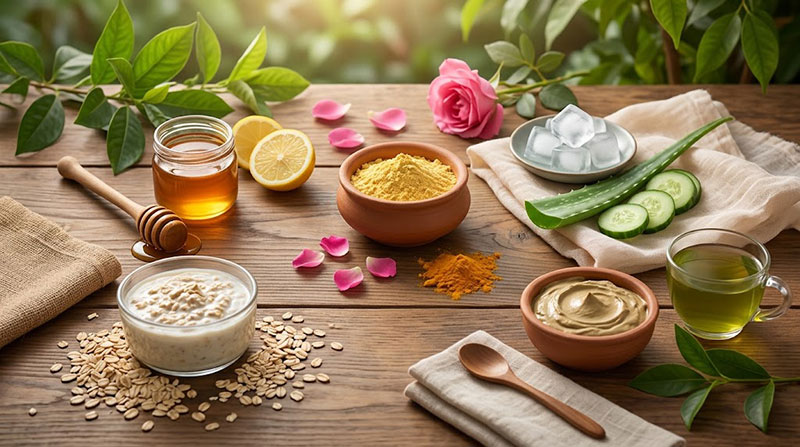
 This week, I give you five simple, time-tested homemade remedies that help reduce the appearance of blemishes, control excess shine and leave your skin feeling softer and smoother.
The Honey and Lemon Brightening Dab:
For stubborn blemish marks, this is a classic. Mix one teaspoon of pure bee honey with three to four drops of fresh lemon juice. Apply gently, only on the affected spots, and leave for 10 minutes before rinsing with lukewarm water. While honey soothes and softens, lemon helps to brighten naturally. Use twice a week in the evening.
Besan and Rose Water Oil-Control Pack:
An ideal remedy to combat shine, especially on the T-zone. Take two teaspoons of besan (gram flour) and mix with sufficient rose water to form a smooth paste. Add a pinch of turmeric for its antiseptic goodness. Apply evenly, keep for 15 minutes and wash off. It absorbs excess oil without over-drying, leaving a beautiful matte finish.
Aloe Vera and Cucumber Ice Soother:
Blend fresh aloe vera gel with the juice of a grated cucumber and freeze the mixture in an ice tray. Each morning, wrap one cube in a soft muslin cloth and gently rub over a cleansed face for 30 seconds. It calms, tightens pores and imparts a baby-soft smoothness.
Oatmeal and Curd Gentle Polish:
Roughness and old blemish marks need gentle exfoliation. Combine one tablespoon of finely powdered oatmeal with one tablespoon of fresh curd (yoghurt). Massage very gently, in circular motions, for one minute, leave for five minutes and rinse. It removes dead cells and unveils softer, clearer skin.
Multani Mitti and Green Tea Magic Mask:
Brew some green tea and allow it to cool completely. Mix one and a half teaspoons of Multani Mitti (Fuller’s Earth) with the tea water to make a fine paste. Apply for 10 to 12 minutes – do not let it dry and crack completely – and wash off. It draws out impurities, fades blemishes and bestows a fresh, shine-free glow.
A Gentle Reminder:
As with any natural remedy, always do a patch test on your inner arm first. For those with oily or combination skin, avoid heavy coconut oil application and harsh scrubbing, as they tend to aggravate shine and blemishes.

 Dream of performing on a world stage? Well, here is your unique, golden opportunity!
The World Championships of Performing Arts (WCOPA) — the one and only official “Talent Olympics” — is the world’s premier global platform for aspiring singers, dancers, actors, models, instrumentalists, etc., to compete, shine and be discovered!
And, yes, this world stage is open to YOU, Sri Lankans living in Sri Lanka and overseas!
Held annually in glittering Las Vegas, WCOPA brings together over 70 countries, all competing for Gold, Silver and Bronze Medals, just like the traditional Olympics.

Lakisha Bernard: Will represent Team Sri Lanka at WCOPA 2027
Outstanding performers vie for the coveted titles of Junior and Senior Grand Champion Performer of the World, with winners and standout participants awarded over $500,000 in scholarships, cash awards and prizes to catapult their education and careers!
Sri Lanka is already making waves! At WCOPA 2026, Natharie Wickramasinghe, representing Team Sri Lanka, made the nation proud by winning a Bronze Medal in the Ethnic/Folklore Dance category!

Lakisha: Accomplished freelance Model and Fashion Design graduate
Recruitment for this prestigious competition is handled through a system of scouts and licensed National Directors — and this is where our very own Chris Rajendra, now based in Las Vegas, and National Director for Team Sri Lanka, comes into the scene.
If you are a singer, dancer, actor, model, instrumentalist — if you have talent burning inside you — contact Chris Rajendra today for registration and, who knows, you may find yourself in Las Vegas, and proudly draped in the Sri Lankan flag, at WCOPA 2027!
The contact address is: Chris Rajendra, wcopa.nationaldirector.sl@gmail.com
or chris.rajendra@gmail.com
Meanwhile, a star is born for 2027, in the form of Lakisha Bernard who is all set to represent Team Sri Lanka at WCOPA 2027.
Originally hailing from the sun-drenched coastal city of Colombo and now carving out her creative career in Canada, 22-year-old Lakisha is stepping into the international spotlight.
This accomplished freelance Model and Fashion Design graduate has officially been appointed as the Team Sri Lanka Promoter for Canada as she prepares to represent Team Sri Lanka at WCOPA in Las Vegas.
Lakisha brings a unique blend of high-fashion sensibility, captivating camera presence and expert garment design to the Team.
Having built her career, from local college shoots to high-glamour concepts, Lakisha’s inspiring journey embodies the true spirit of cultural bridge-building and creative resilience, bringing immense pride and recognition to Sri Lanka on the global stage.
WCOPA 2027 will be held at the legendary Westgate Hotel & Casino, Las Vegas, from 12th to 20th July – the very same iconic arena where the late, great Elvis Presley himself performed!
Your moment is now. Your stage is Las Vegas, so hurry and contact Chris Rajendra.

AgriConnect Sri Lanka’ to be launched on 30 October to Modernise the Agricultural Sector Through Digitalisation

57th Annual Saints’ Quadrangular Tournament on Saturday and Sunday

Showers or thundershowers will occur at most parts of the island

Prison rules to be revised over monks’ attire

AC President recuses himself from hearing prison attire case pertaining to Gnanasara Thera

Court orders steps to obtain INTERPOL Red Notice against Basil

‘Dates have the highest sugar content to fight Coronavirus’

Sunday Island 27 December – Headlines

#SundayIsland 17th December – Headlines

Sunday Island – 28th March

Sunday Island Headlines – 21 March

Sunday Island – 21st February – Headlines
-

 News7 days ago
NDB fraud Rs 60mn more than reported
-

 News7 days ago
Removing monk’s robes matter for Sangha to decide: Mahanayake Theras
-

 News6 days ago
NPP govt. reminded of its responsibilities as US warship leaves Colombo
-

 News5 days ago
Sri Lanka escalates anti-graft drive with Shiranthi’s jailing
-

 Latest News6 days ago
Farhan, Sadaqat help Pakistan ace 183 chase to go 1-0 up
-
 News7 days ago
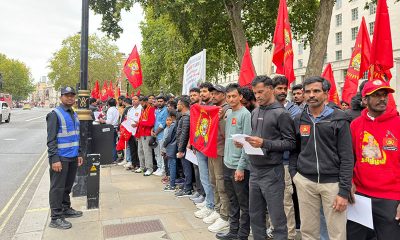
BHC, Colombo: “LTTE remains a proscribed org. in the UK”
-

 Latest News4 days ago
Farhan and Sadaqat help Pakistan seal series in style
-

 News5 days ago
Iranian ships stranded, Lanka fears US sanctions