
Opinion
Reaching out to unify the nation

by Jehan Perera
Much is hoped for from the new government which triumphed with an unprecedented 2/3 majority. The fate of the country at this critical juncture depends on the government’s sagacity when the Covid virus continues its rampage throughout the world and the world economy is in decline. There was an expectation of new faces in the cabinet equal to this task and equipped with the professional orientation that President Gotabaya Rajapaksa has brought to the fore. However, the exigencies of competitive politics, the need to reward loyalty and those who can bring in the votes appear to have prevailed over the demands of professional competence.
Most of the ministers selected are those from the past, including those accused of various offences and have cases in the courts against them. Particularly disappointing has been the failure to appoint women, with only one of the 27 cabinet ministers being a woman. The equal representation of women at all levels of society is a modern ideal. Those who seek international legitimacy, whatever other failings, would tend to improve the status of women. However, in a rather unfortunate turn of events, the subject minister of women’s affairs is a man, and one who is not known to be a specialist in the field of gender equity.
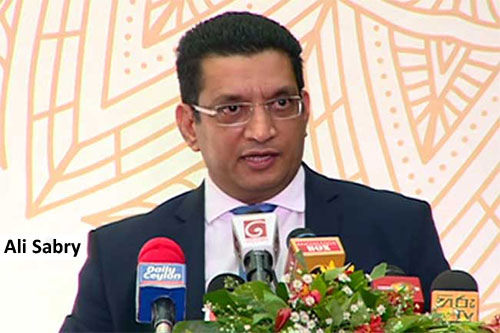
On the plus side, there are silver linings in the appointments of ministers. The main one has been the government’s discipline in keeping the number of cabinet ministers limited to 30 and under as mandated by the 19th Amendment. This is an act of restraint, as less restrained governments have reached the 50 mark in terms of cabinet ministers in the past. Another encouraging action has been the appointment of Mohamed Ali Sabry as Minister of Justice despite criticism that he has been President Gotabaya Rajapaksa’s lawyer in a number of cases in the past few years and also on account of his community. By doing this the government has ensured that the cabinet will be multi ethnic and multi religious in its composition as befits a multi ethnic and multi religious polity.
FILLLING LACUNA
For the past six years at least since the anti-Muslim riots took place in Aluthgama, the Muslim community has been the target of a hate and vilification campaign by extremists mainly from the Sinhalese community. Anti-Muslim sentiment got a further boost after the Easter bombings by extremists from the Muslim community. The presidential election of November 2019 saw anti-Muslim sentiment being stoked to fever pitch by members of the current ruling party and its allies which resulted in the Muslim community voting in unison for the losing presidential candidate. In this context, the appointment of Ali Sabry as Minister of Justice can be considered as an act of political reconciliation which will perhaps give the Muslim community the expectation that they can engage constructively with the government.
There is a lacuna in today’s national politics with regard to national politicians who can reach out to the ethnic and religious minorities to make them feel included in the governance of the country and Sri Lankan in their identity. The recently held elections were notable for not having any of the major political parties proposing how they would bridge the ethnic and religious divides. The last of the champions of non-racist politics, former Prime Minister Ranil Wickremesinghe, is now battling for his political life partly on account of having been identified with being over-sympathetic to the demands of the Tamil and Muslim minorities. Previous champions, such as former President Chandrika Kumaratunga and former Foreign Minister Mangala Samaraweera are presently out of the political centre stage.
The disintegration of the UNP which Ranil Wickremesinghe leads created a vacuum at the recently held general election which resulted in more than two million voters either not voting or spoiling their votes. There is a possibility of the ruling party claiming a part of these votes. This would require new strategies of reaching out to the minorities. The promise of economic development on an equitable basis and regardless of ethnicity or religion can be a powerful motivating factor at elections. Indeed, the recent elections saw a significant shift in the pattern of ethnic and religious minority votes in relation to the presidential election held nine months earlier. In both the North and East and in the central hills which have large populations of minority voters, the ruling party was able to make inroads both directly and through its political allies.
ENSURING BALANCE
The government’s relative success in wooing the minorities at this election is noteworthy as it has rejected the reconciliation process initiated by its predecessor as unsuitable to the country’s ethos and damaging to national sovereignty. However, the need for national reconciliation continues to remain. Despite the gains achieved electorally by the ruling party and its allies, the electoral map that emerged after the elections continues to show signs of this division. The big majority of seats in the Northern and Eastern provinces went to Tamil and Muslim parties in contrast to the voting pattern in the rest of the country. However, the victory of government allies who promised economic development in parts of the North and East suggests that the ethnic and religious minorities are no different from those in the majority community in seeking to improve their economic situation.
It is significant that several key institutions that were set up by the government as part of its national reconciliation process have been newly allocated to the Ministry of Justice. These are the Office for National Unity and Reconciliation (ONUR), formerly headed by former President Chandrika Kumaratunga, the Office on Missing Persons (OMP), the Office for Reparations and the National Authority for the Protection of Victims of Crimes and Witnesses. Both ONUR and the OMP were engaging in pioneering work at the time that the government changed. ONUR had just embarked upon a mass programme of peace education at the community level and the OMP was beginning to find ways to ease the material sufferings of families of those who had gone missing during the war and its aftermath. These are both worthy causes that need to be supported and for which there was significant international goodwill and support.
The government has indicated that its approach to national reconciliation will lie through economic development which requires both political stability and assurance that those who invest will be protected by the law. Apart from the reconciliation mechanisms set up by the previous government, the Ministry of Justice will be responsible for overlooking the Attorney General’s Department and other institutions which play key roles in ensuring the rule of law. Ensuring a balance between the imperatives of justice, rule of law and national reconciliation are the prerequisites for economic development if Sri Lanka is to live up to its potential in a way that it never did in the past.


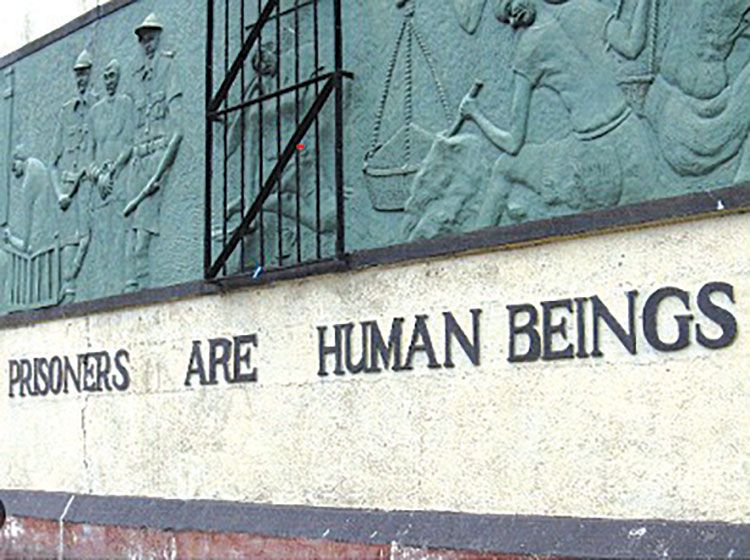
In developed countries such as US, prisons are normally built, far away from City Areas because of the risk of prison breaking as happened recently in Negombo. For an example, just imagine what would be the fate of people around Colombo, if an attempt to break the jail in Welikada become a success. Therefore, it is necessary to introduce strategies to discipline our prisoners to behave as humans rather than simply displaying above message to the people living outside of the prison, as happened in Sri Lanka. To materialised above idea. it is necessary discipline prisoners mentally before they are released. As a Buddhist country we could develop our own model based on Buddhist Stanza such as Wanaropa Sutta to mentally discipline the prisoners. According to that Stanza, people would naturally get self-disciplined themselves while growing trees
The World Health Organization (WHO) reports, that the food not only affects physical and mental health, but is also key to successful rehabilitation and resettlement after release of prisoners. Recognizing this, many organisations and correctional facilities are striving to create a stronger and more sustainable food system among prison populations, which totaled more than 10.35 million globally in 2016, according to the World Prison Brief.
Based on above observations, we could creatively plan to relocate our prisons outside cities. For an example, already ecologically damaged area adjacent to Wilpattu Sanctuary could be used to build an ecofriendly prison. It should be designed with qualified Landscape Architects specialized in designing ecofriendly prisons as adapted in other countries. Those projects should be a joint effort with prisoners because the prisoners themselves should also become the partners of the project while rejuvenating original forest cover after project completion. While creating the forest cover, in the case of Wipattu, we could also use our traditional Chena Cultivation approaches which are now treated in developed countries as most sustainable land use method, to produce healthy foods without damaging eco systems.
By that approach, we could also transform whole prison premises to Organic Food Production Farm, managed by the prisoners themselves. This is very common in developed countries. In my view, the prisoners serving long term jails are ideal for this effort. After their release, they would definitely duplicate their experience in their residence areas rather than repeating crimes as happening now days. They also could be entitled for any profits generated from the project which takes about 5 years for completion. Income generating from farms could be deposited into the bank accounts of prisoners in order to use it after their release.
Another potential area for this intervention is Kandakadu Prison, which was an Agriculture Farm before it was transformed to a rehabilitation camp. Being located adjacent to an area with elephant population and the Beach in Batticaloa, eco-tourism hotel might be the best option for this area. Income generation from tourism is the return on investment which could be used to duplicate same concept to similar locations. Another potential area is the Right Bank area of Maduru Oya located near an Army Camp. Animal Husbandry is ideal for this area. Another potential area is Manthieu island, Batticoloa.
Capital required to invest for this type intervention could be generated by selling the urban areas currently allocated to prisons. Sri Lanka Army could be the ideal implementation agency mainly because of possible reluctances of Prison Officers to work in remote areas such as Wilpattu.
Mahinda Panapitiya
For centuries, many travellers have waxed eloquent about Sri Lanka, the “Resplendent Isle.” They spoke of lush tea estates, golden shores, and a spirit of much-admired spontaneous hospitality that defined our Pearl of the Indian Ocean. But today, the residents of this isle know a different reality; one not of postcards, but of grease, grit, and the grinding misery of a transport system, virtually in terminal collapse. To move from Point A to Point B in modern Sri Lanka is no longer a simple errand; it is a “Herculean effort” of survival against a backdrop of state incompetence, private-sector thuggery, total disregard for human decency and a government that seems to have outsourced its conscience to the highest bidder.
For the millions who call this thrice-blessed island home, the daily reality of navigating it by any form of transport has become a “major catastrophe” of Dickensian proportions. To move from Point A to Point B in 2026 is no longer a simple logistical task; it is a distasteful test of human endurance, a drain on the spirit, and a gamble with one’s own safety. The current transport status of Sri Lanka is not merely “poor”, a terminology that defies even proper definition. It is a monumental systemic failure, a toxic cocktail of state negligence, private-sector extortion, and a total collapse of regulatory oversight.
The Iron Horse in Decay: A Rail Service in Tatters
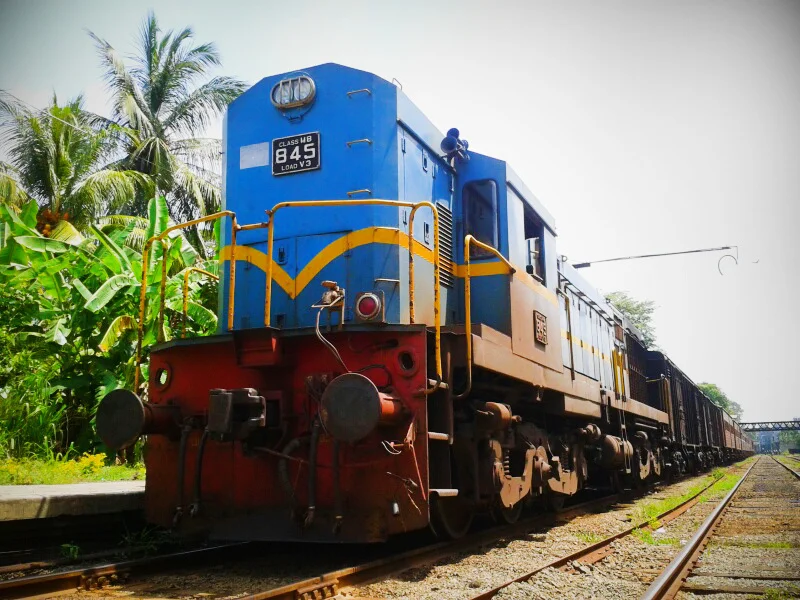
At the heart of our transit woes is the state-run surface rail service. As the only transport entity exclusively handled by the government, the railways should be the backbone of our economy. Instead, they have become a testament to nonchalant and omnipresent bureaucratic apathy. The carriages, many of which look as though they have not seen a lick of paint or a structural repair since the mid-20th century, are in a state of advanced decay.
The statistics tell a grim story. Derailments have become so frequent that they are no longer headline news but a daily footnote in the lives of commuters. These “accidents” are rarely the acts of God; they are the inevitable results of poor maintenance of tracks and rolling stock. Unacceptable delays are now the standard operating procedure. A journey that should take an hour often stretches into three, leaving students, office workers, and labourers stranded on sweltering platforms while the authorities offer nothing but silence or hollow excuses. While other nations race toward high-speed travel connectivity, our “Queen of Jaffna” and “Udarata Menike” crawl through a landscape of systemic neglect.
The symptoms are visible to any commuter: rusted carriages with leaking roofs, seat upholstery that has not seen a deep clean since the 1970s, and an electrical system prone to sparks and darkness. But the issues run deeper than aesthetics. We are witnessing a terrifying frequency of derailments, often blamed on “technical faults” that are actually the predictable results of poor track maintenance and a lack of spare parts. Accidents at unprotected crossings continue to claim lives, while “unacceptable delays” have become the only predictable feature of the timetable. For the office worker in Colombo Fort or the student in Peradeniya, the train is no longer a vessel of progress; it is a gamble with time and safety.
The Bus “Mafia” and the Ransom of the Commuter
If the rail service is a ghost of a bygone era, the fee-levying bus service is a modern-day war zone. The landscape is split between the state-run Sri Lanka Transport Board (SLTB), burdened by a very poorly maintained fleet of ageing buses and a massive and aggressive fleet of private buses, which outmatch and outperform the state-run flotilla, not by efficiency but by sheer intimidation. It is absolutely crucial to note that neither serves the public. The SLTB really operates a skeletal, poorly maintained fleet that barely scratches the surface of demand. The private buses are a law unto themselves.
At the heart of the private transport sector lies an association that critics have aptly dubbed a “Mafia.” Headed by the influential figure colloquially known as “Bus G”, this association holds the entire nation’s commuters to ransom. At the drop of a hat, they can paralyse the country with “trade union action” that are little more than unsophisticated blackmail. In a telling ransom note, whenever a policy change or a fuel hike threatens their bottom line, the buses disappear from the roads. The result? Thousands of citizens are stranded in the blistering heat, watching their productivity and dignity evaporate while the “association” negotiates with a government that appears to be absolutely terrified of their political muscle.
There is a dark irony in the politics of it all. The kingpins of this “bus mafia” openly boast that they were instrumental in bringing the current political powers into office. Consequently, the government appears not just toothless, but complicit. While the public suffers, the state turns a blind eye to overcrowding, reckless driving, and the use of nasty, addictive drugs by the staff, which turns our highways into graveyards. The powers-that-be do not have the gumption to call a spade, just that, a spade, and rein in the miscreants, using the finest employment of the laws that govern this country.
The Law of the Tuk-Tuk: A Free-for-All on Three Wheels
Descending further into the chaos, we find the omnipresent three-wheeler and taxi services. Once a convenient alternative, the “Tuk-Tuk” has become a law unto itself. In a country where the cost of living is already spiralling, these unscrupulous operators have created a “free-for-all” fare system. There is no central control over rates; instead, passengers are forced to haggle or succumb to whatever arbitrary figure the driver decides upon. For those who can afford to bypass the buses, the totally inconsiderate charges of three-wheelers and private taxis offer no sanctuary. What was once a convenient last-mile solution has devolved into a predatory racket. The tuk-tuk services have become stallions of self-importance, operating without any meaningful oversight of rates or conduct.
Commuters are met with the nonchalant refusal of short-distance hires. Drivers, seeking to “make a fast buck,” prioritise long-distance hauls where they can extort exorbitant, unmetered fares. In the absence of a standardised digital fare system enforced by the state, the passenger is always the loser. The arrogance is palpable, and respect for fellow humans has been thrown out the window. These operators behave as if they own the asphalt, often claiming that their collective vote base was the kingmaker for the current political establishment. This perceived “immunity” has bred a culture of impunity where the commuter is treated as a nuisance rather than a customer.
For the elderly trying to reach a hospital or a worker trying to get home during a rainstorm, the “refusal” has become a standard, insulting rejection. The fee-levying taxi services, though slightly more professional in appearance, operate with a similar mercenary mindset, exploiting the desperation of a public that has no other choice.
The RMV Mess, the Registration Trap and the Police Ambush
For those who have attempted to escape the public transport nightmare by purchasing their own vehicles, a different kind of trap awaits. The government has allowed the mass import of private vehicles, including two-wheelers, but the Registrar of Motor Vehicles (RMV) has become a black hole of inefficiency. Delays in vehicle registration now run into several months. Despite a surge in private vehicle imports, the bureaucracy has ground to a resounding halt. Vehicle owners face “blatant delays” in registration that extend for several months, leaving them in a bureaucratic and legal limbo.
The situation is worsened by the government’s decision to halt the private-sector issuance of number plates, centralising it into a system that is currently a “total mess.” Tens of thousands of vehicles are forced to ply the roads displaying only engine and chassis numbers, a temporary measure born of necessity. Yet for all that, and totally against even a minuscule iota of any consideration, the Police Department seems to have missed the memo and become a set of hungry predators. Officers wait in ambush, charging these owners with hefty fines for being on the road without official number plates; plates that the state itself has failed to provide. It is an avaricious cycle, where the state fails to register your car or motorcycle, and then the state’s law enforcement arm punishes you for that very failure. Rather than focusing on the blatantly reckless bus drivers or the lawless Tuk-Tuks, Police Officers wait in ensnarement to pounce on these “unregistered” vehicles. Even when owners produce documents proving the delay lies entirely with the RMV, they are charged and fined. The message is clear: the citizen must pay for the government’s failure.
The Prohibitive Cost of Mobility
Overseeing all of this is the crushing weight of fuel prices. The government continues to raise the cost of petrol and diesel with scant regard for the downstream consequences. These so-called “cost-reflective” adjustments may look good on a balance sheet in Washington or at the International Monetary Fund, but on the ground in Colombo and Kandy, they are prohibitive. Every hike in fuel prices triggers a “ripple effect” that raises the price of bread, vegetables, and, of course, the very transport that people use to get to work to pay for those goods.
Finally, a Nation at a Standstill
The transport crisis is not just a logistical problem; it is a moral one of utter social degradation. It reflects on a government that has abandoned its primary duty: to provide the infrastructure for a functioning society. We are living on a “glorious isle” where the beauty of the landscape is now obscured by the soot of a broken bus and the stress of an uncertain commute. Going from Point A to Point B has become a major travail of unbelievable misery.
Overseeing this chaos is a government that views the fuel pump as an Automated Teller Machine (ATM). The cost of all fuel types, from petrol to the diesel that powers the nation’s mobility has reached “absolutely prohibitive” levels. With scant regard for the domino effect on the cost of living, the authorities and the powers-that-be continue to raise prices, fuelling a major catastrophe of economic inflation.
For the average Sri Lankan, the “travail of unbelievable misery” is now constant. We are a nation on the move, but we are moving towards a cliff from which we are likely to fall into an abyss of no return. Until the transport sector is stripped of its political “protectors” and returned to the service of the people, this “Resplendent Isle” will remain a beautiful prison for those trying to get from Point A to Point B.
If the current administration continues to protect the infamous “mafias”, ignore the decay of the rails, and profit from the administrative chaos of the RMV, and totally fail to get their act together, they are not failing just the transport sector; they are in fact failing the very heart of the nation for sure. Our Motherland, Sri Lanka, deserves a whole lot better than a state of an ever-present and unending transit catastrophe. All the rhetoric about a rich country and a beautiful life that was promulgated in the not-too-distant past remains only as unbelievable wishful thinking.
By an Aficionado
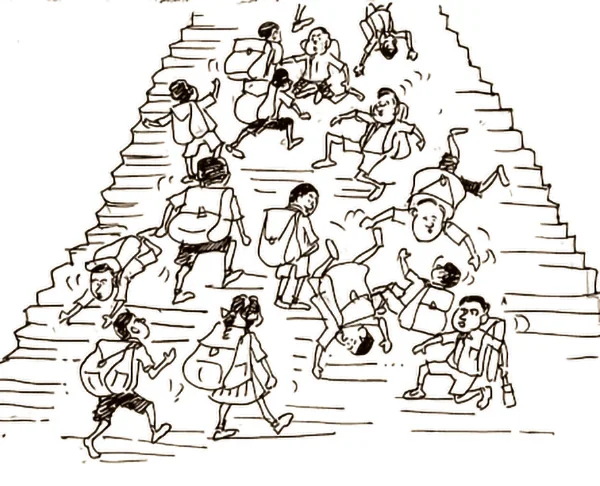
Education is widely recognised as the foundation of a country’s development. In Sri Lanka, free education has provided generations of children with the opportunity to attend school regardless of their economic background. Despite these advantages, many students still leave school before completing their education. School dropout is a significant social issue because it affects not only the lives of young people but also the country’s economic and social progress. Understanding the reasons behind school dropout is essential for finding effective solutions.
One of the main reasons students leave school is financial hardship. Although education in Sri Lanka is free, families still have to spend money on uniforms, stationery, transportation, private tuition, and other school-related expenses. For low-income families, these costs can be difficult to manage. Some students are forced to work to support their families instead of continuing their education. In rural areas especially, children may help with farming, fishing, or family businesses, reducing the time and motivation they have for school.
Another important factor is academic pressure. Sri Lanka’s education system is highly competitive, especially because of major examinations such as the Grade Five Scholarship Examination, the G.C.E. Ordinary Level, and the G.C.E. Advanced Level. Many students feel stressed by the heavy workload and the pressure to achieve high marks. Those who struggle academically may lose confidence and believe they have little chance of success. As a result, some choose to leave school rather than continue facing disappointment and failure.
Family problems also contribute significantly to school dropout rates. Children who experience divorce, domestic violence, alcoholism, or the loss of a parent often face emotional and financial difficulties. Some students become responsible for caring for younger siblings or elderly family members. Without proper support, balancing family responsibilities with education becomes extremely challenging. In such situations, education may become a lower priority.
Another reason is the lack of interest in traditional classroom learning. Every student has different talents and learning styles. However, the education system often focuses mainly on academic achievement rather than practical or vocational skills. Students who are gifted in sports, arts, technology, or technical work may not feel motivated in a classroom that emphasises examinations and textbook learning. Without opportunities to develop their unique abilities, some students become bored and eventually stop attending school.
Bullying and mental health issues are also important causes of school dropout. Some students experience bullying because of their appearance, disability, ethnicity, language, or family background. Others suffer from anxiety, depression, or low self-esteem but do not receive the counseling they need. When students feel unsafe or unwelcome at school, they may begin missing classes and eventually leave school altogether. Schools that lack proper counseling services may struggle to identify and support these vulnerable students.
In some parts of Sri Lanka, long travel distances and transportation difficulties discourage students from attending school regularly. Rural students often travel several kilometers every day, sometimes on foot or using unreliable public transport. During the rainy season, flooded roads and poor infrastructure make travel even more difficult. Frequent absenteeism caused by transportation challenges may eventually lead students to drop out.
For some girls, early marriage and teenage pregnancy become barriers to continuing education. Although these cases are less common than in some other countries, they still affect certain communities. Young mothers often find it difficult to balance childcare with school responsibilities. Social stigma and limited support can further reduce their chances of returning to education.
The COVID-19 pandemic also increased the number of students at risk of dropping out. During school closures, many families lacked internet access, smartphones, computers, or stable electricity for online learning. Students from disadvantaged backgrounds fell behind in their studies, and some never returned to school after classes resumed. The pandemic highlighted inequalities in access to education across the country.
The consequences of school dropout are serious. Students who leave school early often have fewer employment opportunities and may earn lower incomes throughout their lives. They are more likely to experience poverty, unemployment, and social exclusion. School dropout can also contribute to higher crime rates, child labor, and poor health outcomes. For the country, losing educated young people means a less skilled workforce and slower national development.
Several solutions can help reduce school dropout rates in Sri Lanka. The government can strengthen financial assistance for low-income families through scholarships, school meal programmes, and transportation support. Schools should provide counseling services to address mental health concerns and prevent bullying. Teachers can receive training to identify students who are at risk of dropping out and provide timely support. Expanding vocational education and technical training would also give students more opportunities to pursue careers that match their interests and abilities. Finally, parents, schools, communities, and government agencies should work together to encourage regular school attendance and create a supportive learning environment.
In conclusion, school dropout is a complex issue caused by economic difficulties, academic pressure, family problems, mental health challenges, transportation issues, and limited educational opportunities. Although Sri Lanka has made remarkable progress in providing free education, ensuring that every child completes their schooling requires continued effort from all sectors of society. By addressing the root causes of school dropout and supporting vulnerable students, Sri Lanka can build a more educated, skilled, and prosperous future for the next generation.
Saumya Aloysius
saumyaaloysius@gmail.com

Mbappe and Dembele net as France beat Morocco to reach World Cup semifinal

Sallay’s wife further complains to HRC over continuing violation of husband’s FRs by CID

SC upholds Commercial HC ruling that Weerawansa violated intellectual property rights of JVP

Communist Party regrets failure of Justice Minister to visit a single prison

‘Those accused of violence point fingers at SJB’ – Sajith

Herath warns prospective migrant workers not to get fleeced by racketeers

‘Dates have the highest sugar content to fight Coronavirus’

Sunday Island 27 December – Headlines

#SundayIsland 17th December – Headlines

Sunday Island – 28th March

Sunday Island Headlines – 21 March

Sunday Island – 21st February – Headlines
-
 News5 days ago
Singapore-based Buddhist monk marks nearly four decades of humanitarian service
-

 News6 days ago
Freedom 250: US Embassy celebrates America’s 250th Independence Day through magic of American cinema
-

 News4 days ago
AI concerned over proposed SL military deployment in Haiti
-
 News7 days ago
UNEP support pledged to strengthen Sri Lanka’s Environmental Priorities
-

 Midweek Review2 days ago
Unexpected focus on ‘pieces of tin’ worn by military men
-

 Features5 days ago
The NPP’s New Challenge: Balancing Easter Lawfare and Economic Welfare
-

 Latest News3 days ago
Nyamhuri and Ngarava stun Bangladesh by defending 141
-

 Latest News6 days ago
Ukrainian suspect hunted by police after Monaco bomb attack was ‘disguised as a man’