
Opinion
Resplendent isle in transit: The misery of getting from A to B

For centuries, many travellers have waxed eloquent about Sri Lanka, the “Resplendent Isle.” They spoke of lush tea estates, golden shores, and a spirit of much-admired spontaneous hospitality that defined our Pearl of the Indian Ocean. But today, the residents of this isle know a different reality; one not of postcards, but of grease, grit, and the grinding misery of a transport system, virtually in terminal collapse. To move from Point A to Point B in modern Sri Lanka is no longer a simple errand; it is a “Herculean effort” of survival against a backdrop of state incompetence, private-sector thuggery, total disregard for human decency and a government that seems to have outsourced its conscience to the highest bidder.
For the millions who call this thrice-blessed island home, the daily reality of navigating it by any form of transport has become a “major catastrophe” of Dickensian proportions. To move from Point A to Point B in 2026 is no longer a simple logistical task; it is a distasteful test of human endurance, a drain on the spirit, and a gamble with one’s own safety. The current transport status of Sri Lanka is not merely “poor”, a terminology that defies even proper definition. It is a monumental systemic failure, a toxic cocktail of state negligence, private-sector extortion, and a total collapse of regulatory oversight.
The Iron Horse in Decay: A Rail Service in Tatters
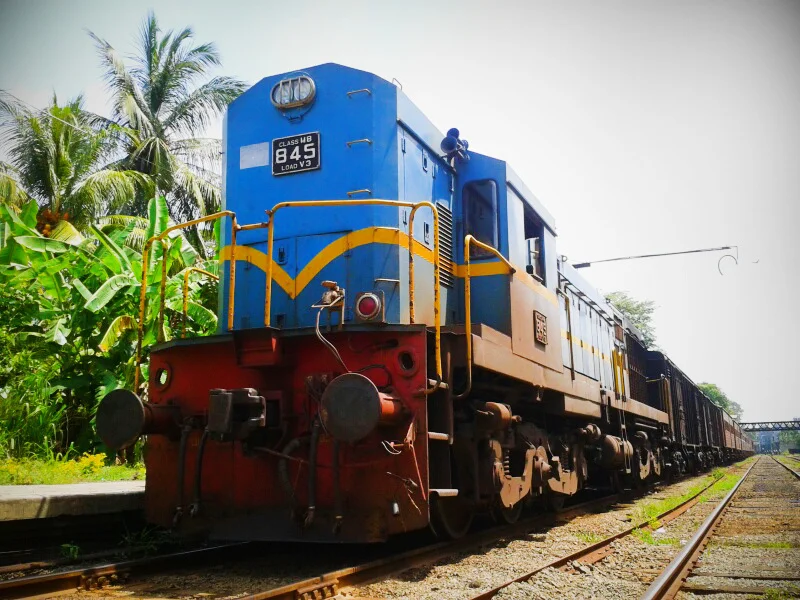
At the heart of our transit woes is the state-run surface rail service. As the only transport entity exclusively handled by the government, the railways should be the backbone of our economy. Instead, they have become a testament to nonchalant and omnipresent bureaucratic apathy. The carriages, many of which look as though they have not seen a lick of paint or a structural repair since the mid-20th century, are in a state of advanced decay.
The statistics tell a grim story. Derailments have become so frequent that they are no longer headline news but a daily footnote in the lives of commuters. These “accidents” are rarely the acts of God; they are the inevitable results of poor maintenance of tracks and rolling stock. Unacceptable delays are now the standard operating procedure. A journey that should take an hour often stretches into three, leaving students, office workers, and labourers stranded on sweltering platforms while the authorities offer nothing but silence or hollow excuses. While other nations race toward high-speed travel connectivity, our “Queen of Jaffna” and “Udarata Menike” crawl through a landscape of systemic neglect.
The symptoms are visible to any commuter: rusted carriages with leaking roofs, seat upholstery that has not seen a deep clean since the 1970s, and an electrical system prone to sparks and darkness. But the issues run deeper than aesthetics. We are witnessing a terrifying frequency of derailments, often blamed on “technical faults” that are actually the predictable results of poor track maintenance and a lack of spare parts. Accidents at unprotected crossings continue to claim lives, while “unacceptable delays” have become the only predictable feature of the timetable. For the office worker in Colombo Fort or the student in Peradeniya, the train is no longer a vessel of progress; it is a gamble with time and safety.
The Bus “Mafia” and the Ransom of the Commuter
If the rail service is a ghost of a bygone era, the fee-levying bus service is a modern-day war zone. The landscape is split between the state-run Sri Lanka Transport Board (SLTB), burdened by a very poorly maintained fleet of ageing buses and a massive and aggressive fleet of private buses, which outmatch and outperform the state-run flotilla, not by efficiency but by sheer intimidation. It is absolutely crucial to note that neither serves the public. The SLTB really operates a skeletal, poorly maintained fleet that barely scratches the surface of demand. The private buses are a law unto themselves.
At the heart of the private transport sector lies an association that critics have aptly dubbed a “Mafia.” Headed by the influential figure colloquially known as “Bus G”, this association holds the entire nation’s commuters to ransom. At the drop of a hat, they can paralyse the country with “trade union action” that are little more than unsophisticated blackmail. In a telling ransom note, whenever a policy change or a fuel hike threatens their bottom line, the buses disappear from the roads. The result? Thousands of citizens are stranded in the blistering heat, watching their productivity and dignity evaporate while the “association” negotiates with a government that appears to be absolutely terrified of their political muscle.
There is a dark irony in the politics of it all. The kingpins of this “bus mafia” openly boast that they were instrumental in bringing the current political powers into office. Consequently, the government appears not just toothless, but complicit. While the public suffers, the state turns a blind eye to overcrowding, reckless driving, and the use of nasty, addictive drugs by the staff, which turns our highways into graveyards. The powers-that-be do not have the gumption to call a spade, just that, a spade, and rein in the miscreants, using the finest employment of the laws that govern this country.
The Law of the Tuk-Tuk: A Free-for-All on Three Wheels
Descending further into the chaos, we find the omnipresent three-wheeler and taxi services. Once a convenient alternative, the “Tuk-Tuk” has become a law unto itself. In a country where the cost of living is already spiralling, these unscrupulous operators have created a “free-for-all” fare system. There is no central control over rates; instead, passengers are forced to haggle or succumb to whatever arbitrary figure the driver decides upon. For those who can afford to bypass the buses, the totally inconsiderate charges of three-wheelers and private taxis offer no sanctuary. What was once a convenient last-mile solution has devolved into a predatory racket. The tuk-tuk services have become stallions of self-importance, operating without any meaningful oversight of rates or conduct.
Commuters are met with the nonchalant refusal of short-distance hires. Drivers, seeking to “make a fast buck,” prioritise long-distance hauls where they can extort exorbitant, unmetered fares. In the absence of a standardised digital fare system enforced by the state, the passenger is always the loser. The arrogance is palpable, and respect for fellow humans has been thrown out the window. These operators behave as if they own the asphalt, often claiming that their collective vote base was the kingmaker for the current political establishment. This perceived “immunity” has bred a culture of impunity where the commuter is treated as a nuisance rather than a customer.
For the elderly trying to reach a hospital or a worker trying to get home during a rainstorm, the “refusal” has become a standard, insulting rejection. The fee-levying taxi services, though slightly more professional in appearance, operate with a similar mercenary mindset, exploiting the desperation of a public that has no other choice.
The RMV Mess, the Registration Trap and the Police Ambush
For those who have attempted to escape the public transport nightmare by purchasing their own vehicles, a different kind of trap awaits. The government has allowed the mass import of private vehicles, including two-wheelers, but the Registrar of Motor Vehicles (RMV) has become a black hole of inefficiency. Delays in vehicle registration now run into several months. Despite a surge in private vehicle imports, the bureaucracy has ground to a resounding halt. Vehicle owners face “blatant delays” in registration that extend for several months, leaving them in a bureaucratic and legal limbo.
The situation is worsened by the government’s decision to halt the private-sector issuance of number plates, centralising it into a system that is currently a “total mess.” Tens of thousands of vehicles are forced to ply the roads displaying only engine and chassis numbers, a temporary measure born of necessity. Yet for all that, and totally against even a minuscule iota of any consideration, the Police Department seems to have missed the memo and become a set of hungry predators. Officers wait in ambush, charging these owners with hefty fines for being on the road without official number plates; plates that the state itself has failed to provide. It is an avaricious cycle, where the state fails to register your car or motorcycle, and then the state’s law enforcement arm punishes you for that very failure. Rather than focusing on the blatantly reckless bus drivers or the lawless Tuk-Tuks, Police Officers wait in ensnarement to pounce on these “unregistered” vehicles. Even when owners produce documents proving the delay lies entirely with the RMV, they are charged and fined. The message is clear: the citizen must pay for the government’s failure.
The Prohibitive Cost of Mobility
Overseeing all of this is the crushing weight of fuel prices. The government continues to raise the cost of petrol and diesel with scant regard for the downstream consequences. These so-called “cost-reflective” adjustments may look good on a balance sheet in Washington or at the International Monetary Fund, but on the ground in Colombo and Kandy, they are prohibitive. Every hike in fuel prices triggers a “ripple effect” that raises the price of bread, vegetables, and, of course, the very transport that people use to get to work to pay for those goods.
Finally, a Nation at a Standstill
The transport crisis is not just a logistical problem; it is a moral one of utter social degradation. It reflects on a government that has abandoned its primary duty: to provide the infrastructure for a functioning society. We are living on a “glorious isle” where the beauty of the landscape is now obscured by the soot of a broken bus and the stress of an uncertain commute. Going from Point A to Point B has become a major travail of unbelievable misery.
Overseeing this chaos is a government that views the fuel pump as an Automated Teller Machine (ATM). The cost of all fuel types, from petrol to the diesel that powers the nation’s mobility has reached “absolutely prohibitive” levels. With scant regard for the domino effect on the cost of living, the authorities and the powers-that-be continue to raise prices, fuelling a major catastrophe of economic inflation.
For the average Sri Lankan, the “travail of unbelievable misery” is now constant. We are a nation on the move, but we are moving towards a cliff from which we are likely to fall into an abyss of no return. Until the transport sector is stripped of its political “protectors” and returned to the service of the people, this “Resplendent Isle” will remain a beautiful prison for those trying to get from Point A to Point B.
If the current administration continues to protect the infamous “mafias”, ignore the decay of the rails, and profit from the administrative chaos of the RMV, and totally fail to get their act together, they are not failing just the transport sector; they are in fact failing the very heart of the nation for sure. Our Motherland, Sri Lanka, deserves a whole lot better than a state of an ever-present and unending transit catastrophe. All the rhetoric about a rich country and a beautiful life that was promulgated in the not-too-distant past remains only as unbelievable wishful thinking.
By an Aficionado


By Chula Goonasekera
For the LEADS Forum (admin@srilankaleads.com)
Sri Lanka’s future prosperity will depend on how effectively it positions itself within an increasingly complex global environment. At a recent LEADS Forum discussion (https://youtu.be/Bbr3e_qU1Fw), veteran diplomat Prasad Kariyawasam, former Secretary to the Ministry of Foreign Affairs, High Commissioner to India, Ambassador to the United States, Ambassador /Permanent Representative to the UN in New York and Geneva —outlined the strategic choices Sri Lanka must make to secure long term stability and economic advancement. Kariyawasam offered a rare blend of historical perspective, diplomatic experience and practical guidance.
His central message was clear: Sri Lanka must exercise strategic agency—engaging all major partners while safeguarding its national interests.
Foreign Policy as an Extension of National Aspirations
Foreign policy, Kariyawasam emphasised, is inseparable from domestic priorities. As your text notes, “foreign relations often reflect the medium- and long-term aspirations of a country’s people and its leadership.” Governments must therefore craft external relations that reflect the public’s economic and social expectations, avoiding short-term political impulses that undermine long-term national interests.
For a small nation, foreign policy cannot be symbolic or personality driven. It must be purposeful, pragmatic and directed towards the security and prosperity of the people.
A History of Global Connectivity
Sri Lanka’s history demonstrates that the island has never been isolated. From ancient ties with India and Southeast Asia to Arab, Persian and Chinese maritime networks, the island prospered when connected to the wider world. We must realise that “geography creates opportunity, but geography alone does not create prosperity.” Institutions, infrastructure and policy determine whether geographic advantage becomes economic success.
Colombo’s emergence as a cosmopolitan trading hub and Galle’s role as a resupply station for Indian Ocean shipping in colonial times , illustrate how deeply Sri Lanka has been embedded in global commerce for centuries.
Lessons from Asia’s High Performers
Kariyawasam highlighted the experiences of Japan, South Korea, Taiwan, Singapore and Vietnam. Their paths differ, but their success rests on common foundations:
• investment in human capital and infrastructure
• merit based institutions
• integration into global markets
• attraction of investment and technology
• export oriented industries
• strategic engagements with both China and Western economies
The lesson for Sri Lanka is not imitation but continuous adaptation and constructive integration with the global economy.
India: Sri Lanka’s Closest Major Partner
India’s transformation into a global economic power presents Sri Lanka with both opportunity and responsibility. India is already Sri Lanka’s largest source of tourists and a major investor. Kariyawasam states, “The larger question is how effectively Sri Lanka can participate in and benefit from India’s growth.”
A partnership should encompass modern, more open pathways for trade, investment, logistics, energy, technology, digital services, education and professional mobility—And asymmetry between the two economies must be handled with maturity and foresight, seeking special and differential treatment .
China and Other Global Partners
China remains a significant economic partner. Sri Lanka must avoid viewing this relationship through a zero sum lens. The goal should be productive and transparent engagement, ensuring better terms of trade and meaningful technology transfer.
Equally Important relations must be nurtured with the United States, European Union, United Kingdom, Japan, Australia, ASEAN and the Gulf.
All these relationships can be vibrant partnerships that does not lead towards , dependency but mutually beneficial pragmatic arrangements .
A Fragmenting International System
Global geopolitics is becoming more volatile. Trade tensions, wars, sanctions, supply chain disruptions, climate change and technological competition increasingly shape national security. We must realise, “foreign policy cannot be separated from economic policy.”
Sri Lanka’s recent economic crisis demonstrated the importance of international confidence, access to finance and resilient supply chains. Energy security, food security, cybersecurity and digital infrastructure are now core elements of national strategy.
Strategic Agency: The Guiding Principle
Sri Lanka must avoid becoming an arena for great power competition. Strategic agency means making decisions based on national interest, expanding Sri Lanka’s choices, not restricting them.
India is essential. China is important. The United States, Europe, Japan, Australia, ASEAN and the Gulf are important. The objective is a web of partnerships that strengthens resilience and autonomy.
Sri Lanka’s Strategic Assets
1. Location: Sri Lanka’s geography is a long standing advantage. Ports such as Colombo, Hambantota, Trincomalee and Galle can become specialised hubs—if connected to logistics, manufacturing, services and exports.
2. Digital Connectivity: Submarine cables, data centres, cloud services and cybersecurity are now as important as physical geography. Sri Lanka can turn its location into both a maritime and digital advantage.
3. Tourism and Natural Heritage: The focus should shift from tourist numbers to value creation—wellness, heritage, ecotourism, cruise tourism, education and MICE tourism.
4. Human Resources and Demographics: High literacy is no longer enough. Skills in technology, engineering, AI, logistics and advanced manufacturing are essential, especially with an ageing population.
5. Migrant Workforce: Migrant workers are a strategic asset, not merely a source of remittances. Bilateral labour agreements, skills recognition and diaspora engagement should be central to foreign policy.
Requirements for Sustained Prosperity
Sri Lanka’s future depends on:
• peace and security
• access to international markets
• productive investment
• a skilled, productive workforce
• modernised agriculture
• higher value tourism
• demographic preparedness
• climate resilience
• strong, predictable institutions
Please note that “foreign policy can open doors. Domestic institutions determine whether we can walk through them.”
The Role of the State
Sri Lanka does not need a larger state—only a more capable one. Policy continuity, professional institutions, predictable regulation and reduced corruption are essential. Geography does not change; long-term national interests do not change. Intentional relationships built over decades should not be reinvented with each election cycle.
Building Trust Internationally
Trust is a strategic asset. Sri Lanka must be known as a country that honours commitments and maintains predictable policies. This is vital not only for diplomacy but also for investment and long term partnerships.
Avoiding Zero Sum Geopolitics
Sri Lanka does not need to choose between India and China, or between Asia and the West. The task is to identify what each relationship can contribute to national development while protecting sovereignty and freedom of decision making.
Sri Lanka’s geography is an inheritance, but prosperity is not guaranteed. The world is changing rapidly—great-power competition, technological disruption, and climate vulnerability demand a foreign policy that is pragmatic, adaptive, and anchored in national interest.
Sri Lanka must build partnerships without dependencies, maintain strategic agency without isolation, and integrate with the global economy while strengthening domestic capacity.
“We cannot change where Sri Lanka is. We can, however, determine what Sri Lanka becomes because of where it is”
by Gomi Senadhira
Sri Lanka’s former ambassador to the United States Mahinda Samarasinghe is back in Sri Lanka lobbying for speedier finalisation of a new tariff deal with the United States. According to news reports, delivering the keynote address at the Sri Lanka Institute of Directors’ Annual Meeting last week, he stated, “I have recommended very strongly to the government that we need to conclude the agreement so that we can lock in the very favourable tariff rate that Sri Lanka has got up to now“.
I do not understand why the former ambassador is urging the government to expedite the finalisation of a new tariff deal or what is “the very favourable tariff rate” he refers to in his speech. However, given the ongoing terrible tariff turbulence in the United States and the fragile economic situation in Sri Lanka, I believe, this is not the right time to rush into finalising any trade agreement with the United States. I am also of the opinion that at this juncture Sri Lanka should maintain strategic patience and explore all available options.
Lessons from the countries that rushed for trade deals
To better comprehend this, let’s look at experiences of the countries that rushed to conclude tariff deals with the United States after President Donald Trump declared his “reciprocal tariffs” under the International Emergency Economic Powers Act (IEEPA) in April 2025. As Samarasinghe stated in his keynote, “The bottom line on all these negotiations was that every country that finally agreed to sign the agreement had to give either complete duty-free access for American exports into those markets, or near complete duty-free access.” In exchange for these tariff concessions and other market access commitments these countries managed to get the newly introduced country specific “reciprocal tariffs” reduced.
However, in February 2026, the Supreme Court of the United States (SCOTUS) struck down these “reciprocal tariffs” under the IEEPA. With that, the market access gains these countries received in exchange for complete duty-free access for American exports into their markets evaporated under U.S. domestic law. By moving too fast to conclude bilateral tariff agreements with the United States these countries are now bound to strict obligations whereas the benefits they bargained from the U.S. administration are not worth the paper those were written on.
Sri Lanka’s experience
In April 2025, President Trump declared his “reciprocal tariffs” and labelled Sri Lanka as the worst offender, imposing one of the highest additional duties at 44%. Since then, Ambassador Samarasinghe and other negotiators have managed to negotiate this down to 20%. I do not know what the deal was through which Sri Lanka managed to reduce the 44% tariff to 20% or what we gave in return for this “concession.” However, what we received in return has absolutely no value after the decision by the SCOTUS.
Current state of US tariffs
After the decision by SCOTUS, the U.S. administration introduced a temporary 10% additional tariff on all countries for 150 days. At the end of that period, this 10% tariff was replaced by a new “forced labor tariff ” of 10% to 12.5% on all trading partners under Section 301 of U.S. trade law. Twenty-five U.S. states and several small businesses have already filed lawsuits against these tariffs in U.S. courts. This new “forced labour tariff ” on Sri Lanka was first fixed at 12.5%. Later, after President Anura Kumara Dissanayake issued a gazette notice prohibiting the importation of goods produced using forced labour, it was reduced to 10%. That means Sri Lanka has already made a substantial commitment to receive this “tariff concession,” and I presume our negotiators understand the implications of this commitment.
Make haste slowly
After President Trump imposed 44% “reciprocal tariffs” on Sri Lanka, through an article published in The Island on 25th April 2026 (), I urged the government to engage immediately with the US administration on these tariffs. However, I also emphasised that the best way to move forward was to make haste slowly.
Two millennia ago, Augustus Caesar, the first emperor of Rome, frequently used the phrase, “make haste slowly”, because he detested rashness and haste in his military commanders. It was the recurring guiding maxim that he emphasised throughout his 40-year imperial rule. After 2000 years, this classical oxymoron remains a definitive golden rule for professional trade negotiators. More importantly it is the exact blueprint required when navigating turbulence in trade negotiations with the Trump administration.
The endgame – The most dangerous moment in trade negotiation
Samarasinghe has also stated the agreement is 90% complete. Any experienced trade negotiator should know that the final 10% contains high-stakes provisions and is the most dangerous moment in a trade negotiation. A single misplaced comma or ambiguous product description in a tariff schedule can cost millions through unintended loopholes. Rushing this last stretch to secure a deal can permanently expose Sri Lanka to sudden shifts in American trade policy, heavy compliance costs, or strict enforcement under Section 301 regarding supply-chain labour standards. Hence, this is the time for strategic patience.
(The writer can be reached at senadhiragomi@gmail.com)
Upon reading the article titled “Prof. Pieris says Buddha Dhamma recognized as source of law under Constitution” (Island, September 12, 2026), the classical Sinhala idiom “Yanne Koheda? Malle Pol” immediately comes to mind. The expression, translating literally to answering “I have coconuts in my bag” when asked “Where are you going?”, underscores a complete disconnect in logic. Because it is uncertain whether the article accurately represents the professor’s precise words, the following critique addresses the contents of the report rather than the speaker himself.
The central premise of the report concerns a statement delivered by the Chief Justice regarding a petition filed against the 22nd Amendment to the Constitution. According to the report, the Chief Justice’s observation that the determination would be made strictly on the basis of established law rather than Buddhist teachings was characterised as a “cavalier dismissal” of the Buddha Dhamma. This assertion carries a host of unexamined assumptions. Had the writer specified precisely which tenets of the Buddha Dhamma were violated, a direct legal or philosophical evaluation could take place. However, no specific Buddhist tenet or law was identified as having been transgressed, and for good reason: no such statutory legal framework exists within the Buddha’s teachings.
To understand the flaw in this argument, one must examine the constitutional context alongside the canonical meaning of the terms involved. Article 9 of the 1978 Constitution of Sri Lanka mandates that the Republic shall give Buddhism the foremost place and that it shall be the duty of the State to protect and foster the Buddha Sasana, while guaranteeing the fundamental rights of all religions under Articles 10 and 14(1)(e).
While “Buddhism” and “Buddha Dhamma” are frequently used as interchangeable terms in casual dialogue, they represent distinct concepts. “Buddhism” is an umbrella term coined by 19th-century Western scholars to classify the global institutionalised religion, incorporating its diverse sects, cultural traditions, rituals, and socio-political histories. Conversely, Sasana is the ancient term designating the structural framework established by the Buddha to preserve and transmit his teachings, comprising the monastic order (Sangha) and its supporting institutions.
In classical Theravada commentarial literature, the Sasana operates as a functional three-tiered structure. It encompasses Pariyatti Sasana, the preservation and study of sacred texts; Paṭipatti Sasana, the practical execution of the doctrine through ethical conduct and meditation; and Paṭivedha Sasana, the direct experiential realization of ultimate truth, or enlightenment. This structural breakdown raises fundamental questions about state capacity. While a state can readily support Pariyatti Sasana through academic institutions, textual preservation, and educational funding, it cannot legislate or enforce Paṭipatti or Paṭivedha. Practical engagement and spiritual realisation are inherently internal, first-person experiences. Expecting the state to codify or guarantee enlightenment is a conceptual impossibility.
Furthermore, the Buddha Dhamma refers specifically to the unconditioned truths of existence and the teachings imparted to realize them, including the Four Noble Truths, the Eightfold Path, and Dependent Origination. As the late Venerable Professor Kotagama Wachissara Thera observed, there is no rigid ideologue or “ism” in the core Dhamma. The teachings do not constitute a system of divine commandments or a legal statute enforced through reward and punishment. Rather, Buddhist ethics function as self-directed guidelines for psychological clarity and moral inquiry. Even the Vinaya Pitaka, which contains explicit rules of conduct, functions as an internal monastic code rather than a civil or criminal law intended for the laity.
Throughout the Pali Canon, guidance regarding governance focuses on the moral character of leadership and the social duties of statecraft rather than rigid legal codification. In discourses such as the Cakkavatti Sihanada Sutta (DN 26), the Buddha observes that social instability and crime cannot be eliminated solely through punitive measures, emphasising instead that states must provide economic opportunities, fair wages, and resource distribution to maintain societal balance. Crucially, in the Maha Parinibbana Sutta (DN 16), the Buddha explicitly highlights the importance of respecting established laws and traditions rather than enacting arbitrary regulations.
The natural laws articulated in the Dhamma, such as the law of cause and effect or the three characteristics of existence, govern all phenomena universally, regardless of legal statutes or personal belief. They are not human laws to be applied or suspended by a court of law. Therefore, characterizing the Chief Justice’s adherence to constitutional jurisprudence over religious doctrine as a “cavalier dismissal” lacks logical and textual foundation. Framing the judiciary’s adherence to legal precedent as an attack on the Dhamma distracts from fundamental constitutional principles and risks misguiding the public for political ends.
Geewananda
Gunawardana,
Ph.D.

‘Vision’ Programme Marks Two Years

Costa Rica minister fired for unapproved meeting with Trump in US

At least 41 die as boat capsizes in DRC’s Lake Tanganyika

Showers will occur at times in the Western, Sabaragamuwa, Southern, Central and North-western provinces

Sajith vows to scrap 22A under future govt.

Two retired female Navy officers remanded over disappearance of two women during war

‘Dates have the highest sugar content to fight Coronavirus’

Sunday Island 27 December – Headlines

#SundayIsland 17th December – Headlines

Sunday Island – 28th March

Sunday Island Headlines – 21 March

Sunday Island – 21st February – Headlines
-

 News6 days ago
Shanakiyan urges urgent action over reported death sentence for Lankan in Saudi Arabia
-

 News5 days ago
Namal Rajapaksa Buddhist gambit fails, bail denied
-

 Features5 days ago
Why the spelling Sri Lankan names in English vary
-

 Features5 days ago
Three bands, a new identity: Sri Lankan wolf snake recognised as distinct species
-

 Business5 days ago
SLIIT holds largest-ever convocation
-
 News5 days ago
Vehicle prices drop by up to Rs. 1 mn, says importers’ body
-
 News5 days ago
Govt monitors reported Saudi death sentence – Foreign Ministry
-

 Business5 days ago
All-new Bolero MaXX Pik-Up unveiled in Lanka