
Business
RDB ranks first in providing most loans to women entrepreneurs under ADB’s We-Fi initiative

ComBank 5th in the ranking, yet records highest disbursement
By Sanath Nanayakkare
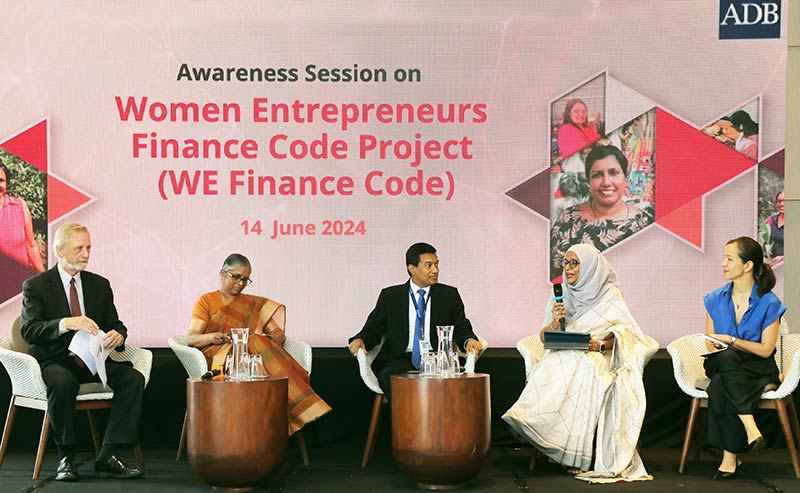
Women Entrepreneurs Finance Initiative (We-Fi) is a programme of the Asian Development Bank (ADB) which enables an empowering business environment for women entrepreneurs in Sri Lanka, conducted in collaboration with 13 banks.
The media was educated about this at a workshop related to We-Fi programme hosted by the ADB at the Courtyard by Marriott Colombo on 14 June 2024.
The data at the workshop showed that in expanding access to finance, the Regional Development Bank (RDB) tops the list of We-Fi grants distribution with 482 grants- a share of 31% of the total grants- thus distributing US$ 1.07 million among women entrepreneurs.
The Bank of Ceylon has distributed 327 grants – a share of 21.1% of the total grants – thus distributing US$ 1.23 million among women entrepreneurs. The People’s Bank was a distant third with 112 grants – a share of 7.2% of the total grants – thus distributing US$ 0.43 million among women-led MSMEs.
HNB, ComBank and NDB which are generally orientated towards financing established SMEs had notably taken advantage of ADB’s We-Fi by clinching the fourth, fifth and sixth place respectively in the loan distribution ranking.
Interestingly, the exceptional case here was the ComBank which reported the largest disbursement of US$ 1.31million among women entrepreneurs despite its fifth place in terms of the number of grants.
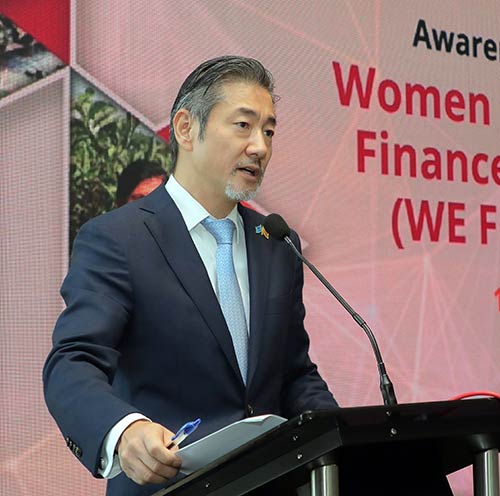
Takafumi Kadono, Country Director, Sri Lanka Resident Mission, Asian Development Bank (ADB) delivers the welcome remarks at the awareness session
The ADB programme spans over 5 areas:
Expanding access to finance for underserved women entrepreneurs
Providing technical assistance for financial institutions on gender inclusive finance
Gender inclusive policy, regulatory framework and network strengthening
building business capacity of women entrepreneurs
Strengthening the evidence base on women-owned/led SMEs
Three government institutions and two civil society organisations participate in the programme.
The Department of Development Finance at the Ministry of Finance is the implementing agency.
The project has achieved the following:
$9.5 million of the We-Fi grant has mobilized with ADB’s $46.6 million loan funds as blended finance
1,553 women entrepreneurs employing 21,494 workers have financially benefitted from the We-Fi grant
Nearly 90% of loans and We-Fi grants were made for economic activities outside Colombo District, including in lagging regions (eastern, northern, Sabaragamuwa and Uva provinces) and across various industries (including manufacturing, tourism, trade, healthcare, agriculture, and construction)
Conducted specialized training program for women entrepreneurs. 470 women entrepreneurs completed the programme
Launched an online platform (SME Connect) in October 2022 to build business capacity of WSMEs through learning, mentoring, and networking. Currently 902 women entrepreneurs are registered on the platform.48% of the loans were granted on non-collateralized basis while 35% were made to first time borrowers.







Senior business leaders, economists and international development experts, alongside the Prime Minister of Sri Lanka, will headline the Sri Lanka Economic & Investment Summit 2026, organised by The Ceylon Chamber of Commerce on 12 and 13 October at the Shangri-La Colombo.
The Summit will open with a keynote address by T. Krishnakumar, Chief Executive Officer, Reliance Consumer Products Ltd, who brings more than four decades of experience in the consumer brands and FMCG sectors. Having previously served as President of Coca-Cola India and Southwest Asia, with extensive experience in building businesses and driving growth across emerging markets, Krishnakumar, more popularly known as Kk, now leads Reliance Consumer Products as it expands across categories and builds new customer, partnership and market opportunities.
Day 2 will bring together four international perspectives across discussions on economic resilience, regional connectivity, sector growth and digital transformation.
Lilia Aleksanyan, Senior Country Economist for Sri Lanka at the Asian Development Bank, will open the day’s discussions with a focus on Sri Lanka’s economic resilience. Her work covers the country’s macroeconomic outlook, policy advice and macro-fiscal and financial-sector reform. Her international policy experience also includes roles at the French Ministry of Finance and the French Central Bank.
The Summit will then turn to Sri Lanka’s connections with regional markets, with P. D. Singh, Chief Executive Officer, India & South Asia, Standard Chartered Bank, delivering the keynote for the session on trade corridors and value chains. Singh counts close to three decades of experience in banking and finance, with senior leadership roles spanning Standard Chartered, JPMorgan Chase Bank and HSBC.
The Sector Deep Dives will bring international perspectives to discussions on healthcare and energy.
Tushar Shroff, Chief Financial Officer, Zydus Lifesciences Ltd, will deliver the keynote for the healthcare discussion, drawing on more than three decades of experience in corporate finance, strategic investment and financial transformation. His career spans senior finance and leadership roles with ABB, Piramal Healthcare, Intas Pharmaceuticals and Vedanta Group, giving him a broad perspective on the business and investment decisions shaping the healthcare sector.
For the energy-focused deep dive, Edore Onomakpome, Regional Infrastructure Industry Manager for Bangladesh, Sri Lanka and Nepal at the International Finance Corporation, will bring extensive experience in infrastructure investment and project finance across emerging markets. Since joining IFC in 2013, she has held senior roles across Africa and South Asia, including managing IFC’s infrastructure portfolio across 16 countries.
The Summit will conclude its keynote programme with Prime Minister Dr. Harini Amarasuriya, who will deliver the keynote for “Nation Building in the Digital Age.” The Prime Minister also oversees the Ministry of Education, Higher Education and Vocational Education, bringing a direct policy perspective to discussions on digital transformation, innovation, education and the skills needed for a changing economy.
Together, these perspectives will bring regional, international and policy insight to SLEIS 2026 as Sri Lanka considers how to strengthen economic resilience, attract investment, deepen regional connections and develop new sources of growth.
Held under the theme “Positioning Sri Lanka in a Changing Global Economy: Resilience, Reform, and the Future of Economic Policy,” SLEIS 2026 will take place on 12 and 13 October 2026 at the Shangri-La Colombo.
The Sri Lanka Economic & Investment Summit 2026 is supported by its valued sponsors and partners. Platinum Sponsor – Standard Chartered Bank Sri Lanka, Gold Sponsor – VISA Worldwide (Pvt) Ltd., Bronze Sponsor – South Asia Gateway Terminals (Pvt) Ltd., Strategic Development Partner – Asian Development Bank, Telecommunication Partner – Dialog Telecommunication, Television Partner – Dialog Television, Session Sponsors – David Pieris Motor Company (Pvt) Ltd., Hemas Holdings PLC, Sunshine Holdings PLC, International Construction Consortium (Pvt) Ltd., Microsoft Sri Lanka (Pvt) Limited, Official Logistics Partner – Hayleys Advantis Limited, Official Airline – SriLankan Airlines Ltd., Official Hospitality Partner – Shangri-La Colombo, Airline Partner – China Eastern Air Holding Co. Ltd.
Registrations for SLEIS 2026 are now closed. The Ceylon Chamber looks forward to welcoming participants to the discussions on Sri Lanka’s future trajectory on 12 and 13 October.
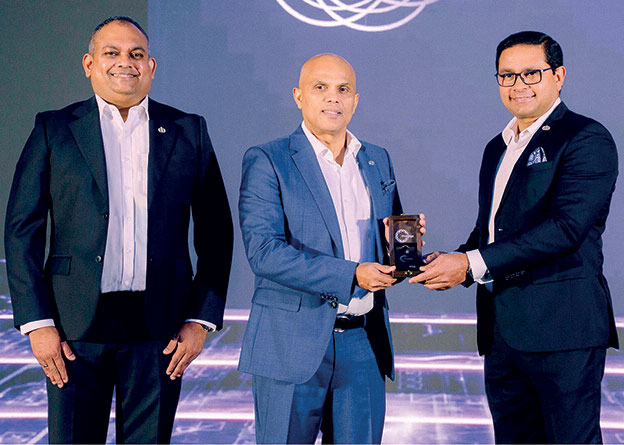
Commercial Bank of Ceylon has launched ‘Prestige’, a three-tier banking proposition aimed at high-net-worth (HNW) clients, combining wealth management, advisory services and lifestyle benefits.
The initiative replaces the bank’s existing ‘Elite’ private banking brand with Ruby, Sapphire and Diamond tiers, designed to cater to customers according to their wealth profiles and banking relationships.
The bank said Prestige would provide dedicated relationship managers, priority branch services, preferential rates on loans and deposits, enhanced card privileges, family banking programmes and offshore account solutions.
Its wealth and investment management services include access to capital-protected income solutions, dual-currency investments, institutional deals and estate and portfolio governance.
Clients will also have access to specialist financial and corporate advisory services, including assistance with international relocation, overseas property and capital repatriation.
The programme includes lifestyle benefits such as VIP airport lounge access, travel concierge services, property management and medical coordination, as well as access to selected art and culinary events.
The bank said its flagship Prestige banking residence at R.G. Senanayake Mawatha, Colombo 07, had been refurbished, with the service to be extended to other economically important cities.
Commercial Bank Managing Director/CEO Sanath Manatunge said Prestige was intended to support customers in managing their wealth, business interests, family needs and long-term legacy.
Existing Elite clients are being transitioned to the new programme, the bank said.
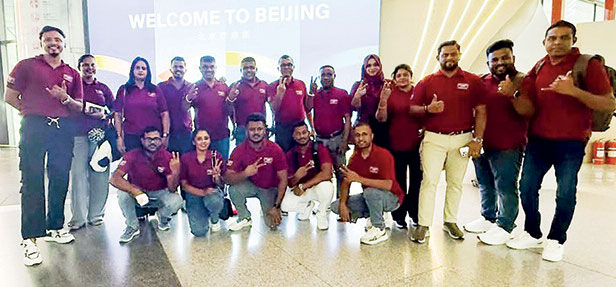
Ceylinco Life has rewarded 80 members of its sales force with overseas tours to Vietnam and China for their outstanding performance in the company’s 2025 sales competitions.
The group comprised 62 sales achievers who travelled to Vietnam and 18 who visited China.
The Vietnam tour included visits to Hanoi’s Ho Chi Minh Complex, One Pillar Pagoda, Tran Quoc Pagoda and Hoan Kiem Lake. The group also travelled to Ha Long Bay, where they went on an Aurora Cruise and explored attractions including Sung Sot Cave, Luun Cave and Titop Island.
The tour also featured a sunset party aboard the cruise, with music and refreshments.
The 18 achievers who travelled to China visited several of Beijing’s major historical and cultural attractions, including Tiananmen Square, the Forbidden City and the Summer Palace. They also took a boat ride on Kunming Lake.
A highlight of the China tour was a visit to the Mutianyu section of the Great Wall, including a round-trip cable car ride. The group also attended an acrobatic show at Chaoyang Theatre and visited the Panda Garden at Beijing Zoo.
The company said the tours were organised to recognise and reward sales personnel for their performance and achievements.

Rahmat, Malik fifties lead Afghanistan’s strong reply

Showers above 75 mm are likely at some places in the Western, Sabaragamuwa, Central, Uva and North-Western provinces and in Galle, Matara, Anuradhapura and Mannar districts.

Iranian ships stranded, Lanka fears US sanctions

Sri Lanka CERT warns of overseas university admission scams

Navi Pillay’s Lankan affairs in focus as she wins 2026 Nobel Peace Prize

Lanka welcomes Indian SC remarks on Katchatheevu dispute

‘Dates have the highest sugar content to fight Coronavirus’

Sunday Island 27 December – Headlines

#SundayIsland 17th December – Headlines

Sunday Island – 28th March

Sunday Island Headlines – 21 March

Sunday Island – 21st February – Headlines
-

 News6 days ago
Geneva takes up Sallay’s case and govt. ignores opportunity to answer accusations
-

 Features5 days ago
Preventing grievances from becoming communal
-

 Features3 days ago
The Sri Lankan who made Scottish history
-

 Sports3 days ago
Nissanka absence opens door for Sri Lanka’s young guns
-

 News4 days ago
Gnansara Thera to be assigned to prison printing section: Officials
-

 Features6 days ago
Sri Lanka Cricket Bill: Governance reform is not yet a cricket strategy
-

 News2 days ago
NDB fraud Rs 60mn more than reported
-

 Features3 days ago
Future of Sri Lanka’s state university system: Should it be shut down and reopened?