
Editorial
Quorum quandary


Monday 11th December, 2023
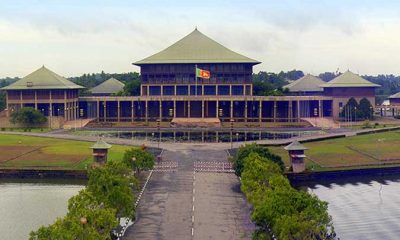
Yesterday’s parliamentary session had to be adjourned until today for want of a quorum. While the VAT (Amendment) Bill was being debated, an SJB MP brought it to the notice of the Chair that the session was inquorate. The SLPP has about 124 MPs on its side, but most of them were absent yesterday. The SJB MPs walked out in protest against what they called serious flaws in the list of commodities to be subjected to VAT.
Inquorate parliamentary sessions are not uncommon in this country. What’s the world coming to when at least 20 out of 225 MPs, whom the public is paying through the nose to maintain, are not present in Parliament when a crucial tax bill is taken up for debate?
The MPs often take the moral high ground and wax eloquent on the virtues of diligence and punctuality. They berate public officials for dereliction of duty. But they are not present in Parliament even during debates on crucial bills. What is the use of maintaining 225 MPs when Parliament can do without many of them?
However, there was something unusual about yesterday’s inquorate parliamentary session. The Opposition is known to stage walkouts and plunge Parliament into chaos when it seeks to delay the passage of bills, etc. But the government MPs make it a point to be present in the House when an important bill is presented, and it is puzzling why so many SLPP MPs were absent yesterday.
Speculation is rife in political circles that most of the government MPs kept away yesterday due to an internal dispute in the ruling coalition. It may be recalled that SLPP MP Namal Rajapaksa was absent when a vote was taken on the second reading of Budget 2024 recently. Later, he said he had absented himself because the budget had not offered any relief to the public. Interestingly, his father, Mahinda, voted for the budget, making one wonder if Namal and his father did not see eye to eye on the budget. The SLPP is also resentful that some of its district leaders have been denied ministerial posts.
The proposed VAT increase from 15% to 18% with its application being expanded to cover almost all goods and services is bound to cause a surge in the general price level, aggravating the economic woes of the public. Increases in indirect taxes adversely impact the entire population. The public will have to pay more for public transport, essential commodities and services including medical care. The VAT (Amendment) Bill has been presented to Parliament almost on the eve of an election year. It is therefore natural that the SLPP MPs are wary of openly supporting the hugely unpopular bill and incurring public opprobrium in the process.
They stand accused of having inflicted untold suffering on the public by supporting the policies and actions of the Gotabaya Rajapaksa government, which precipitated the country’s bankruptcy. If they vote for the VAT bill, they will make the people’s lot even more unbearable, and there’ll be hell to pay in such an eventuality. This is something the government MPs need like a hole in the head with only a couple of weeks to go before the dawn of an election year. They, however, will have to decide whether to support them or oppose them, soon. They cannot dilly-dally indefinitely. The passage of the VAT bill is a prerequisite for the release of the next tranche of the IMF loan.
In the run-up to the debate on the VAT bill a story began to do the rounds that Parliament was likely to be dissolved early next year. This rumour can be considered part of a campaign to tame the SLPP MPs by instilling fear of elections in them. President Ranil Wickremesinghe can now dissolve Parliament at a time of his choosing.
All eyes are on today’s parliamentary session. Chief Government Whip and Minister Prasanna Ranatunga told the House yesterday that the VAT bill would be debated and passed on Monday (11). Whether the SLPP MPs will attend Parliament today and help the government secure the passage of the bill remains to be seen.








Friday 27th February, 2026
Three teenage girls from a children’s home in Kalutara have been arrested for breaking into a canteen and making off with a stock of confectionery worth Rs. 40,000. Upon being informed of the theft, the police lost no time in recovering the sweets and making arrests. Those who conducted the ‘raid’ posed for photographs with the recovered items and released them to the media. Such is their selective efficiency.
One may recall that some years ago, the police arrested a small schoolgirl in Kalutara for stealing a few coconuts. In the same district, a little girl was taken into custody for stealing a five-rupee coin. If only the long arm of the law dealt with the politically backed perpetrators of serious crimes in a similar manner.
The three girls arrested for stealing sweets may have thought that in a country where people get away with grand thefts, their offence would go unnoticed. The incumbent government tells us that its political rivals stole colossal amounts of state funds while in power, but no legal action has been taken against most of them. Worse, the corrupt politicians in the Opposition have embarked on a crusade against corruption.
Worryingly, the incumbent government, which has undertaken to eliminate bribery and corruption and restore the rule of law, is led by a party with a history of terrorism, extortion, armed robberies and wanton destruction of state assets. A Cabinet minister has had the audacity to boast that he and his ‘comrades’ destroyed transformers, etc., in the late 1980s. He has sought to romanticise such acts of terrorism which are nonbailable transgressions under the Offences Against Public Property Act. Strangely, no action has been taken against him or his colleagues on the basis of his confession. If such crimes had been investigated properly during previous governments, some of the ruling party politicians who indulge in moral grandstanding would have been behind bars.
It has now been revealed that the procurement of eight shipments of substandard coal has caused a staggering loss of Rs. 8 billion to the state coffers. The coal supplier is said to be a company blacklisted for selling substandard rice to Sathosa. The corrupt coal tender has not been cancelled.
The present-day rulers, who came to power vowing to eliminate bribery and corruption, are now in overdrive, trying to justify losses caused by low-grade coal imports and shield the racketeers. Substandard medicines imported after the 2024 regime change have not only caused massive losses to the state but also snuffed out several lives in government hospitals. Much has been spoken in Parliament about corrupt procurement deals in Sathosa under the current dispensation. Curiously, no arrests have been made.
What was made out to be a new beginning in late 2024 has turned out to be another false dawn. The champions of good governance have been exposed for corruption and abuse of power.
The current rulers claim to be on a mission to restore the rule of law in keeping with one of their main campaign promises. That no doubt is a noble goal that must be achieved. However, mere rhetoric won’t do. They have to back up their words with deeds.
The least the government can do to convince the public that it is serious about fulfilling its pledge to restore the rule of law is to ensure that the police deal with the corrupt elements in both the Opposition and the government in the same way as they did in the case of the three girls who stole sweets in Kalutara.

Thursday 26th February, 2026
The CID yesterday arrested former Military Intelligence Chief Major General (Retd.) Suresh Sallay in connection with the ongoing investigations into the Easter Sunday terror attacks (2019). Police Spokesman ASP F. U. Wootler told a hurriedly summoned media briefing that the arrest of Sallay was based on credible evidence. If so, the burden is on the police to prove their very serious charges against the war-time military intelligence officer who played a pivotal role in eliminating LTTE terror. Otherwise, they will have to face the consequences of their actions when their current political masters lose power. It amounts to a grave violation of fundamental rights to arrest people without sufficient grounds and hold them on remand for extended periods.
Everything possible must be done to trace the masterminds behind the Easter Sunday carnage and bring them to justice. However, efforts to ensure that justice is served must be devoid of partisan politics. The unprecedented politicisation of the CID under the current dispensation has severely undermined the integrity of the investigations into the Easter Sunday terror attacks. The CID is now under two former senior police officers, namely ex-SDIG Ravi Seneviratne and ex-SSP Shani Abeysekera. While in active service, they reduced the CID to a mere appendage of the UNP-led Yahapalana government and were accused of launching politically motivated probes and arresting the political opponents of that failed regime. They themselves have been accused of failing to act on warnings to prevent the 2019 terror attacks. Both Seneviratne and Abeysekera joined the Retired Police Collective of the JVP/NPP, which, after forming a government in 2024, brought them out of retirement and appointed them as Secretary to the Public Security Ministry and CID Director, respectively. They have to advance the incumbent government’s agenda as a quid pro quo for their elevation to the current positions.
Whenever the JVP-NPP government faces trouble on the political front, the police come to its aid, making high-profile arrests. So, the Opposition’s argument that the CID has arrested Sallay to distract public attention from the mega coal scam, which has sent the government reeling, is not without merit. Most of all, with the seventh anniversary of the Easter Sunday carnage only about two months away, the government needs to show that it is on course to fulfil its pledge to bring the terror masterminds to justice.
Curiously, one main aspect of the Easter Sunday carnage continues to be ignored; it is the alleged foreign involvement therein. Dr. Wijeyadasa Rajapakshe, who was the Justice Minister in the Yahapalana government, taking part in a Sirasa TV programme in the run-up to the 2024 presidential election hinted at the possibility of some world powers having had a hand in the Easter Sunday bombings. He said that he had opposed the handing over of the strategically important Hambantota Port to China in 2017, warning the Yahapalana Cabinet that another world power would seek to take control of the Trincomalee harbour, the oil tank farm near it, and the Colombo Port, and that if Sri Lanka did not grant those demands, it would be plunged into a bloodbath and forced into submission. He said the Yahapalana administration had ignored his warning and gone ahead with the Hambantota Port deal, and three months later his prediction had come true; the US asked for the Trincomalee harbour with land around it, and India demanded that the Trinco oil tanks and the East Terminal of the Colombo Port be handed over to it. Prime Minister Ranil Wickremesinghe had sought to grant those demands and presented a bill to Parliament to amend the Land Ordinance, Dr. Rajapakshe said, adding that he had moved the Supreme Court successfully, aborting the Yahapalana government’s bid to hand over the Trincomalee harbour and land. That administration’s attempt to grant India’s demand had come a cropper due to protests, and a few months later, the Easter Sunday attacks had happened, Dr. Rajapakshe said, drawing parallels between the destabilisation of Sri Lanka and that of Bangladesh.
If one reads between the lines, it may not be difficult to figure out what Dr. Rajapakshe chose to leave unsaid. He is not alone in claiming that there was a foreign hand in the 2019 terrorist bombings. Speaking at St. Sebastian’s Church, Katuwapitiya, on 21 July 2019, Archbishop of Colombo Malcolm Cardinal Ranjith flayed President Maithripala Sirisena and Prime Minister Ranil Wickremesinghe for having failed to resist the foreign conspiracy to destabilise the country.
Among the key witnesses who expressly testified before the Presidential Commission of Inquiry (PCoI) on the Easter Sunday terror attacks that there had been ‘an external hand or conspiracy behind the attacks’, were Cardinal Ranjith, Ravi Seneviratne, Shani Abeysekera and SDIG Nilantha Jayawardena, who said an Indian named Abu Hind ‘may have triggered the attacks’. Abu Hind was a character created by a section of a provincial Indian intelligence apparatus, and the intelligence the Director SIS received on 4th, 20th and 21st April, 2019 about the terror attacks was from this operation and the intelligence operative pretending to be one Abu Hind, according to an international terrorism expert who testified before the PCoI. In an interview with BBC in 2019, Dr. Nalinda Jayatissa declared that according to ‘investigative evidence’ he was privy to, India had been behind the Easter Sunday terror attacks. Curiously, the alleged foreign involvement in the Easter Sunday terror attacks has been ignored.
A thorough probe must be conducted into the alleged foreign involvement in the 2019 terror attacks, which may have been the beginning of a sinister campaign to make Sri Lanka’s economy scream in 2022, as we have argued in a previous comment.
Wednesday 25th February, 2026
The JVP-NPP government has irreparably blackened its reputation with low-grade coal. Laboratory tests have confirmed that all eight shipments of coal supplied by a new company to the Norochcholai power plant are substandard. To make matters worse, Opposition Leader Sajith Premadasa has claimed that the ninth shipload of coal is also substandard.
There was a time when the JVP leaders vehemently condemned the Presidents and ministers of the day as kleptocrats and vowed to end the culture of impunity and uphold accountability if voted into power. They were instrumental in ousting the Mahinda Rajapaksa government, which they described as the most corrupt regime in Sri Lanka, and installing the UNP-led Yahapalana administration in 2015. A couple of weeks into office, those who came to power promising good governance committed a Treasury bond scam. Something similar has happened under the JVP-led dispensation.
A few weeks after the formation of the JVP-NPP government, as many as 323 red-flagged freight containers were green-channelled. The government is conducting a sham probe into the container scandal, and it reminds us of the bogus investigation conducted by a group of UNP lawyers into the Treasury bond scams in 2015.
The shameful manner in which the JVP/NPP leaders are trying to cover up the coal scandal reminds us of Prime Minister Ranil Wickremesinghe’s denial of Treasury bond scams in 2015. The JVP was an ally of the UNP-led Yahapalana government when the Treasury bond scams were committed, and it continued to support the UNP until the 2019 presidential election. PM Wickremesinghe sought to ridicule the Opposition, which raised the bond issue in Parliament; he audaciously claimed that the Opposition MPs did not know a Treasury bond from James Bond. The UNP was accused of having raised funds for its election campaigns through the Treasury bond scams. The current Opposition says the JVP has benefited from the coal scams and that is why the government is defending Energy Minister Kumara Jayakody to the hilt.
It has been revealed in Parliament that the JVP-NPP government arbitrarily extended the closing date for the coal tender and revised the eligibility criteria in favour of the company responsible for the substandard coal imports.
The company that won the coal tender is alleged to have a history of supplying low-quality goods to Sathosa, and its owner and local agent are reportedly under a cloud. A complaint has been lodged with the Commission to Investigate Allegations of Bribery or Corruption against Minister Jayakody over alleged misappropriation of state funds when he was in the Fertiliser Corporation. It is against this backdrop that the coal scam should be viewed.
There is no way the government can justify taking delivery of low-grade coal imports on the grounds that fines are imposed on the supplier. According to tender guidelines, all coal shipments supplied by the new company should have been rejected outright as their calorific values were below the stipulated minimum levels. The supplier will not mind being fined because it can still make profits by supplying unsaleable, low-quality coal to the CEB.
When a racket of procuring substandard and fake medicines came to light during the previous government, the JVP leaders let out a howl of protest, demanding the arrest of the then Health Minister Keheliya Rambukwella and some Health Ministry panjandrums—and rightly so. They insisted that the fraudulent procurement could not have happened unbeknownst to Rambukwella, who authorised the purchase of low-quality drugs and fake immunoglobulin. But they are now defending Energy Minister Jayakody vis-à-vis the Opposition’s demand that he be sacked and prosecuted for the procurement of substandard coal which has caused huge losses to the state coffers. The CEB has recently revealed before a Parliamentary Sectoral Oversight Committee that direct losses from eight shipments of substandard coal amount to Rs. 7,672 million.
The JVP has portrayed the Rajapaksas’ saataka as a symbol of corruption. Unless the incumbent government cancels the questionable coal tender forthwith, removes Minister Jayakody from the Cabinet, and establishes an independent probe, its opponents may say the JVP leaders’ ‘double pockets’ symbolise their double standards on corruption.

Madushani, Sumedha among athletes to reach qualifying standards

Can resourceful New Zealand lock in semi-final spot against already-qualified England?

Fair weather will prevail over most parts of the island

CEB engineers raise alarm over power sector stability

CB identifies 24 pyramid scams in Sri Lanka

Church urges patience, warns against interference with Easter attacks probe

‘Dates have the highest sugar content to fight Coronavirus’

Sunday Island 27 December – Headlines

#SundayIsland 17th December – Headlines

Sunday Island – 28th March

Sunday Island Headlines – 21 March

Sunday Island – 21st February – Headlines
-

 Features6 days ago
Why does the state threaten Its people with yet another anti-terror law?
-

 Features6 days ago
Reconciliation, Mood of the Nation and the NPP Government
-

 Features6 days ago
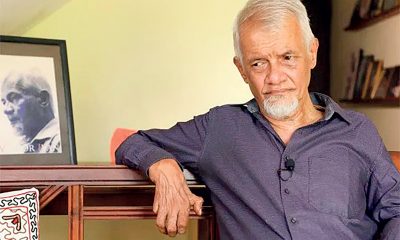
Victor Melder turns 90: Railwayman and bibliophile extraordinary
-

 Features5 days ago
LOVEABLE BUT LETHAL: When four-legged stars remind us of a silent killer
-
 Features6 days ago
Victor, the Friend of the Foreign Press
-

 Business5 days ago
Seeing is believing – the silent scale behind SriLankan’s ground operation
-

 Business5 days ago
Bathiya & Santhush make a strategic bet on Colombo
-

 Features6 days ago
Barking up the wrong tree