
Business
‘Puritas Sathdiyawara’ continues to empower its adopted villages

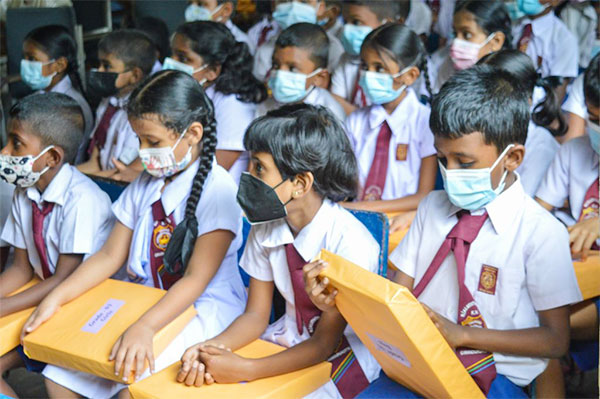
Cumulative Group contribution reaches Rs. 111Mn Improved the lives of over 43,808 people across 19 rural communities through sustainable projects Long-lasting impact through water purification, construction of fully-equipped libraries, digital classrooms and provision of essential school supplies
Iconic Sri Lankan multinational conglomerate, the Hayleys Group continued to provide vital support towards education at its adopted rural villages under the banner of its flagship social sustainability initiative, ‘Puritas Sathdiyawara Going Beyond’ for the seventh consecutive year.
The initiative was launched as ‘Puritas Sathdiyawara’ to supply clean drinking water to rural communities impacted by Chronic Kidney Disease (CKD), by establishing Reverse Osmosis (RO) water purification plants. Today, this basic life-giving initiative has extended to far-reaching sustainable community development, through investments in education, livelihood development and the establishment of fully-equipped libraries, and internet access centers under the extension of ‘Puritas Sathdiyawara Going Beyond’.
Hayleys Chairman and Chief Executive Mohan Pandithage speaking at this occasion said, “Hayleys continues to lead in Sri Lankan Corporate sphere with a flag ship business model to live by example of sustainable business practices where the social and environmental stewardship runs in parallel to its record growth in economic performance. Corporate Social Responsibility is in our DNA.”
Puritas and Haycarb Managing Director, Rajitha Kariyawasan said, “Puritas Sathdiyawara was born from an understanding of the urgent need to provide quality drinking water for communities affected by Chronic Kidney Disease (CKD) in Sri Lanka’s dry zone. The initiative was then extended to community outreach to reduce poverty, provide opportunities for quality education and work towards reducing inequalities. In that time, we are privileged to see an increase in the overall attendance, and an increased number of students being able to sit for national examinations.”
Speaking at this occasion Head of Puritas, Sharmila Ragunathan, who has sphere headed and coordinated this project with her dedicated team for all business sectors of Hayleys Group stated, “We believe that simple measures such as removing the burden of school expenses from these families are the need of the hour, and contribute towards reducing dropouts. We are fully committed to continuing this vital work to strengthen these communities, and supporting them to overcome the severe economic hardships resulting from the pandemic.
The distribution of the school essentials, launched in 2014, has today expanded to include sponsorship and collaboration from Haycarb PLC, Hayleys Advantis Limited, Hayleys PLC, Hayleys Fabric PLC, Dipped Products PLC, Hayleys Aventura, Hayleys Agriculture Holdings, Alumex PLC, Mabroc Teas and Hayleys Fibre PLC.
This year, the campaign provides essentials to over 3,500 students across 14 schools linked to Sathdiyawara communities in North Central, North and Uva provinces.2
In 2020, the ‘Puritas Sathdiyawara Going Beyond’ initiative facilitated online education for over 12 schools in partnership with DP Education, the free digital education platform dedicated to transforming teaching and learning excellence. These efforts ensured education continued uninterrupted during the lockdown period.

Business
CBSL and Australia’s S4IE programme partner to advance digital financial literacy for MSMEs


The Central Bank of Sri Lanka (CBSL) has entered into a Memorandum of Understanding (MoU) with Australia’s Skills for an Inclusive Economy (S4IE) programme to launch a pilot initiative aimed at enhancing digital financial literacy among micro, small, and medium enterprises (MSMEs). Recognised as a vital engine of Sri Lanka’s economic recovery and inclusive development, MSMEs stand to benefit from targeted interventions designed to improve access to finance, strengthen institutional coordination, and foster a more supportive enabling environment.
The pilot will test evidence-based approaches, the outcomes of which will inform future policy design and programming. CBSL intends to scale successful measures in collaboration with national and international partners.
Commenting on the partnership, Dr. P. Nandalal Weerasinghe, Governor of the Central Bank of Sri Lanka, stated: “This initiative reflects CBSL’s dedication to practical, evidence-based solutions. The pilot enables us to test and refine methodologies that can be expanded over time to deliver sustainable outcomes for MSMEs across the country.”
His Excellency Matthew Duckworth, Australian High Commissioner to Sri Lanka, emphasied the program’s long-term vision: “Australia is pleased to partner with the Central Bank of Sri Lanka on this initiative. From the outset, our focus has been on building systems and partnerships that are both sustainable and scalable, ensuring benefits extend well beyond the pilot phase.”
The initiative aligns with broader efforts to promote inclusive economic growth and strengthen institutional capacity. It reflects Australia’s ongoing partnership with Sri Lanka in support of reforms that advance economic stability, resilience, and shared prosperity.
Representing the Australian High Commission, Zoe Kidd, First Secretary (Development), and R. Sivasuthan, Senior Programme Officer, reaffirmed Australia’s commitment to close collaboration with CBSL. Their aim is to ensure the pilot yields actionable insights and sustainable outcomes, with a clear pathway toward future scaling.

Adding to the existing pressures, the Public Utilities Commission of Sri Lanka (PUCSL) has approved a revision of electricity tariffs for the second quarter of 2026, effective from today for users who consume over 180 electricity units. This increase arrives just as the Sri Lankan rupee faces renewed pressure, having recorded a 3.6% depreciation against the US dollar year-to-date. The convergence of a weaker currency and higher power costs creates renewed pressure on the cost of living.
For the average Sri Lankan household, this policy shift is not just a line item on a utility bill; it is a catalyst for a broader inflationary trend. Even before this revision, headline inflation had already shown signs of a sharp ascent, with the Colombo Consumer Price Index (CCPI) surging to 5.4% in April 2026, a stark jump from the 2.2% recorded only a month prior.
This statistical climb is most painfully visible at the local marketplace. At the Narahenpita Economic Centre, the cost of essentials has become highly volatile: beans have climbed to Rs. 700/kg, while carrots have reached Rs. 400/kg. The protein basket is equally strained, with Kelawalla fish priced at Rs. 2,980/kg. With the new electricity tariffs taking effect, the food manufacturing industry now faces fresh overheads for processing, refrigeration, and packaging. These increased costs will inevitably trickle down to the retail shelf, threatening to push these prices even higher.
While global energy markets offered a brief moment of relief with Brent crude prices dipping by over $6 per barrel last week, the domestic impact of a depreciating rupee means that the cost of imported fuel and raw materials remains high.
This invisible pressure, combined with the visible hike in electricity rates, leaves little room for families to breathe.
Despite these immediate challenges, the broader economic framework shows pockets of resilience, according to the Central Bank’s economic indicators. Industrial production in food and apparel grew steadily earlier this year, and the government recorded a notable budget surplus of Rs. 169.7 billion in the first two months of 2026.
However, as the nation moves into the second quarter, the strength of this fiscal discipline will be tested against the lived reality of its citizens. As the new rates come into effect from today, Sri Lankans are left to wait and see just how much further their kitchen budgets can be stretched.
By Sanath Nanayakkare

Janashakthi Finance PLC, a member of JXG (Janashakthi Group), has relocated its Nugegoda Branch to a more accessible and customer-friendly location at No. 136/5, S. De S. Jayasinghe Mawatha, Nugegoda, further strengthening its commitment to convenience and service excellence.
Situated in the heart of one of Colombo’s busiest urban centres, the new premises offer improved accessibility and enhanced facilities, enabling customers to engage with the Company’s services in a more comfortable and efficient environment.
The branch continues to provide a comprehensive range of financial solutions, including deposits, savings accounts, leasing, gold loans, alternative finance solutions, corporate and SME financing and other tailored financial services designed to meet both individual and business needs.
Speaking at the opening, Sithambaram Sri Ganendran, Chief Executive Officer of Janashakthi Finance PLC said, “Customer convenience and accessibility remain central to our branch strategy. Nugegoda is a vibrant and densely populated commercial hub, and this relocation allows us to enhance service delivery while providing an improved experience for our valued customers. We remain committed to supporting the financial aspirations of individuals and businesses within the community”.

CBSL and Australia’s S4IE programme partner to advance digital financial literacy for MSMEs

Lalkantha cites Lenin: “No women’s liberation while kitchen culture exists”

EU supports development of Net-Zero Roadmap for Lanka’s textile and apparel sector

Higher power costs and a weakening rupee set to strain Sri Lankan kitchen budgets

US, Lanka partner to advance American AI leadership in higher education

Ven Gomagoda Sri Rathanasara Nayaka Thero passes away at 81

‘Dates have the highest sugar content to fight Coronavirus’

Sunday Island 27 December – Headlines

#SundayIsland 17th December – Headlines

Sunday Island – 28th March

Sunday Island Headlines – 21 March

Sunday Island – 21st February – Headlines
-

 News4 days ago
MIT expert warns of catastrophic consequences of USD 2.5 mn Treasury heist
-

 News6 days ago
CJ urged to inquire into AKD’s remarks on May 25 court verdict
-

 News7 days ago
USD 3.7 bn H’tota refinery: China won’t launch project without bigger local market share
-

 Editorial4 days ago
Clean Sri Lanka and dirty politics
-

 News24 hours ago
Lanka Port City officials to meet investors in Dubai
-

 Editorial7 days ago
Deliver or perish
-
 Opinion6 days ago
Security, perception, and trust: Sri Lanka’s delicate balancing act
-

 Editorial3 days ago
The Vijay factor