
News
Public sector importers deprive Treasury of Rs 57 bn in taxes – Customs


Excise Chief won’t act on Parliament instructions
By Shamindra Ferdinando
Chief Financial Officer of Customs, Anura Muthukude, yesterday (26) disclosed that the Treasury would lose taxes amounting to approximately Rs 57 bn owed by public sector importers over the years.
Muthukude said that this was due to the public sector being allowed to clear goods without paying the applicable taxes as directed by successive governments.
This revelation was made at a press conference held at the President’s Media Division (PMD), at Janadhipathi Mawatha, to explain the status of revenue collection undertaken by the Inland Revenue, Excise and Customs.
Of the 38 importers who had been categoried in this regard, 37 were public enterprises, the official said.
The official explained that the Treasury couldn’t, under any circumstances, recover the money owed to them.
Deputy Commissioner General Tax Policy, International Affairs and Legal, Inland Revenue, B.K.S. Shantha, and Commissioner General of Excise, M.J.Gunasiri, explained efforts made by their respective institutions to meet revenue targets set by the government.
The top Customs official said that they had no option but to abide by government directives regarding the release of goods without paying the applicable taxes.
At the onset of the media briefing, the PMD declared that their intention was to clear misconceptions regarding tax collection.
Responding to The Island query regarding the Excise Department’s failure to collect Rs 7.9 bn in taxes from liquor manufacturers in spite of a specific directive issued by the Ways and Means Committee of Parliament, Excise Chief Gunasiri said that he couldn’t go ahead with such instructions unless cleared by the Secretary to the Treasury Mahinda Siriwardana.
Gunasiri declared that he had to abide by instructions issued from the Secretary to the Treasury as he was his Chief Accounting Officer.
According to a statement released by Parliament, on 11 August, the Excise Department hadn’t carried out instructions issued by the Ways and Means Committee, claiming that the Commissioner General of Excise didn’t receive Finance Ministry approval.
Having presented facts and figures related to the revenue collection since 2019, Gunasiri declared that he could comfortably meet the staggering Rs 232 bn revenue target set for 2024 by the government.
Gunasiri said that last year they collected Rs 179 bn and the target had been raised by Rs 53 bn (29.6%) this year and efforts were being made to further strengthen the revenue collection process.
Commenting on continuing controversy over the issuance of liquor licenses with the Opposition repeatedly alleging that liquor licenses were issued to influence crossovers in the run-up to the presidential election, Gunasiri explained the introduction of a new scheme to collect as much as Rs 2 bn from this exercise.
Gunasiri revealed that of that envisaged amount Rs. 1.75 bn had been collected so far.
sought an explanation from Deputy Commissioner Shantha whether the government consulted the Inland Revenue before the recent announcement regarding a sharp salary increase in January 2025. The Department’s views were sought as the government recently declared that implementation of Rs 10,000 salary increase to public servants would compel them to increase current VAT from 18% to 20%.
Shantha politely said that he was not aware of consultations taking place between the government and the Inland Revenue Department.
Chairman of the Expert Committee on Public Service Salary Disparities, Udaya R. Seneviratne, last week told the media at PMD that the basic salary of public service employees would be increased by a minimum of 24% for primary-level service categories. For all government officials, salaries would be gradually increased from an average of 24% to 50%, depending on current fiscal feasibility, Seneviratne said.
Seneviratne added that in light of prevailing inflation and economic conditions, a cost of living allowance of Rs. 25,000 would remain unchanged for three years and would be provided to all government employees for three consecutive years, starting from January 2025, with 2025 being considered the base year.
Shantha explained how the legal process in addition to the Tax Appeals Commission procedures caused quite significant delays in tax collection for obvious reasons.
The official said that anyone who felt being wronged by the Department could move even the Supreme Court. As much as Rs 878 bn had been tied up in legal processes at varying stages and posed serious challenge in meeting collecting targets.
Shantha declared that so far the Inland Revenue was on track to meet the 2024 revenue target of Rs 2024 bn. The official released data to support his declaration.
Muthukude said that they too could meet 2024 revenue target of Rs 1533 bnin spite of serious shortage of workers. “Of 3090 approved cadre, we are operating with 2150 people with a staggering 940 vacancies,” Muthukude said, adding that 30.4% vacancies existed.





Latest News
“Let us resolve, with renewed determination to overcome obstacles and build a better and more prosperous nation” -PM

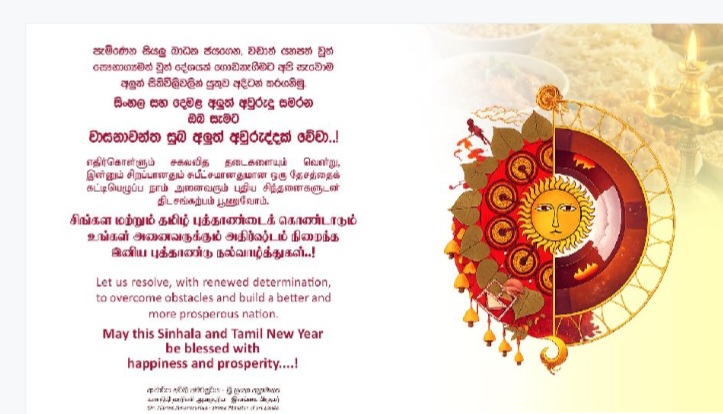
Prime Minister Dr Harini Amarasooriya in her New Year message requested every Sri Lankan to resolve, with renewed determination to overcome obstacles and build a better and more prosperous nation.
The full text of the PM’s message:
“Marking the auspicious transition of the sun from one planet to another, and the arrival of the spring season following the harvest, the Sinhala and Tamil New Year celebrated by the people of Sri Lanka since ancient times, has dawned once again.
The New Year is not merely a festive occasion; it symbolizes a renewal of prosperity, unity, coexistence, and the strengthening of mutual relationships embedded within our cultural values.
On this occasion, I extend my wishes for a peaceful and prosperous Sinhala and Tamil New Year to all Sri Lankans who celebrate this occasion with their families and loved ones, observing customs at the auspicious time.
A unique feature of Sinhala and Tamil New Year is the way an entire nation comes together through a shared set of customs. Despite the demands and challenges of daily life, this season offers a valuable opportunity to move forward with renewed hope as families, communities and a nation.
The true blessing of the New Year lies in setting aside differences and grievances, and embracing a fresh beginning in a spirit of solidarity and goodwill. Especially in the face of ongoing global challenges, the courage, compassion and resilience shown by our people in facing various natural and economic hardships in recent times stand as an example to the world. It is our responsibility to carry forward that collective strength.
At this auspicious moment, I extend my greetings to our fellow Sri Lankans working overseas, who dedicate themselves to securing a better future for their families and for the country. In particular, I extend my thoughts for the safety and well-being of those living in the Middle East during these tumultuous times.
Let us resolve, with renewed determination to overcome obstacles and build a better and more prosperous nation. As we undertake in a significant social and political transformations, we remain committed to striving tirelessly towards a better future.
May this Sinhala and Tamil New Year be blessed with happiness and prosperity!”
Latest News
Sun directly overhead Nawaladi, Paranthan, Murasumodai, Vellikkandal, Udapattukkandal, Puliyampokkanei about 12:10 noon today [14]

On the apparent northward relative motion of the sun, it is going to be directly over the latitudes of Sri Lanka from the 05th to 15th of April in this year.
The nearest areas of Sri Lanka over which the sun is overhead today (14th) are Nawaladi, Paranthan, Murasumodai, Vellikkandal, Udapattukkandal, Puliyampokkanei about 12:10 noon.
Latest News
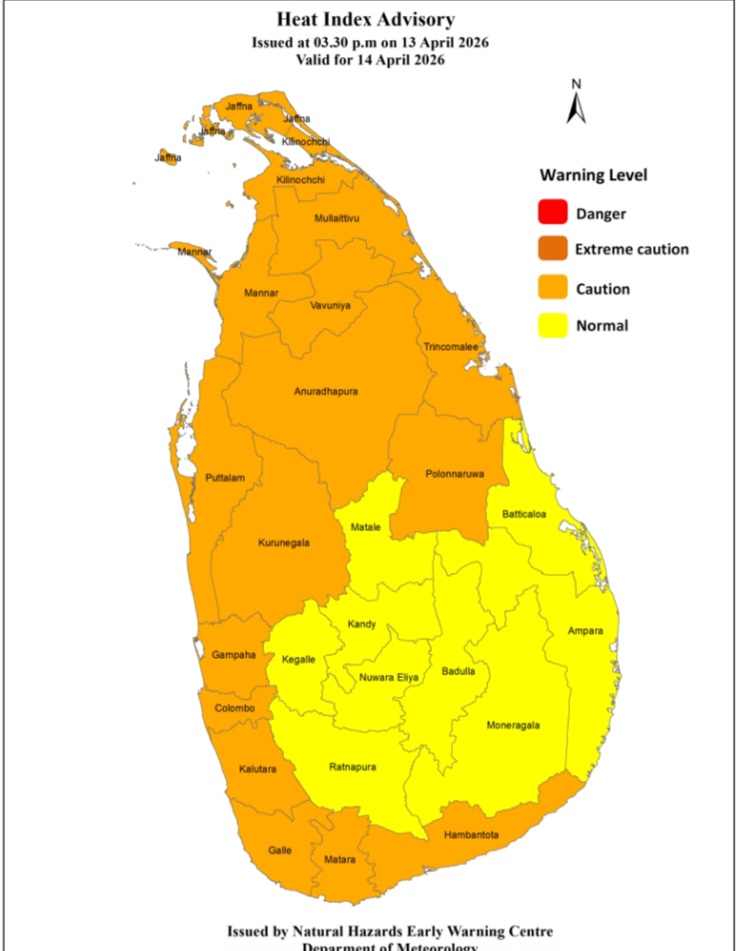
Heat Index at Caution Level in the Northern, North-central, North-western, Western and Southern provinces and in Trincomalee district.
Warm Weather Advisory
Issued by the Natural Hazards Early Warning Centre
Issued at 3.30 p.m. on 13 April 2026, valid for 14 April 2026.
The Heat index, the temperature felt on human body is likely to increase up to ‘Caution level’ at some places in the Northern, North-central, North-western, Western and Southern provinces and in Trincomalee district.
The Heat Index Forecast is calculated by using relative humidity and maximum temperature and this is the condition that is felt on your body. This is not the forecast of maximum temperature. It is generated by the Department of Meteorology for the next day period and prepared by using global numerical weather prediction model data.

Effect of the heat index on human body is mentioned in the above table and it is prepared on the advice of the Ministry of Health and Indigenous Medical Services.
ACTION REQUIRED
Job sites: Stay hydrated and takes breaks in the shade as often as possible.
Indoors: Check up on the elderly and the sick.
Vehicles: Never leave children unattended.
Outdoors: Limit strenuous outdoor activities, find shade and stay hydrated.
Dress: Wear lightweight and white or light-colored clothing.
Note:
In addition, please refer to advisories issued by the Disaster Preparedness & Response Division, Ministry of Health in this regard as well. For further clarifications please contact 011-7446491.

“Let us resolve, with renewed determination to overcome obstacles and build a better and more prosperous nation” -PM

Sun directly overhead Nawaladi, Paranthan, Murasumodai, Vellikkandal, Udapattukkandal, Puliyampokkanei about 12:10 noon today [14]

Heat Index at Caution Level in the Northern, North-central, North-western, Western and Southern provinces and in Trincomalee district.

Showers or thundershowers will occur at most places of the island after 1.00 pm

Salt and Patidar power RCB past Mumbai Indians

Prasidh, Buttler set up comfortable win for Gujarat Titans

‘Dates have the highest sugar content to fight Coronavirus’

Sunday Island 27 December – Headlines

#SundayIsland 17th December – Headlines

Sunday Island – 28th March

Sunday Island Headlines – 21 March

Sunday Island – 21st February – Headlines
-

 News2 days ago
CEB orders temporary shutdown of large rooftop solar systems
-

 News5 days ago
AG: Coal procurement full of irregularities
-

 Business4 days ago
Israeli attack on Lebanon triggers local stock market volatility
-

 Business5 days ago
Hayleys Mobility introduces Premium OMODA C9 PHEV
-

 Business4 days ago
HNB Assurance marks 25 years with strategic transformation to ‘HNB Life’
-

 Features2 days ago
From Royal College Platoon to National Cadet Corps: 145 years of discipline, leadership, and modern challenges
-

 Sports5 days ago
DS to face St. Anthony’s in ‘Bridges of Brotherhood’ cricket encounter
-
 News6 days ago
AKD admits import of substandard coal, blames technicalities and supplier