
News
Prez vows to clean up public sector

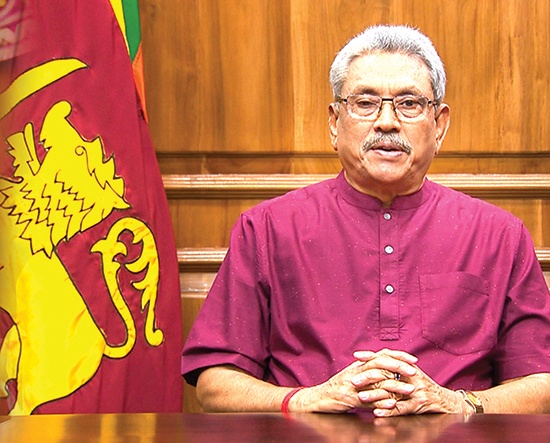
‘Wrongdoers will be punished irrespective of their social status’
President Gotabaya Rajapaksa yesterday (18) pledged to eliminate waste and corruption in the state administration. Measures should be taken to completely eliminate waste and corruption in all the ministries and government institutions and the wrongdoers engaged in such malpractices must be brought before the law irrespective of their social status, the President assured in his address to the nation telecast last night
The following is the text of the speech delivered to mark completion of his first year in Office: “A year ago, more than 6.9 million voters in this country elected me as your new President.
It is no secret that the majority who voted for me then were Sinhalese. They rallied because they had legitimate fears that the Sinhala race, our religion, national resources and the heritage would be threatened with destruction in the face of various local and foreign forces and ideologies that support separatism, extremism and terrorism.
The main appeal made by the people to me was to, “Protect the Country”.
During this short period of time we have taken steps to ensure the security of the country as requested by the people. The public should not have apprehensions on this issue any longer.
An administration that protects the rights of all citizens regardless of racial or religious differences will be established during my tenure. I have always acted in accordance with the pledge I made in front of Ruwalweli Maha Seya to protect the unity of the country and to safeguard and nurture the Buddha Sasana as per the Constitution, the supreme law of this country.
I meet with an advisory council comprising leading Buddhist monks of Three Chapters every month to seek their advice on matters pertaining to governance.
Prior to my assumption of office, many lives have been lost in this country to the activities of religious extremists. The underworld had become powerful and a wave of killings had begun throughout the country. Sri Lanka had become a haven for international drug traffickers. The country was becoming insecure due to the weakening of the intelligence and security forces. Historic sacred sites of archeological value were being encroached by extremists.
After I came into power, I appointed suitable officials in charge of security apparatus of the country and gave them the required authority to carry out their responsibilities without any compromise. The intelligence services that had collapsed in the past were restructured and revitalized.
Accordingly, we have managed to control the possibility of a resurgence of extremism in any form. A very effective and robust programme has been implemented to control the drug menace. There is no room anymore to engage in drug trafficking or operate the underworld from inside of prison cells as in the past. People of this country no longer have reasons to live in fear of underworld gangs, extortionists and racketeers.
We will strive to further strengthen this initiative in the future.
I have now set up a special Task Force to protect sites of archeological value and to preserve our Buddhist and national heritage.
All what we have done so far in line with “Saubhagyaye Dekma” (Vistas of Prosperity and Splendour) Policy Statement formulated by the people for the people, which was endorsed by the majority of this country in both Presidential and Parliamentary Elections.
The era of betraying war heroes, selling national assets, willingness to accept any deal for short-term gains, allowing foreign forces to interfere in the internal affairs of the country have now come to an end. We have once again shown the world our position as a proud, sovereign country, ready to maintain friendly relations will all the nations, non-aligned, non-partisan in conflicts between powerful nations. This is the reason today why we receive due respect from regional powers as well as global powers.
In a very short period of time we have been able to bring about many attitudinal changes in the traditional political culture of this country. We initiated this trend with the Presidential Election itself. At that time we introduced to the country an exemplary election campaign based on principles and free from plastic, polythene and posters, free from insults and slander. The subsequent Parliamentary Election too can be termed as one of the most exemplary election campaigns in recent history. Most candidates abstained from displaying posters, banners and cutouts. Violation of election laws were kept to a minimum. Violence, harassments and election fraud were not even heard of. With this transformation, the people have deprived many former politicians of their Parliamentary seats irrespective of their status. As a result, the newly elected Members of Parliament have the opportunity to regain the respect of the people who once said no to all 225 members.
Even after assumption of office, I acted on the principle that the Presidency is not a privilege but a responsibility. Accordingly, I have taken steps to completely eliminate unnecessary expenses, waste and vain glorifications.
During the time gone by, we have not influenced the judiciary or the police in any manner. Appointments and promotions were all made on merit without any political bias. We totally rejected the practice of abusing the law to suppress political opponents. We showed by example, not by word, how we truly uphold the rule of law.
We appointed a committee comprising professionals to select right candidates for senior government positions. No other government has followed such a policy before. Furthermore it blocked the opportunity of unsuitable persons being appointed as heads of state entities due to political patronage.
When I assumed duties as the President, the economic growth rate of the country which experienced an immense decline during the last five years had plummeted as low as 2.1%.
The unemployment rate which had fallen to 4.3% in 2014 had risen again to 4.8% by 2019.
The sharp fall in the value of Rupee against the USD had destabilized the currency and left the economy in a state of great uncertainty.
The tourism industry was on the verge of collapse. Annual income from foreign employment was declining.
The country’s debt portfolio had skyrocketed. Then government had imposed a heavy tax burden on the people. Due to high interest rates, local entrepreneurs faced great difficulties.
We quickly took a number of steps to control this situation.
The burden of tax was reduced and relief was given to the people. The direct tax, especially on wages, was reduced and the withholding tax on interest was removed.
Measures were taken to provide a number of tax concessions aiming local entrepreneurs. Tax systems were simplified and the competitive imports unhealthy for local products were restricted.
Loans were provided to people and businesses in need through massive reduction of interest rates.
We managed to maintain the foreign exchanges rate, which had been falling steadily for several years, stable.
We were able to control the rapidly increasing foreign borrowings. We also paid off all foreign debt installments that were due to be paid without damaging the image of our country internationally.
We took action to settle large sums of arrears that had not been paid to local suppliers by the previous government. Rs. 24 billion for fertilizer, Rs. 32 billion for medicines, Rs. 119 billion for construction, Rs. 20 billion for elders’ allowance and Rs. 47 billion for those who provided services to various ministries were paid. The release of money in this way to the society helped to reactivate the economic process of the country that remains paralyzed.
As per the Saubhagyaye Dekma Policy Statement, we have done a great deal in a short period of time to revive the agricultural sector in which the majority of the rural population of our country are involved.
The guaranteed purchase price of paddy was increased from Rs. 32 to Rs. 50.
The fertilizer subsidy was made free.
Re-export of crops such as pepper was halted to protect the local agricultural producers and the importation of some agro products was stopped completely.
Import duties were managed so as to encourage the production of paddy, maize, cereals, potatoes and onions.
Importation of Ethanol was completely banned.
We were able to create a new impetus in the field of agriculture by re-cultivating abandoned paddy lands all over the country, attracting youth to cultivation and encouraging people for home gardening.
No matter how harsh the difficulties were, we did not let our exports to collapse. At present our total export earnings are at a higher level than in previous years.
Finding a sustainable solution to the issue of poverty among our rural masses is a priority in our economic policy. Accordingly, we have identified several areas that need immediate attention.
The programme to provide 100,000 jobs targeting poorest of the poor in our country was launched. Through each of these employment opportunities, a foundation was laid for a better future for extremely poor families. So far, 35,000 jobs have been given to the most suitable candidates. The rest will be given jobs soon.
If a large number of graduates who received their education at the expense of the public money are unemployed for a long time, it is certainly a fault in the education system. While rectifying this error in the future through university education reforms, we have provided employment to 60,000 graduates and provided them with the required training to serve the country productively.
Provision of 20,000 acres of freehold land to each of the landless families as yet another step to eradicate poverty among the rural population is currently underway.
Under our initiative to provide drinking water to every family, the required groundwork to supply water to 429,000 families islandwide has been completed.
Three 10,000 km road development projects have commenced under the 100,000Km Roads Development Programme.
Work on around 5,000 bridges is nearing completion under the scheme for construction of 10,000 Bridges.
During this year alone, construction of more than 20,000 houses for urban low-income families and middle-income families has begun.
14,000 rural houses are being constructed under the ‘One House for One Village Programme’.
The programme to build 4,000 houses for plantation workers too has commenced.
1,000 schools across the country are being upgraded to the national level.
The number of students enrolled to universities has already increased by 10,000. No other year has seen such an increase in the number of students receiving admission to universities in a year since Independence. Plans are underway to increase the capacity of universities each year in the same manner.
We did all this not under normal circumstances but in the midst of many formidable challenges.
Since the day I assumed duties as the President until the dissolution of Parliament, I had to work with a minority government. As the Opposition had the majority in Parliament it was not possible to pass any Bill or a Budget proposal.
The COVID pandemic began to spread across the globe less than a month after the Presidential Election. When Wuhan in China was closed down in January 2020, a quick decision was taken to bring back 33 Sri Lankan students, quarantine them properly and send them to their homes, setting an example to the rest of the world.
By the time the first COVID patient was reported in Sri Lanka, we had established a Task Force to control a possible COVID wave that could occur in the future. This enabled us to control the first wave of Corona very quickly. Sri Lanka’s success in controlling Corona was recognized even by the World Health Organization.
Nevertheless, we should never forget the fact that we had to lock down the country for nearly two months to protect our citizens from the Corona virus.
During this period the government took measures to minimize the economic impact on the lives of the people. Mechanisms were devised to make essential food available to the people. An allowance of Rs. 5,000 each was given to 5.9 million families twice. Tax relief was provided to reduce the prices of essential food items during the difficult period.
The government has so far spent over Rs. 70,000 million on identifying Corona infected, quarantine close associates, PCR testing and welfare activities.
I was elected in November last year. The Parliamentary Election was held nine months later in August this year. People gave us a two third majority in the Parliamentary Election because they approved the way we functioned during this period.
The best yardstick of the success or failure of mine is the public opinion and not the organized propaganda spread by political opponents on social media platforms.
Currently, the world is experiencing a second wave of Corona. It has been identified that a new strain of rapidly transmitting COVID virus is the cause for this surge. Although it poses a new challenge for every country in the world, we can take the advantage of the experiences of the past. These experiences will particularly be helpful in increasing testing capacity, identifying the infected as well as their close associates, adopting proper quarantine methods and segregating vulnerable areas and maintaining normal life in other areas.
Similar to last time, we act according to a plan. While successfully containing the spread of the disease, our healthcare sector has been able to maintain a mortality rate of less that 0.05% of those diagnosed with the disease and referred for treatment.
If all of us adhere to health guidelines and fulfill our respective duties as responsible citizens we can control this new situation in the future in the same manner we handle the first wave of coronavirus.
I have taken steps to appoint Ministers and State Ministers clearly identifying many fields that can directly contribute for the development of the country. The scopes and responsibilities of each Ministry and State Ministry have been demarcated very clearly. The State Ministers are able to fulfill their respective duties and responsibilities without any hindrance as the monetary provisions required to implement development projects and financial responsibility are directly placed with them.
When assigning subjects to Ministries, special attention was paid to several sectors related to agriculture, plantation, fisheries industry, traditional industries and promoting self-employment opportunities as these sectors affect the majority of the people in the country.
In the National Policy Framework, ‘Suabhagyaye Dekma’, we promised the people to realize the objectives described under the concept, ‘A Productive Citizen and a Happy Family’. As special attention should be focused on housing issues faced by the people belonging to different layers of the society, three separate Ministries were established.
Furthermore, special attention was paid to develop urban as well as rural infrastructure facilities with the aim of enhancing the living standard of the people.
The Government plans to produce many high-quality medicines to meet the country’s requirement of pharmaceuticals locally, instead of importing these medicines spending a huge amount of foreign exchange. We will take steps to eliminate various corrupt practices occurring in the medicine importation process. A separate State Ministry of Pharmaceutical Production, Supply and Regulation was established with this objective.
As mentioned in the National Policy Framework “Saubhagyaye Dekma”’ the development of education and skills is vital in building a productive citizen. For this purpose, we have taken all the state institutions relating to the education and skills development under the purview of a single ministry.
We have established a separate State Ministry and two Task Forces to implement the educational reforms to meet the demands of the modern world.
As I have pledged, steps have been taken to upgrade the Gampaha Wickramarachchi Ayurveda Institute to the level of a fully-fledged university with the aim of developing the indigenous medicine in the country.
There are plans afoot to build CITY UNIVERSITIES centering the cities in ten selected districts which do not have higher education institutes.
By now, plans have been completed to take all the Nurses Teaching Schools under the purview of one university with the aim of providing the opportunity for the nurses to upgrade their qualifications to a Bachelor’s Degree level instead of Nursing Diploma. With the Implementation of this initiative, doors will be open for them to enter foreign job market.
Furthermore, plans are underway to provide higher educational opportunities for our talented sports men and women as well as to pave the way to create a sports economy and to establish a National Sports University with the aim of opening its branches in several areas of the country.
For the first time in history we will take steps to make it mandatory for the university students to learn the subjects of English language and Information Technology and they will also be presented with internationally recognized certificates once they successfully complete these subjects.
As I have pledged, the government has taken steps to develop the Open University system and the expand access to distance education in order to facilitate all the students who passed the G.C.E. (A/L) Examination to receive university level education in addition to the increase of the universities’ intake capacity. We have planned to enroll 10,000 new students in the next year for the Bachelor of Technology degree programme in Open Universities and from their first year itself to provide them education while they are employed.
We have given the relevant instructions to the University authorities to ensure that the subjects the students learn at the universities could directly contribute for social and economic development. Special attention has been given to encourage technological education and innovations.
If you want to truly serve the people it is necessary to continuously listen to them. Because of that I go to the grass roots to address people’s grievances. In the recent months, I have travelled in the rural areas of Sri Lanka to see the difficulties suffered by fellow citizens and get firsthand experience. As a result of this I had the opportunity to take necessary decisions and actions with a correct understanding of the issues common to every district as well as issues unique to a particular area. I have always advised the Ministers, State Ministers and MPs to go among the people to give swift solutions to their grievances at the village level while understanding their genuine problems.
An efficient government service is a requisite vital for the forward march of the country. I request all the public servants to take steps to swiftly provide solutions for the reasonable issues of the public instead of hiding behind rules and regulations. Occasionally I visit public departments and institutions to observe whether these institutions are functioning in an appropriate manner. I hope to continue this initiative in the future as well. Ministers, State Ministers as well as high ranking officials of the government should always scrutinize the functions of their respective institutions.
We have pledged the people to eliminate waste and corruption in the state administration. Measures should be taken to completely eliminate the waste and corruption in all the ministries and government institutions and the wrongdoers engaged in such malpractices must be brought before the law irrespective of their social status.
The success of a democratic state is determined by the Constitution of that country. Even though we were able to eliminate the problematic situation created by the 19th Amendment to the Constitution by passing the 20th Amendment to the Constitution, a few controversial aspects still remained. We have already appointed a Committee to seek public opinion to draft a new Constitution.
The success of a democratic state is determined by the Constitution of that country. Even though we were able to eliminate the problematic situation created by the 19th Amendment to the Constitution by passing the 20th Amendment to the Constitution, a few controversial aspects still remain. We have already appointed a Committee to seek public opinion to draft a new Constitution.
The People of this country have given me and our government a huge mandate to make our country prosperous while changing the traditional political culture. We are, at all times committed to fulfill those aspirations.
My hope is to establish a government which gives priority for talent or skill over relationships, give more attention for the common needs than individual desires, motivate investments instead of obtaining loans, honour actions than words and value the true public service than deceitfully exhibitionism. The political authority as well as the public servants should take responsibilities in this regard.
Not only Sri Lanka but also the whole world has reached an important milestone in history. There are many challenges ahead of us. All Sri Lankans who love their Motherland must work together to take the country forward in a systematic manner while acting according to a definite policy frame to overcome these challenges.
We were able to defeat the LTTE terrorism, which was a major threat for our country, as a result of a collective effort. At that time the majority of our country committed to achieve one goal. We faced the challenges with team spirit and in disciplinary manner. We should be able to conquer the economic challenges that the country is facing in the future in the same manner we won the war when most were of the opinion that we would not be able to win it. We should understand that all of us have a common responsibility in this regard. In this context, not only the politicians and officials but also the public have the responsibility to actively contribute in increasing the production capacity of the country, to improve service efficiency and eliminate corruption.
I am a person who has constantly faced challenges and overcame them. I am not a person scared of empty threats. I don’t have the habit of simply running away from problems. Instead, I resolve those issues.
I do not want to please anyone only for the purpose of securing votes. As I have pledged, my determination is to build a prosperous nation. I will not hesitate to take whatever action is necessary according to my conscience to achieve this target.
I love my country. I am proud of my country. I have a vision for my country. This is the Motherland of all of us. Hence, the time has come for all of us to join hands as productive citizens with the team spirit and fulfilling responsibilities in a disciplined manner in building the prosperous nation we promised to our people.
May the Noble Triple Gem bless you all!





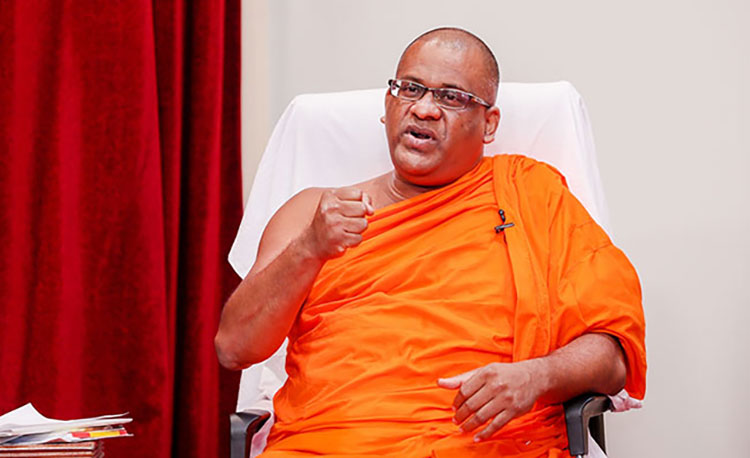
The Mahanayaka Theras of all Nikayas have protested against Bodu Bala Sena (BBS) General Secretary Ven. Galagodaaththe Gnanasara Thera, who is serving a prison sentence for contempt of court, being produced before court in civilian attire.
In a letter to the Commissioner General of Prisons, the Mahanayaka Theras have said they were surprised and concerned by the decision to remove the monk’s robes.
The letter has been signed by Most Ven. Thibbotuwawe Sri Siddhartha Sumangala Thera of the Malwatu Chapter, Most Ven. Warakagoda Sri Gnanarathana Thera of the Asgiri Chapter, Most Ven. Karagoda-Uyangoda Maithri Murthi Thera of the Amarapura Maha Nikaya and Most Ven. Makulawe Sri Wimala Thera of the Ramanna Maha Nikaya.
The Mahanayaka Theras have said they respect the Constitution and the judicial process, but maintained that removing a monk’s robes or ending his status as a member of the Buddhist Order is a matter that should be decided by the Maha Sangha.
They have said the relevant Sangha Council has not determined that Ven. Gnanasara Thera committed a Parajika offence or any other offence warranting his removal from the Buddhist Order.
The Mahanayaka Theras have also referred to Regulation 550 of the Prison Standing Orders, which they say stipulates that convicted prisoners should not be taken to court in prison uniform and should be allowed to wear the type of clothing they normally wore before their conviction. In the case of a Buddhist monk, they have said, this means his monastic robes.
They also referred to the United Nations Standard Minimum Rules for the Treatment of Prisoners, which provide for prisoners taken outside prison to be allowed to wear their own clothing or other unobtrusive clothing.
The Mahanayaka Theras have requested the Commissioner General of Prisons to allow Ven. Gnanasara Thera to wear his robes when appearing in court and to maintain his status as a monk while he remains in prison.
Prisons authorities have said that the clothing decision was made under prison regulations, and the Prisons Department has stated that prisoners serving sentences of more than three years are required to wear prison-issued clothing when produced before court.
The Committee on Public Finance has said that the actual losses suffered by the NDB bank are much more than what was initially reported. When compared with the initial disclosure made by NDB on 6 April 2026, the reported amount of the fraud had increased by Rs. 0.4 billion, from Rs. 13.2 billion to Rs. 13.6 billion, the committee said.
When compared with the amount disclosed by NDB on 26 June 2026, based on the interim report dated 22 June 2026, the additional amount of fraud is Rs. 60 million.
The has committee issued the following statement: The Committee on Public Finance recently summoned officials of the Central Bank of Sri Lanka to Parliament to inquire into the financial irregularities identified at NDB Bank and the final audit report relating to the matter.
The Committee meeting, chaired by Member of Parliament Dr. Harsha de Silva, discussed irregularities identified in NDB Bank’s financial statements, shortcomings in the audit process, and the relevant audit reports.
The meeting was attended by Deputy Ministers Chathuranga Abeysinghe, Dr. Kaushalya Ariyaratne, and Nishantha Jayaweera, as well as Members of Parliament Attorney-at-Law Rauff Hakeem, Ravi Karunanayake, Ajith Agalakada, Nimal Palihena, Wijesiri Basnayake, M.K.M. Aslam, Champika Hettiarachchi, and Attorney-at-Law Lakmali Hemachandra.
The Committee also focused on the findings of the investigation conducted by the Sri Lanka Accounting and Auditing Standards Monitoring Board (SLAAMB), as well as the findings revealed through the investigation conducted by Deloitte Touche Tohmatsu India LLP. In particular, the Committee inquired into the failure of the external auditors to identify irregularities in NDB Bank’s financial statements.
The accountability of senior management with regard to corporate governance and risk management in relation to the financial irregularities was also discussed.
As a significant proportion of NDB Bank’s shares are held by institutions representing public and state funds, the Committee also considered the potential impact of such financial irregularities on public funds and the general public.
The Committee also discussed the progress made by LankaPay in establishing a centralized fraud monitoring system to prevent fraud within the financial system. The need to strengthen fraud monitoring systems at the individual bank level to monitor transactions carried out within each bank was also emphasized.
Accordingly, the following observations are included in the final audit report concerning the financial irregularities at NDB Bank:
1. The audit covers the period from 1 April 2016 to 31 March 2026. The audit report specifically identifies the financial impact arising from fraudulent transactions amounting to Rs. 13,639,664,684 (Rs. 13.6 billion).
2. According to the disclosure made on 29 September 2026, the financial impact arising from the fraudulent transactions is as follows:
· Rs. 1.5 billion for the period prior to 1 January 2025;
· Rs. 9.6 billion during 2025; and
· Rs. 2.5 billion for the quarter ended 31 March 2026.
3. Compared with the initial disclosure made by NDB on 6 April 2026, the reported amount of the fraud has increased by Rs. 0.4 billion, from Rs. 13.2 billion to Rs. 13.6 billion. Compared with the amount disclosed by NDB on 26 June 2026, based on the interim report dated 22 June 2026, the additional amount of fraud is Rs. 60 million.
4. The final audit report has also confirmed the previous disclosures that no customer accounts were affected as a result of the fraud incident.
5. The report has identified several governance failures at NDB relating to the processing of CEFT transactions, user-level activities within the Core Banking System, and the management of user credentials and access information. In addition, shortcomings have been identified in several operational areas, including transaction monitoring, daily account reconciliation, financial compliance, internal audit, branch network management, and operational risk management.
The audit report has made comprehensive recommendations to strengthen the control mechanisms, governance structures, and processes relating to the above-mentioned activities of the bank.
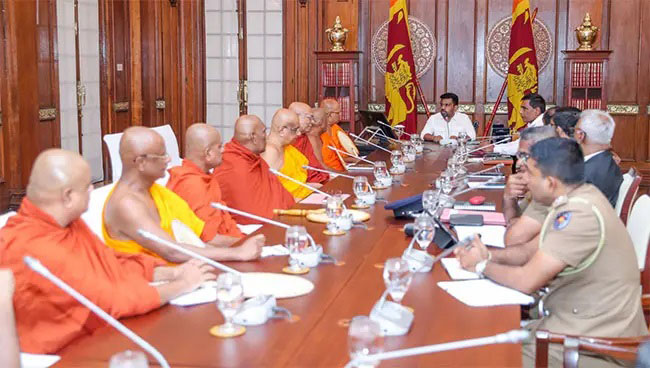
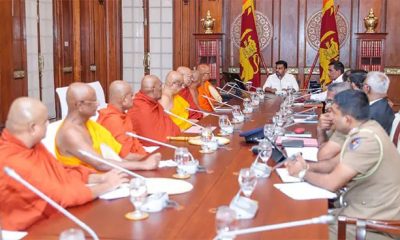
President Anura Kumara Dissanayake has ordered the formation of a committee to review the laws and regulations on how Buddhist monks serving prison sentences are treated, including the procedures that apply when they are taken out of prison.
He revealed this at a special meeting with Maha Sangha representatives held yesterday (8) at the Presidential Secretariat. The meeting was called after concerns were raised over how Ven. Galagoda Aththe Gnanasara Thera was treated when he was taken from prison to court.
The committee will recommend amendments to existing laws and, where needed, new prison standing orders and regulations. Its members will be drawn from the Attorney General’s Department, the Ministries of Justice, Public Administration, and Buddha Sasana, Religious and Cultural Affairs, and the Department of Prisons, including the Commissioner General of Prisons. It has been given two weeks to review the current legal provisions and submit its recommendations. The President added that any changes specific to Buddhist monks would be made in consultation with the Maha Sangha.
Outlining the legal background, the President said prison administration was governed by the Prisons Ordinance of 1877, along with the regulations and standing orders issued under it. That framework mostly addressed prisoners in general, he said, and had few provisions dealing specifically with Buddhist monks.
The meeting was attended by senior Maha Sangha members representing the Siyam, Amarapura and Ramanna Nikayas, along with Minister of Buddhasasana, Religious and Cultural Affairs Hiniduma Sunil Senevi and Minister of Justice Harshana Nanayakkara.

Showers or thundershowers will occur in most part of the island after 1.00 p.m.

Removing monk’s robes matter for Sangha to decide: Mahanayake Theras

NDB fraud Rs 60mn more than reported

President orders review of laws on treatment of imprisoned monks

BHC, Colombo: “LTTE remains a proscribed org. in the UK”

Sri Lanka runs out of essential anti-TB medicines, India comes to rescue

‘Dates have the highest sugar content to fight Coronavirus’

Sunday Island 27 December – Headlines

#SundayIsland 17th December – Headlines

Sunday Island – 28th March

Sunday Island Headlines – 21 March

Sunday Island – 21st February – Headlines
-

 Features5 days ago
The first woman in the foreign service or Ceylon Overseas Service it was then called
-

 Editorial6 days ago
Fuelling discontent and protest
-

 News4 days ago
Geneva takes up Sallay’s case and govt. ignores opportunity to answer accusations
-

 Foreign News6 days ago
Ten injured after car crashes into rugby supporters in Australia
-

 Latest News6 days ago
Tharindu Rathnayake, bowlers secure Asian Games Bronze for Sri Lanka
-

 News5 days ago
Nearly 20 Iranian tankers stranded off Lanka amid US sanctions
-

 Features4 days ago
Sri Lanka Cricket Bill: Governance reform is not yet a cricket strategy
-
 News5 days ago
Lanka enters new phase of prosecutions as hurdles clear