
News
Prez to consolidate power

* Constitutional Council to be abolished
* No provision for civil society members
* Dual citizens can enter parliament
* A person aged 30 can run for President
* Restriction on number of Cabinet ministers, deputies removed
* Parliament can be dissolved within one year
* Romesh de Silva heads team tasked with preparing draft new Constitution
By Shamindra Ferdinando
The Constitutional Council (CC) introduced in terms of the 19th Amendment in 2015 is to be abolished by the 20th Amendment (20A) gazetted yesterday (3).
In place of the 10- member CC, the 20A has proposed a Parliamentary Council comprising the Prime Minister, the Speaker, the Opposition Leader and nominees (one each) of the Prime Minister and the Opposition Leader.
The 20th Amendment stipulates that the nominees of the Premier and the Opposition Leader belong to the communities other than the communities represented by the Prime Minister, the Speaker and the Opposition Leader.
In terms of the 19th Amendment, the CC headed by the Speaker, included three civil society representatives as well as a representative of the President. The 20A has done away with both civil society representatives and the presidential nominee.
Cabinet spokesman Mass Media Minister Keheliya Rambukwella and co-cabinet spokespersons, Ministers, Dr. Ramesh Pathirana and Udaya Gammanpila refrained from commenting on the provisions of the 20A in spite of the media repeatedly seeking their comments.
The Attorney General on Sept 2, ruled that the 20A could be enacted by a two-thirds vote sans a referendum. SLPP National List member Justice Minister Ali Sabry, PC, worked out the 20th Amendment.
In line with 20A, the President will have the authority to make appointments to the Election Commission, the Public Service Commission, the National Police Commission, the Human Rights Commission of Sri Lanka, the Commission to Investigate Allegations of Bribery or Corruption, the Finance Commission and the Delimitation Commission (all in Schedule I) having obtained observations of the Parliamentary Council.
The President will seek the observations of the Parliamentary Council in appointing the Chief Justice and judges of the Supreme Court, the President and the judges of the Court of Appeal and the members of the Judicial Service Commission other than the Chairman (all under Schedule II/Part I) and the Attorney General, the Auditor General, the Parliamentary Commissioner for Administration (Ombudsman) and the Secretary General (Schedule II/Part II).
In terms of the 20th Amendment, the immunity of the President, both in official and private capacity has been restored.
The SLPP, both at the presidential and parliamentary elections held in Nov 2019, and Aug 2020, respectively, campaigned for a two-thirds majority to do away with the 19th Amendment. The SLFP obtained 145 seats and with the support of its allies can muster the required two thirds.
There is provision in the 20th Amendment for the President to remove the nominees of the Prime Minister and the Opposition Leader in the Parliamentary Council.
The Parliamentary Council has to submit its observations as regards the President’s nominees to the above mentioned offices within one week. In case, the Parliamentary Council fails to respond within a week after the President sought its observations, there is provision for the President to go ahead with the appointments.
There is provision for leaders of recognised political parties to propose suitable persons to the Commissions categorized under Scheduled I for the President’s consideration.
The 20th Amendment also seeks to do away with the restriction on the number of ministers to 30 and non-cabinet ministers to 40 introduced by the 19th Amendment. The President will be head of the cabinet.
The 20th A seeks to provide space for the President, in consultation with the President, if necessary, to determine the number of ministers and also appoint ministers who are not members of the cabinet of ministers. There is also provision for the appointment of Deputy Ministers, from time to time, in consultation with the Prime Minister, if necessary, to assist members of the cabinet.
In terms of the 20th Amendment, the President can remove Prime Minister, a member of the cabinet, any other minister or a Deputy Minister.
The President has retained the constitutional authority to dissolve parliament after completion of sittings for a period of one year. The 19th Amendment, deprived the President the power to dissolve parliament until the House completed four and half years of five-year term.
The 20th Amendment has retained the five-year term for the President and two term restriction.
The 20th Amendment provides for the introduction of emergency Bills.
The age of presidential contestants has been reduced to 30 from 35. The 20th Amendment also paved the way for dual citizens to contest parliamentary election.
Addressing the media at the Information Department, cabinet spokesperson said that a nine member expert committee headed by Romesh De Silva, PC had been asked to prepare a new draft Constitution. The media was told that the 20th Amendment was temporary measure until consensus could be reached on a brand new Constitution. The team comprises Gamini Marapana, PC, Manohara de Silva, PC, Sanjiva Jayawardena, PC, Samantha Ratwatte, PC, Professor Nasima Kamurdeen, Dr. A Sarweswaran, Professor Wasantha Seneviratne and Professor G. H. Peiris.




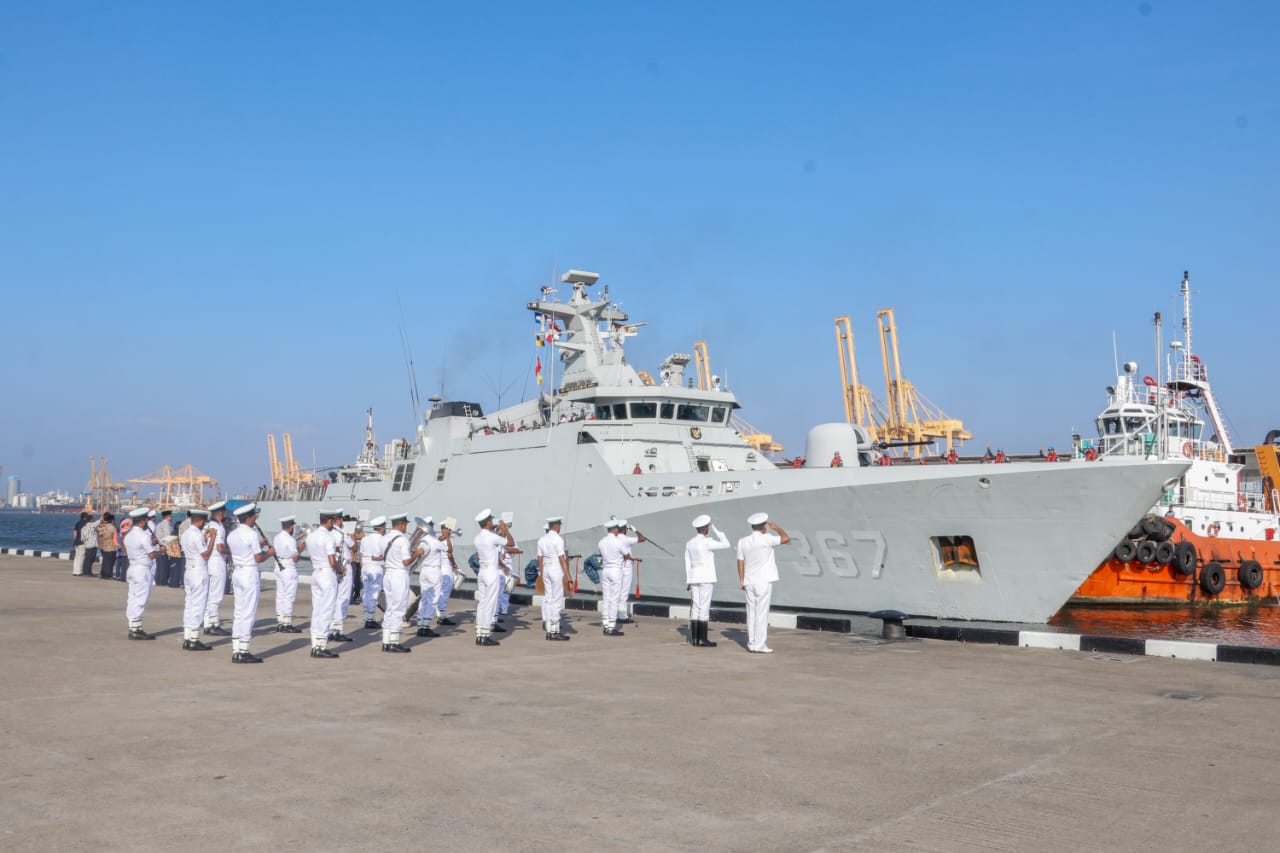
The Royal Navy of Oman Ship ‘AL SEEB’ concluded a logistics replenishment visit to Sri Lanka and departed the Port of Colombo on 24 Jan 26.
In accordance with naval tradition, the Sri Lanka Navy extended a customary farewell to the departing ship.
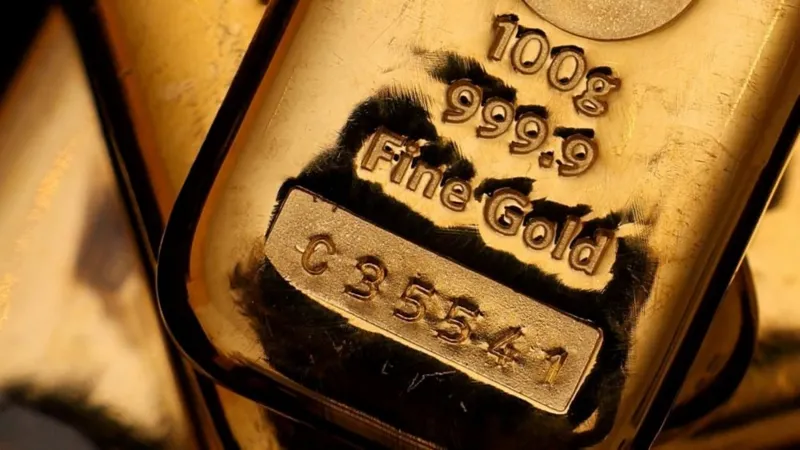
The price of gold has risen above $5,000 (£3,659) an ounce for the first time, extending a historic rally that saw the precious metal jump by more than 60% in 2025.
It comes as tensions between the US and NATO over Greenland have added to growing concerns about financial and geopolitical uncertainty.
US President Donald Trump’s trade policies have also worried markets. On Saturday he threatened to impose a 100% tariff on Canada if it strikes a trade deal with China.
Gold and other precious metals are seen as a so-called safe-haven assets that investors buy in times of uncertainty.
Demand for gold has also been driven by a range of other factors including higher-than-usual inflation, the weak US dollar, buying by central banks around the world and as the US Federal Reserve is expected to cut interest rates again this year.
Wars in Ukraine and Gaza, as well as Washington seizing Venezuelan President Nicolás Maduro, have also helped push up the price of gold.
On Friday, silver topped $100 an ounce for the first time, building on its almost 150% rise last year.
[BBC]
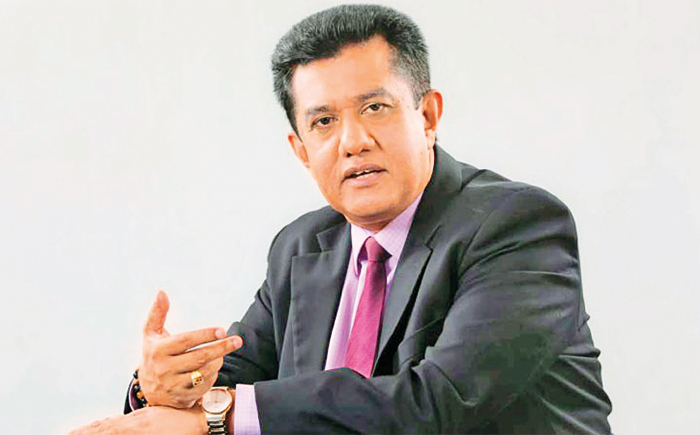
SJB Working Committee member and ex-SLPP lawmaker Charitha Herath says that all eyes are on the newly constituted Constitutional Council (CC) as to how it will handle the dispute between President Anura Kumara Dissanayake, and the previous CC, over the appointment of Auditor General (AG).
The former parliamentarian said so in response to The Island query yesterday (25). In terms of the Constitution, Prime Minister Dr. Harini Amarasuriya and Opposition Leader Sajith Premadasa last week agreed on the appointment of former civil servant Austin Fernando, Professor Wasantha Seneviratne and Ranjith Ariyaratne as non-MP members of the CC.
They replaced former Ministry Secretary Dr. Prathap Ramanujam, former Chairperson of the Sri Lanka Medical Association Dr. Dilkushi Anula Wijesundere and Dr. Dinesha Samararatne of the University of Colombo. Pointing out that they rejected the President’s nominees for the AG’s post on several occasions, Herath emphasised the pivotal importance of the appointment of a person with impeccable credentials.
The other CC members are the Prime Minister, Speaker Dr. Jagath Wickremaratne (Chairman), the Opposition Leader, the President’s nominee Bimal Rathnayake and five persons appointed by the President, upon being nominated as follows: one MP nominated by agreement of the majority of the MPs representing the Government (Aboobucker Athambawa, MP), one MP nominated by agreement of the majority of the Members of Parliament of the political party, or independent group, to which the Leader of the Opposition belongs (Ajith P. Perera, MP), and one MP nominated by agreement of the Members of Parliament other than those representing the Government and those belonging to the political party or independent group to which the Leader of the Opposition belongs, and appointed by the President ( Sivagnanam Shritharan, MP.)
The present CC was established on October 31, 2022 in terms of the 21st Amendment to the Constitution. The Attorney General heads the National Audit Office (NAO). One-time COPE Chief said that it would be the responsibility of the government to ensure the integrity of the NAO.
Chulantha Wickramaratne, who served as AG for a period of six years, retired in April 2025. Following his retirement, President Dissanayake nominated H.T.P. Chandana, an audit officer at the Ceylon Petroleum Corporation as the AG. The CC rejected that nomination. Subsequently, President Dissanayake appointed the next senior-most official at the NAO Dharmapala Gammanpila as Acting Auditor General for a period of six months. Then, the President nominated Senior Deputy Auditor General L.S.I. Jayarathne to serve in an acting capacity, but her nomination, too, was also rejected. Many an eyebrow was raised when the President nominated O.R. Rajasinghe, the Internal Audit Director of the Sri Lanka Army for the top post. That nomination too was rejected. As a result, the vital position remains vacant since 07 December, 2025.
Herath said that the government was in a bind over the Auditor General’s appointment and the disgraceful campaign launched against Attorney General Parinda Ranasinghe, Jr, PC.
The ex-lawmaker said that JVP/NPP loyalists masquerading as journalists and civil activists had launched the protest against the Attorney General. Herath said that the decision to send Deputy Secretary General of Parliament Chaminda Kularatne, on compulsory leave, too, was a matter of serious concern.
Herath said: “This is the same government that campaigned strongly on non-interference, institutional independence, and respect for the rule of law—principles they used to criticise every previous administration. Now, they appear to be doing exactly what they once opposed, only more openly. If this pattern continues, these undemocratic actions will eventually lead to their own downfall.”
BASL in late December, 2025 urged President Dissanayake and others, including the Opposition Leader, to consult civil society and professional bodies, including them, before the appointment of civil society representatives.
Herath said that the newly constituted CC would face its first acid test when it addressed the Auditor General issue.
by Shamindra Ferdinando

Royal Navy of Oman Ship ‘AL SEEB’ leaves island

Gold tops $5,000 for first time ever, adding to historic rally

Showers will occur in the Northern, North-central, Eastern, North-western, Western, Sabaragamuwa and Uva provinces and in Matale, Matara, Galle and Nuwara-Eliya districts

U – 19 World Cup: Andrew, McKenzie deliver West Indies comfortable win

U – 19 World Cup: Bowlers, Hogan help Australia breeze past South Africa

Abhishek blasts 14-ball fifty to hand India unassailable 3-0 lead against New Zealand

‘Dates have the highest sugar content to fight Coronavirus’

Sunday Island 27 December – Headlines

#SundayIsland 17th December – Headlines

Sunday Island – 28th March

Sunday Island Headlines – 21 March

Sunday Island – 21st February – Headlines
-
 Business16 hours ago
ComBank, UnionPay launch SplendorPlus Card for travelers to China
-

 Business2 days ago
ComBank advances ForwardTogether agenda with event on sustainable business transformation
-

 Opinion7 days ago
American rulers’ hatred for Venezuela and its leaders
-

 Opinion5 days ago
Remembering Cedric, who helped neutralise LTTE terrorism
-
 Business5 days ago
CORALL Conservation Trust Fund – a historic first for SL
-

 Opinion4 days ago
A puppet show?
-
 Opinion2 days ago
Conference “Microfinance and Credit Regulatory Authority Bill: Neither Here, Nor There”
-
 Opinion7 days ago
History of St. Sebastian’s National Shrine Kandana