
News
Prez should explain why he scrapped time-tested exchange controls – NFF

By Shamindra Ferdinando
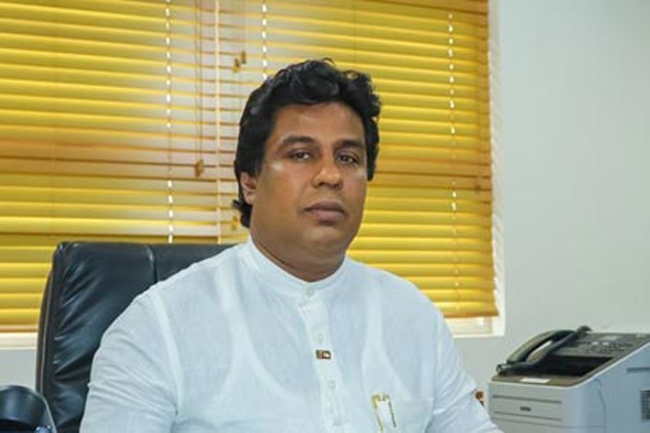
President Ranil Wickremesinghe, who is also the Finance Minister, should take immediate steps to restore the provisions of Exchange Control Act (ECA) of 1953 as part of the overall efforts to stabilise the national economy, NFF MP Jayantha Samaraweera told The Island yesterday (09).
The former State Minister said that furthermore UNP leader Wickremesinghe owed an explanation as to why his government introduced the current Foreign Exchange Act in 2017. The Kalutara District lawmaker said that President Wickremesinghe couldn’t remain silent as it was his government that disposed of the Exchange
Control Act of 1953, thereby paving the way for exporters to park export proceeds running into billions of dollars abroad.Responding to queries, MP Samaraweera said that he had raised the accountability on the part of President Wickremesinghe in parliament on March 08.
Acknowledging that though the economic situation had slightly improved over the past several weeks, MP Samaraweera said that Wickremesinghe-Rajapaksa government should take remedial measures to plug the loopholes or face the consequences. “The current Exchange Act introduced during Ravi Karunanayake’s tenure as the Finance Minister is perhaps one of the major reasons for the continuing crisis,” the former JVPer said.
The issue at hand was whether somebody in the yahapalana government benefited by repealing the time-tested exchange control laws, MP Samaraweera asked, underscoring the need to examine this matter carefully. “The possibility of a conspiracy cannot be ruled out. All of us know how the UNP perpetrated Treasury bond scams, twice, in Feb 2015 and March 2016. The new Exchange Control Act was enacted in the wake of Treasury bond scams,” MP Samaraweera pointed out.
Referring to a statement made by Trade Minister Nalin Fernando in Parliament on Wednesday, MP Samaraweera said that the government had lost the wherewithal to meet its basic obligations as it didn’t have foreign exchange.
Now, the UNP leader who created an environment for exporters not only to stash away export proceeds overseas and oversaw the Treasury bond scams, held the finance portfolio, MP Samaraweera said. Wickremesinghe should set a deadline for restoring the old Foreign Exchange Act, the MP said, recalling how the UNP leader publicly acknowledged the need to amend the 2017 Act.
MP Samaraweera told parliament on Wednesday President Wickremesinghe couldn’t afford to turn a blind eye to the declaration made by Justice Minister Dr. Wijeyadasa Rajapakse, PC, early last December on the basis of disclosure made by the US-based Global Financial Integrity watchdog that as much as USD 58 bn were parked overseas.
The MP pointed out that in addition to Minister Rajapakse, Opposition lawmakers Vasudeva Nanayakkara, Wimal Weerawansa and Gevindu Cumaratunga, in Parliament, estimated the stashed amount at over USD 35 bn, MP Jayaweera said. The trio has alleged that the Exchange Control Act No 12 of 2017, enacted during the yahapalana administration, allowed exporters to keep funds overseas.
MP Jayaweera said that President Wickremesinghe should inform the parliament without further delay how he intended to address the issue. “We obtained about USD 4 bn in 2022 from India. On top of that Sri Lanka owes the world as much as USD 53 bn. No one should forget that the situation stabilised to an extent as a result of Sri Lanka halting debt servicing,” MP Samaweera said.
Asked why President Gotabaya Rajapaksa’s government didn’t amend the yahapalana Exchange Control Act, MP Samaraweera said that NFF leader Wimal Weerawansa had taken up the issue with the Cabinet-of-Ministers. However, Basil Rajapaksa, who succeeded Mahinda Rajapaksa as the Finance Minister in June 2021 had dismissed the NFF’s recommendation, MP Samaraweera said, adding that Basil had declared that restrictions would discourage exporters. In fact, General Secretary of the Democratic Left Front (DLF) Vasudeva Nanayakkara proposed the introduction of a ‘QR’ system in 2021 in view of the foreign exchange crisis, MP Jayaweera said. That proposal, too, was rejected by Basil Rajapaksa, he said.
The MP stressed the need to tackle quite a formidable challenge posed by well-organised influential public–private sector partnership engaged in ‘over invoicing’ and ‘under invoicing’, with the blessing of successive governments. That too contributed to the forex crisis, the MP said.






Latest News
Heat Index at Caution Level in the Western, Sabaragamuwa, Southern, Eastern, North-western, Northern and North-central provinces and in Monaragala district


Warm Weather Advisory
Issued by the Natural Hazards Early Warning Centre
Issued at 3.30 p.m. on 31 March 2026, valid for 01 April 2026.
The Heat index, the temperature felt on human body is likely to increase up to ‘Caution level’ at some places in the Western, Sabaragamuwa, Southern, Eastern, North-western, Northern and North-central provinces and in Monaragala district.
The Heat Index Forecast is calculated by using relative humidity and maximum temperature and this is the condition that is felt on your body. This is not the forecast of maximum temperature. It is generated by the Department of Meteorology for the next day period and prepared by using global numerical weather prediction model data.

Effect of the heat index on human body is mentioned in the above table and it is prepared on the advice of the Ministry of Health and Indigenous Medical Services.
ACTION REQUIRED
Job sites: Stay hydrated and takes breaks in the shade as often as possible.
Indoors: Check up on the elderly and the sick.
Vehicles: Never leave children unattended.
Outdoors: Limit strenuous outdoor activities, find shade and stay hydrated.
Dress: Wear lightweight and white or light-colored clothing.
Note:
In addition, please refer to advisories issued by the Disaster Preparedness & Response Division, Ministry of Health in this regard as well. For further clarifications please contact 011-7446491.


Govt. rations stocks as imports falter
By Ifham Nizam
The government faces a looming fertiliser crisis ahead of the 2026 Yala season, with a sharp shortfall in urea threatening paddy yields and food security.
Experts have warned that the fertiliser shortage will take its toll on the yala harvest.
With just over 100,000 tonnes of fertiliser in stock by early March—barely enough for paddy cultivation alone—and more than half of expected imports either cancelled or delayed, the government has moved to ration supplies through Agrarian Service Centres, based on last year’s consumption.
Leading crop scientist Professor Buddhi Marambe has warned that while rationing is unavoidable, it will reduce productivity. “Even last season we applied below recommended levels. This year, the gap will be worse,” he said.
Authorities are prioritising paddy, followed by maize and tea, as limited stocks are stretched across crops.
However, experts estimate yields could fall by 15–20% if nutrient shortages persist—raising the risk of higher food prices in the months ahead.
The crisis has been worsened by global disruptions, including Gulf conflict affecting fertiliser shipments and precautionary export restrictions by key suppliers, such as China.
Although the Government is pursuing deals with countries like Russia, supplies remain uncertain.
With global urea prices surging and production costs rising, smallholder farmers are expected to be the hardest hit.
“This is a wake-up call,” Prof. Marambe said, urging urgent steps to build buffer stocks and strengthen Sri Lanka’s long-term food security strategy.

By Shamindra Ferdinando
Frontline Socialist Party (FSP) spokesman Pubudu Jayagoda says the Gampaha Magistrate’s Court order that the ruling JVP hand back the FSP’s Kirindiwela office, grabbed by a group of JVP politicians on 02 September, 2025, has shown that the government cannot undermine the law.
Jayagoda said that the FSP had been compelled to move the court against the JVP as the Gampaha police refused to intervene due to political pressure. “They probably thought we were going to give up that office. Perhaps, the ruling party felt they could forcibly occupy other FSP offices,” Jayagoda said.
FSP’s Administrative Secretary Chamira Koswatta and trade unions, which operated from the Salmal Garden office, sought the court intervention to confirm the ownership of that building in the FSP. The court initially transferred the building to the police and issued a directive to law enforcement authorities to remove the JVP/NPP from that building.
Among the 20 respondents was Tilvin Silva, General Secretary of the JVP. Those now identified themselves as FSP quit the JVP in 2011 and later formed their own party.
Gampaha Additional Magistrate Shilani Perera on Monday ruled that the legitimate owner was the FSP. The Magistrate ruled that the FSPers had been forced out of that office, illegally.
Jayagoda said that the FSP considered the court ruling a victory for democracy and a devastating blow to the increasingly authoritarian JVP/NPP rule.

Punjab Kings fined for slow over-rate

Ice-cool Connolly leads nervy Punjab Kings home on IPL debut

Showers expected in the Western, Sabaragamuwa and Southern provinces in the evening or night

Heat Index at Caution Level in the Western, Sabaragamuwa, Southern, Eastern, North-western, Northern and North-central provinces and in Monaragala district

Urea shortage threatens Yala harvest: Experts

2025 property grab: Court orders JVP to hand back Yakkala office to FSP

‘Dates have the highest sugar content to fight Coronavirus’

Sunday Island 27 December – Headlines

#SundayIsland 17th December – Headlines

Sunday Island – 28th March

Sunday Island Headlines – 21 March

Sunday Island – 21st February – Headlines
-

 Features4 days ago
A World Order in Crisis: War, Power, and Resistance
-

 News5 days ago
Energy Minister indicted on corruption charges ahead of no-faith motion against him
-

 News6 days ago
US dodges question on AKD’s claim SL denied permission for military aircraft to land
-

 Business6 days ago
Dialog Unveils Dialog Play Mini with Netflix and Apple TV
-

 Sports5 days ago
SLC to hold EGM in April
-

 Latest News6 days ago
A strong Technical and Vocational Education and Training (TVET) system equips individuals with practical, relevant, and future-oriented skills helping to innovate responsibly towards a greener and sustainable future – PM
-

 Opinion5 days ago
When elephants fight, it is the grass that suffers
-

 Features5 days ago
Lest we forget