
Latest News
President Ranil Wickremesinghe’s address at the UNGA: ‘Sri Lanka’s journey to rebuild trust and global solidarity’

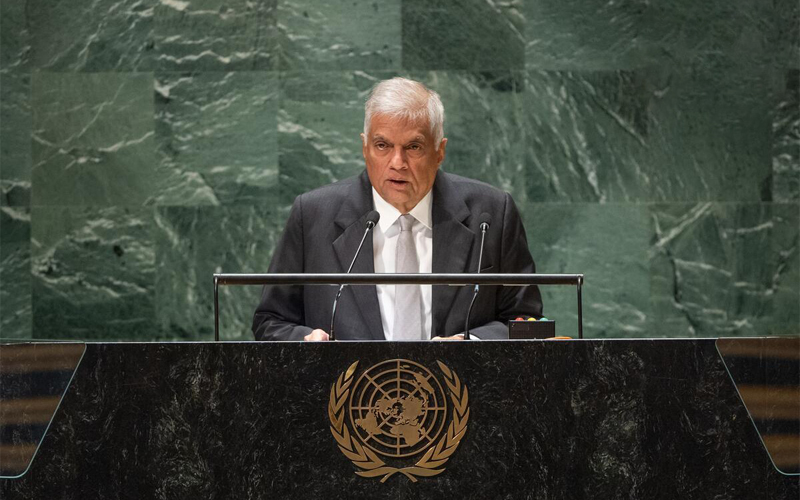
President Ranil Wickremesinghe addressed the UN General Assembly in New York on Thursday (21) on the theme “Rebuilding trust and reigniting solidarity” and its relevance to Sri Lanka’s recent challenges.
He mentioned how Sri Lanka faced significant social, economic and political challenges in the past year, including threats to democratic traditions but has managed to achieve a democratic transition.
He highlighted efforts made to stabilize the economy, including economic reforms and foreign assistance and said that his intention is to lead Sri Lanka towards sustainable recovery and growth, benefiting all segments of society and ensuring peace, prosperity and reconciliation.
The President also discusses the global geopolitical landscape, emphasizing the inter-connectedness of various challenges, such as climate change, debt and sustainable development. He stresses the need for international solidarity and climate finance, particularly for smaller, climate-vulnerable and debt-ridden countries.
President Wickremesinghe mentioned Sri Lanka’s commitment to climate action, including renewable energy goals, forest conservation and emissions reduction while expressing concern about the impact of climate change on food security, clean energy and livelihoods, emphasizing the urgency of mobilizing climate finance.
The President called on developed countries to fulfill their commitments, provide assistance and assume their share of responsibility, while underscoring the importance of restructuring the international financial system to address climate change and sustainable development.
Additionally, the President emphasized the need for reform in multilateral institutions like the UN, particularly the expansion of the Security Council’s composition and the importance of disarmament and the impact of global military expenditures.
Overall, the President’s speech highlighted the challenges faced both by Sri Lanka and the world, and emphasized the importance of solidarity, climate action, disarmament and multilateral cooperation in addressing these issues.
Following is the full speech delivered by President Ranil Wickremesinghe at the 78th session of the United Nations General Assembly;
“Rebuilding trust and reigniting solidarity“ is an appropriate point of departure not only for reflecting on the challenges before the multilateral today, but also for reviewing developments in my own country, Sri Lanka, over the past year.
At this time last year, amidst multiple global crises, Sri Lanka was experiencing its most challenging period in recent times socially, economically and politically, which had a devastating impact on people’s lives.
Even our Democratic traditions were threatened by attempts to occupy our Parliament and bring it to a halt. Nevertheless, we succeeded in bringing about a democratic political transition, due to our deeply entrenched and resilient democratic traditions.
Resorting to the re-graduation of Sri Lanka’s economy, coupled with the gift of fertilizer from the United States’ Government which led to a bumper harvest, has assisted us in ensuring stability during that period.
The reforms I have since initiated in the economic, financial, institutional and reconciliation fronts have been directed on the one hand towards rebuilding trust and confidence between the people and the government; and on the other, towards laying the foundation for economic stabilization and recovery. Sri Lankans are already witnessing the positive outcomes of these measures in their daily lives and the revival of confidence internally and externally in the progress of the country.
It is my intention to lead the country towards sustainable and stable recovery and growth which will benefit all segments of Sri Lankan society in all parts of the country, ensuring a future of peace, prosperity and reconciliation for the present and future generations of women and men. In reaching this goal, we will be accompanied by the support, trust, and solidarity of our own people and of the international community.
As we turn the corner towards the 80th anniversary of the UN and prepare for the Summit of the Future in 2024, we see the fragmented geopolitical landscape of a multi-polar world where new centers of global power have emerged.
Accompanying this systemic change, are, on one hand, great expectations of development and human progress with millions of people rising out of poverty to prosperity.
On the other hand, we see a world where former big power rivalries and geopolitical tensions have reignited in open war, overlapping with new theaters of conflict and tension on land and in the oceans. Security Alliances have expanded and recent arrangements have been formed to deal with strategic threat perceptions in old and new theaters of conflict. North-South divisions are widening with the digital divide, the financial and debt crisis and the energy transition. Contrary to the promise of 2030, today we are seeing levels of poverty and hunger not witnessed since decades.
Neutral, nonaligned countries of the global South such as Sri Lanka are once again constrained in-between new global power configurations facing those who not respect the sovereignty of our nations.
In numerous recent Declarations in the UN and beyond including at the G20 in Delhi, the BRICS in Praetoria and G7 in Hiroshima, we have agreed that our challenges are interconnected, across borders and all other divides. We must grasp the opportunity to unite in order to build an inclusive future.
It is an appropriate reflection of this current global predicament, that the theme of this year’s general debate is “Rebuilding trust and reigniting global solidarity”.
This year, in parallel with the UNGA, we have participated in three interrelated summits dealing with accelerating the SDGs, Financing for Development and Climate Ambition where we agreed that international solidarity and collective action is needed to address these simultaneously.
Cross-border financial impacts of crises such as climate change and the pandemic are impeding the ability of smaller indebted countries such as mine, to make progress on SDG’s and climate adaptation and mitigation. Conflicts and tensions among big powers are complicating the policy environment for the rest by adding uncertainty to economic and macro-financial stability, disrupting supply chains and causing inflation as well as food and energy insecurity.
Long before the SDGs, Sri Lanka had achieved high human and social development indicators which ranked us in a category well above other middle-income countries. Neither has Sri Lanka shirked its responsibility to the planet. Last year at COP27 we outlined our Climate Ambition Plan. We said that by 2030 we will have 70% renewable energy in electricity generation, increase forest cover by 32% and reduce greenhouse emissions by 14.5%. We will phase out coal by 2040, and reach net zero by 2050.
Our low carbon development trajectory gave us one of the lowest per capita carbon emission rates for a lower MIC country.
This year as a result of exogenous shocks and debt, the incremental progress we were proud to have reached has been reversed. Food inflation reached putting significant pressure on food security amongst vulnerable communities. At the same time children’s education and nutrition have suffered due to the pandemic and the economic crisis.
In parallel, last month in Sri Lanka we were grappling with the driest weather spell seen in recent years followed by torrential rainfalls.
Adverse climate outcomes spilling over onto our tight fiscal space just as we begin to stabilize from last year’s economic crisis. As a climate vulnerable developing country in debt crisis, the urgency to mobilize climate finance is greater today than it was ever before. However, despite promises made to which we were all witness, rich countries are not delivering to expectation.
Developed countries must do their part and fulfill what they agreed – assume their share of the common but differentiated responsibility, provide assistance for mitigation and adaptation and compensation for loss and damage.
National efforts alone will not suffice to ensure the success of the SDGs and reverse climate change. The need for global solidarity to restructure the international financial architecture is paramount. This is articulated loud and clear in multiple global fora including in G20, and the BRICS. The Secretary General’s SDG stimulus highlights the interconnections between the achievements of the SDGs, combatting climate change and the concrete interventions required by creditors sovereign and private, as well as by IFIs including to mitigate the debt crisis.
It is estimate that the 2008 financial crisis has cost the U.S. economy $4 trillion. Recent studies in the U.S. have stated that the impact of the pandemic on the U.S. economy from 2020 to 2024 would reach $14 trillion. These numbers would more than double if the rest of the global economy is added. We have not faced an economic crisis of this magnitude any time before in our modern history. The cost of World War 2 in today’s USD would amount to $4 trillion, and the Marshall Plan would be $ 150 billion.
This is the magnitude of the challenge before us. Therefore if we are unable to restructure the global fiscal order, then certainly we will fail in the struggle to reverse climate change and achieve the SDG goals.
There is still time for course correction as the crisis has not reached its peak. At the same time, the Paris Summit for a New Global Financing Pact will come up with the funding requirements.
Therefore, the Summit of the Future should not be crafting new programs, but re-structuring the present financial architecture to suit the needs of climate change and sustainable development.
This must be the priority of this General Assembly; we cannot afford to allow divisions to drive focus away from this crisis.
While key issues such as the Bridgetown Initiative and the necessity to address the debt of low-income countries are being discussed in this assembly, it is not commanding the attention it deserves. Unfortunately, the Security Council has failed to give priority to these connected issues of climate change, debt relief and sustainable development. This impacts the future of mankind. The survival of the planet must be our priority, we cannot afford to go into this war with a divided high command. The future of all species on the globe is dependent on our ability to put aside our rivalries until this crisis is solved.
Multilateral machinery which reflects the world of the past century needs to be reformed to meet the challenges of the present and the future, a machinery which has failed to find a solution to the longstanding Palestine question. The composition of the Security Council must be expanded to be representative of current global diversity and decision-making. In parallel, the role of the UNGA must be strengthened.
We are asking that the permanent members engage in a credible dialogue which will lead to a unified approach to combat these threats ahead of the next sessions.
While we seek solidarity and financing to alleviate poverty and climate challenges, global military expenditures have risen today to record levels reaching $2.24 trillion. This reflects the strategic trust deficit among the powerful, key arms control frameworks which were instrumental in maintaining system stability in the past have collapsed and nuclear conflict is once again under open discussion, potentially and apocalyptically triggered by autonomous control. We urge restraint in the increase of military expenditure which leads to escalation of conflict.
Developing countries have been the voice of sanity and reason in this regard for decades. In keeping with Sri Lanka’s longstanding position supportive of disarmament of WMD and nuclear weapons, this year Sri Lanka ratified the Comprehensive Test Ban Treaty. Yesterday, we acceded to the Treaty on the Prohibition of Nuclear Weapons.
The war in Ukraine has far-reaching and severe financial and humanitarian repercussions on food, hunger and debt in all parts of the world including Sri Lanka. It is recalled that the UN Charter vests on powerful states in the Security Council the responsibility to maintain international peace and security and to deescalate rather than ignite conflict.
We need to halt the momentum where this and other big power tensions are spilling over into established areas of international rules-based cooperation forged over decades of multilateral negotiation, ranging from international trade to ocean governance.
This international system is today undergoing vast changes. At the same time, it is being confronted with unprecedented challenges. We come to the United Nations to demonstrate solidarity in arriving at common solutions. What is at stake is not the future of the United Nations, but of our planet as a whole. Member States will need to find new ways of working together despite the increasing mistrust that has permeated international relations.
We who have not been able to find a solution to the Palestinian question must now be able at least to find a solution to the questions which threaten the existence of the present global community.
This can be achieved through the willingness of the permanent members to work together in solidarity with the developing world. They must show the way”
President Wickremesinghe also extended his sincere condolences to the victims and families of the natural disasters that hit Morocco and Libya in recent days and pledged solidarity with Moroccan and Libyan friends during this difficult time.
(PMD)




Latest News
Heavy showers above 100 mm are likely at some places in the Western, Sabaragamuwa, Southern, Central, and North-western provinces and in Anuradhapura district.
WEATHER FORECAST FOR 14 OCTOBER 2026
Issued at 05.30 a.m. on 14 October 2026 by the Department of Meteorology
Due to a low-level atmospheric disturbance persisting in the Bay of Bengal near Sri Lanka, cloudy skies and increased rainfall are expected to continue over the island.
Misty conditions can be expected at some places in the Sabaragamuwa, Central and Uva provinces during the early hours of the morning.
Showers or thundershowers will occur at times in the Northern, Eastern, Southern and Western provinces. Showers or thundershowers will occur in other parts of the island after 1.00 p.m.
Heavy showers above 100 mm are likely at some places in the Western, Sabaragamuwa, Southern, Central, and North-western provinces and in Anuradhapura district while fairly heavy showers above 75 mm are likely at some places in other areas of the island.
The general public is kindly requested to take adequate precautions to minimize damage caused by temporary localized strong winds and lightning during thundershowers.
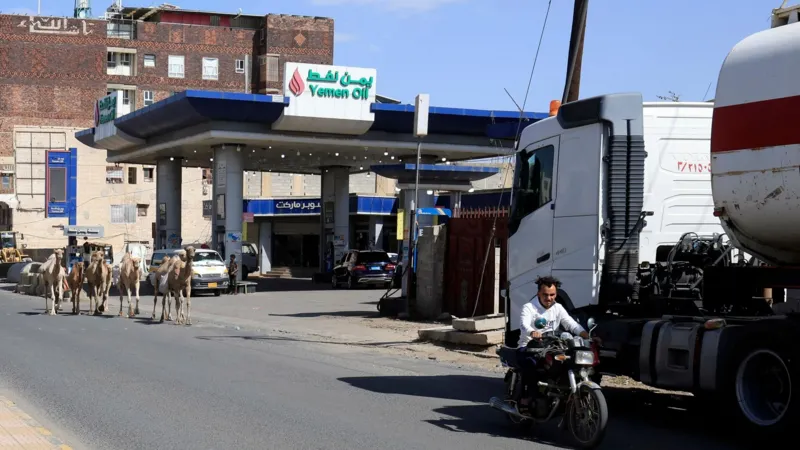
Missiles and drones have been intercepted over Riyadh after the Saudi-led coalition fighting in Yemen struck a fuel depot near the Houthi-controlled capital, Sanaa, its spokesperson says.
Maj Gen Turki al-Maliki said several projectiles targeting the Saudi capital and other cities were intercepted after the coalition carried out a strike on the Yemen Petroleum Company’s al-Sabaha facility on Tuesday night.
The Houthis warned they would target the airport and Aramco refinery in Saudi Arabia’s capital, Riyadh, and Aramco’s headquarters in the eastern city of Dammam.
Al-Maliki later said missiles targeting cities including Dammam had been intercepted, while shrapnel had fallen in a residential area in Dhahran.
It came as the Saudi cabinet, chaired by Crown Prince Mohammed bin Salman, said the Iran-backed group would “bear the consequences” of its recent deadly attacks on the kingdom.
Thirteen people were killed when a missile hit King Khalid International Airport in Riyadh on Saturday, while another person was killed in a similar attack there the following day.
On Tuesday, the coalition said its forces had destroyed three drones north of Riyadh.
The Houthis have said they are targeting airports, oil and gas facilities, and military bases in Saudi Arabia with missiles and drones in response to deadly Saudi strikes on territory that they control in western Yemen, including Sanaa.
The Saudi-led coalition has been providing air support for Yemeni pro-government forces mounting an offensive on Yemen’s Red Sea coast and several other front lines.

A correspondent for AFP news agency reported that queues formed at petrol stations in Sanaa on Tuesday afternoon following the coalition’s warning of an impending operation against the al-Sabaha oil facility, with many residents worried about shortages.
The Yemen Petroleum Company, which is run by the Houthis, issued a statement that sought to reassure them, saying the facility “does not contain any stock of petroleum products”.
The company also said it had “taken all necessary precautionary measures to address any emergency, ensuring the stability of the supply situation and the continued meeting of citizens’ needs in a normal manner”.
After al-Maliki confirmed the strike, first reported by Houthi media, explosions were heard over Riyadh and other Saudi cities, with al-Maliki reporting four missiles and two drones had been intercepted near the capital.
Yemen has been devastated by a civil war that began in 2014, when the Houthis ousted the internationally-recognised government from Sanaa. The conflict escalated in 2015, after the Saudi-led coalition of Arab states intervened in an attempt to restore the government’s rule.
A four-year-old informal ceasefire began to unravel in July, when the Houthis announced a “maritime embargo” against Saudi Arabia and began missile and drone attacks on Saudi airports, oil facilities and tankers in the Red Sea.
The Houthis said they were retaliating for what they call a Saudi blockade of their territory, as well as an air strike on Sanaa airport that they blamed on the kingdom.
The conflict escalated in September after the Houthis seized part of Yemen’s south-western Red Sea coast near the Bab al-Mandab Strait, a chokepoint for global shipping. Their advance contributed to a rise in oil prices following six months of war between the US, Israel and Iran.
US President Donald Trump said on Truth Social on Tuesday the Houthis were “behaving very badly… and purposefully trying to drive up Oil Prices”.
Speaking to reporters, he did not answer a question on whether he’d made a decision to help the Saudis retaliate against them, but said he “might” ask Turkish President Tayyip Erdogan to intervene.
Last week, pro-government forces said they had regained control of territory overlooking Bab al-Mandab after launching a major counter-offensive with the support of Saudi air strikes.
Hundreds of people have reportedly been killed in Yemen since August. The UN’s human rights office says they include at least 54 civilians, half of them children.
More than 216,000 people have also been displaced across the country, and suspected cholera cases have tripled in three weeks, rising from 217 to 647, according to the UN.
[BBC]
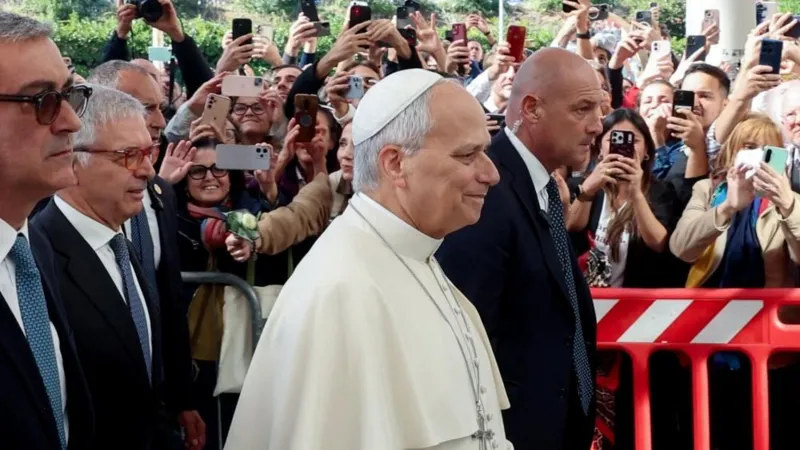
Pope Leo XIV has been diagnosed with lung cancer but had successful surgery to remove a lower lobe of his right lung, the Vatican has said in a medical bulletin.
The 71-year-old underwent a 90 minute surgery on Tuesday at Rome’s Gemelli Hospital and was subsequently diagnosed with lung adenocarcinoma.
“After the operation, the Pope awoke normally and returned after a brief period of observation to his room on the 10th floor,” the Vatican said in a statement.
The lump was first detected during what the Vatican has described as “routine checks”.
Earlier, large crowds gathered outside the hospital to greet the Pope, with some waiting for several hours.
They cheered greetings and well wishes as he passed, while he waved and smiled back through the lowered back window of his car.
He was then met by staff on the hospital steps. “I’m sorry,” one of them commiserated, to which the Pope gave a smile and a shrug. “We’re here for you,” he was assured.
In its statement, the Vatican said the whole lower lobe of the Pope’s right lung was removed “to ensure the procedure was radical”.
A Vatican source told Agence France-Presse news agency further tests were being carried out to see if there was any sign the cancer had spread.
It was Leo XIV himself who on Sunday announced news of his operation to the world, speaking from the balcony in St Peter’s Square after delivering the traditional Angelus blessing.
He said the nodule, or growth, on his lung was “contained” and had been found “at a very early stage”, but that doctors had advised him to have it removed.
Gemelli’s thoracic surgery team operated on the Pope, whose schedule has already been cleared until 20 October to give him time to recover.
Nodules are quite common and not necessarily cancerous, but after it was examined the medical team confirmed it was pulmonary adenocarcinoma, “as suspected by pre-operative tests”, the Vatican said.
The Vatican has stressed that the pontiff, who is generally thought to be fit, had no symptoms of infection or illness.

Cardinal Kikuchi Tarcisio Isao of Tokyo wrote on social media that he’d had an audience with Pope Leo on Monday, and said the pontiff felt “nothing wrong” physically.
He said the Pope had decided to check in for surgery as soon as possible because he was due to travel to Latin America in early November, and was keen to stick to that plan.
The trip is particularly significant because it includes a visit to Peru, where the pontiff was a missionary and then a Bishop for many years.
Despite all the reassurances, the news has shaken Catholics all over the world.
“Am I worried? Yes, because I certainly wasn’t expecting anything like this,” Vatican Secretary of State Cardinal Parolin told journalists on Tuesday.
He agreed that the news was like a “bolt from the blue”, but said the cardinals had been struck by the Pope’s “serenity” and were confident in his recovery.
Outside Gemelli Hospital, which has treated several popes and is home to a large statue of John Paul II, a few Catholics lingered after the pontiff was admitted.
Carla had come specially, wanting to be close.
“He seems calm, so we are calm too – even though illness is always unpleasant,” she told the BBC. “We will wait here and pray.”
[BBC]

Heavy showers above 100 mm are likely at some places in the Western, Sabaragamuwa, Southern, Central, and North-western provinces and in Anuradhapura district.

Sri Lanka, India caught in US-Iran ship crisis

Namal further remanded

IMF projects Lankan economic growth to moderate amidst mounting global uncertainties

Major Gen Pushpakumara assumes command of 56 Infantry Division

Dickwella axed, Bandara earns maiden Test call up

‘Dates have the highest sugar content to fight Coronavirus’

Sunday Island 27 December – Headlines

#SundayIsland 17th December – Headlines

Sunday Island – 28th March

Sunday Island Headlines – 21 March

Sunday Island – 21st February – Headlines
-

 Features6 days ago
The Sri Lankan who made Scottish history
-

 Sports6 days ago
Nissanka absence opens door for Sri Lanka’s young guns
-

 News5 days ago
NDB fraud Rs 60mn more than reported
-

 News5 days ago
Removing monk’s robes matter for Sangha to decide: Mahanayake Theras
-
 News6 days ago
Shiranthi R remanded until 13 Oct.
-

 Features6 days ago
Future of Sri Lanka’s state university system: Should it be shut down and reopened?
-

 News3 days ago
Sri Lanka escalates anti-graft drive with Shiranthi’s jailing
-

 Latest News4 days ago
Farhan, Sadaqat help Pakistan ace 183 chase to go 1-0 up