
Features
President picks up the gauntlet


by Jehan Perera
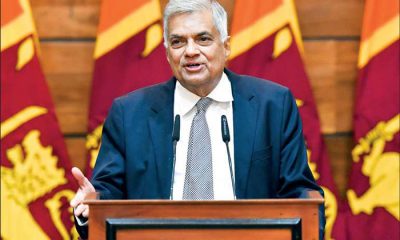
By proroguing parliament President Ranil Wickremesinghe has given the parliamentarians, and the country at large, a reminder of the power of the presidency. There was no evident reason for the president to suddenly decide to prorogue parliament. More than 40 parliamentary committees, including important ones concerning public finances, enterprises and accounts have ceased to function. The president’s office has said that when parliament reconvenes on February 8, after the celebration of the country’s 75th Independence Day on February 4, the president will announce new policies and laws, which will be implemented until the centenary celebrations of Sri Lanka’s independence in 2048. Prime Minister Lee Kwan Yew transformed Singapore from a relatively underdeveloped and impoverished agrarian society into one of the world’s most developed countries in the same 25 years that the president has set for Sri Lanka.
President Wickremesinghe has been getting increasingly assertive regarding his position on issues. Recently he attended a large gathering of Muslim clerics, where he was firm in saying that society needs to modernise, and so do religious practices. He has also held fast to his positions on reviving the economy and resolving the economy. There have been widespread protests against the tax hikes being implemented which have eroded the purchasing power of taxpayers. First they had to absorb the impact of inflation that rose to a rate of 80 percent at the time the country reneged on its foreign debt repayments and declared bankruptcy. Now they find their much diminished real incomes being further reduced by a tax rate that reaches 36 percent.
But the government is not relenting. President Wickremesinghe, who holds the finance minister’s portfolio, is going against popular sentiment in being unyielding on the matter of taxes. He appears determined to force the country away from decades of government policies that took the easy route of offering subsidies rather than imposing taxes to use for government expenses and development purposes. In Sri Lanka, the government’s tax revenue is less than 8 percent, whereas in comparable countries the tax revenue is around 20 to 25 percent. The long term cost of living off foreign borrowings rather than generating resources domestically through taxation has been evident for a long while in the slow growth of the economy even prior to the economic collapse.
13TH AMENDMENT
Another area in which the president appears to have taken the decision to stand firm is the issue of finding a solution to the ethnic conflict. This problem has proven to be unresolvable by governments and political leaders who give deference to ethnic nationalism. Being an ethnic nationalist in the context of Sri Lanka’s ethnic and religious divisions has been a sure way of gaining votes and securing election victories. No leader in Sri Lanka has to date been able to implement the compromise solutions that they periodically arrived at, the last being the 13th Amendment. Earlier ones included the Bandaranaike-Chelvanayakam Pact of 1957 and the Dudley Senanayake-Chelvanayakam Pact of 1965 which could not even be started to be implemented.
At the All Party meeting that he summoned to discuss the ethnic conflict and national reconciliation, President Wickremesinghe took the bull by the horns. He exchanged words with ethnic nationalist parliamentarians who sought to challenge his legitimacy to be making changes. He said, “It is my responsibility as the Executive to carry out the current law. For approximately 37 years, the 13th Amendment has been a part of the constitution. I must implement or someone has to abolish it by way of a 22nd amendment to the constitution by moving a private member’s bill. If the bill was voted against by the majority in the House, then the 13th amendment would have to be implemented. We can’t remain in a middle position saying that either we don’t implement the 13th amendment or abolish it.”
The 13th Amendment has not been fully implemented since it was passed by parliament with a 2/3 majority in 1987. Successive governments, including ones the president has been a member of variously as a minister or prime minister, have failed to implement it in a significant manner, especially as regards the devolution of police and land powers. When parliament reconvenes on February 8 after prorogation, President Wickremesinghe will be provided the opportunity to address both the parliament and the country on the way forward. Having demonstrated the power of the presidency to prorogue parliament at his discretion, he will be able to set forth his vision of the solution to the ethnic conflict and the roadmap that needs to be followed to get to national reconciliation.
IRONIC PERSECUTION
It is significant that on February 20, the president will also acquire the power to dissolve parliament at his discretion. By proroguing parliament, the president has sent a message to both parliamentarians and the larger society that he will soon have the power to dissolve parliament with the same suddenness that he prorogued parliament. On February 20, the parliament would have been in existence for two and a half years. The 21st Amendment empowers the president to dissolve parliament after two and a half years. Most of the parliamentarians belonging to the ruling party are no longer in a position to go to their electorates let alone canvass for votes among the people. Under these fraught circumstances, they would not wish to challenge the president or his commitment to implementing the 13th Amendment in full.
On the other hand, the taming of parliament by the president does not guarantee the success of an accommodation on the ethnic conflict and a sustainable political solution. The ethnic conflict evokes the primordial sentiments of the different ethnic and religious communities. Political parties and politicians are often portrayed as the villains who led the country to decades of ethnic conflict and to war. However, the conflict in the country predates the political parties. In 1928, in response to demands from community leaders in Ceylon as it was then known, the British colonial rulers sent a commission to the country to ascertain whether it was ready for self-rule. The assessment was negative—the Donoughmore commission wrote that the representatives of the biggest community held to the position that their interest was the national interest. All the representatives of the smaller communities who were divided one against the other were united against the biggest.
An important role therefore devolves upon civil society not to fall prey to the divisions that come down the years. There is a need for enlightened leaders of civil society to work with commitment to explain to the people the need for a political solution and inter-ethnic power sharing that the 13th Amendment makes possible. There were signs of this during the height of the Aragalaya when the youth leading the protests called publicly for equal citizenship and non-discrimination on the basis of ethnicity, religion and caste. They pledged not to be divided by ethnic nationalist politicians for their narrow electoral purposes. It is ironic that the government led by President Wickremesinghe has made these enlightened youth leaders the target of a campaign of persecution instead of making them a part of the solution by constructively engaging with them and issuing a general amnesty.







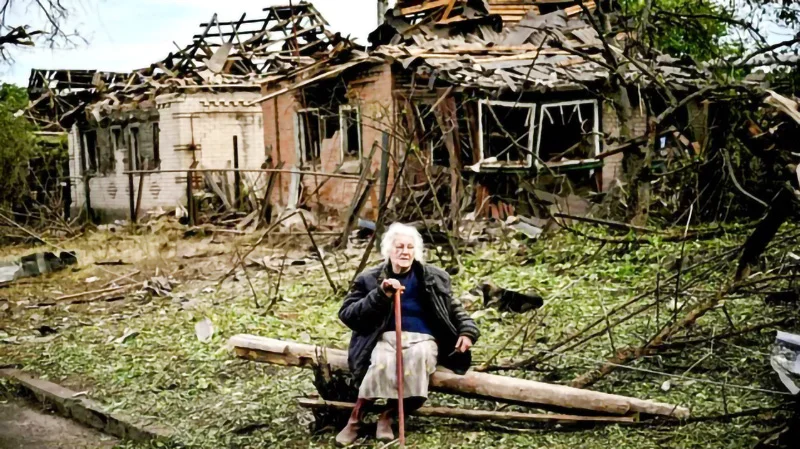
 The world has unhappily arrived at the 4th anniversary of the Russian invasion of Ukraine and as could be seen a resolution to the long-bleeding war is nowhere in sight. In fact the crisis has taken a turn for the worse with the Russian political leadership refusing to see the uselessness of its suicidal invasion and the principal power groupings of the West even more tenaciously standing opposed to the invasion.
One fatal consequence of the foregoing trends is relentlessly increasing ‘Global Disorder’ and the heightening possibility of a regional war of the kind that broke out in Europe in the late thirties at the height of Nazi dictator Adolph Hitler’s reckless territorial expansions. Needless to say, that regional war led to the Second World War. As a result, sections of world opinion could not be faulted for believing that another World War is very much at hand unless peace making comes to the fore.
Interestingly, the outbreak of the Second World War coincided with the collapsing of the League of Nations, which was seen as ineffective in the task of fostering and maintaining world law and order and peace. Needless to say, the ‘League’ was supplanted by the UN and the question on the lips of the informed is whether the fate of the ‘League’ would also befall the UN in view of its perceived inability to command any authority worldwide, particularly in the wake of the Ukraine blood-letting.
The latter poser ought to remind the world that its future is gravely at risk, provided there is a consensus among the powers that matter to end the Ukraine crisis by peaceful means. The question also ought to remind the world of the urgency of restoring to the UN system its authority and effectiveness. The spectre of another World War could not be completely warded off unless this challenge is faced and resolved by the world community consensually and peacefully.
It defies comprehension as to why the Russian political leadership insists on prolonging the invasion, particularly considering the prohibitive human costs it is incurring for Russia. There is no sign of Ukraine caving-in to Russian pressure on the battle field and allowing Russia to have its own way and one wonders whether Ukraine is going the way of Afghanistan for Russia. If so the invasion is an abject failure.
The Russian political leadership would do well to go for a negotiated settlement and thereby ensure peace for the Russian people, Ukraine and the rest of Europe. By drawing on the services of the UN for this purpose, Russian political leaders would be restoring to the UN its dignity and rightful position in the affairs of the world.
Russia, meanwhile, would also do well not to depend too much on the Trump administration to find a negotiated end to the crisis. This is in view of the proved unreliability of the Trump government and the noted tendency of President Trump to change his mind on questions of the first importance far too frequently. Against this backdrop the UN would prove the more reliable partner to work with.
While there is no sign of Russia backing down, there are clearly no indications that going forward Russia’s invasion would render its final aims easily attainable either. Both NATO and the EU, for example, are making it amply clear that they would be staunchly standing by Ukraine. That is, Ukraine would be consistently armed and provided for in every relevant respect by these Western formations. Given these organizations’ continuing power it is difficult to see Ukraine being abandoned in the foreseeable future.
Accordingly, the Ukraine war would continue to painfully grind on piling misery on the Ukraine and Russian people. There is clearly nothing in this war worth speaking of for the two peoples concerned and it will be an action of the profoundest humanity for the Russian political leadership to engage in peace talks with its adversaries.
It will be in order for all countries to back a peaceful solution to the Ukraine nightmare considering that a continued commitment to the UN Charter would be in their best interests. On the question of sovereignty alone Ukraine’s rights have been grossly violated by Russia and it is obligatory on the part of every state that cherishes its sovereignty to back Ukraine to the hilt.
Barring a few, most states of the West could be expected to be supportive of Ukraine but the global South presents some complexities which get in the way of it standing by the side of Ukraine without reservations. One factor is economic dependence on Russia and in these instances countries’ national interests could outweigh other considerations on the issue of deciding between Ukraine and Russia. Needless to say, there is no easy way out of such dilemmas.
However, democracies of the South would have no choice but to place principle above self interest and throw in their lot with Ukraine if they are not to escape the charge of duplicity, double talk and double think. The rest of the South, and we have numerous political identities among them, would do well to come together, consult closely and consider as to how they could collectively work towards a peaceful and fair solution in Ukraine.
More broadly, crises such as that in Ukraine, need to be seen by the international community as a challenge to its humanity, since the essential identity of the human being as a peacemaker is being put to the test in these prolonged and dehumanizing wars. Accordingly, what is at stake basically is humankind’s fundamental identity or the continuation of civilization. Put simply, the choice is between humanity and barbarity.
The ‘Swing States’ of the South, such as India, Indonesia, South Africa and to a lesser extent Brazil, are obliged to put their ‘ best foot forward’ in these undertakings of a potentially historic nature. While the humanistic character of their mission needs to be highlighted most, the economic and material costs of these wasting wars, which are felt far and wide, need to be constantly focused on as well.
It is a time to protect humanity and the essential principles of democracy. It is when confronted by the magnitude and scale of these tasks that the vital importance of the UN could come to be appreciated by human kind. This is primarily on account of the multi-dimensional operations of the UN. The latter would prove an ideal companion of the South if and when it plays the role of a true peace maker.
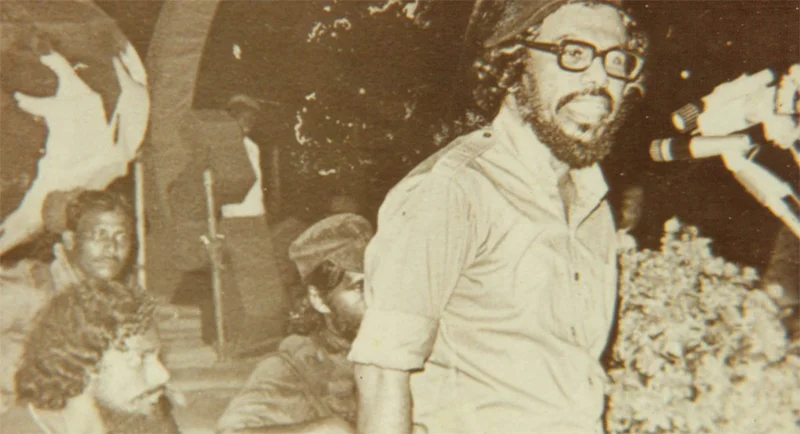
The National People’s Power (NPP), led by the Janatha Vimukthi Peramuna (JVP), came to power promising democratic renewal and long-awaited economic, educational, healthcare, and social transformation. It pledged to build a modern Sri Lanka rooted in democratic values while steering the country toward its vision of Democratic Socialism. For many supporters, the NPP’s rise to the pinnacle of political power represents a historic opportunity to reset the nation’s direction.
Yet recent developments have stirred unease. Statements by several senior ministers and certain policy signals have prompted critics to question whether the government’s path remains firmly democratic. Some warn that in the pursuit of rapid development and social justice, central pillars of the NPP’s election campaign, there may be a growing temptation to consolidate power in ways that edge toward policies of old “Hammer & Sickle.”
Is the NPP committed to pluralistic democratic socialism, or is Sri Lanka witnessing the early signs of a more centralised political model? To answer this question, it is necessary to revisit the JVP’s ideological history, examine the pressures that shape governing parties once in power, and weigh the potential consequences, both promising and perilous, of any shift in direction.
History of the JVP
The JVP emerged in the mid-1960s with a revolutionary agenda, mobilising youth through its Five Lecture Programme, which criticised capitalist policies, questioned the country’s “real independence,” opposed Indian influence, and called for armed struggle. This ideology culminated in the 1971-armed uprising against the elected government, leading to widespread violence, a harsh state crackdown, mass arrests, and the banning of the party.
Although suppressed, the JVP later re-entered democratic politics after its leaders were imprisoned and eventually pardoned. In the 1980s, after electoral defeat, the JVP shifted from strict Marxist-Leninist ideology toward a national, framework known as “Jathika Chinthanaya”, while maintaining strong opposition to Indian involvement.
However, it launched a second violent insurgency in 1988–1989, resulting in significant loss of life and severe repression, including the killing of its leader, Rohana Wijeweera. These events marked a decisive turning point, after which the party gradually moved away from armed struggle and embraced parliamentary politics.
By 1994, the JVP abandoned armed insurrection and embraced parliamentary democracy. While retaining its Marxist-Leninist identity, it adopted a more pragmatic socialist approach, seeking influence through elections rather than violence.
Embracing Parliamentary Democracy
The party served as Ministers and Deputy Ministers under President Chandrika Kumaratunga (2004–2005) and later supported Mahinda Rajapaksa in the 2005 presidential and subsequent parliamentary elections. Between 2005 and 2010, the JVP aligned with the Rajapaksa government in opposing federalism and supporting a unitary state.
Historically, the JVP opposed federalism. Under Anura Kumara Dissanayake (AKD), however, there appears to be a strategic shift toward decentralisation and inclusivity, without formally endorsing federalism. Since 2019, the NPP/JVP has criticised successive governments for failing to implement the 13th Amendment fully. This transformation is real and should be acknowledged.
Reports indicate the NPP/JVP is drafting a new constitution, but there is limited public clarity on its position regarding abolishing the Executive Presidency and devolving powers to Provincial Councils. Sri Lanka can chart a path toward a united, prosperous future where all citizens feel valued and represented. Therefore, I hope that NPP will consider the Provincial Councils in their current form might best serve as a relic of the past, making way for more cohesive and efficient systems of governance.
It is also a fact that many parties have historically criticised the Executive Presidency while in opposition, only to retain it in power. Whether the NPP/JVP will pursue genuine reform remains a subject of debate.
Democratic Concerns State Power
A recent statement by a senior Cabinet Minister that the party holds government power but has not yet “captured” broader state power raises fundamental questions. In a parliamentary democracy, winning government is the highest legitimate authority a party can obtain. Government power is temporary which is granted by voters, limited by the Constitution, and revocable at elections.
State power is permanent and it lies with state institutions i. e. the judiciary, administrative service, armed forces, law enforcement, and independent commissions. These bodies must remain politically neutral and serve the Constitution, to prevent any ruling party from dominating the permanent machinery of governance.
To frame democratic victory as incomplete without “capturing” state power, suggests a conception of power that goes beyond electoral legitimacy. It echoes a revolutionary mindset highlighting the real transformation requires ideological alignment of the state itself.
Past few decades, Sri Lanka has suffered from politicised institutions. Replacing one form of control with another is not reform, it is substitution.
Judiciary and Due Process
Public frustration over past corruption is understandable. However, allegations must be addressed through due legal process. In a democracy, individuals are innocent until proven guilty in a court of law. When parliamentarians publicly pass judgments on opposition figures before judicial proceedings conclude, it risks undermining the rule of law and raising concerns about political overreach.
Concerns are further heightened when there are perceptions that the rule of law is not applied equally, particularly if members of the governing party are treated differently in similar circumstances in the recent past. Unequal enforcement of legal standards can erode public trust in institutions. If such patterns persist, they may raise broader questions about the strength and impartiality of democratic governance.
Village-Level Courts
Democratic Concerns
State Power
In another recent statement, by a senior Minister reiterated one of his earlier proposals to establish judicial courts at the village level to adjudicate certain legal cases, depending on the nature and severity of the alleged offences. While improving local access to justice may enhance efficiency, such courts require strong institutional safeguards.
As this proposal raises serious concerns, it bears characteristics often associated with totalitarian systems, where village-level courts may be controlled by ruling party “cadres” who preside over legal matters and pass judgments against individuals. Without strong safeguards to ensure independence, transparency, and adherence to the rule of law, such courts could be misused to suppress dissent and curtail legitimate political opposition.
Any reform of the judicial system must uphold constitutional protections and preserve the separation of powers. Failing to do so could raise broader concerns about democratic accountability and institutional independence.
Civil / Administrative Service
Before 1978, Sri Lanka’s civil service was widely respected for its professionalism and independence. Over time, however, political appointments increasingly influenced senior administrative positions.
There are growing concerns that some recent appointments to high-level administrative service posts by the NPP may also be politically motivated. Many voters expected systemic reform and a decisive shift toward merit-based governance under the NPP/JVP. It is disappointing to observe indications that similar patterns of politicisation may be continuing.
The real test of reform lies not in rhetoric but in institutional safeguards. Transparent selection criteria, independent oversight mechanisms, and clear accountability structures are essential to ensuring that the administrative service remains professional and non-partisan.
History shows that democracy does not usually collapse overnight. It erodes gradually when ruling parties seek to align permanent institutions with their own ideological or political objectives.
Strengthening institutional independence is not optional, it is imperative. Sri Lanka’s democratic future depends not only on who holds power, but on how responsibly that power is exercised.
Media Freedom
“I disapprove of what you say, but I will defend to the death your right to say it”
(Evelyn Beatrice Hall, describing Voltaire’s belief in freedom of speech.)
Recent reports suggest the NPP/JVP government is dissatisfied with parts of the media, accusing some outlets of political bias and even proposing bans for allegedly spreading false information. Such actions would be undemocratic and would weaken constructive criticism.
Governments already possess legal remedies for defamation. If laws are inadequate, they may be reviewed. However, this must not undermine the media’s fundamental right to fair, independent, and legitimate criticism of those in power.
Every government dislikes criticism. But mature democracies tolerate it. Any attempt to restrict the media risks eroding democratic freedoms and should be adamantly opposed by all who value an independent media.
Religion and Public Conduct
In the past, opposition parties accused the JVP of being hostile to religion, particularly toward Buddhist monks aligned with political opponents. Confirming this accusation, recently a few NPP/JVP ministers, MPs, and party supporters have publicly criticised Buddhist monks who speak and organise meetings against the government.
At the same time, social media contains intolerable language about the conduct of certain Buddhist monks. While misconduct by members of the clergy is concerning, it does not justify hostile or disrespectful reactions from politicians or the public.
Responding with anger and division contradicts the very Dhamma many claim to defend. Using monks as political tools, or attacking them publicly, only deepens social divisions. If there are genuine concerns about the monastic order, they should be addressed respectfully through proper religious channels rather than through public humiliation.
Economic Democracy
Following Sri Lanka’s 2022 fiscal crisis, the NPP/JVP revised its economic policy and aligned itself with a framework closer to Social Democracy. This shift suggests that the JVP has accepted capitalism as the economic system necessary to revive the collapsed economy. At the same time, it has emphasised redistribution, welfare measures, and regulatory reforms aimed at reducing inequality.
The NPP/JVP’s economic policy now focuses on reforming capitalism rather than replacing it. The party initially sought to renegotiate the IMF agreement to ease the burden on the public. However, it was unable to secure significant changes. A key long-term objective remains reducing dependency on imports. The NPP aims to promote local industries and agriculture, while supporting small and medium-sized enterprises (SMEs) to reduce unemployment and expand export capacity.
Although the party pledged to strengthen state-owned enterprises through improved management rather than outright privatisation, recent developments indicate a shift toward public-private partnerships and selective privatisation.
Overall, economic progress is gradually aligning with these reformed Capitalist policies. This approach marks a significant departure from the original “Hammer and Sickle” ideology associated with classical Marxist theory as articulated by thinkers such as Karl Marx, Vladimir Lenin, and Friedrich Engels.
If judged solely on economic direction, the shift from revolutionary rhetoric to reformist governance appears substantial.
Bribery and Corruption
The nation is deeply grateful to the NPP government for taking bold steps to minimise bribery and corruption, which have long been a cancer eating away at our society. For decades, this practice has existed from top politicians to the lowest levels of the state sector, and even within society at large. Full credit must be given to the NPP government for prioritising the fight against this unethical and deeply rooted problem. It is hoped that the law will be applied equally to everyone, irrespective of status or party affiliation.
However, the public remains sceptical about the delay in pressing charges against the alleged culprits. During the election campaign, the JVP claimed that it possessed substantial evidence, over one hundred files, sufficient to prosecute members of previous governments accused of misusing public funds. Are they now discovering that the evidence is not as concrete as initially suggested?
Conclusion
Having analysed the current situation of the NPP/JVP, it is evident that there are conflicting statements from some senior figures in the JVP. Some favour the continuation of the traditional “Hammer and Sickle” policies. Others within the NPP emphasise and implement aspects of Social Democratic policies. Considering these differences, the nation is entitled to seek clarity regarding the government’s present direction.
It remains to be seen whether the JVP is merely marking time before reintroducing its former ideological policies, or whether it has genuinely chosen the path of Social Democracy.
By Gamini Jayaweera
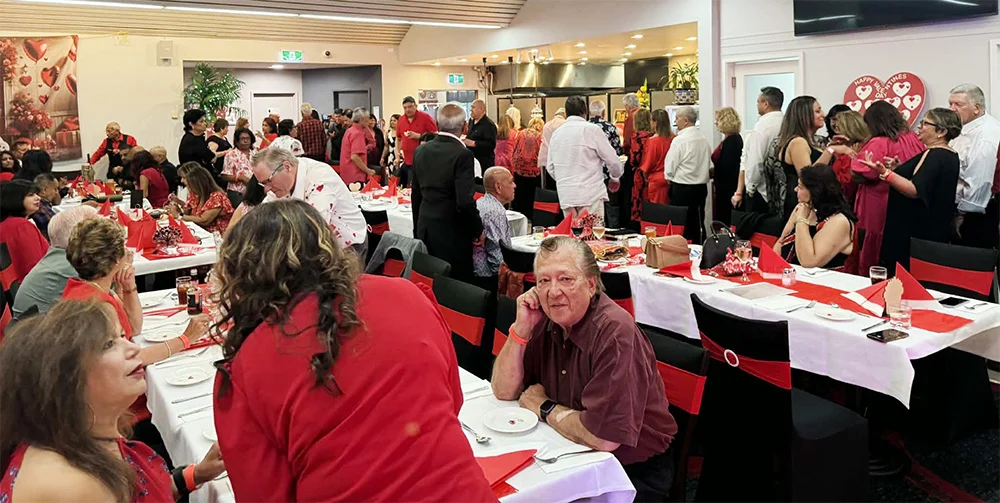
In Melbourne, Australia, catering veteran Chris Cannon hosted the annual Valentine’s Day fundraiser at the Springvale RSL, with all proceeds being donated to the Home of Compassion in Sri Lanka, run by the Mother Teresa Sisters.
The Valentine’s Day fundraiser was held on 14 February and the event featured music by Shey and George (of Redemption fame) and DJ Jeremy Ekanayake.
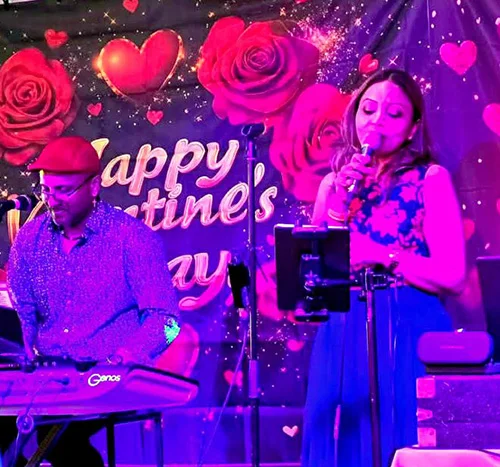
Shey and George providing the entertainment
The international buffet was a spread of Thai specialties and yummy Sri Lankan dishes and the large crowd present enjoyed the setup thoroughly, I’m told.
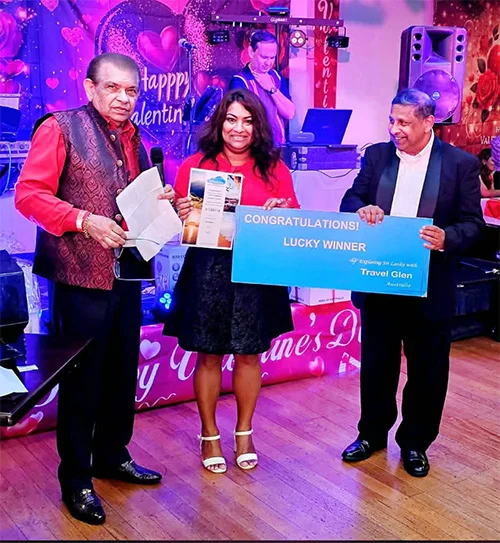
The lucky winner … trip to Sri Lanka
The Thai Street Food buffet was provided by Chris Cannon’s catering service, with his Thai wife, Annie, doing the needful.
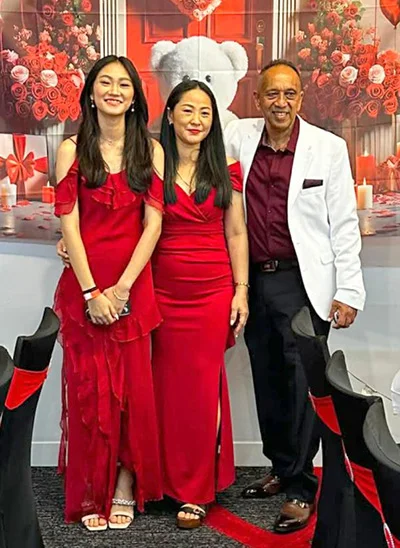
The Cannon Team: Alice, Annie and Chris
His daughter, Alice, also played an active part in this fundraiser.
Chris, a Sri Lankan-born Melbourne resident, who has been hosting this annual event for several years, with all proceeds going to charity, attributes the success of this Valentine’s Day fundraiser to the team that worked tirelessly to make it a happening event.

Rose and a teddy for the ladies
“I’m ever so grateful to the Team that was responsible for the success of this fundraiser. They all worked with enthusiasm and the smiles on their faces, at the end of the event, said it all.”
It was a sell-out, with every lady receiving a rose and a teddy but, unfortunately, said Chris “we had to disappoint several who wanted tickets as it was a limited space venue.”
What’s more, there were also attractive prizes on offer, including a seven nights stay in Sri Lanka.

Samra, Airee headline Associates’ team of the tournament

Maharoof expects ‘some hard decisions’ after Sri Lanka’s T20 World Cup exit

Matthews’ century leads West Indies to six-wicket victory

Cuba says it shot dead four people on US-registered speedboat

’Reimagining International Relations from a Global South Perspective’ offers a timely and rigorous contribution, providing key insights into policy, diplomacy, and global governance – PM

Fair weather will prevail over most parts of the island

‘Dates have the highest sugar content to fight Coronavirus’

Sunday Island 27 December – Headlines

#SundayIsland 17th December – Headlines

Sunday Island – 28th March

Sunday Island Headlines – 21 March

Sunday Island – 21st February – Headlines
-
 Features5 days ago
Why does the state threaten Its people with yet another anti-terror law?
-
 Features5 days ago
Reconciliation, Mood of the Nation and the NPP Government
-

 Features5 days ago
Victor Melder turns 90: Railwayman and bibliophile extraordinary
-

 Features4 days ago
LOVEABLE BUT LETHAL: When four-legged stars remind us of a silent killer
-
 Features5 days ago
Victor, the Friend of the Foreign Press
-
 Latest News6 days ago
New Zealand meet familiar opponents Pakistan at spin-friendly Premadasa
-
 Latest News6 days ago
Tariffs ruling is major blow to Trump’s second-term agenda
-

 Latest News6 days ago
ECB push back at Pakistan ‘shadow-ban’ reports ahead of Hundred auction