News
Sajith claims Ranil afraid of grand alliance in the making
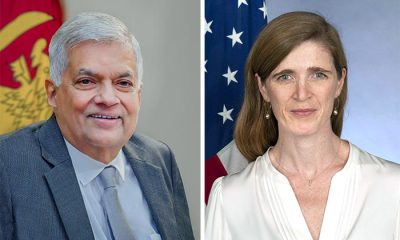
Samagi Jana Balawegaya (SJB) and Opposition Leader Sajith Premadasa, MP, has accused President Ranil Wickremsinghe of propagating lies with the help of a section of the media.
Premadasa claimed that UNP leader Wickremesinghe was afraid of the formation of a powerful political grouping, hence the stepped-up campaign of lies.
The SJB leader said so addressing a gathering in Matara on January 1. Some of the SLPP rebels have already accepted Premadasa’s candidature at the presidential election scheduled for this year.
Commenting on the exposure of the immunoglobulin scam, MP Premadasa said that 113 government MPs who voted against the no-confidence motion moved by the SJB against the then Health Minister Keheliya Rambukwella in early September last year should bear the responsibility for the deterioration of the health sector.
MP Premadasas said that President Wickremesinghe couldn’t disassociate from the health sector crisis as he was the one who protected Minister Rambukwella.
(SF)

News
First six battery energy storage systems arrive
The first six of 16 Battery Energy Storage Systems (BESS), with a total capacity of 160 MW, imported by the government, arrived at the Port of Colombo in the early hours of Saturday (30). The systems were procured under an international competitive tender called in July 2025.
According to a statement issued by the Ministry of Ports and Civil Aviation, the six BESS units will be installed near electricity transmission substations in Mahawa, Vavuniya, Chunnakam, Kilinochchi, Anuradhapura and Polonnaruwa.
Each system is capable of storing 40 MW of electricity generated during daytime hours and releasing 10 MW to the national grid during periods of peak night-time demand. Accordingly, the six systems will contribute a combined capacity of 60 MW to the national power system.
This marks the first time that Battery Energy Storage Systems are being deployed to enhance the stability of Sri Lanka’s electricity grid. The systems will be operated and managed by the National System Operator Ltd. (NSO), which comes under the Ministry of Energy, while maintenance responsibilities have been assigned to the respective suppliers.
The initiative is also expected to bring significant economic benefits to electricity consumers. While it currently costs around Rs. 115 to generate one unit of electricity using fuel, the cost of supplying a unit through the BESS systems is estimated at only around Rs. 30, according to the statement.
The government expects the project to save approximately US$ 2.6 million per month in foreign exchange currently spent on fuel-based power generation. Plans are in place to pass these benefits on to consumers in the future.
The statement further noted that the BESS systems produce no carbon emissions or air pollution, making them a fully environmentally friendly alternative. China already uses BESS technology for more than 50 percent of its power generation requirements, while developed countries, such as the United Kingdom, Germany and Australia, have also successfully adopted the technology.
News
Ambassador Prasad Kariyawasam elected Chair of the Committee on Migrant Workers
Former Foreign Secretary, Ambassador Prasad Kariyawasam, was elected by acclamation as the Chair of the United Nations Committee on the Protection of the Rights of All Migrant Workers and Members of Their Families (CMW) last Thursday (28) at the opening segment of the Committee’s 42nd session held at Palais Wilson in Geneva.
In his remarks, following the election, Ambassador Kariyawasam thanked the Committee for electing him by acclamation and emphasised the importance of adopting a strategic approach to the Committee’s future work, particularly in the context of evolving challenges in the human rights landscape and resource constraints.
Ambassador Kariyawasam, who was elected to the Committee in June 2023, will serve as Chair for a two-year term. He previously served as the inaugural Chair of the Committee, upon its establishment in 2004, and has served on the Committee for four terms.
Ambassador Kariyawasam’s vision for the Committee is deeply rooted in his extensive contribution to norm-setting processes, within the UN system, particularly on the rights of migrant workers. His decade-long expertise would contribute to address the challenges faced by migrant workers across origin, transit, and destination countries. Throughout his career, Ambassador Kariyawasam has collaborated extensively with governments, non-governmental entities, and civil society organisations to promote and protect the welfare of migrant workers.
During his previous tenures with the CMW, Ambassador Kariyawasam was actively involved in drafting several foundational General Comments issued by the Committee, contributing for promotion of migrant workers’ rights in the complex and evolving environment of the 21st century.
Ambassador Kariyawasam is a retired career diplomat, with over three decades of professional experience, both in Sri Lanka and internationally, and is a well-recognized expert in this field.
The United Nations Committee on the Protection of the Rights of All Migrant Workers and Members of Their Families (CMW) is a body of 14 independent experts that monitors the implementation of the International Convention on the Protection of the Rights of All Migrant Workers and Members of Their Families which is a core international human rights treaty.
News
The British govt.’s dog massacre
How Her Majesty’s Government used systematic canicide as psychological warfare in their campaign of terror to force the Chagossians from their homeland.
The British people pride themselves on being the greatest dog-lovers on Earth. In the nation with the oldest dog charities, public transport authorities not only permit dogs but often encourage them openly. Many pubs and shops display witty signs that read, “Dogs welcome, people tolerated,” and keep treat jars on their counters. Ironically, the Government of this cynophilic country perpetrated the world’s worst act of mass dog murder in living memory.
In one of the most grotesque acts of state-sponsored animal cruelty in modern history, the British government systematically massacred every dog on the Chagos Archipelago in the early 1970s. They did this, not as a side effect of forced expulsion, but as a deliberate instrument of psychological warfare designed to terrorise the Chagossian population into abandoning their ancestral homeland. This calculated mass canicide represents a crime both against animals and against the human families who watched their beloved pets tortured and killed before their eyes.
The Chagos archipelago formed a natural paradise. The 1,500 islanders lived self-sufficiently on an abundance of natural produce, and no extreme weather threatened them. Thriving villages, a school, a hospital, a church, a railway, and an undisturbed way of life flourished there, amid the coconut trees and the fishing boats.
The dogs of Diego Garcia and the outer Chagos islands did not only roam as strays or nuisance animals. Chagossian families cherished them as beloved members of their households, loyal companions, and integral parts of island life across generations. By rounding up, gassing, burning, and incinerating these animals systematically, British officials and US Navy personnel sent a brutally clear message to the Chagossians: your family will be destroyed, your way of life will be obliterated, and resistance is futile.
Gassing: The Primary Method of Murder Le Monde Diplomatique
revealed in 2015 that the killings began with attempts at shooting the dogs. When that missed the mark, “they tried to poison them with strychnine.” When that in turn failed, according to survivor testimony documented by People’s World in 2009, the British gassed the dogs to death using carbon monoxide or similar gas. Chagossian survivor Vine testified: “Their pet dogs were rounded up and gassed, and their bodies burned, before the very eyes of their traumatised owners.” According to Le Monde Diplomatique, “they gassed the howling animals with exhaust piped in from US military vehicles.”
The authorities chose this method for its efficiency and psychological impact. The gassing was not quick or humane. Witnesses reported that the killing process was deliberately prolonged to maximise the suffering of both the animals and the watching Chagossian families.
This detail matters: it reveals that the canicide did not arise from a spontaneous act of cruelty but from a systematic operation in which perpetrators tested different killing methods for efficiency. When shooting or poisoning proved too slow or ineffective, they moved to the more “efficient” method of gassing. The dogs thus served as literal test subjects in a programme of state-sponsored mass murder.
After gassing the dogs to death, the perpetrators incinerated and burned their bodies. In These Times documented that “they watched their dogs be gassed to death and incinerated before they were ejected from the islands.”
The burning served multiple purposes: disposal of bodies to prevent the Chagossians from burying their pets; destruction of evidence of the mass killing; inflicting additional psychological trauma as families watched the flames consume their beloved animals; and denying the Chagossians closure, as they were denied even the dignity of proper burial for their pets
Watched by the Owners: Psychological Torture
It is crucial to understand that the dogs killed were not only stray or unwanted animals. Human Rights Watch emphasised that the British and Americans killed the Chagossians’ pets. These were beloved family animals that had been kept by families for generations. They had been companions providing emotional support in isolated island communities and family members beloved by children and adults alike. The loss of these dogs represented not just the loss of property, but the destruction of the Chagossian way of life itself.
Most chillingly, the perpetrators performed the canicide in full view of the families. This was no accident or logistical necessity. The authorities intended the public nature of the killings to break the spirit of the Chagossian people by forcing them to witness the torture and murder of their beloved family members. The British government understood that watching one’s pet being gassed and burned would create psychological trauma that would last for generations. They wanted this trauma to make the Chagossians more compliant about their own forced expulsion.
The canicide was total and systematic. Every dog on Diego Garcia and the outer islands was killed, with no exceptions, no survivors. This completeness was essential to the British strategy. If any dogs had survived, the Chagossians might have maintained hope of rebuilding their lives. By eliminating all dogs, the British ensured the psychological trauma would be total and inescapable.
According to In These Times, the Chagossians “were not permitted to bring their dogs into exile”. This ensured that the trauma of the canicide would be complete: the Chagossians could not rebuild their lives with their pets in their new homeland. This trauma has been passed down through generations. Chagossian elders continue to tell their children and grandchildren about watching their pets being gassed and burned. The psychological wounds have never healed.
State-Sponsored Terrorism
Human Rights Watch confirmed that “British officials ordered the killing of the dogs on Diego Garcia, including the Chagossians’ pets.” This was not rogue action by individual contractors or military personnel. The order came from the highest levels of the British government, demonstrating that the canicide was official state policy.
The fact that British officials gave the orders makes this a state crime. The UK government authorised the systematic murder of thousands of innocent animals as a weapon of political coercion.
Le Monde Diplomatique
documented that “British government agents and US Navy personnel” carried out the killings. This reveals that this was not a purely British colonial project, but a collaborative effort between the two imperial powers who wanted the Chagos Archipelago depopulated.
The canicide sent a clear message to the Chagossians: We can destroy your family, the way we killed your beloved pets. your customs, your animals, your island existence has no value to us. Resistance is futile and you had better leave now, or worse will happen. The dog killings were a warning of what would happen to the Chagossians themselves if they resisted.
The authorities used canicide as just one element in a broader campaign that included: cutting off food and medicine supplies, economic strangulation by closing coconut plantations and stopping wages and physically loading Chagossians onto ships. The dog killings were perhaps the most psychologically destructive element because they demonstrated the British government’s willingness to commit cruelty for its own sake.
The systematic killing of thousands of dogs, using deliberately cruel and inhumane methods, for no legitimate purpose other than psychological warfare against their human owners constitutes a crime against animals. The canicide was an integral component of the broader ethnically-cleansing, which Human Rights Watch has characterised as “crimes against humanity”. The dog massacre was intended to facilitate the forced displacement of an entire people by terrorising them into compliance. This makes it not just animal cruelty but a crime against the Chagossian people.
The fact that British officials ordered the canicide and that US Navy personnel carried it out makes this state-sponsored terrorism. The British government used the torture and murder of innocent animals as a weapon to terrorise the Chagossian population into abandoning their homeland. This is not a metaphor. The canicide was terrorism in the literal sense: violence designed to create terror and force political compliance. The victims were innocent dogs and the Chagossian families who loved them.
Why the canicide must be remembered
In March 2024, the British Indian Ocean Territory (BIOT) Supreme Court overturned a longstanding ban on Chagossians visiting the outer islands of the Archipelago. This ruling represents a significant victory for Chagossian rights, though it does not yet grant the unconditional right of return to permanently resettle.
The BIOT Supreme Court ruling acknowledges that the strategy of breaking the Chagossians’ spirit has failed. They have persisted in their fight for justice for over 50 years, and the court has recognised that they have legitimate rights to their ancestral territory.
The court’s ruling implicitly acknowledges the unjust nature of the original expulsion, as well as the canicide. By allowing Chagossians to visit their outer islands, the court recognises that they maintain a legitimate connection to their homeland, despite the British government’s attempts to sever that connection through terror.
The British government has never formally acknowledged the canicide. When the dog killings are mentioned in court proceedings, they are treated as minor details rather than the crime they represent. The systematic killing of thousands of innocent animals to terrorise a human population into exile remains largely unknown to the general public.
The dogs of Chagos were innocent victims of state-sponsored terrorism. They were tortured and killed for no reason other than to serve the strategic interests of the British and American governments. Honouring their memory requires acknowledging what happened to them and the suffering they caused to their human families.
The mass torture and murder of Chagos’ innocent dogs reveal the lengths to which imperial powers will go to achieve their objectives. The canicide was no anomaly, but characteristic of colonial attitudes toward indigenous peoples and their animals.
Yet, although the dogs of Chagos may be dead, the people survive, and their fight for justice continues, a symbol of the resilience of the oppressed.
By Vinod Moonesinghe
-
News2 days agoIMF urges Lanka not to meddle with exchange rate
-
News7 days agoPolice probe underway to ascertain links between criminals deported from UAE and local politicians
-
News6 days agoEaster Sunday carnage: Court told Maulana’s statement cannot be accepted without cross-examination
-
News6 days agoUK passport holder hiding here wants to have deportation order rescinded to leave without blemish
-
Opinion6 days agoUndermining the democratic political framework
-
Features3 days agoThe Division Bell Mystery
-
Business3 days agoSri Lanka’s construction industry losing ground while no one watches
-
Midweek Review5 days agoIsraeli-US aggression won’t go unanswered -Iranian Ambassador