
Features
Preparing for ‘beyond GSP Plus’


By Neville Ladduwahetty
In the midst of all the challenges that Sri Lanka is currently facing, the prospect of having to prepare itself for a possible temporary withdrawal by the European Union (EU) of its tariff preference in favour of developing countries known as GSP+ at this particular juncture, when the whole world is desperately trying to cope with the effects of a pandemic, runs counter to the EU’s own mission of helping developing countries through GSP+. This preferential treatment is extended to Low and Middle Income countries as classified by the Word Bank. According to this classification the Gross National Income (GNI) of Low Middle Income Countries varies between $1036 and $4045, while GNI of Upper Income Countries varies between $ 4046 and 12535.
The GNI per capita in Sri Lanka has hovered around $4000 depending on the method of calculation. Therefore, reaching a GNI per capita greater than $4046 is not much of a stretch. However, the issue is that a GNI in excess of $4046 needs to be sustained for three consecutive years for Sri Lanka not to qualify for tariff preference; a benchmark that is applicable for normal global conditions. Sri Lanka reached the Upper Income Status in 2019 prior to COVID-19. If not for COVID-19 Sri Lanka could have maintained the growth momentum for three years and beyond, in which event Sri Lanka would have lost the benefits of tariff preference. The fact that no allowance is made for a shortfall in GNI per capita due to a global pandemic, the consequences of which are experienced by every country, is not only deeply regretted but also lacks acknowledgement of reality. If such an allowance is made for 2020 and 2021 there is a strong possibility that Sri Lanka could reach the Upper Income status in 2021 and the requirement for three consecutive years would have been met. In such an event Sri Lanka would have lost tariff preference for GSP+ anyway. Therefore, the EU should seriously consider adjusting the threshold for Upper Income category for countries such as Sri Lanka that hover around the lower limit of Upper Income, instead of waiving temporarily or otherwise, GSP+ based on standards that do not apply for unprecedented global catastrophes.
As stated by former Director General, Dhammika Senasinghe, for Europe, Central Asia, the EU and Commonwealth, of the Foreign Ministry of Sri Lanka at a business forum, “As Sri Lanka progress to graduate to upper middle income states in the future we will be not qualify for the GSP+ benefits, which means we would need to work out on a special trading arrangement with the EU whilst highlighting our climate change related vulnerability also under the sustainable development criteria.” (ECONOMYNEXT, June 23, 2021).
Therefore, Sri Lanka has to prepare for the day when it is not eligible to GSP+. Since this is a real prospect, the Government should set up a group that is knowledgeable and experienced in trade related issues, preferably with international experience to prepare a proposal that could serve as a blue print for negotiations with the EU. The mandate for such a team should be to provide the same tariff preferences as the current scheme, or better for substantially all trade.
GSP+ to HELP DEVELOPING
COUNTRIES
According to the European Commission, GSP+ is a “Special Incentive Arrangement for Sustainable Development and Good Governance”. Furthermore, the Commission states: “The GSP+ scheme is designed to help developing countries assume the special burdens and responsibilities resulting from the ratification of 27 core International Conventions on human and labour rights, environmental protection and good governance as well as from the effective implementation thereof. It does so by granting full removal of tariffs on over 66% of tariff lines covering a very wide array of products including, for example, textiles and fisheries”.
Despite these inducements nearly 75% of the 193 countries remain in the Low or Upper Income category, as per the World Bank. Furthermore, only eight (8) countries are beneficiaries of the GSP+ scheme. They are, Armenia, Bolivia, Cape Verde, Kyrgyzstan, Mongolia, Pakistan and Sri Lanka. Therefore, there has to be an explanation why more Low Income Countries are not attempting to take advantage of the tariff preference and work towards becoming an Upper Middle Income country. For instance, India, Nepal, Bhutan and Bangladesh are not beneficiaries. Perhaps each of these countries have negotiated and initiated arrangements outside the constraints of GSP+ Therefore, there is a need to study the policies and strategies adopted by these countries including Vietnam, in order to stay competitive without the benefits of tariff preference of GSP+.
SITUATION in SRI LANKA
The former DG cited above opined that “Sri Lanka utilization rate of facilities is around 55- 58 percent, while Pakistan is 96 percent and the Philippines is 73 percent. Confirming this situation during the 14th Trade Policy Review of the European Union held on 18th February 2020, at the WTO, Geneva, the Sri Lankan delegation stated: “judging from Sri Lanka’s two years’ experience, the utilization rate of the GSP+ facility by Sri Lankan exporters stand relatively low at 55 – 60%, due to several reasons, including difficulties of qualifying GSP preferential Rules of Origin Criteria. For instance, more than half of the apparel exports of Sri Lanka enter the EU market without availing the GSP+ facility, but paying relatively high import duties compared to other industrial goods”.
Continuing the Sri Lankan Delegation stated: “Sri Lanka is in the verge of losing the EU GSP/GSP+ benefits from 01st January 2023, if this Status continues for two consecutive years. Sri Lanka has already flagged this situation and wishes to negotiate an alternative bilateral preferential trade mechanism or alternatively, a special scheme of preferential market access for small and vulnerable countries in the upper middle-income category.
Whatever measures Sri Lanka adopts to improve the rate of utilization of facilities, the stark fact facing Sri Lanka is how to use the facilities offered by the EU when Sri Lanka is recognized as an Upper Income Country. How to prepare for such an eventuality should be the focus of the government. In such a context, the dire warnings by commentators about the prospect of losing the benefits of GSP+ on grounds of the status of Human Rights in Sri Lanka, highlighted by the UN Human Rights Commissioner and the ineffective measures adopted to address accountability and reconciliation by the Core Group, would be secondary to losing GSP+ on grounds that Sri Lanka is recognized as an Upper Income Country not only for its economic gains but also for its noteworthy achievement in the field of Human Development that in fact surpasses some of those within EU’s 27 Members.
If Sri Lanka is to undergo experiences similar to what it had to endure with the withdrawal of GSP+ in 2010 on grounds of the Human Rights situation in the country, the prediction is that many factories and commercial establishments would close down and thousands would lose employment at a time when the public is already facing unprecedented hardships due to COVID-19. Therefore, instead of waiting for the axe to fall, Sri Lanka should adopt a “proactive approach” as suggested by the Free Trade Zone Manufacturers Association (FTZMA). However, it would have been helpful if the FRZMA had specifically proposed such an approach.
GEOPOLITICAL DIMENSIONS of the EU RESOLUTION
The Resolution of the EU Parliament having given regard to related documents and a Preamble with paragraphs A to K, proceeds to adopt nineteen (19) Resolutions. Nearly all the issues Resolved either impact on issues within the domestic jurisdiction of Sri Lanka or relate to GSP+ except for paragraph 18 of the Resolution which states: “Expresses, concern about the growing role and interference of China in Sri Lanka”. The question that naturally arises is whether the real reason for Paragraphs 14 and 18 to co-exist in the same Resolution is because of genuine concern for Human Rights or because of concern for China’s “growing role and inference of China in Sri Lanka?
Paragraph 14 states: “Underlines that the GSP+ scheme offered to Sri Lanka has made a significant contribution to the country’s economy, from which exports to the EU have increased to EUR 2.3 billion, making the EU Sri Lanka’s second-largest export market; highlights the ongoing monitoring of Sri Lanka’s eligibility for GSP+ status and stresses that the continuance of GSP+ trade preferences is not automatic; calls on the Commission and the European External Action Service (EEAS) to take into due account current events when assessing Sri Lanka’s eligibility for GSP+ status; further calls on the Commission and the EEAS to use the GSP+ as a leverage to push for advancement on Sri Lanka’s human rights obligations and demand the repeal or replacement of the PTA, to carefully assess whether there is sufficient reason, as a last resort, to initiate a procedure for the temporary withdrawal of Sri Lanka’s GSP+ status and the benefits that come with it, and to report to Parliament on this matter as soon as possible”.
If the EU hopes to use a temporary withdrawal of GSP+ to make matters difficult for Sri Lanka because of China’s growing role in Sri Lanka, the EU may be acting against its own interests of staying engaged with Sri Lanka because China is bound to grab the opportunity and entrench itself even further. Therefore, it is in the interest of the EU to stay engaged with Sri Lanka and negotiate an arrangement special to Sri Lanka, conscious of the fact that Sri Lanka would not be eligible for GSP+ anyway, in the very near term.
CONCLUSION
After wading through paragraph after paragraph of the EU Resolution, the only two paragraphs that matter are paragraphs 14 and 18. While the former intends to explore the prospect of a “temporary withdrawal” of GSP+ as leverage to advance Human Rights in Sri Lanka, the latter is concerned with the “growing role and interference of China in Sri Lanka”. While a temporary withdrawal is bound to hurt Sri Lanka at a moment of unprecedented hardship due to COVID-19, there is a strong possibility that China would take advantage and step into the breach. Such an outcome would not be in the interests of the EU and the recently stated resolve of the G7 to Build Bigger and Better (B3B), in order to counter the growing global imbalance created by China’s Belt and Road initiative.
Instead, it would be far more prudent for the EU to stay engaged with Sri Lanka because doing so is in its own interest and that of the West, and recognize that Sri Lanka is on the threshold of becoming an Upper Income Country, and in keeping with such a prospect work out arrangements as stated in Article 4 of EU’s GUIDE to SRI LANKAN EXPORTERS. Article 4 states: “Sri Lanka would become ineligible for the GSP+ scheme should the EU conclude a Preferential Trade Agreement with Sri Lanka, which provided the same tariff preferences as the scheme, or better, for substantially all trade. The EU is currently not negotiating any further trade agreements with Sri Lanka”.


S. J. V. Chelvanayakam: Visionary and Statesman
S. J. V. Chelvanayakam KC Memorial Lecture Delivered at Jaffna Central Collage on Sunday, 26 April, by Professor G. L. Peiris – D. Phil. (Oxford), Ph. D. (Sri Lanka); Rhodes Scholar, Quondam Visiting Fellow of the Universities of Oxford, Cambridge and London; Former Vice-Chancellor and Emeritus Professor of Law of the University of Colombo.
I. Life and Career
Had Mr. Chelvanayakam been with us today, he would no doubt be profoundly unhappy with the state of our country and the world.
Samuel James Velupillai Chelvanayakam was born on 31 March, 1898, in the town of Ipoh, in Malaya. When he was four years of age, he was sent by his father, along with his mother, for the purpose of his education to Tellippalai, a traditional village at the northern tip of Sri Lanka, or Ceylon as the country was then called, in close proximity to the port of Kankesanturai. He attended three schools, Union College in Tellippalai, St John’s College Jaffna and S. Thomas’ College Mount Lavinia, where he was a contemporary of S. W. R. D. Bandaranaike, with whom he was later destined to sign the Bandaranaike-Chelvanayakam Pact.
He graduated in Science as an external student of the University of London, in 1918. In 1927, he married Emily Grace Barr-Kumarakulasinghe, daughter of the Maniyagar, or administrative chief for the area, appointed by the colonial government. He had four sons and a daughter. His son, S. C. Chandrahasan, worked closely with me during my time as Foreign Minister on the subject of repatriation of refugees from India. Chandrahasan’s wife, Nirmala, daughter of Dr. E. M. V. Naganathan, was a colleague of mine on the academic staff of the University of Colombo.
Mr. Chelvanayakam first contested the Kankesanturai constituency at the parliamentary election of 1947. His was a long parliamentary career. He resigned from his parliamentary seat in opposition to the first Republican Constitution of 1972, but was re-elected overwhelmingly at a by-election in 1975. He died on 26 April, 1977.
There are many strong attributes which shine through his life and career.
He consistently showed courage and capacity for endurance. He had no hesitation in resigning from employment, which gave him comfort and security, to look after a younger brother who was seriously ill. As his son-in-law, Professor A.J. Wilson remarked, he learned to move in two worlds: a product of missionary schools, he was a devout Christian who never changed his religion for political gain. He was, quite definitely, a Hindu by culture, and never wished to own a house in Colombo for fear that his children would be alienated from their roots.
Gentle and self-effacing by disposition, he manifested the steel in his character by not flinching from tough decisions. Never giving in to expediency, differences of principle with Mr. G. G. Ponnambalam, the leader of the All Ceylon Tamil Congress, of which Mr. Chelvanayakam was a principal organiser, led him to break away from the Congress and to form a new party, the Ilankai Tamil Arasu Kachchi, or the Federal Party.
During the disturbances in March and April, 1958, he was charged in the Magistrate’s Court in Batticaloa and sentenced to a week’s imprisonment. He was also subject to house arrest, but he never resorted to violence and used satyagraha to make his voice heard. When, in 1961, he was medically advised to travel to the United Kingdom for surgical treatment, he had to be escorted to the airport by the police because he was still under detention. Although physically frail and ailing in health during his final years, he lost none of the indomitable spirit which typified his entire life.
II. Advocacy of Federalism: Origins and Context
At the core of political convictions he held sacrosanct was his unremitting commitment to federalism. A moment of fruition in his life was the formation of the Federal Party, Ilankai Tamil Arasu Kachchi, on 18 December, 1949.
Contrary to popular belief, however, federalism in our country had its origin in issues which were not connected with ethnicity. At its inception, this had to do with the aspirations, not of the Tamils, but of the Kandyan Sinhalese. The Kandyan National Assembly, in its representations to the Donoughmore Commission, in November, 1927, declared: “Ours is not a communal claim or a claim for the aggrandizement of a few. It is the claim of a nation to live its own life and realise its own destiny”.
Mr. S. W. R. D. Bandaranaike, soon after his return from Oxford, as a prominent member of the Ceylon National Congress, was an ardent advocate of federalism. He went so far as to characterise federalism as “the only solution to our political problems”. With Thomas Hobbes in his famous work, The Leviathan, he conceived of liberty as “political power broken into fragments”. Bandaranaike went on to state in a letter published in The Morning Leader on 19 May, 1926: “The two clashing forces of cooperation and individualism, like that thread of golden light which Walter Pater observed in the works of the painters of the Italian Renaissance, run through the fabric of civilisation, sometimes one predominating, sometimes the other. To try and harmonise the two has been the problem of the modern world. The only satisfactory solution yet discovered is the federal system”.
Federalism had a strong ideological appeal, from a Marxist-Leninist perspective. The constitutional proposals, addressed by the Communist Party of Ceylon to the Ceylon National Congress on 18 October, 1944, go very far indeed. They envisioned the Sinhalese and the Tamils as two distinct “nations” or “historically evolved nationalities”. The high watermark of the proposals was the assertion that “Both nationalities have their right to self-determination, including the right, if they so desire, to form their own separate independent state”.
These proposals received further elaboration in a memorandum submitted to the Working Committee of the Ceylon National Congress by two leading members of the Communist Party, Mr. Pieter Keuneman and Mr. A. Vaidialingam. Their premise was set out pithily as follows: “We regard a nation as a historical, as opposed to an ethnographical, concept. It is a historically evolved, stable community of people living in a contiguous territory as their traditional homeland”.
The Soulbury Commission, which arrived in the country in December, 1944, had no hesitation in recognising that “The relations of the minorities – the Ceylon Tamils, the Indian Tamils, Muslims, Burghers and Europeans, with the Sinhalese majority – present the most difficult of the many problems involved in the reform of the Constitution of Ceylon”.
They took fully into account the apprehension expressed by the All Ceylon Tamil Congress that “The near approach of the complete transfer of power and authority from neutral British hands to the people of this country is causing, in the minds of the Tamil people, in common with other minorities, much misgiving and fear”.
III. Constitutional Provisions at Independence
The Souldbury Commission, like the Donoughmore Commission before it, was not friendly to the idea of federalism, principally because of their commitment to the unity of the body politic. Opting for a solution, falling short of federalism, they adopted the approach that, if the underlying fear related to encroachment on seminal rights by capricious legislative action, this anxiety could be convincingly assuaged by enshrining in the Constitution a nucleus of rights placed beyond the reach of the legislature.
The essence of the solution, which commended itself to the Soulbury Commission, was a carefully crafted constitutional limitation on the legislative competence of Parliament, encapsulated in Article 29(2) of the Independence Constitution. The gist of this was incorporation of the principle of non-discrimination against racial or religious communities by explicit acknowledgement of equal protection under the law.
The assumption fortifying this expectation was the attribution of an imaginative role to the judiciary in respect of interpretation. It was lack of fulfillment in this regard that precipitated a setback which time could not heal. Judicial attitudes, including those of the Judicial Committee of the Privy Council, which constituted at the time the highest tier of the judicial hierarchy, were timid and diffident.
When the Citizenship Act of 1948, by means of a new definition, sought to deprive Tamils of Indian origin of the suffrage, no protection was forthcoming from the courts on the ground of impermissible discrimination. This refusal of intervention was premised on an implausibly narrow construction of the word “community”, in that, according to the Courts’ reasoning, in the landmark case of Kodakkan Pillai v. Madanayake, Indian Tamils were not identifiable as a community distinct from the larger community of the Tamils of Ceylon. It is hard to disguise the reality that this was, at bottom, a refusal to deal with the substantive issues candidly and frontally.
The resulting vulnerability of minority rights, which judicial evasion laid bare, was a major contributory cause of the erosion of confidence on the part of minority groups. This mood of suspicion and despair, arising from an ostensibly weak method of protection of human rights, presaged ensuing developments.
IV. Further Quest for a Constitutional Solution

Chelvanayakam
The central theme of this lecture, in honour of a statesman who was an epitome of restraint and moderation, is that the deterioration of ethnic relations, which culminated in a war of unrivalled savagery over a span of three decades, was progressive and incremental. There was no inevitability about the denouement. It was gradual and potentially reversible. At several crucial points, there was opportunity to arrest a disastrous trend. These windows of opportunity, however, were not utilised: extremist attitudes asserted themselves, and polarisation became the outcome. This trajectory was, no doubt, met with dismay by far-sighted leaders of the calibre of Mr. Chelvanayakam.
The formation of the Federal Party was a turning point. With Mr. S.J.V. Chelvanayakam, King’s Counsel, as founder-president, and Dr. E.M.V. Naganathan and Mr. V. Navaratnam as joint secretaries, the party embarked on a journey which marked a radical departure from the conventional thinking of the past. This was plain from the text of seven resolutions adopted at the national convention of the party held in Trincomalee in April, 1951. The foundation of these resolutions was the call to establish a Tamil state within the Union of Ceylon, and the uncompromising assertion that no other solution was feasible.
The path was now becoming manifest. The demand up to now had been for substantial power sharing within a unitary state. This was now giving way to a strident demand for the emergence of a federal structure, destined to be expanded in the fullness of time to advocacy of secession.
Although standing out boldly as a landmark in constitutional evolution, the Federal Party resolutions did not carry on their face the hallmark of finality or immutability. The call of the Tamil leadership for secession yet being some years away, the ensuing decades saw further attempts by different governments to resolve the vexed issues around power sharing.
The first of these was the Bandaranaike-Chelvanayakam pact, signed by the Prime Minister and the leader of the Federal Party on 26 July, 1957. There was an air of uneasy compromise surrounding the entire transaction. This was evident from the structure of the pact, which, as one of its integral parts, contained a section not reduced to writing in any form, but consisting of a series of informal understandings.
The essence of the pact was the proposed system of regional councils which were envisaged as an intermediary tier between the central government and local government institutions. This did break new ground. Not only did the pact confer on the people of the North and East a substantial measure of self-governance through these innovative councils, including in such inherently controversial areas as colonisation, irrigation and local management, but territorial units were conceived of as the recipients of devolved powers. Of particular significance, the regional councils were to be invested with some measure of financial autonomy. The blowback, however, was so intense as to compel the government to abrogate the pact.
The next attempt, eight years later, was by the United National Party, which had vehemently opposed the Bandaranaike–Chelvanayakam Pact. This was the Dudley Senanayake–Chelvanayakam Pact, signed between the leader of the United National Party, at the time Leader of the Opposition, and the leader of the Federal Party. It differed from the Bandaranaike–Chelvanayakam Pact, both contextually and substantively.
As to context, it was signed on 24 March, 1965, on the eve of a parliamentary election, to ensure for the United National Party the support of the Federal Party. A disheartening feature was the plainly evident element of duplicity. Once in government, the Prime Minister’s party showed little interest in implementing the pact. Within three years, the Federal Party left the government, and its representative in the cabinet, Mr M. Tiruchelvam QC, Minister of Local Government, relinquished his portfolio.
Substantively, the lynchpin of the pact was a system of district councils, but there was entrenched control of these bodies by the central government, even in regard to action within their vires. This was almost universally seen as a sleight of hand.
Despite the collapse of these efforts, room for resilience and accommodation had by no means disappeared. Nowhere is this better exemplified than in the events which led up to the drafting and adoption of the “autochthonous” Constitution of 1972. This involved the historic task of severing the centuries-old bond with the British Crown and bringing into being the Republic of Sri Lanka.
One of the Basic Resolutions, which eventually found expression as Article 2 of the new Constitution, characterised Sri Lanka as a unitary state. The Federal Party proposed an amendment that the word “federal” should be substituted for “unitary”. Mr. V. Dharmalingam, the spokesman for the party on this subject, in his address to the Constituent Assembly, on 16 March, 1971, showed flexibility by declaring that the powers of the federating units and their relationship to the centre were negotiable, once the principle of federalism was accepted. Indivisibility of the Republic was emphatically articulated, self-determination in its external aspect being firmly ruled out.
There was no reciprocity, however. Mr. Sarath Muttettuwegama, administering a sharp rebuke, declared: “Federalism has become something of a dirty word in the southern parts of this country”. The last opportunity to halt the inexorable march of events was spurned.
The pushback came briskly, and with singular ferocity. This was in the form of the Vaddukoddai Resolution adopted by the Tamil United Liberation Front at its first national convention held on 14 May, 1976. The historic significance of this document is that it set out, for the first time, in the most unambiguous terms, the blueprint for an independent state for the Tamil nation, embracing the merged Northern and Eastern Provinces. The second part of the Resolution contained the nucleus of Tamil Eelam, its scope extending beyond the shores of the Island. The state of Tamil Eelam was to be home not only to the people of the Northern and Eastern Provinces, but to “all Tamil-speaking people living in any part of Ceylon and to Tamils of Eelam origin living in any part of the world who may opt for citizenship of Tamil Eelam”.
The most discouraging element of this sequence of events was the timid and evasive approach adopted by prominent actors at crucial moments. The District Development Councils Act of 1980 presented a unique opportunity. Disappointingly, however, the Presidential Commission, presided over by Mr. Victor Tennekoon QC, a former Chief Justice and Attorney General, lacked the courage even to interpret the terms of reference as permitting allusion to the ethnic conflict. Despite the persevering efforts of Professor A.J. Wilson, son-in-law of Mr. Chelvanayakam, and a confidant of President J.R. Jayewardene, and Dr. Neelan Tiruchelvam, the majority of the members were inclined to adopt a narrow, technical interpretation of the terms of reference. The setting of the legislation was one in which Tamil formations, such as the Tamil United Liberation Front, were struggling to maintain their moderate postures in an increasingly polarised environment, with pressure from radical elements proving almost irresistible.
The whole initiative paled into insignificance in comparison with a series of tragic events, including the burning of the Jaffna library during the run-up to the District Development Council elections in the North and the calamitous events of Black July 1983. Policymakers, at a critical juncture, had, once again, let a limited opportunity slip through their fingers.
The next intervention occurred in the sunset years of the United National Party administration. This was the Parliamentary Select Committee on the ethnic conflict, known after its Chairman as the Mangala Moonesinghe Committee, appointed in August, 1991.
The Majority Report made a detailed proposal which was intended to serve as the basis of a compromise between two schools of thought—one stoutly resisting any idea of merger of the Northern and Eastern Provinces, and the other demanding such merger as the indispensable basis of a viable solution. An imaginative via media was the concept of the Apex Council, which formed the centrepiece of the Majority Report. It adopted as a point of departure two separate Provincial Councils for the North and the East. This dichotomy would characterise the provincial executive as well: each Provincial Council would have an Executive Minister as the head of the Board of Ministers. However, over and above these, the two Provincial Councils together would constitute a Regional Council for the entire North-East region. Although presenting several features of interest, as a pragmatic mediating mechanism, the proposal did not enjoy a sufficiently broad support base for implementation. (To be concluded)
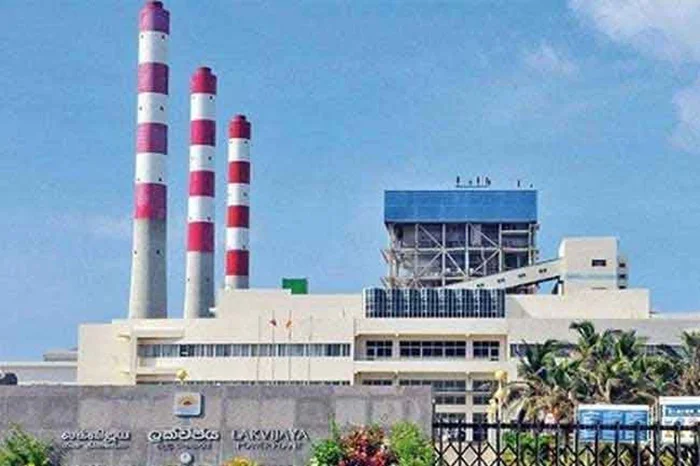
Coal crisis far worse than first feared
Sri Lanka’s coal supply crisis is significantly deeper than previously understood, with senior engineers and energy analysts warning that a dangerous combination of reduced procurement volumes, rising coal consumption and shipment delays could place national power generation at serious risk.
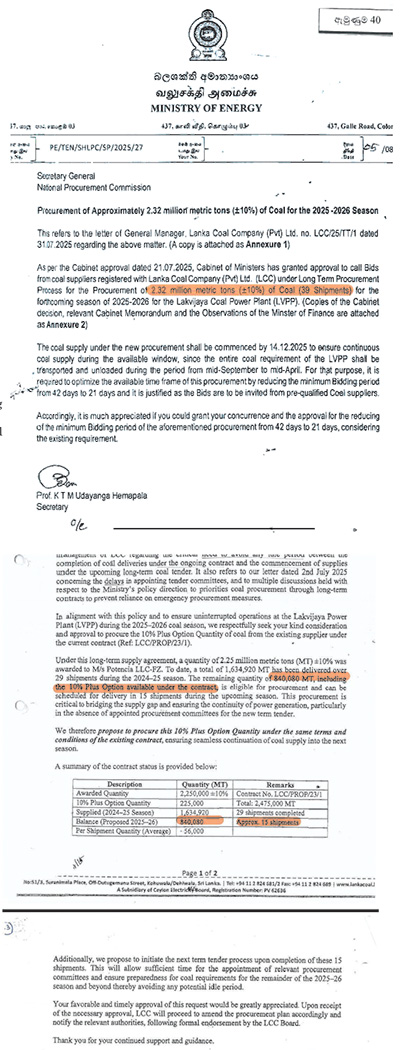
Information reviewed by The Island shows that Lanka Coal Company (LCC) had originally planned to secure 2.32 million metric tons of coal for the relevant supply period to meet generation requirements at the Lakvijaya coal power complex.
Following procurement discussions, the final arrangement was to obtain 840,000 metric tons from Potencia, including a 10 percent optional quantity, and 1.5 million metric tons from Trident, equivalent to 25 vessels.
However, subsequent decisions resulted in the cancellation of four Potencia shipments, reducing that supplier’s volume to 627,000 metric tons. This brought the total expected procurement down to 2.16 million metric tons, creating an immediate 160,000 metric ton deficit, even before operational demand is considered.
 “This is a major shortfall in any generation planning model,” a senior engineer familiar with coal operations said. “When stocks are planned to the margin, a reduction of this scale can have serious consequences.”
Power sector sources said the deficit becomes more critical because coal consumption rates have increased by more than 10 percent, meaning larger volumes are now required to generate the same electricity output.
“In simple terms, the system is burning more coal for less efficiency,” an energy analyst told The Island. “That means the real shortage may be substantially larger than the paper shortage.”
Experts attributed the higher burn rate to ageing equipment, maintenance constraints and operating inefficiencies at the Norochcholai plant.
A third concern has now emerged in the form of shipment delays and possible unloading constraints, raising fears that even contracted supplies may not arrive in time to maintain safe reserve levels.
“If vessel schedules slip or unloading is disrupted, stocks can fall very quickly,” another senior engineer warned. “At that point, the country has little choice but to shift to costly thermal oil generation.”
Such a move would sharply increase electricity generation costs and place additional pressure on public finances.
Analysts said the convergence of three separate risks — procurement reductions, higher-than-expected consumption and delivery uncertainty — had created a serious energy planning challenge.
“This is no longer a routine procurement issue,” one industry observer said. “It has become a national power security issue.”
Calls are growing for authorities to disclose current coal inventories, incoming vessel schedules and contingency measures to reassure the public and industry.
With electricity demand expected to remain high and hydro resources dependent on rainfall, engineers caution that delays in addressing the coal gap could expose the country to avoidable supply disruptions in the months ahead.
By Ifham Nizam

LETTER
The capsizing of two boats in Lake Gregory on 19 April was merely an isolated incident. It has come as a stark and urgent warning that a far more serious tragedy is imminent unless decisive action is taken without delay.
Mayor of Nuwara Eliya, Upali Wanigasekera has publicly stated that stringent measures have been introduced to prevent similar occurrences. However, it must be noted that such measures are unlikely to yield meaningful results in the absence of a comprehensive regulatory framework governing Inland Water Adventure Tourism (IWAT) in Sri Lanka.
For decades, this sector has operated without any regulation. Despite repeated calls for reform, there remains no structured legal mechanism to oversee operational standards, safety compliance, or accountability. Consequently, there is chaos particularly in critical operational aspects of this otherwise vital tourism segment.
The situation in Lake Gregory is not unique. Other prominent inland tourism destinations, such as Kitulgala and Madu Ganga, face similar risks. Without urgent intervention, it is only a matter of time before a major calamity occurs, placing both local and foreign tourists in grave danger.
At present, there appear to be no enforceable legal requirements governing:
* The fitness for navigation of vessels
* Mandatory safety standards and equipment
* Certification and competency of boat operators
The display of permits issued by local authorities is often misleading. These permits function merely as revenue licences and should not be misconstrued as certification of compliance with safety or technical standards.
Furthermore, local authorities themselves appear constrained. The Nuwara Eliya Mayor is reportedly limited in his ability to enforce meaningful improvements due to the absence of legal backing. Compounding this issue is the proliferation of unauthorised operators at Lake Gregory, functioning with minimal oversight.
Disturbingly, there are credible concerns that some boat operators function under the influence of intoxicants, while enforcement authorities appear to maintain a lackadaisical stance. The parallels with the unregulated private transport sector are both evident and alarming.
In the absence of a proper legal framework, any victims of such incidents are left with no recourse but to pursue lengthy and uncertain claims under common law against individual operators.
The Minister of Tourism, this situation demands your immediate and personal intervention.
A robust regulatory framework for Inland Water Adventure Tourism must be urgently introduced and enforced. This should include licensing standards, safety regulations, operator certification, regular inspections, and strict penalties for non-compliance.
Failure to act now will not only endanger lives but also severely damage Sri Lanka’s reputation as a safe and responsible tourist destination.
The time for incremental measures has passed. What is required is decisive policy action.
Athula Ranasinghe
Public-Spirited Citizen

Police officers donate LKR 9,687,462 from day’s salary to ‘Rebuilding Sri Lanka’ Fund

Iran’s top diplomat in Russia as Tehran intensifies efforts to end the war

Rinku, Narine win Kolkata Knight Riders error-strewn Super Over game

Rabada and Sudharsan crush Chennai Super Kings

Showers or thundershowers will occur at several places in most parts of the island after 1.00 pm

Heat Index at Caution Level in the Northern, North-central, North-western, Western, Sabaragamuwa, Southern, and Eastern provinces and in Monaragala district during the day time

‘Dates have the highest sugar content to fight Coronavirus’

Sunday Island 27 December – Headlines

#SundayIsland 17th December – Headlines

Sunday Island – 28th March

Sunday Island Headlines – 21 March

Sunday Island – 21st February – Headlines
-
 News7 days ago
Rs 13 bn NDB fraud: Int’l forensic audit ordered
-

 News5 days ago
Lanka faces crisis of conscience over fate of animals: Call for compassion, law reform, and ethical responsibility
-
 News4 days ago
Whistleblowers ask Treasury Chief to resign over theft of USD 2.5 mn
-

 News4 days ago
No cyber hack: Fintech expert exposes shocking legacy flaws that led to $2.5 million theft
-

 News20 hours ago
BIA drug bust: 25 monks including three masterminds arrested
-

 Business2 days ago
Nestlé Lanka Announces Change in Leadership
-
 News5 days ago
USD 2 mn bribe: CID ordered to arrest Shasheendra R, warrant issued against ex-SriLankan CEO’s wife
-
 News2 days ago
Hackers steal $3.2 Mn from Finance Ministry