
Sports
Practical ideas for young high jumpers, athletes, parents, teachers and coaches


An Olympian writes
by Nagalingam Ethirveerasingam
In villages and urban areas in Sri Lanka children play softball cricket, soccer, running and jumping after school, weekends and during end-of-term holidays. This article is based on my experience from 1943. Children can use space available in areas near their houses or in space available around their house. Children are creative, to plan, execute and resolve their problems and learn from their errors.
It is important for children to actively take part in sports with whatever facilities available. If none are available to make them, they can play indigenous games that uses legs, hands, running, jumping, balls, seeds, marbles to create strategies, problem solving and decision making, and learn social and sportsmanship skills. In all games the participants will learn to abide by the rules and decision made by the Referee or Umpire.
In athletics, we dug high jump and pole vault pits. We loosened the soil with a spade. The high jump and pole vault posts were two thick straight branches from the Poovarasu tree planted permanently with nails driven two inches apart. The bar was a one-inch thick branch of the same tree. The pole was a straight branch thicker than the cross bar.
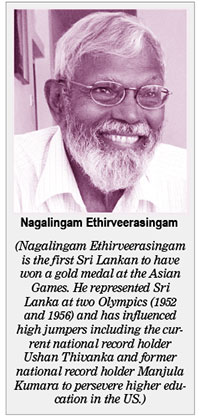 At school, the high jump, long jump, triple jump and pole vault pits were filled with sand. The pole vault standards were made of wood with a base. It had a movable part inside the main post that can be raised to 12 or 13 ft. For high jump the same posts or posts 6’ 6″ with a base is used. All wooden posts were made by carpenters in Jaffna adopting design in sports books or modeled after the posts in schools in Colombo. The poles were bamboo of different length and thickness. They were cured in fire made from dry leaves to strengthen them.
The loosened soil or sand in the jumping pit dictated we land in one or both feet in the high jump or pole vault. The bar clearance was sideways or chest facing the bar. In the high jump most used the scissors style and land in one or both feet. Older jumpers used Eastern Cut Off. In that style they ran from the front of the bar, made a curve going outside one of the posts and took off with one foot.
In 1948 we read in the papers the results of the athletic events. We saw the pictures of events. We saw Harrison Dillard won the 100m. Australian John Winter won the high jump using the Eastern Cut-Off style. In 1949 my school Principal, Rev. C.A. Smith took the whole school to see the London Olympics at the Regal Theatre near the Fort. We saw the 400m hurdles and Duncan White winning Silver Medal. It is then I wanted to compete in an Olympic Games someday. Did not tell anyone. I did not think at that time that I will take part in the 1952 Olympics in Helsinki.
I am sure a 14-year-old or older watching the 2020 (2021) Olympics on television will be inspired to train to take part in the 2024 Paris Olympic Games or Los Angeles Games in 2028.
If you are a beginning high jumper dreaming of competing in future Olympic Games, start with jumping using the scissors style. But with a run-up with a 4-stride curve at the end before you take-off. A sand pit, or a pit with loosened soil is sufficient. The posts and bar can be from branches like described above. This advice is for high jumpers, coaches and parents. Such beginning will help to learn the fundamentals of high jumping and requirements for a technically correct run-up and take-off. It will help to clear the bar using the flop style. When you can jump 1.55m or 1.60m with scissors you can then learn to jump using the flop from an experienced coach who has coached high jumpers who had jumped at least two metres or higher.
Many people, parents and teachers often assume that, jumping, running, hurdling and throwing does not teach children about what is required by the curricula and National Examinations. This is far from the truth. Athletics, cricket, football and other games teach principles of science, especially physics. We learn principles of social science, mathematics and about the working of the muscles, exhaustion, recovery and abiding by the rules of the games and decisions of referees and umpires. A sportsperson is consumed by sports and desire to excel they spend much of their study time daydreaming or figuring out how best to practice and perform better.
The best way the education system can help the sportspersons to do well in sports and studies is to require students to earn credit passes in the subjects at the end of a term to represent the school and take part in sports. The sportspersons will earn the Credit pass grade to represent the school and take part in sports. Such a system is practiced in the school and university system in the United States. Those who represent the United States in the Olympic Games or win medals are all either students in universities or graduates of universities. Sri Lanka athletes and sportspersons have the same capacity to be great in studies and sports if opportunities to learn and compete.
The choice is ours to motivate and give the opportunities to our sportspersons to excel in sports, studies and profession.



England Women 81 for 3 in 13.5 overs (Sophia Dunkley 22, Mala Bouchier 19*, Heather Knight 18; Bree Illing 1-20, Nensi Patel 1-07, Melle Kerr 1-18) beat New Zealand Women 80 in 19.1 overs (Isabella Gaze 17, Maddy Green 14, Jess Kerr 20; Linsey Smith 2-15, Issy Wong 1-20, Sophia Ecclestone 1-11, Charlie Dean 3-13, Dani Gibson 3-14) by seven wickets

Royal Challengers Bengaluru [RCB] might look at Gujarat Titans [GT] across the ring in Qualifier 1 of IPL 2026, and wonder if they helped create this monster. When GT went to Bengaluru on April 24, they were still a conservative side straddling the middle of the table, and happy with a 57-ball hundred from their opener. But they have been a changed unit since RCB cruised to that chase of 206 against them that day.
Since that match, the halfway point for GT, their run rate has increased by nearly a run per over. That is 20 runs per innings. By the time they faced RCB next, they were giving more importance to balls remaining than to wickets in hand while chasing. When batting first, GT were looking to score above par; there has been a pair of 229s in the two matches they have batted first in since that Bengaluru debacle.
The thing with GT is that they have a team with such strong basics that they don’t need to make only subtle changes to their approach. Their control rate has gone from 80% to 75%. A little more risk, a lot more rewards. Their bowling has only become more streamlined over this period with Jason Holder adding constant threat to an already good attack. The result is a 6-1 win-loss record in the second half of their tournament.
RCB, though, have been solid throughout, carrying forward the change in approach that took them to the title last year. They won five in the first half and four in the second. They have consistently looked to finish matches early or set above-par scores when batting first. A second consecutive top-two finish is just rewards for being the most consistently good side over this period.
They will want to make it straight from Dharamsala to Ahmedabad, where they won their first title last year. Not only to make the final but to also hope to avoid meeting GT in a final at their home, something that should be the right of defending champions. Not least because GT are on a four-match winning streak at home, which includes two wins despite losing the toss.
RCB have used the fewest number of players this IPL, a sign of a settled unit. It would certainly have been fewer if not for the injury to Phil Salt, who is now back in India and racing against time to be ready in time for the playoffs. If he doesn’t make it, though, it brings in the temptation to drop Suyash Sharma for Jacob Duffy considering Suyash has not had a great IPL, and night games in Dharamsala can negate spinners. In fact, Dharamsala hosted the only completed match this season where no spin was used.
Venkatesh Iyer has made a case for himself in the limited opportunities he has got, but Salt should be a no-brainer as opener if he is fit.
Royal Challengers Bengaluru (probable): Virat Kohli, Phil Salt/Venkatesh Iyer, Devdutt Padikkal, Rajat Patidar (capt), Jitesh Sharma, Romario Shepherd, Tim David, Krunal Pandya, Bhuvneshwar Kumar, Jacob Duffy/Suyash Sharma, Josh Hazlewood, Rasikh Salam
GT have played the second-fewest number of players. They seem to have their first XI figured with Nishant Sindhu being persisted with as the extra batter. Their only doubt remains around the Impact Player: extra fast bowler in Prasidh Krishna or extra spinner in R Sai Kishore or Manay Suthar.
Gujarat Titans (probable): Shubman Gill (capt), B Sai Sudharsan, Jos Buttler (wk), Washington Sundar, Jason Holder, Rahul Tewatia, Nishant Sindhu, Rashid Khan, Arshad Khan, Kagiso Rabada, Mohammed Siraj, Prasidh Krishna/R Sai Kishore/Manav Suthar
[Cricinfo]

Aken Thilakawardhana produced an impressive all-round display as St. Sylvester’s registered a huge 101-run victory over Sri Rahula, Katugastota in their Under 17 Division I first round cricket encounter at Katugastota on Monday.
Chasing a target of 219 runs for victory, the home team never looked in contention as wickets fell at regular intervals before they were bowled out for 117 runs in the 34th over.
St. Sylvester’s bowlers struck early to put Sri Rahula under pressure, with Sasiru Dineth and Sakuna de Silva reducing the hosts to 18 for three wickets. Aken then joined the attack to further dismantle the batting line-up, claiming three wickets to cap an outstanding all-round performance.
Aken, who had earlier contributed a valuable 48 runs with the bat, finished with impressive figures of 3 for 24.
Sri Rahula’s innings was led by Savinu Mendis, who top scored with 28 runs, but lacked support from the other batsmen as St. Sylvester’s maintained control throughout the chase. Sasiru Dineth returned figures of 3 for 33, while Sakuna de Silva too two for 23.
Earlier, put to bat first, St. Sylvester’s posted a competitive 218 all out in 49.2 overs after receiving a brisk start from opener Adithya Ranamukage. He raced to a half-century in just 35 deliveries, smashing nine boundaries and two sixes in an aggressive knock.
Nithil Herath contributed 25 runs, Keshan Perera made 27, while Aken added 48 to strengthen the innings. Vihanga Perera also chipped in with 23 runs.
For Sri Rahula, Chamindu Sathsara was the pick of the bowlers with 3 for 55, while Shehan Weddagala, Praboth de Silva and Savinu Mendis claimed two wickets apiece.
Scores:
St. Sylvester’s
218 all out in 49.2 overs (Adithya Ranamukage 50, Nithil Herath 25, Keshan Perera 27, Aken Thilakawardhana 48, Vihanga Perera 23; Shehan Weddagala 2/31, Chamindu Sathsara 3/55, Praboth de Silva 2/24, Savinu Mendis 2/31)
Sri Rahula Katugastota
117 all out in 33.2 overs (Savinu Mendis 28; Sasiru Dineth 3/33, Sakuna de Silva 2/23, Aken Thilakawardhana 3/24). (RF)

Cabinet approves sale of Paddy stocks held by the Paddy Marketing Board
Amendment to the Promotion of Export Agriculture Act, No. 46 of 1992 to be gazatted
Ms. M.K.D.N. Madampe, appointed as Director General of the Department of Management Services

Cabinet approves collaboration agreement between Sri Lanka and Brazil for the implementation of the “Sugarcane Project in Sri Lanka”
Cabinet approval for Implementation of a Project for the Joint Exchange of Genetic Resources between Sri Lanka and Vietnam and the Development of High-Yielding and Salinity-resilient Rice Varieties.

Landslide Early Warnings issued to the Districts of Kalutara, Kegalle, Nuwara Eliya and Ratnapura extended till1600 hrs on Wednesday [27]

‘Dates have the highest sugar content to fight Coronavirus’

Sunday Island 27 December – Headlines

#SundayIsland 17th December – Headlines

Sunday Island – 28th March

Sunday Island Headlines – 21 March

Sunday Island – 21st February – Headlines
-

 Features7 days ago
Octopus, Leech, and Snake: How Sri Lanka’s banks feast while the nation starves
-

 Sports7 days ago
Sri Lanka women’s volleyball team ready for Central Asian challenge
-
 Opinion6 days ago
Murder of Ehelepola family, Bogambara Wewa and Sightings of Wangediya
-

 Business5 days ago
Historic launch of CCWE Fashion Week & International Summit 2026
-
 News6 days ago
Steps underway to safeguard Sri Lanka’s maritime heritage
-

 News2 days ago
Police probe underway to ascertain links between criminals deported from UAE and local politicians
-

 Features3 days ago
The NPP’s pivot to the past
-

 Editorial6 days ago
A play without its protagonist