
Midweek Review
Post-war military matters and concerns

This year’s annual Indian Navy–Sri Lanka Navy bilateral maritime Exercise SLINEX was conducted amidst political turmoil here. The six-day SLINEX, the 10th edition of the series commenced three days after the launch of a public protest campaign near President Gotabaya Rajapaksa’s private residence at Pangiriwatte, Mirihana. The two-phased exercise involved several Indian vessels INS Kiltan (Advanced Anti-Submarine Warfare Corvette) and INS Savitri (Offshore Patrol Vessel), SLNS Gajabahu (Advance Offshore Patrol Vessel/The one in which President Gotabaya Rajapaksa took refuge on July 09) and SLNS Sagara (OPV). In addition, Indian Navy Chetak helicopter and Dornier Maritime Patrol Aircraft and SLAF Dornier and BELL 412 helicopters participated in the exercise. The Exercise featured the Special Forces of the two Navies. The previous edition of SLINEX was conducted in Visakhapatnam from 7-12 March 2022.
By Shamindra Ferdinando
The Indian Defence Research Wing (government website) recently declared that Australia would provide a former Royal Australian Air Force Beechcraft KA 350 King Air (registration A32-673) to Sri Lanka on a request made by India. The KA350 King Air is a modern twin-engine turboprop aircraft.
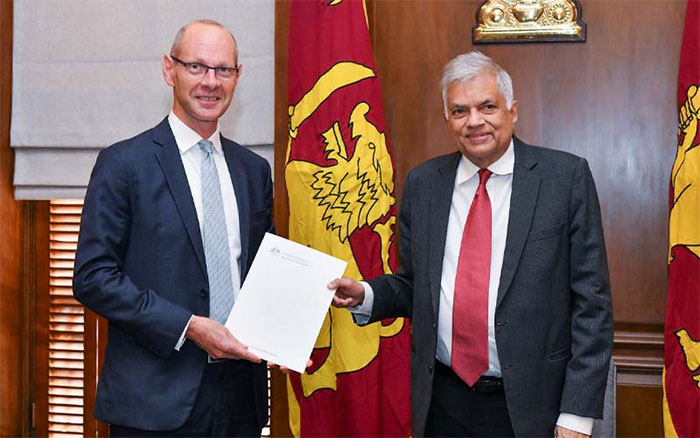
The story, posted on 16 May, four days after Australian High Commissioner to Sri Lanka, Paul Stephens, officially informed President Ranil Wickremesinghe, who is also the Defence Minister and Commander-in-Chief of the armed forces of the move, was headlined ‘Australia to donate Beechcraft KA 350 to Sri Lanka upon India’s request.’
HC Stephens was accompanied by Deputy High Commissioner Ms. Lalita Kapur, First Secretary Brett Zehnder and Defence Advisor Captain Ian Cain. The meeting took place at the Presidential Secretariat, the scene of violent confrontation between President Gotabaya Rajapaksa’s administration and the protest movement, a year ago.
The Indian website asserted that the Australian move mirrored New Delhi’s bid to strengthen security ties with Sri Lanka as part of its Indian Ocean outreach. According to the website, the deployment is meant to boost Sri Lanka’s sovereign aerial maritime surveillance capability. In terms of the agreement between the two governments, the donor would support the operation of the aircraft for a period of 12 months.
The President’s Media Division (PMD) announced: “The gift of the aircraft is part of the Australian Government’s commitment to strengthening and enhancing the cooperation and collaboration that is the foundation of the strong bilateral relationship between Australia and Sri Lanka. A key focus of this relationship remains the continued cooperation on countering all forms of transnational crime, including drug smuggling, as well as strengthening border management through intelligence sharing and the deterrence, disruption, interception and return of maritime people smuggling ventures under the border security operation, known as Operation Sovereign Borders.”
Operation Sovereign Borders is a high profile military led mission, launched in 2013, to thwart illegal entry of would-be asylum seekers. The change of governments, over the past decade, hasn’t undermined the high profile operation as major political parties are committed to block illegal migration whatever the consequences.
The donation of the aircraft is in line with the understanding the two countries reached following a visit undertaken by Australian Home Affairs Minister Clare O’Neil, from June 19-21 last year, amidst deepening political turmoil here. She met the then President Gotabaya Rajapaksa, Premier Ranil Wickremesinghe, as well as Foreign Minister Prof. G. L. Peiris. A year later, Wickremesinghe is at the helm and Gotabaya Rajapaksa ousted by a US-backed protest campaign, as alleged by former Minister Wimal Weerawansa, a claim denied by the US mission here, but not denied by Speaker Mahinda Yapa Abeywardena, a key protagonist referred to by the accuser.
In April and June 2014, Sri Lanka took delivery of two 38.2 m long Australian patrol boats and they were commissioned as SLNS Mihikatha and SLNS Ratnadeepa. Both vessels are in service today. It would be pertinent to mention that the talks, on the transferring of vessels, were finalized in Colombo when the then Australian Premier Tony Abbott visited Colombo for the Commonwealth Heads of Government of Meeting (CHOGM). The Australian move was made in the wake of the UK going all out against Sri Lanka over the accountability issues.
In the following year, the then Sri Lanka’s shameless government co-sponsored the US–led accountability resolution at the Geneva-based United Nations Human Rights Council (UNHRC) against one’s own country.
India, Australia strategy
In late August last year, Australia announced an unprecedented move to pay for a part of Sri Lankan military’s fuel requirement. Australian High Commissioner in Colombo Paul Stephens tweeted:
“Australia is pleased to be working with India to provide fuel to Sri Lanka’s Navy and Air Force. It will help our long-standing cooperation, against transnational crime, to continue. As Indian Ocean neighbours, all three countries share a commitment to preserving regional security.”
India and Australian joint approach here should be examined against the backdrop of ‘Quad’ strategy in relation to Sri Lanka. However, India pursues its own policy in terms of India’s policy of ‘Neighbourhood First’, ‘Security and Growth for all in the Region (SAGAR),’ as well as ‘Priority One’ partner. ‘Quad’ security alliance meant to counter growing Chinese influence consists of the US, Japan, Australia and India. Sri Lanka has been caught up in the China vs ‘Quad’ battle and Sri Lanka’s dependence on Chinese investments made the situation worse.
The US has included Sri Lanka in its military exercises programme while the other ‘Quad’ member Japan entered into the ‘Comprehensive Partnership’ Agreement in October 2015.
Sri Lanka took delivery of a Dornier 228 maritime patrol aircraft, from India, in mid-August last year. The SLAF declared that India made available the aircraft in response to a request made during the Yahapalana administration (2015-2019). India assured that another Dornier would be supplied within two years after the deployment of the first naval Dornier – a short takeoff and landing multirole light transport aircraft with a turboprop twin-engine, in production since 1981.
An Indian statement said: “The aircraft would act as a force multiplier, enabling Sri Lanka to tackle multiple challenges, such as human and drug trafficking, smuggling and other organized forms of crime, in its coastal waters, more effectively. Induction of the aircraft is timely in view of the current challenges to Sri Lanka’s maritime security.”
Bankrupt Sri Lanka should be grateful for Australian and Indian stepped up assistance at a time the country is experiencing a deepening economic-political-social crisis. Obviously, the crisis here can be a push factor for more Sri Lankans to risk their lives to reach foreign lands. However, the military’s growing dependence on foreign assistance must be a matter for concern for all as there is always the danger of being smothered by the giant neighbour or being unnecessarily dragged into a wider conflict between between the Quad on one side and Russia and China on the other.
Recently, India announced further help to the SLAF. The announcement was made during the four-day official visit of Chief of Air Staff Indian Air Force Air Chief Marshal V. R. Chaudhari earlier this month. The Indian air chief was here on the invitation of SLAF Commander Air Marshal Sudarshana Pathirana.
During the visit, Air Chief Marshal V.R. Chaudhari laid the foundation stone for the construction of the India-Sri Lanka Friendship Auditorium at the Air Force Academy, Trincomalee. In line with New Delhi’s ‘Neighbourhood First Policy,’ the project would be carried out under a 250 mn LKR grant assistance from India. The Indian air chief also donated AN-32 propellers to the SLAF, at the China Bay Air Force Academy, and at the National Defence College training aids were donated to students.
In addition to massive economic assistance provided in the recent past to Sri Lanka struggling on the financial front, the Indian investment, in the defence sector, is rapidly growing.
Deputy High Commissioner Vinod K. Jacob, in late February this year, underscored the Indian investment when he addressed the Indian Navy-trained Sri Lankan military personnel on board Offshore Patrol vessel Sukanya in Colombo. The Indian High Commission quoted Jacob as having stressed that training is the strongest and most enduring pillar of bilateral defence cooperation between India and Sri Lanka. The Deputy High Commissioner declared that India offered approximately 1500 training slots every year, to Sri Lanka, financed through a special programme with an annual allocation of USD 7 million.
Security sector reforms
-
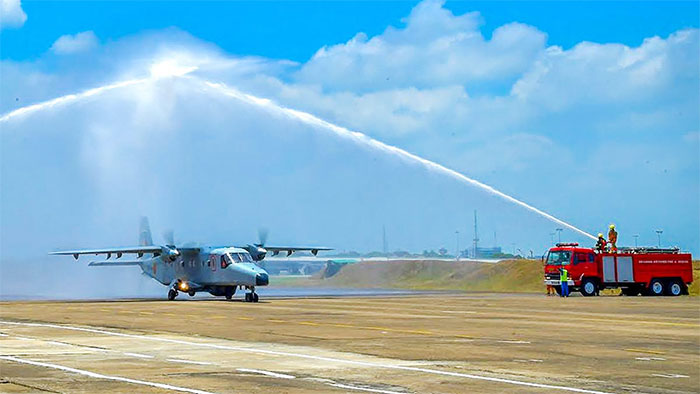
- Sri Lanka receives Indian Dornier at the BIA in August, 2022
Last week’s midweek piece, titled ‘Blind security reforms: Assurance to US on the size of military’, attracted the attention of quite a number of military officers, including the retired. They queried whether a proper and cohesive assessment has been made before the declaration that the 200,000 plus wartime strength (2009) would be reduced to 135,000 by 2024 and 100,000 by 2030.
One retired General, who had served the infantry and considered one of the foremost battlefield strategists, pointed out that the projected downsizing/right sizing of the Army, should be studied, taking into consideration the current strength. “Do not forget we are already down to 160,000 officers and men,” the retired General said, while another pointed out AWOL (‘absence without leave’ seems to be quite a problem). A retired General Officer Commanding (GoC) of a fighting division on the Vanni front emphasized the need to examine how the proposed reduction would affect post-war deployment and what is the land mass of ‘Eelam State’ (north east districts) and in relation to the drop in ground strength.
In the absence of a cohesive strategy, in relation to vital sectors, including defence, Sri Lanka seems to have neglected matters of utmost importance. Against the backdrop of a worsening situation, regardless of the USD 2.9 bn IMF package, spread over a period of 48 months, Sri Lanka cannot ignore the need to be cautious and be ready to meet any eventuality. In line with the Army, the Navy and Air Force are also to be slimmer and the fact that the downsizing of overall military strength takes place at a time of great political uncertainty and economic upheaval.
In March, Deputy Indian High Commissioner Jacob underscored the importance of Indo-Lanka relations on the basis of five areas of particular significance in the immediate short and medium term objectives.
Addressing Indian and Sri Lankan military personnel, onboard Sukanya, Jacob declared: “First is the potential for economic and financial cooperation by building on the Indian support to the people of Sri Lanka, in 2022, to the tune of USD 4 billion. The Indian HC quoted Jacob as having emphasized that focus could be laid on areas, such as trade, in national currencies, ease of investments and strengthening financial cooperation. “Second, the two sides are working towards increasing air, ferry, digital and energy connectivity. Third, a new type of development cooperation partnership, building on the existing multi-billion portfolio with special emphasis on vulnerable communities, is required. Fourth, both sides need to enhance people to people exchanges, particularly in tourist movements. Fifth, it is essential to strengthen the cultural, religious, music, movie and sporting links for mutual benefit.”
The Indian High Commission media statements present a clear picture of Indo-Lanka developments. A recent Indian High Commission statement that dealt with a visit undertaken by Indian Navy Ship ‘Batti Malv’ to Trincomalee disclosed hitherto unknown information.
Let me reproduce the relevant section from the media statement dated 17 May. The statement issued soon after the vessel departed Trincomalee made an important reference to further Indian support. “The visit of the Indian ship Batti Malv, a fast patrol craft, is also significant in view of the potential for cooperation between India and Sri Lanka for augmenting capabilities of Sri Lanka Navy in similar fast patrol craft for efficiently addressing shared challenges for maritime security in the region,” the High Commission stated.
However, the statement issued by SLN, on that particular ship visit, didn’t make any reference to the possibility of a similar type vessel being made available to Sri Lanka. The locally built 46 m long vessel, crewed by five officers and 54 men, was inducted into the Indian Navy in July 2006, the year Sri Lanka launched a combined forces campaign to eradicate the LTTE.
Since the successful conclusion of the war against the LTTE, in May 2009, India gradually advanced its relationship with a series of military visits at different levels, though the progress was slow. But, over the past several years, there has been a steady enhancement of the relationship which sort of coincided with the deterioration of the national economy.
The Indian Western Fleet visited Colombo and the China-managed Hambantota port, in the second week of March, last year, as Sri Lanka was heading for an unprecedented crisis over the collapse of supply chains.
Four ships of the Western Fleet under the charge of Flag Officer Commanding Western Fleet (FOCWF),
Rear Admiral Sameer Saxena visited Sri Lanka. The indigenous guided missile frigate BRAHMAPUTRA along with frigate TALWAR entered Hambantota port while advanced indigenous destroyer INS CHENNAI and frigate TEG entered Colombo harbour. In spite of being invited to join a reception, onboard INS Chennai, on 10 March, the then President Gotabaya Rajapaksa skipped the event. Instead, Foreign Minister Prof. G.L. Peiris represented the President. The other notable invitee was Speaker Mahinda Yapa Abeyawardena.
A few weeks later, the Indian High Commission had to deny reports of Indian military deployment here in the wake of the eruption of public anger, near President Gotabaya Rajapaksa’s private residence at Pangiriwatte, Mirihana. In brief statements, issued in English, Sinhala and Tamil, the High Commission of India strongly denied, what it called, blatantly false and completely baseless reports in a section of media that India is dispatching its soldiers to Sri Lanka.
The High Commission statement, dated 02 April, 2022, also condemned what it described as irresponsible reporting while expressing the belief those responsible for spreading rumours would desist from doing so.
Delhi’s assistance seemed vast with the Indian Navy actively engaged with Sri Lanka Navy in facilitating engagements, like Deck Landing Practice and Co-pilot experience on indigenous ALHand Sail Training Experience onboard INS Tarangini for SLAF/ SLN personnel in March 2022.
In line with India’s Neighbourhood First Policy, spares for SLNS Sagara, SLCG Suraksha and AN 32 are being provided, on grant basis, by New Delhi, to ensure, what the Indian High Commission called, optimal operational availability of the platform and thereby improve security in the region.
Sri Lanka should take stock of overall foreign military assistance to the post-war military as Sri Lanka faced growing international criticism over accountability issues. Canada has taken the anti-Sri Lanka project to a new extreme by declaring Tamils were subjected to genocide. In a bid to appease powerful Diaspora groups, Canadian parliament has targeted Sri Lanka with the declaration that two former Presidents, Mahinda Rajapaksa and Gotabaya Rajapaksa, are war criminals, is a clear move to inspire countries, with large communities of Sri Lankan origin, to act in a similar fashion. Unfortunately, Sri Lanka has pathetically failed to counter the Canadian project, built on the preposterous accusation that over 40,000 Tamils perished during the final phase of the combined security forces offensive on the Vanni east front. This is despite even UN internal documents placing casualties in the north, during the final phases of fighting, to be in the region of 7000.










The failure on the part of the Janatha Vimukthi Peramuna (JVP)-led National People’s Power (NPP) government to fulfil a plethora of promises given in the run up to the last presidential election, in September, 2024, and a series of incidents, including cases of corruption, and embarrassing failure to act on a specific weather alert, ahead of Cyclone Ditwah, had undermined the administration beyond measure.
Ditwah dealt a knockout blow to the arrogant and cocky NPP. If the ruling party consented to the Opposition proposal for a Parliamentary Select Committee (PSC) to probe the events leading to the November 27 cyclone, the disclosure would be catastrophic, even for the all-powerful Executive President Anura Kumara Dissanayake, as responsible government bodies, like the Disaster Management Centre that horribly failed in its duty, and the Met Department that alerted about the developing storm, but the government did not heed its timely warnings, directly come under his purview.
The NPP is on the back foot and struggling to cope up with the rapidly developing situation. In spite of having both executive presidency and an overwhelming 2/3 majority in Parliament, the government seems to be weak and in total disarray.
The regular appearance of President Dissanayake in Parliament, who usually respond deftly to criticism, thereby defending his parliamentary group, obviously failed to make an impression. Overall, the top NPP leadership appeared to have caused irreparable damage to the NPP and taken the shine out of two glorious electoral victories at the last presidential and parliamentary polls held in September and November 2024 respectively.
The NPP has deteriorated, both in and out of Parliament. The performance of the 159-member NPP parliamentary group, led by Prime Minister Dr. Harini Amarasuriya, doesn’t reflect the actual situation on the ground or the developing political environment.
Having repeatedly boasted of its commitment to bring about good governance and accountability, the current dispensation proved in style that it is definitely not different from the previous lots or even worse. (The recent arrest of a policeman who claimed of being assaulted by a gang, led by an NPP MP, emphasised that so-called system change is nothing but a farce) In the run-up to the November, 2024, parliamentary polls, President Dissanayake, who is the leader of both the JVP and NPP, declared that the House should be filled with only NPPers as other political parties were corrupt. Dissanayake cited the Parliament defeating the no-confidence motions filed against Ravi Karunanayake (2016/over Treasury Bond scams) and Keheliya Rambukwella (2023/against health sector corruption) to promote his argument. However, recently the ongoing controversy over patient deaths, allegedly blamed on the administration of Ondansetron injections, exposed the government.
Mounting concerns over drug safety and regulatory oversight triggered strong calls from medical professionals, and trade unions, for the resignation of senior officials at the National Medicines Regulatory Authority (NMRA) and the State Pharmaceutical Corporation (SPC).
Medical and civil rights groups declared that the incident exposed deep systemic failures in Sri Lanka’s drug regulatory framework, with critics warning that the collapse of quality assurance mechanisms is placing patients’ lives at grave risk.
The Medical and Civil Rights Professional Association of Doctors (MCRPA), and allied trade unions, accused health authorities of gross negligence and demanded the immediate resignation of senior NMRA and SPC officials.
MCRPA President Dr. Chamal Sanjeewa is on record as having said that the Health Ministry, NMRA and SPC had collectively failed to ensure patient safety, citing, what he described as, a failed drug regulatory system.
The controversy has taken an unexpected turn with some alleging that the NPP government, on behalf of Sri Lanka and India, in April this year, entered into an agreement whereby the former agreed to lower quality/standards of medicine imports.
Trouble begins with Ranwala’s resignation
The NPP suffered a humiliating setback when its National List MP Asoka Ranwala had to resign from the post of Speaker on 13 December, 2024, following intense controversy over his educational qualification. The petroleum sector trade union leader served as the Speaker for a period of three weeks and his resignation shook the party. Ranwala, first time entrant to Parliament was one of the 18 NPP National List appointees out of a total of 29. The Parliament consists of 196 elected and 29 appointed members. Since the introduction of the National List, in 1989, there had never been an occasion where one party secured 18 slots.
The JVP/NPP made an initial bid to defend Ranwala but quickly gave it up and got him to resign amidst media furor. Ranwala dominated the social media as political rivals exploited the controversy over his claimed doctorate from the Waseda University of Japan, which he has failed to prove to this day. But, the JVP/NPP had to suffer a second time as a result of Ranwala’s antics when he caused injuries to three persons, including a child, on 11 December, in the Sapugaskanda police area.
The NPP made a pathetic, UNP and SLFP style effort to save the parliamentarian by blaming the Sapugaskanda police for not promptly subjecting him for a drunk driving test. The declaration made by the Government Analyst Department that the parliamentarian hadn’t been drunk at the time of the accident, several days after the accident, does not make any difference. Having experienced the wrongdoing of successive previous governments, the public, regardless of what various interested parties propagated on social media, realise that the government is making a disgraceful bid to cover-up.
No less a person than President Dissanayake is on record as having said that their members do not consume liquor. Let us wait for the outcome of the internal investigation into the lapses on the part of the Sapugaskanda police with regard to the accident that happened near Denimulla Junction, in Sapugaskanda.
JVP/NPP bigwigs obviously hadn’t learnt from the Weligama W 15 hotel attack in December, 2023, that ruined President Ranil Wickremeinghe’s administration. That incident exposed the direct nexus between the government and the police in carrying out Mafia-style operations. Although the two incidents cannot be compared as the circumstances differ, there is a similarity. Initially, police headquarters represented the interests of the wrongdoers, while President Wickremesinghe bent over backwards to retain the man who dispatched the CCD (Colombo Crime Division) team to Weligama, as the IGP. The UNP leader went to the extent of speaking to Chief Justice Jayantha Jayasuriya, PC, and Speaker Mahinda Yapa Abeywardena to push his agenda. There is no dispute the then Public Security Minister Tiran Alles wanted Deshabandu Tennakoon as IGP, regardless of a spate of accusations against him, in addition to him being faulted by the Supreme Court in a high-profile fundamental rights application.
The JVP/NPP must have realised that though the Opposition remained disorganised and ineffective, thanks to the media, particularly social media, a case of transgression, if not addressed swiftly and properly, can develop into a crisis. Action taken by the government to protect Ranwala is a case in point. Government leaders must have heaved a sigh of relief as Ranwala is no longer the Speaker when he drove a jeep recklessly and collided with a motorcycle and a car.
Major cases, key developments
Instead of addressing public concerns, the government sought to suppress the truth by manipulating and exploiting developments
* The release of 323 containers from the Colombo Port, in January 2025, is a case in point. The issue at hand is whether the powers that be took advantage of the port congestion to clear ‘red-flagged’ containers.
Although the Customs repeatedly declared that they did nothing wrong and such releases were resorted even during Ranil Wickremesinghe’s presidency (July 2022 to September 2024), the public won’t buy that. Container issue remains a mystery. That controversy eroded public confidence in the NPP that vowed 100 percent transparency in all its dealings. But the way the current dispensation handled the Port congestion proved that transparency must be the last thing in the minds of the JVPers/NPPers holding office.
* The JVP/NPP’s much touted all-out anti-corruption stand suffered a debilitating blow over their failure to finalise the appointment of a new Auditor General. In spite of the Opposition, the civil society, and the media, vigorously taking up this issue, the government continued to hold up the appointment by irresponsibly pushing for an appointment acceptable to President Dissanayake. The JVP/NPP is certainly pursuing a strategy contrary to what it preached while in the Opposition and found fault with successive governments for trying to manipulate the AG. It would be pertinent to mention that President Dissanayake should accept the responsibility for the inordinate delay in proposing a suitable person to that position. The government failed to get the approval of the Constitutional Council more than once to install a favourite of theirs in it, thanks to the forthright position taken by its civil society representatives.
The government should be ashamed of its disgraceful effort to bring the Office of the Auditor General under its thumb:
* The JVP/NPP government’s hotly disputed decision to procure 1,775 brand-new double cab pickup trucks, at a staggering cost exceeding Rs. 12,500 mn, under controversial circumstances, exposed the duplicity of that party that painted all other political parties black. Would the government rethink the double cab deal, especially in the wake of economic ruination caused by Cyclone Ditwah? The top leadership seems to be determined to proceed with their original plans, regardless of immeasurable losses caused by Cyclone Ditwah. Post-cyclone efforts still remain at a nascent stage with the government putting on a brave face. The top leadership has turned a blind eye to the overwhelming challenge in getting the country back on track especially against the backdrop of its agreement with the IMF.
Post-Cyclone Ditwah recovery process is going to be slow and extremely painful. Unfortunately, both the government and the Opposition are hell-bent on exploiting the miserable conditions experienced by its hapless victims. The government is yet to acknowledge that it could have faced the crisis much better if it acted on the warning issued by Met Department Chief Athula Karunanayake on 12 November, two weeks before the cyclone struck.
Foreign policy dilemma
Sri Lanka moved further closer to India and the US this year as President Dissanayake entered into several new agreements with them. In spite of criticism, seven Memorandums of Understanding (MoUs), including one on defence, remains confidential. What are they hiding?
Within weeks after signing of the seven MoUs, India bought the controlling interests in the Colombo Dockyard Limited for USD 52 mn.
Although some Opposition members, representing the SJB, raised the issue, their leader Sajith Premadasa, during a subsequent visit to New Delhi, indicated he wouldn’t, under any circumstances, raise such a contentious issue.
Premadasa went a step further. The SJB leader assured his unwavering commitment to the full implementation of the 13th Amendment to the Constitution that was forced on Sri Lanka during President JRJ’s administration, under the highly questionable Indo-Lanka Accord of July, 1987, after the infamous parippu drop by Indian military aircraft over Jaffna, their version of the old gunboat diplomacy practiced by the West.
Both India and the US consolidated their position here further in the post-Aragalaya period. Those who felt that the JVP would be in a collision course with them must have been quite surprised by the turn of events and the way post-Aragalaya Sri Lanka leaned towards the US-India combine with not a hum from our carboard revolutionaries now installed in power. They certainly know which side of the bread is buttered. Sri Lanka’s economic deterioration, and the 2023 agreement with the IMF, had tied up the country with the US-led bloc.
In spite of India still procuring large quantities of Russian crude oil and its refusal to condemn Russia over the conflict in Ukraine, New Delhi has obviously reached consensus with the US on a long-term partnership to meet the formidable Chinese challenge. Both countries feel each other’s support is incalculably vital and indispensable.
Sri Lanka, India, and Japan, in May 2019, signed a Memorandum of Cooperation (MoC) to jointly develop the East Container Terminal (ECT) at the Colombo Port. That was during the tail end of the Yahapalana administration. The Gotabaya Rajapaksa administration wanted to take that project forward. But trade unions, spearheaded by the JVP/NPP combine, thwarted a tripartite agreement on the basis that they opposed privatisation of the Colombo Port at any level.
But, the Colombo West International Terminal (CWIT) project, that was launched in November, 2022, during Ranil Wickremesinghe’s presidency, became fully operational in April this year. The JVP revolutionary tiger has completely changed its stripes regarding foreign investments and privatisation. If the JVP remained committed to its previous strategies, India taking over CDL or CWIT would have been unrealistic.
The failure on the part of the government to reveal its stand on visits by foreign research vessels to ports here underscored the intensity of US and Indian pressure. Hope our readers remember how US and India compelled the then President Wickremesinghe to announce a one-year moratorium on such visits. In line with that decision Sri Lanka declared research vessels wouldn’t be allowed here during 2024. The NPP that succeeded Wickremesinghe’s administration in September, 2024, is yet to take a decision on foreign research vessels. What a pity?
The NPP ends the year on the back foot, struggling to cope up with daunting challenges, both domestic and external. The recent revelation of direct Indian intervention in the 2022 regime change project here along with the US underscored the gravity of the situation and developing challenges. Post-cyclone period will facilitate further Indian and US interventions for obvious reasons.
****

Perhaps one of the most debated events in 2025 was the opening of ‘City of Dreams Sri Lanka’ that included, what the investors called, a world-class casino. In spite of mega Bollywood star Shah Rukh Khan’s unexpected decision to pull out of the grand opening on 02 August, the investors went ahead with the restricted event. The Chief Guest was President Anura Kumara Dissanayake, who is also the Finance Minister, in addition to being the Defence Minister. Among the other notable invitees were Dissanayake’s predecessor Ranil Wickremesinghe, whose administration gave critical support to the high-profile project, worth over USD 1.2 bn. John Keells Holdings PLC (JKH) and Melco Resorts & Entertainment (Melco) invested in the project that also consist of the luxurious Nüwa hotel and a premium shopping mall. Who would have thought President Dissanayake’s participation, even remotely, possible, against the backdrop of his strong past public opposition to gambling of any kind?
Don’t forget ‘City of Dreams’ received a license to operate for a period of 20 years. Definitely an unprecedented situation. Although that license had been issued by the Wickremesinghe administration, the NPP, or any other political party represented in Parliament, didn’t speak publicly about that matter. Interesting, isn’t it, coming from people, still referred by influential sections of the Western media, as avowed Marxists?
By Shamindra Ferdinando

Through the Eyes of the Patua:
 Organised by the Colombo Institute for Human Sciences in collaboration with Millennium Art Contemporary, an interesting and unique exhibition got underway in the latter’s gallery in Millennium City, Oruwala on 21 December 2025. The exhibition is titled, ‘Through the Eyes of the Patua: Ramayana Paintings of an Artisanal Community’ and was organized in parallel with the conference that was held on 20 December 2025 under the theme, ‘Move Your Shadow: Rediscovering Ravana, Forms of Resistance and Alternative Universes in the Tellings of the Ramayana.’ The scrolls on display at the gallery are part of the over 100 scrolls in the collection of Colombo Institute’s ‘Roma Chatterji Patua Scroll Collection.’ Prof Chatterji, who taught Sociology at University of Delhi and at present teaches at Shiv Nadar University donated the scrolls to the Colombo Institute in 2024.
The paintings on display are what might be called narrative scrolls that are often over ten feet long. Each scroll narrates a story, with separate panels pictorially depicting one component of a story. The Patuas or the Chitrakars, as they are also known, are traditionally bards. A bard will sing the story that is depicted by each scroll which is simultaneously unfurled. For Sri Lankan viewers for whom the paintings and their contexts of production and use would be unusual and unfamiliar, the best way to understand them is to consider them as a comic strip. In the case of the ongoing exhibition, since the bards or the live songs are not a part of it, the word and voice elements are missing. However, the curators have endeavoured to address this gap by displaying a series of video presentations of the songs, how they are performed and the history of the Patuas as part of the exhibition itself.
The unfamiliarity of the art on display and their histories, necessitates broader explanation. The Patua hail from Medinipur District of West Bengal in India. Essentially, this community of artisans are traditional painters and singers who compose stories based on sacred texts such as the Ramayana or Mahabharata as well as secular events that can vary from the bombing of the Twin Towers in New York in 2001 to the Indian Ocean Tsunami of 2004. Even though painted storytelling is done by a number of traditional artisan groups in India, the Patua is the only community where performers and artists belong to the same group. Hence, Professor Chatterji, in her curatorial note for the exhibition calls them “the original multi-media performers in Bengal.”
‘The story of the Patuas’ also is an account of what happens to such artisanal communities in contemporary times in South Asia more broadly even though this specific story is from India. There was a time before the 21st century when such communities were living and working across a large part of eastern India – each group with a claim to their recognizably unique style of painting. However, at the present time, this community and their vocation is limited to areas such as Medinipur, Birbhum, Purulia in West Bengal and Dumka in Jharkhand.
A pertinent question is how the scroll painters from Medinipur have survived the vagaries of time when others have not. Professor Chatterji provides an important clue when she notes that these painters, “unlike their counterparts elsewhere, are also extremely responsive to political events.” As such, “apart from a rich repertoire of stories based on myth and folklore, including the Ramayana and other epics, they have, over many years, also composed on themes that range from events of local or national significance such as boat accidents and communal violence to global events such as the tsunami and the attack on the World Trade Centre.”
There is another interesting aspect that becomes evident when one looks into the socio-cultural background of this community. As Professor Chatterji writes, “one significant feature that gives a distinct flavour to their stories is the fact that a majority of Chitrakars consider themselves to be Muslims but perform stories based largely on Hindu myths.” In this sense, their story complicates the tension-ridden dichotomies between ethno-cultural and religious groups typical of relations between groups in India as well as more broadly in South Asia, including in Sri Lanka. Prof Chatterji suggests this positionality allows the Patua to have “a truly secular voice so vital in the world that we live in today.”
As a result, she notes, contemporary Patuas “have propagated the message of communal harmony in their compositions in the context of the recent riots in India and the Gulf War. Their commentaries couched in the language of myth are profoundly symbolic and draw on a rich oral tradition of storytelling.” What is even more important is their “engagement with contemporary issues also inflects their aesthetics” because many of these painters also “experiment with novel painterly values inspired by recent interaction with new media such as comic books and with folk art forms from other parts of the country.”
From this varied repertoire of the Patuas’ painterly tradition, this exhibition focusses on scrolls portraying different aspects of the Ramayana. In North Indian and the more dominant renditions of the Ramayana, the focus is on Rama while in many alternate renditions this shifts to Ravana as typified by versions popular among the Sinhalas and Tamils in Sri Lanka as well as in some areas in several Indian states. Compared to this, the Patua renditions in the exhibition mostly illustrate the abduction of Sita with a pronounced focus on Sita and not on Ravana, the conventional antagonist or on Rama, the conventional protagonist. As a result, these two traditional male colossuses are distant. Moreover, with the focus on Sita, these folk renditions also bring to the fore other figures directly associated with her such as her sons Luv and Kush in the act of capturing Rama’s victory horse as well as Lakshmana.
Interestingly, almost as a counter narrative, which also serves as a comparison to these Ramayana scrolls, the exhibition also presents three scrolls known as ‘bin-Laden Patas’ depicting different renditions on the attack on New York’s Twin Towers.
While the painted scrolls in this collection have been exhibited thrice in India, this is the first time they are being exhibited in Sri Lanka, and it is quite likely such paintings from any community beyond Sri Lanka’s shores were not available for viewing in the country before this. Organised with no diplomatic or political affiliation and purely as a Sri Lankan cultural effort with broader South Asian interest, it is definitely worth a visit. The exhibition will run until 10 January 2026.

Power comes like a demonic spell,
To restless humans constantly in chains,
And unless kept under a tight leash,
It drives them from one ill deed to another,
And among the legacies they thus deride,
Are those timeless truths lucidly proclaimed,
By prophets, sages and scribes down the ages,
Hailing from Bethlehem, Athens, Isipathana,
And other such places of hallowed renown,
Thus plunging themselves into darker despair.
By Lynn Ockersz

S. Achchudan appointed as Director General of the Sports Development Department.

Amendment of the National Environment Act No. 47 of 1980
Tax relief for Dates received as donations or gifts for Ramadan
Cabinet nod to establish the Sri Lanka Industrial Transformation and innovation Authority
Temporary employment of Sri Lankan labour in the State of Israel
Cabinet approves liquidation of Sahasya Investment Company

‘Dates have the highest sugar content to fight Coronavirus’

Sunday Island 27 December – Headlines

#SundayIsland 17th December – Headlines

Sunday Island – 28th March

Sunday Island Headlines – 21 March

Sunday Island – 21st February – Headlines
-

 News6 days ago
British MP calls on Foreign Secretary to expand sanction package against ‘Sri Lankan war criminals’
-
 News5 days ago
Street vendors banned from Kandy City
-
 Sports6 days ago
Chief selector’s remarks disappointing says Mickey Arthur
-

 Opinion6 days ago
Disasters do not destroy nations; the refusal to change does
-

 News7 days ago
Sri Lanka’s coastline faces unfolding catastrophe: Expert
-

 News5 days ago
Lankan aircrew fly daring UN Medevac in hostile conditions in Africa
-
 Midweek Review7 days ago
Year ends with the NPP govt. on the back foot
-
 Sports7 days ago
Life after the armband for Asalanka