
Foreign News
Pope Francis fires Texan bishop after criticism of reforms


Pope Francis has fired the Texan bishop Joseph Strickland, a fierce critic who has questioned the Pope’s leadership of the Catholic church.
The Vatican said the bishop would be “relieved” of his duties as a result of investigations at his Diocese of Tyler. Bishop Strickland is a leading voice in a branch of US Catholicism that is opposed to the Pope’s reforms. His removal comes after Francis spoke of the “backwardness” of some US Catholic church leaders.
Bishop Strickland has launched a series of attacks on the Pope’s attempts to update the Church’s position on social matters and inclusion, including on abortion, transgender rights and same-sex marriage.
In July, he warned that many “basic truths” of Catholic teaching were being challenged, including what he called attempts to “undermine” marriage “as instituted by God” being only between a man and a woman.
He criticised as “disordered” the attempts of those who “reject their undeniable biological God-given identity”. His letter suggested that attempts to change “that which cannot be changed” would lead to an irrevocable schism in the Church. Those seeking change, he warned, “are the true schismatics”.
Bishop Strickland was under investigation by the Vatican and had previously declined the opportunity to resign, and in an open letter in September challenged the Pope to fire him. “I cannot resign as Bishop of Tyler because that would be me abandoning the flock,” he said.The right-wing “Coalition for Canceled Priests” held a conference earlier this year to support him during the investigation.
The Vatican said that the decision to fire him “came after an apostolic visitation ordered by the Pope last June in the Diocese of Tyler”. According to Catholic media, the investigation also looked at the handling of financial affairs at the diocese.
Bishop Strickland, 65, was appointed bishop in 2012, while Benedict XVI was pope.
It all follows significant attempts made by the Pope to make the Church more progressive during his papacy.
On Thursday, the Vatican announced that transgender people can be baptised in the Catholic Church, as long as doing so does not cause scandal or “confusion”.
In October, he suggested that the Church would be open to bless same-sex couples, as he told a group of cardinals “we cannot be judges who only deny, reject and exclude”.
Speaking at a meeting at the World Youth Day celebrations in Lisbon the Pope said the backwardness of some people was “useless”. “Doing this you lose the true tradition and you turn to ideologies to have support. In other words, ideologies replace faith,” he added.
Climate change has also been a key pillar of his papacy – from a landmark paper on the environment in 2015 to recent warnings that the world may be “nearing breaking point” due to climate change. He has also strongly condemned climate deniers and will be at the United Nations’ Climate Summit (COP28) later this month – the first time a pope has attended the event since they began in 1995.
The Vatican said that the Diocese of Tyler would be temporarily administered by Bishop Joe Vasquez of Austin.
(BBC)


A ferry carrying around 260 people has capsized off the coast of northern Cyprus with a search underway for survivors, according to local media.
The catamaran-style boat was travelling from the port of Kyrenia, also known as Girne, and started sinking a few kilometres off the coast of the island state on Sunday.
There were no immediate reports of casualties.
[Aljazeera]
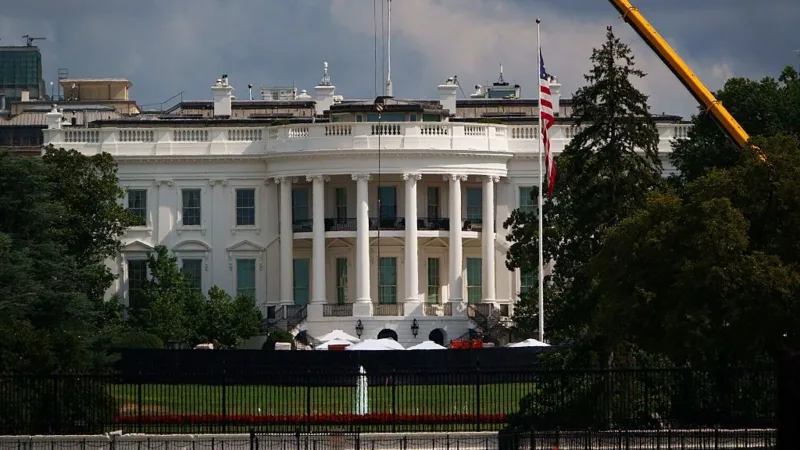
A former White House teleprompter operator has been ordered to pay more than $172,000 (£127,000) for using inside information to bet on US President Donald Trump’s speeches.
Gabriel Perez was found to have made trades on what the president would say during addresses between December 2025 and February 2026 on Kalshi – a prediction markets platform where users can bet on real-world events.
Its regulator, the Commodity Futures Trading Commission (CFTC), said Perez would have to surrender profits of $107,539.02 (£79,452) and pay a civil penalty of $65,000 (£48,000).
The White House has not yet commented. In July then press secretary Karoline Leavitt said Perez was on unpaid leave and would not return to his post.
Announcing the settlement on Friday, the CFTC said Perez had “misappropriated” his prior knowledge of Trump’s speeches to place bets “in breach of his duty of trust and confidence”.
It said his civil penalty had been reduced due to his “exemplary co-operation” with the investigation.
Perez has also been banned from trading for three years.
Writing on X, Kalshi’s lead lawyer Bobby DeNault welcomed the decision: “It doesn’t matter who you are: violate our rules or federal law and you will face the consequences.”
(BBC)
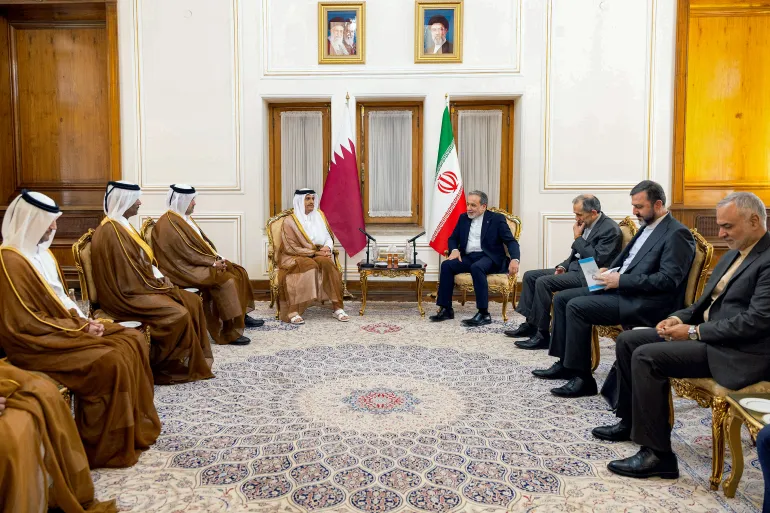
Qatar’s prime minister has held meetings in the Iranian capital, discussing key issues including the future of the Strait of Hormuz, amid international hopes that dialogue between the United States and Iran on ending the war will resume.
Iran’s Foreign Minister Abbas Araghchi and Qatar’s Sheikh Mohammed bin Abdulrahman bin Jassim Al Thani on Thursday discussed a proposed framework that includes the creation of a temporary shipping corridor through the Strait of Hormuz, as well as a possible “joint project” to clear the strait of mines, the Qatari Ministry of Foreign Affairs said in a statement. Iran says the mines were laid during the war.
The two officials also reviewed “the latest developments in the regional situation … along with the efforts being made to reduce escalation and create appropriate conditions for dialogue, contributing to the enhancement of regional security and stability”, the statement added.
Sheikh Mohammed, who is both prime minister and foreign minister of Qatar, later met separately with Iranian President Masoud Pezeshkian and parliament speaker and top negotiator, Mohammad Bagher Ghalibaf.
Ghalibaf emphasised the need to de-escalate regional tensions, according to Iran’s Tasnim news agency. He and Sheikh Mohammed also exchanged views on the current developments in the region and efforts to create suitable conditions for resuming dialogue, the report added.
“Qatar believes that dialogue and diplomatic solutions remain the optimal path for addressing disputes and overcoming crises,” Sheikh Mohammed said in a post on X, adding that his discussions in Tehran serve as “confirmation of our continued efforts to de-escalate tensions … while opening the door to peaceful solutions – including underscoring the importance of respecting freedom of navigation in the Strait of Hormuz in accordance with international law.”
Sheikh Mohammed also met with Iran’s security chief, Mohsen Rezai.
Rezai told him the “US must first take practical steps to fulfil Iran’s conditions and then Iran will proceed to open the Strait of Hormuz”, the Islamic Republic News Agency (IRNA) reported.
Rezai also reiterated previous pledges by Tehran that if Washington “starts any evil”, Iran would “bring disaster to its military and economic interests”.
Sheikh Mohamed’s visit follows a week of intense diplomacy in Iran involving separate meetings with Oman’s Foreign Minister Badr Albusaidi and senior Pakistani officials seeking ways to end the US-Israel war on Iran and reopen the strategic waterway through which about 20 percent of the world’s oil passes in peacetime.
[Aljazeera]

Ferry carrying 260 people capsizes off northern Cyprus coast

Imam unlikely to play rest of Lord’s Test after picking up left calf tear

Vimukthi, Ayodhya hand Sri Lanka winning start to Asia Cup title defence

Voting closes in Iceland’s knife-edge EU referendum

Showers in the Sabaragamuwa, Western and North-western provinces and in Galle, Matara, Kandy and Nuwara-Eliya districts

Sun directly overhead Mannar, Periyamadu, Puliyankulam, Welioya and Pulmoddai about 12.11 noon today (30)

‘Dates have the highest sugar content to fight Coronavirus’

Sunday Island 27 December – Headlines

#SundayIsland 17th December – Headlines

Sunday Island – 28th March

Sunday Island Headlines – 21 March

Sunday Island – 21st February – Headlines
-

 News6 days ago
Missing doctor’s body found in Mahiyanganaya
-
 News6 days ago
Australia declines to release Finance Secy Suriyapperuma’s citizenship details
-

 News6 days ago
22A: BASL suggests CJ recuse himself from hearing petitions
-

 News3 days ago
Eight politicians in drug kingpin probe
-

 Editorial7 days ago
Govts. drag feet as undergrads age
-
 Features5 days ago
Insights from Chieftains of Uva: Genealogy of two Kandyan Families – Part II
-

 Features5 days ago
Export diversification: Missing the wood for the trees – Part I
-

 Business3 days ago
Sri Lanka opens up: A new season of direct connectivity