
News
Political appointments erode working culture of state institutions – Anura

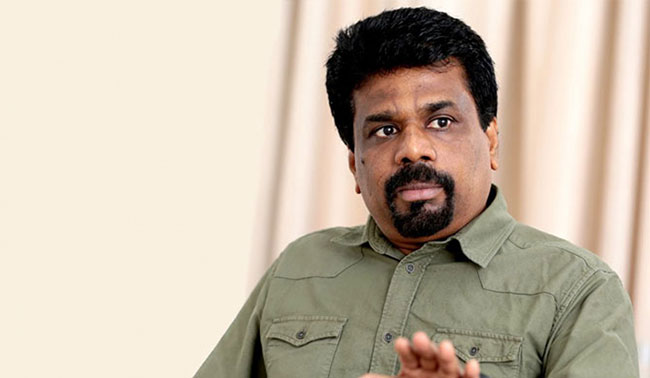
The UNP, the SLFP and the SLPP are responsible for the overstaffing of the public sector, Janatha Vimukthi Peramuna (JVP) leader Anura Kumara Dissanayake says.
“A lot of people are now talking about the overstaffing of government institutions. How did this happen? There are people coming from Matara to Colombo port everyday in five buses. There are two buses that come from Kuliyapitiya to Isusrupaya. Two buses come each day from Ratnapura to the Sri Lanka Bureau of Foreign Employment. God knows how many buses come from Badulla to hospitals across the country. This happens because there were ministers from the above-mentioned areas in charge of these institutions,” the JVP leader said on Thursday.
Dissanayake said that the same people who had overstaffed state institutions now pretended that the JVP was responsible for the surplus workforce in government institutions.
“Let’s look at Universities. Qualified academic staff is low in almost all universities, there are shortages everywhere. However nonacademic staff is through the roof. This is because its harder for a minister to fill up academic positions. To be recruited to the university academic staff, a graduate should have a first or second upper class dirision pass for his or her degree and has to go through the interview process, which is very tough. But it’s easy to recruit nonacademic staff members. Minister Kanchana Wijesekera says he can run the Ceylon Petroleum Corporation with 500 people and that Ceylon Electricity Board can operate with 50 percent staff. Well, that’s good to know. Go tell that to your colleagues that sit next to you,” he said.
The JVP leader said that more than the financial burden in the form of salaries, politicized staffing has a detrimental impact on the working culture of state institutions.
“The driver is a stooge of the minister. He won’t even listen to a director. These stooges are impolite to people who come to government institutions. Given that they have nothing to do, they would make it harder for people who actually have work. Soon, the output of the institution goes down. This is what has been happening to us since 1977,” he said.





Latest News
Expedite the cleaning of Colombo’s canals and drainage systems within the next two weeks – PM instructs officials

[Prime Minister’s Media Division]
Approval has been granted at the Cabinet meeting held on 22.07.2024 to publish the draft bill of State Assets Management Act in the government gazette notification and thereby present it to the Parliament for its concurrence.
However, the draft bill couldn’t be passed in Parliament as a result of the Parliament being dissolved in the month of October 2024.
Thereafter, the draft bill was subject to further inspection by a
committee appointed which comprised of officials and authorities on the subject.
The said Committee has recognized the amendments to be made and a fundamental draft has been prepared including the proposed amendments.
Accordingly, the Cabinet of Ministers approved the resolution furnished by the President in his capacity as the Minister of Finance, Planning and Economic Development to suspend further activities regarding the draft bill of State Assets Management Act published in the extraordinary gazette of 02.08.2024, and to direct the Legal Draftsman to prepare a draft bill based on the fundamental draft prepared by the subject specialists’ committee.
Considering the compliance of the Cooperative Societies’ operations with the concurrent socio – economic circumstances as well as the changes in the common law, the requirement of amending the Cooperative Employees Commission Act No. 12 of 1972 has been recognized.
A fundamental draft including proposed amendments based on the experience gained by that Commission as well as the opinions and proposals of Cooperative societies, their director board members, cooperative employees and other interested parties has been prepared.
Accordingly, the Cabinet of Ministers granted approval to the resolution furnished by the Minister of Trade, Commerce, Food Security and Cooperative development to provide instructions to the Legal draftsman to prepare a draft bill to amend the Cooperative Employees Commission Act No. 12 0f 1972, based on the said fundamental draft.

Expedite the cleaning of Colombo’s canals and drainage systems within the next two weeks – PM instructs officials

Kusal Mendis’ unbeaten 87 hands Sri Lanka consolation win

Cabinet approves redrafting of State Assets Management Act
Cooperative Employees Commission Act No. 12 of 1972 to be amended
Dilki Wathsala Marambage appointed as Director General of the Department of Technical Education and Training
Declaration of Naakolagane Sanctuary under the Fauna and Flora Protection Ordinance

‘Dates have the highest sugar content to fight Coronavirus’

Sunday Island 27 December – Headlines

#SundayIsland 17th December – Headlines

Sunday Island – 28th March

Sunday Island Headlines – 21 March

Sunday Island – 21st February – Headlines
-

 Features6 days ago
The Sri Lankan who made Scottish history
-

 Sports6 days ago
Nissanka absence opens door for Sri Lanka’s young guns
-

 News5 days ago
NDB fraud Rs 60mn more than reported
-

 News7 days ago
Gnansara Thera to be assigned to prison printing section: Officials
-

 News5 days ago
Removing monk’s robes matter for Sangha to decide: Mahanayake Theras
-

 News7 days ago
OIC of FCID summoned before Maligakanda Magistrate
-

 News6 days ago
Shiranthi R remanded until 13 Oct.
-

 Features6 days ago
Future of Sri Lanka’s state university system: Should it be shut down and reopened?