
Business
PM calls for ‘clean, abundant and universally accessible’ solar power

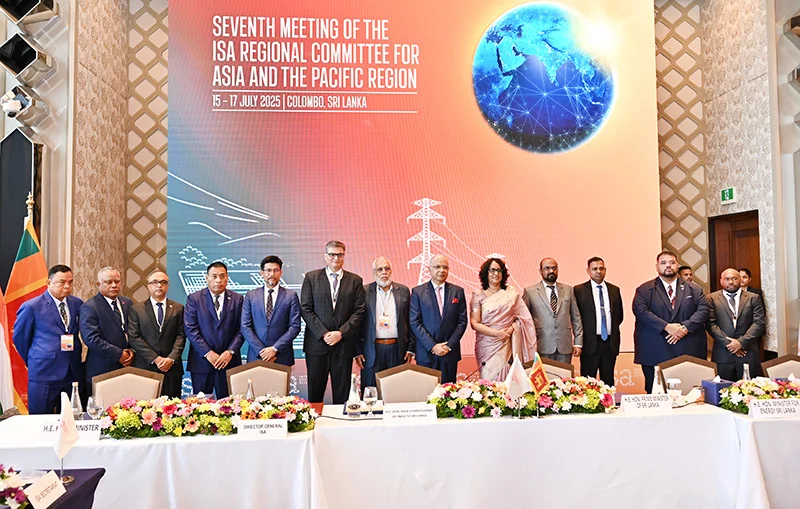
In a call to action for solar cooperation across Asia and the Pacific, Sri Lankan Prime Minister Dr. Harini Amarasuriya said the 21st century must be led not by fossil fuels, but by the promise of sunlight—”clean, abundant and universally accessible.”
She was addressing delegates from across the region at the 7th Regional Committee Meeting of the International Solar Alliance (ISA) for the Asia and Pacific Regions, held at the ITC Ratnadipa Colombo yesterday. The high-level gathering brought together ministers, diplomats, energy experts and institutional partners to strengthen regional solar energy strategies.
“If the 20th century was defined by fossil fuel, then the 21st century must be led by the promise of sunlight, said Prime Minister Amarasuriya. “This is not merely an alternative—it is an imperative.”
Present at the event were the High Commissioner of India to Sri Lanka Santosh Jha, Deputy Minister of Power and Energy Kumar Jayakodi, Deputy Minister Naveer Rathna, Director-General of the ISA Ashish Khanna, and other regional dignitaries. The meeting was marked by the formal exchange of the Country Partnership Framework (CPF) between Sri Lanka and the ISA—a key milestone that will guide collaboration, investments and technology transfer in Sri Lanka’s solar sector.
“Asia and the Pacific stand at a critical junction, PM Amarasuriya said. “Our region must shoulder the dual responsibility of accelerating economic growth while confronting climate vulnerabilities. Our strategies must be both resilient and equitable.”
She acknowledged that many countries, including Sri Lanka, were facing the twin pressures of fiscal recovery and rising energy demands, especially in remote and underserved communities. In that context, she praised ISA’s role in supporting decentralised energy solutions and innovative financial models.
“We are deeply grateful for the continued support of the ISA. Its work has laid a strong foundation for scaling rural electrification, which remains a top priority for our government, she added.
Despite a difficult economic backdrop, Sri Lanka has exceeded expectations. Prime Minister Amarasuriya made said during her speech:
“A month ago, Sri Lanka achieved its national target of generating 70% of electricity from renewable energy sources, ahead of our 2030 deadline.”
She said the focus now shifts from hitting the target to sustaining it, ensuring grid stability and long-term affordability for citizens.
‘At the heart of Sri Lanka’s strategy is the ‘Surya Balasangramaya – Battle for Solar Energy’ programme, which is expanding rooftop solar panels across homes, schools and public buildings. The country has also completed two floating solar projects at Chandrika Dabba and Kiri Perth Dabba, pushing boundaries on land-scarce solar generation.
‘Additionally, the government is in the process of revising national electricity laws to encourage competitive bidding, boost investor confidence and integrate modern solar technologies’.
Recognising the role of knowledge transfer in long-term transformation, the Prime Minister also announced the establishment of a Star Centre at the University of Moratuwa to serve as a regional hub for solar training and research.
Energy Minister Kumara Jayakody and ISA Director-General Ashish Khanna signed the Country Partnership Framework (CPF) in the presence of regional dignitaries. The CPF outlines a clear roadmap for deepening collaboration between Sri Lanka and the ISA across training, project development, finance mobilisation, and regional knowledge exchange.
ISA Director-General Khanna commended Sri Lanka’s leadership in renewable energy and noted that the country could be a regional model for clean energy transition—particularly for island and middle-income nations.
By Ifham Nizam


The Asian Development Bank (ADB) is actively engaging with Sri Lanka on a potential budget financing package, following recent discussions between ADB President Masato Kanda and President Anura Kumara Dissanayake.
Describing the request as “crucial,” Kanda said the proposal is now under internal consideration, with a broader framework being developed to ensure funds are directed toward priority sectors such as energy security, food security, and overall budgetary support. While no figures or timelines were disclosed, he emphasised the need for a carefully structured and mutually agreed resource allocation strategy
Sri Lanka is among several countries that have approached the ADB for similar assistance, reflecting mounting fiscal pressures across the region.
Speaking at one of the key meetings of the 59th Annual Meeting of the ADB in Samarkand, Kanda outlined a broader institutional shift in response to escalating global economic uncertainties, particularly those stemming from tensions linked to the Iran conflict.
“Asia and the Pacific can’t afford to retreat into isolation,” he said, reiterating a paradigm shift in how the ADB responds with greater speed, flexibility, and coordination.
Reaffirming the bank’s commitment to the region, Kanda stated, “We will step forward as one, while the ADB will be your steadfast anchor,” signaling a more proactive and unified approach to crisis response and economic stabilisation.
As part of this renewed strategy, the ADB has launched a $70 billion initiative aimed at strengthening regional connectivity through integrated power grids and digital infrastructure. The program is expected to play a transformative role in boosting cross-border energy cooperation and technological integration. By 2035, the bank aims to facilitate the integration of approximately 20 gigawatts of renewable energy capacity across national borders, supporting both energy transition goals and regional resilience.
Kanda also detailed a multi-tiered response framework to address immediate and long-term economic disruptions. In the short term, the ADB is leveraging its Trade and Supply Chain Finance Program to provide rapid liquidity support. This is complemented by fast-disbursing budget assistance designed to shield vulnerable populations from economic shocks.
Over the medium term, the bank plans to deploy resilience-building tools to help the regional economies stabilise and adapt to ongoing geopolitical and financial stresses.
The evolving strategy reflects a recognition that traditional development financing models may be insufficient in the face of increasingly complex and interconnected global crises. For countries like Sri Lanka, the outcome of these discussions could prove pivotal in facing current economic challenges while laying the groundwork for sustainable recovery.
As deliberations continue in Samarkand, the focus remains on translating high-level commitments into tangible support mechanisms tailored to the specific needs of ADB”s member countries.
By Sanath Nanayakkare in Samarkand, Uzbekistan
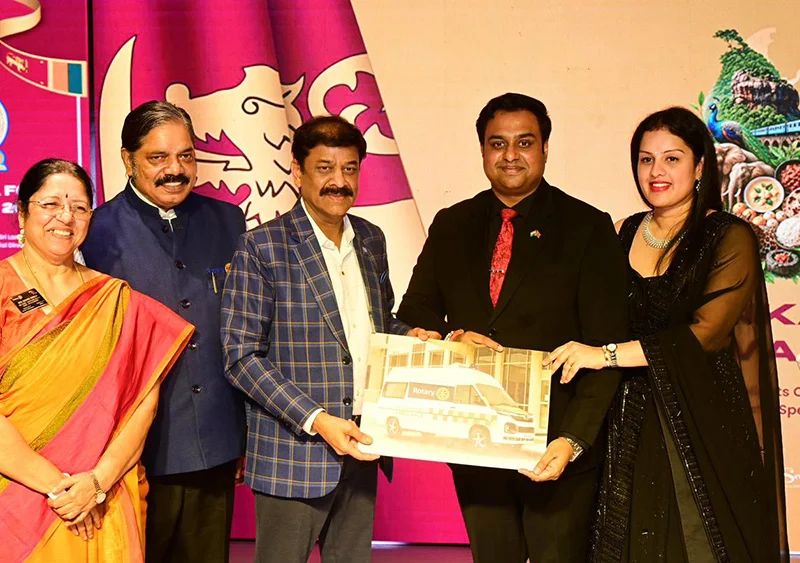
At the initiative of the Deputy High Commissioner of Sri Lanka, Dr. Ganesanathan Geathiswaran, the Deputy High Commission of Sri Lanka in Chennai successfully organized the first-ever “Sri Lanka Food Festival 2026” from 24th to 26th April at Green Meadows Resort, Chennai.
The Festival provided a unique platform to showcase the rich and diverse culinary heritage of Sri Lanka, offering guests an authentic experience of traditional Sri Lankan cuisine.
The event was organized in collaboration with esteemed partners, including the Ministry of Foreign Affairs, Foreign Employment and Tourism of Sri Lanka; Sri Lanka Tourism Promotion Bureau; Cinnamon Grand Hotel, Colombo; Ministry of External Affairs of India; India Tourism, the Government of India, the Tourism Department of the Government of Tamil Nadu, Dwarka Productions Chennai, and Tarlton Tea.
The primary objective of the festival to further strengthen cultural ties between Sri Lanka and South India while promoting tourism, trade, and people-to-people connections through a shared appreciation of culinary heritage was successfully achieved.
The occasion was further honoured by the presence of Suresh Jain, District Governor of Rotary District 3234; Navin Gupta, President of the Rotary Club of Chennai Coastal; and the Chief Guest, Dr. Ishari K. Ganesh, Founder, Chairman and Chancellor of Vels University.
The event was also attended by Mr. Blaze Kannan of Dwarka Productions; Nazoomi Azhar, General Manager of Cinnamon Grand Hotel, Colombo; and Sri Lankan actor Kalana Gunasekara, whose presence added further distinction to the occasion.
The festival witnessed the participation of diplomatic Corps, South Indian actors and actresses, distinguished business leaders, members of travel and tourism associations, members of Rotary Clubs, Round Table members, and members of the media fraternity, making it a prestigious and diverse gathering.
Over 700 guests attended the festival across the three days, reflecting strong interest and engagement from the local community.
In addition, the Rotary Club of Chennai Coastal announced its initiative to donate an ambulance to Sri Lanka and to renovate 30 schools across the country, further strengthening goodwill and support in the healthcare and education sectors between the two regions.

Since its UK debut in January 2025, JAECOO has recorded 28,232 new vehicle registrations within its first year, validated by the SMMT, making it the fastest-growing mainstream automotive brand Britain has seen in over a decade. Its flagship model, the JAECOO J7 PHEV, ranked among the most popular retail cars in the UK within its first year and emerged as the best-selling new car in Britain in March 2026.
These results have been further reinforced by a series of prestigious industry accolades:
Carwow Brand of the Year 2026
 Leasing.com Overall Car of the Year
Recognised by Google as the most searched Chinese automotive brand in the UK in its Year in Search 2025
Supporting this growth is JAECOO’s parent company, Chery Group, ranked 233rd in the Fortune Global 500 (2025) and China’s No. 1 passenger vehicle exporter for 23 consecutive years.
This global momentum is beginning to translate into local demand, with growing interest in the JAECOO J7 PHEV across Sri Lanka. Designed to combine premium styling with advanced technology and everyday practicality, the model is well suited to both urban driving and more challenging terrain. It offers a combined range of up to 1,200 km, fast-charging capability (30% to 80% in 20 minutes), and acceleration from 0–100 km/h in under 8.5 seconds. Safety and reliability are reinforced through advanced driver-assistance features, a five-star Euro NCAP rating, and a seven-year warranty offered by Hayleys Mobility.

Minister of Health of the Russian Federation attends the Sri Lanka–Russia Medical Forum

Members of Sri Lanka Cricket Transformation Committee Officially Appointed

Three prison guards arrested following the death of an inmate

Showers or thundershowers will occur at most places of the island after 1.00 pm.

CJ urged to inquire into AKD’s remarks on May 25 court verdict

ITAK MPs representing East take their woes to Canadian HC

‘Dates have the highest sugar content to fight Coronavirus’

Sunday Island 27 December – Headlines

#SundayIsland 17th December – Headlines

Sunday Island – 28th March

Sunday Island Headlines – 21 March

Sunday Island – 21st February – Headlines
-

 News7 days ago
Treasury chief’s citizenship details sought from Australia
-

 News6 days ago
Rooftop Solar at Crossroads as Sri Lanka Shifts to Distributed Energy Future
-
 News5 days ago
“Three-in-one blood pressure pill can significantly reduce risk of recurrent strokes”
-

 News7 days ago
Central Province one before last in AL results
-

 Sports7 days ago
Well done AKD!
-

 News2 days ago
USD 3.7 bn H’tota refinery: China won’t launch project without bigger local market share
-

 News5 days ago
Alarm raised over plan to share Lanka’s biometric data with blacklisted Indian firm
-
 News3 days ago
Easter Sunday Case: Ex-SIS Chief concealed intel, former Defence Secy tells court