
Foreign News
Plane forced to return to airport after horse escapes crate

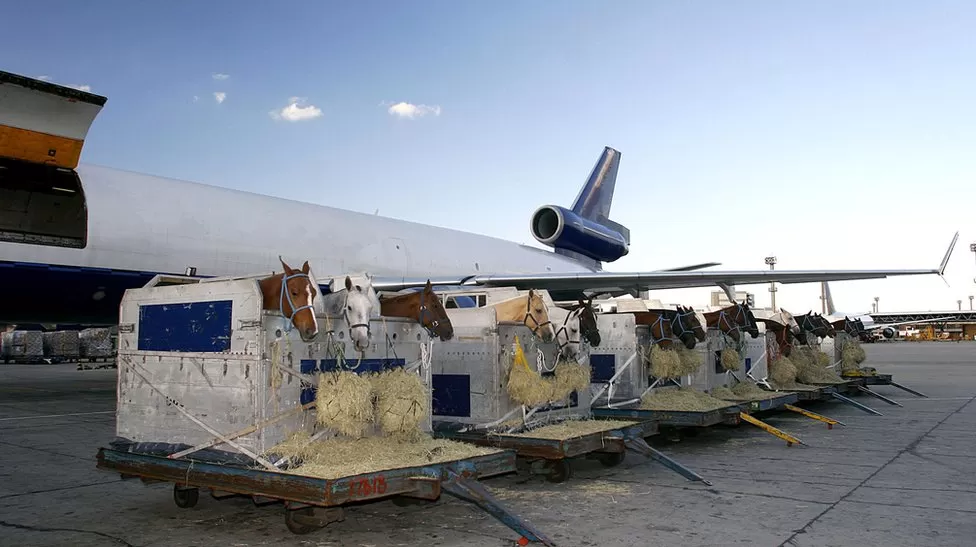
A Boeing 747 cargo jet has been forced to turn around, after a horse escaped from its stall and caused chaos as the plane cruised at 30,000ft (9,144m).
The plane was headed to Belgium from New York but did a U-turn roughly 90 minutes after its departure when the animal got loose.
Air traffic control audio recorded the pilot saying: “We have a live animal, a horse, on board the airplane. The horse managed to escape.” “We cannot get the horse back secured.”
The pilot flying Air Atlanta Icelandic flight 4592 told air traffic control the plane was fine but that the horse on the loose was the concern. He then requested a veterinarian meet the aircraft once it landed back at John F Kennedy International Airport.
As the plane made its way back during the incident last Thursday, the pilot said he needed to dump 20 tonnes of fuel, “east of Nantucket”, a popular enclave for the rich near Massachusetts. The plane had to dump the fuel due to the plane’s weight.
It remains unclear how the horse Houdini-ed its way out, but it was unrestrained when the plane landed at the airport.
“Do you require assistance?” air traffic control asked the pilot after the plane arrived. “On the ground, negative” the pilot replied. “On the ramp, yes. We have a horse in problem, in difficulty.”
The flight took off later in the same day and successfully arrived at Liege Airport on Friday morning, according to FlightRadar24.
Air Atlanta Icelandic did not immediately respond to the BBC’s request for comment.
Why the horse was being transported also remains unknown. One of the more common reasons is the transportation of race horses, according to experts. “You have a first class, a business class, and the economy,” one source told CNN, referring to the different size container options available for the animals.
This latest incident was not the first time an animal escaped its cargo stall while onboard an airplane. In August, a bear freed itself from its crate on an Iraqi Airways flight headed from Dubai to Baghdad, the Associated Press reported.
(BBC)


Ten people have been killed after a fire broke out in the trauma centre of a government hospital in the eastern Indian state of Odisha.
All the victims were patients, while 11 hospital staff are being treated for burns suffered while trying to rescue patients, state Chief Minister Mohan Charan Majhi said.
The fire – suspected to have been caused by an electrical short circuit – started in the trauma care ICU of SCB Medical College and Hospital in Cuttack city around 02:30 local time on Monday (21:00 GMT Sunday).
Hospital fires are often reported in India, with many blamed on electrical faults. Last October, six critically ill patients were killed in an ICU fire in Rajasthan state.
In 2024, a blaze in the neonatal ICU of a medical college in northern Jhansi city killed at least 10 new born babies. In 2021, a fire in the ICU of Vijay Vallabh hospital in the western city of Virar killed 13 patients receiving treatment for Covid-19. Another fire in 2021 at a newborn care unit in Bhandara district in western state Maharashtra killed 10 infants.
In Odisha, the blaze was brought under control after fire service personnel rushed to the hospital. Patients were moved to other departments inside the same hospital, officials said.
SCB Medical College and Hospital is one of the largest government-run medical facilities in Odisha.
Speaking to reporters after visiting the hospital, Majhi said the fire affected the trauma care ICU as well as an adjoining ICU and wards.
Majhi said medical staff and security personnel “risked their lives” during the rescue operation and some of them were injured, adding that the government had directed officials to ensure proper treatment for those hurt in the incident.
The state government has announced financial compensation for the families of the victims. Majhi said he has ordered a judicial inquiry into the incident and said strict action would be taken against anyone found responsible.
Short circuits are among the most common causes of hospital fires in India. Hospitals are particularly vulnerable to fires because they contain a lot of electrical equipment, oxygen systems and patients who often cannot be moved quickly during emergencies.
[BBC]

The Ecuadorean government has deployed more than 75,000 police officers and soldiers to four of the country’s most violence-wracked provinces, the interior minister says.
The authorities have also declared a night-time curfew in these areas as part of a “new phase” in their “war” on criminal gangs.
Since coming to office in November 2023, President Daniel Noboa has tried to quell drug-related violence but nevertheless Ecuador registered a record murder rate in 2025.
Noboa has also joined a US-led alliance of 17 countries aimed at fighting criminal cartels in the Western Hemisphere.
“We’re at war,” Ecuadorean Interior Minister John Reimberg told residents of the provinces of El Oro, Guayas, Los Ríos and Santo Domingo de los Tsáchilas.
“Don’t take any risks, don’t go out, stay at home,” he added.
Ecuador’s geographical location – sandwiched between Colombia and Peru, the world’s largest producers of cocaine – has turned it into a key transit country for the illicit drug.
Around 70% of the cocaine produced in Colombia and Peru is estimated to be shipped through Ecuador.
Noboa’s government has been working with the administration of US President Donald Trump to quell the flow of cocaine from Ecuador to the US.
Last week, the FBI opened its first office in the Andean country, a move which came shortly after the two countries launched joint counter-narcotic operations.
Noboa was one of the Latin American leaders to attend an international meeting hosted by Trump in Mar-a-Lago, which the US authorities dubbed the “Shield of the Americas” summit.
At the summit, Trump likened criminal gangs to a “cancer” and urged his Latin American counterparts to use military force to root them out.
“We don’t want it spreading,” Trump added.
Following the meeting, Noboa posted a photo on social media of himself standing next to Trump with the words: “For too long, the mafias thought that America was their territory. That they could cross borders, move drugs, guns and [spread] violence without consequences. Their time has run out.”
Since coming to office, Noboa has tried to combat criminal organisations in his country with an iron fist and has declared several states of emergency but nevertheless the murder rate rose by over 30% between 2024 and 2025.
[BBC]

Stew, a 35-year-old from Montana, has enjoyed dabbling in sports bets since he downloaded the Kalshi app about 18 months ago.
But just a few weeks ago, after spotting reports of elevated pizza deliveries around the Pentagon during some late-night scrolling, he made a different kind of bet – wagering $10 (£7.50) on the odds that Iran’s Ayatollah Ali Khamenei would be “out” by 1 March.
It was a trade that tested the limits of the kinds of bets Americans are allowed to make.
So-called predictions markets – overseen by firms such as Kalshi – have exploded in popularity over the last year, hosting more than $44bn in trades.
They are rapidly transforming the betting landscape in the US, where sports betting was largely illegal until 2018 and gambling on elections had been off-limits for years until 2024.
While much of the activity on the platforms revolves around sporting matches, users can speculate on any number of questions, including local elections, whether the US central bank will cut interest rates and the year of Jesus Christ’s return.
The apps caught fire during America’s 2024 presidential campaign, after a legal victory cleared the way for them to accept election bets and they showed the odds tilting toward Donald Trump.
But it is more grisly wagers tied to military action involving Iran, Venezuela and Israel that have drawn attention lately.
In theory, such bets run afoul of US financial rules, which bar trading on contracts involving war, terrorism, assassination, gaming or other illegal activities.
But that hasn’t stopped firms from taking in millions of trades.
Critics have seized on the activity, calling for a crackdown on the apps, which they say are facilitating unseemly, and potentially illegal, war profiteering, generating national security risks and enabling opportunities for insider trading and corruption.
“You have now opened up gambling basically on almost anything and it has turned into this very, very gruesome type of thing on the death of a head of state,” said Craig Holman, government affairs lobbyist at the Public Citizen advocacy group, which recently filed a complaint this week over the bets.
Polymarket alone has hosted what Bloomberg estimated as more than $500m in bets related to the Iran war, at one point offering an opportunity to play the odds on the chance of nuclear detonation.
The company, which is headquartered in New York but operates on a limited basis in the US, eventually removed that market after it drew scrutiny on social media but users can still submit bets on questions like when US forces will enter Iran. It did not respond to the BBC’s request for comment.
Kalshi also ended up cancelling the Khamenei market, which had drawn $54m in trades, noting that US-regulated entities are barred from “having a market directly settling on someone’s death”.
The company, which did not respond to a request for comment for this article, has said the war bets are happening on unregulated exchanges outside the US.
Concerns about the war bets have collided with a bigger battle over how prediction market firms should be regulated.
Unlike traditional gaming firms, in which the odds are set by the company, prediction market companies function more like a stock exchange, allowing users to bet against each other on the outcome of future events using “event contracts”.
That design has allowed national financial regulators at the Commodities Futures Trading Commission (CFTC) to claim oversight.
But critics say they are sports betting and gambling operations trying to dress up as financial exchanges in a bid to avoid stricter rules and taxes faced by traditional gaming firms, which are regulated by the states.
Disagreement over who should be policing the apps has sparked dozens of legal battles across the US, as states start to assert their right to regulate the companies like other gaming firms, rather than leave oversight up to the CFTC.
Even some Republicans have voiced concerns, as traditional gaming firms have also stepped up their lobbying, enlisting a savvy former Trump official, Mick Mulvaney, to plead their case in Washington.
“Nobody is saying that gambling shouldn’t be allowed,” says Ben Schiffrin, director of securities policy at Better Markets, which advocates for financial reforms. “What the states are saying and other advocates are saying is things that are gambling should be regulated as gambling.”
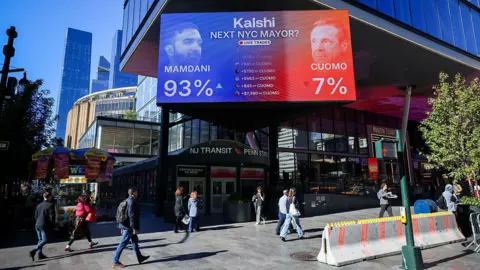
Suspiciously timed bets related to military operations involving Israel, Venezuela and Iran have added fodder to those calls.
In recent weeks, Democrats have introduced legislation to bar federal officials from trading event contracts, pointing to incidents such as when a gambler new to Polymarket made nearly half a million dollars on the capture of Venezuela’s president just before it was officially announced.
They have also issued alerts to consumers about the risks of insider trading and written to the administration urging it to more clearly enforce the rules against wagering on war.
But the odds of a crackdown remain long.
Though the Biden administration had taken a hard line on the sector, proposing to ban sports and politics-related event contracts, that regulatory drive stalled after a court defeat and the 2024 election of Donald Trump, who came to power promising a lighter hand.
Last month, the CFTC said it would withdraw the proposed ban on sports and election related contracts.
It has also taken the side of prediction market firms in the legal fights they are facing in the states, which Michael Selig, Trump’s chairman of the Commodity Futures Trading Commission, condemned in a recent opinion piece as “overzealous”.
He argued that event contracts served “legitimate economic functions”, allowing businesses to hedge against risks triggered by events.
“It’s clear that Americans like the product and want to participate,” he said, while also emphasising that platforms must still follow rules.
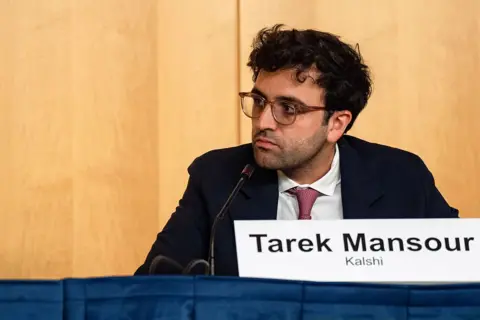
As the pressure mounts, Polymarket has announced steps to more formally police suspicious activity, while Kalshi, which advertises its status as a “regulated exchange”, has become more vocal about what it is doing to combat insider trading.
It recently announced punishments in two cases of insider trading and disclosed that it had opened up 200 investigations over the last year.
The company also ultimately cancelled the $54m market around Khamenei’s ouster.
In series of statements explaining the decision, the firm said it did not “list markets directly tied to death”, noting that its terms had included that carve-out.
It promised to make the terms more clear from the get-go, saying it had “learned a lot” from the incident.
But in an indication of growing pains, the decision still sparked outrage among users, including Stew, who said the firm had initially “buried” those rules and its explanation seemed disingenuous, given that there were “only a handful of realistic methods” for Khamenei to go.
Stew, who received a refund, said he wasn’t sure regulation was the answer, but he was sympathetic to the idea that the debate seemed to be stumbling around semantics.
“They call it contract trading, which I guess technically speaking, that’s what it is. But if we’re all being honest here, it’s still betting,” he said.
[BBC]

Israel says it’s killed Ali Larijani, Iran’s security chief and Basij commander

Devon Conway, bowlers star as New Zealand make it 1-1

Israel claims to have assassinated commander of Iran’s Basij militia unit

Trump seeks to delay meeting with Xi in China

Pakistan lodge official complaint about Bangladesh’s review at end of chase

Showers or thundershowers will occur at several places in the Central, Sabaragamuwa, Southern and Uva provinces after 2.00 pm.

‘Dates have the highest sugar content to fight Coronavirus’

Sunday Island 27 December – Headlines

#SundayIsland 17th December – Headlines

Sunday Island – 28th March

Sunday Island Headlines – 21 March

Sunday Island – 21st February – Headlines
-

 Business7 days ago
BOI launches ‘Invest in Sri Lanka’ forum
-

 News6 days ago
Historic address by BASL President at the Supreme Court of India
-

 Sports6 days ago
The 147th Royal–Thomian and 175 Years of the School by the Sea
-

 Sports7 days ago
Royal start favourites in historic Battle of the Blues
-

 News7 days ago
CEBEU warns of operational disruptions amid uncertainty over CEB restructuring
-

 Features7 days ago
Indian Ocean zone of peace torpedoed!
-

 Life style3 days ago
From culture to empowerment: Indonesia’s vision for Sri Lanka
-
 News6 days ago
Power sector reforms jolted by 40% pay hike demand