
News
Place names say who we are: Nallur triumphs Nellore

by S. Ratnajeevan H. Hoole
The Perahera in Kandy was permitted even with artistes catching Covid. The Nallur Thiruvilla was banned. Our terrorizing police had parades at the temple for TV but shut down streets and diverted traffic although no one was worshiping. When robbers came two doors away (21.08.2021) during curfew, the police emergency number did not answer, and the normal number was hung up when I called. The police do not protect us. My Nellore is being robbed of its name and history.
Rick Grannis of UC Irvine found American racial populations being organized according to “who is down the street.” I address here the subtle fight over place names to suggest the dwellers’ caste. Nellore is the name of Nallur in early church records; streets correlate to caste and land price.
We see street segregation in the Tamil Hindu Epic Chilappathikaram Canto 5. Streets are reserved by caste having their “respective localities.” Jewellers, copper/iron mongers, cobblers, grain-sellers, et al., had their reservations – even mutton vendors, fishmongers, and prostitutes. These places in the city went by the name of Maruvurppakkam (the Other Village Side). In Pattinappakkam (Town Side) dwelt highly renowned great men.
Nellore was the seat of the Jaffna Kingdom of the Aryachakaravarthies. Chekarajacekaramalai says their lineage was Brahmin (I doubt it). Our royals naturally upheld agamic Hindu culture; particularly caste.
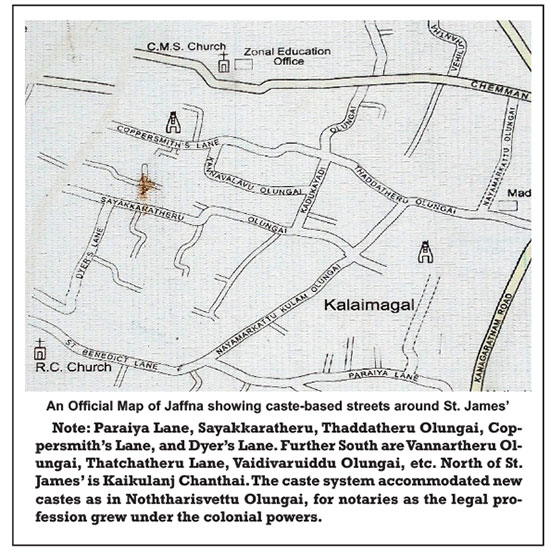
 Madurai’s practice was upheld in Nellore – see the street map from the Jaffna Public Library. The CMS St. James’ stands where the principal Hindu Temple stood at Nallur Centre. Guardian-temples stood in agamic fashion, namely Chattanaathar Kovil (North), a destroyed untraceable temple (West), Moothavinayagar Kovil (South) and Veyyilviluntha Pillaiyar Kovil (East). The map says what caste lived where. People who want a high-status buy into Vellala areas.
There is push back. For example, North of Chattanaathar Kovil is where the Kaikular of middling caste live (palace guards). It was called Kaikulanj Chanthai, now renamed Kalviankadu. This area North of the Palace was occupied by the Portuguese garrison. Many Kaikular show admixture: physical stature (like TELO’s Sri Sabaratnam), pink skin, and grey eyes which are now ascribed to Brahmin admixture and used by Kaikulas to make claims to Brahmin-ritual, like shorter periods of mourning.
The upper castes lived on the main roads within the circle of the guardian temples centred on CMS St. James’, called Changili Thoppu (King Changili’s Garden). People in the by-lanes were of lower castes – typically workers from the trades and musicians, whom the royals needed, and untouchables.
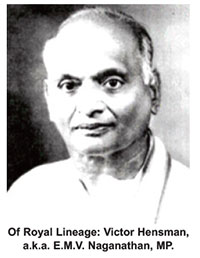
The Rev. John Hensman was the first Anglican priest from Jaffna. It is a shame that Dr. Victor Hensman (later Naganathan) of that family whose life we celebrated only on 15 Aug. 2021 through an international Zoom conference, abandoned that proud heritage and took on the name E.M.V. Naganathan, MP, SJV Chelvanayakam’s righthand.
The high-caste Circle stopped East of Veyyil Viluntha Pilllaiyar Kovil where Chemmany Road (leading to Chemmany) ends on the map. East of that is Nayanmaarkattu where field workers lived. The unnamed road at the top-right of the map was Nayanmaarkattu Veethi (becoming Aadiyapaatham Road) going to Thirunelveli Market. The short stretch of road from Kachcheri-Nallur Road towards the temple as Point Perdro curves toward Muththirai Chanthai was exclusively for Musicians, who could be heard practising their sweet music up to the mid-1960s. They have sold their lands to those seeking caste-upgrade by coming closer to the Nallur Temple.
Many new families have moved in buying land especially as the Christians left Nellore. Changili Thoppu where CMS St. James’ stands and the Palace stood, contains Muthirai Chanthai (Stamp Market, where stood a market to my times, and named so because the King’s tax collectors stamped in indication that taxes had been paid). That market is gone now so new-comers give away their late-coming status by calling it Muththirai Chanthi (Stamp Junction), although Church deeds refer to “Muththirai Chanthai.”
Chemmany Road
Chemmany Road, running by the old palace and central temple with the stretch of Point Pedro Road in front of the Palace entrance, was one of the most important roads. Fr. V. Perniola (The Catholic Church in Sri Lanka) makes occasional reference to the early church in Jaffna in Portuguese times. The early missionaries were Franciscans. King Changili martyred the first Franciscans and many Tamil saints, including his own son. The name Chemmany Road is commonly thought to have its etymology in chem (red) mani (stone, jewel). That, however, is far-fetched because there are no red stones or gems in the area. The likely etymology is chem (holy-red) munn (sand)-ee (the place that has red sand). Chemmany is the place where martyrs’ blood was spilt. As such, the church precincts and the Teachers’ Training College, with its associated Practising School, are hallowed grounds for Christians, RC and non-RC.
The Rev. Elijah Hoole married a girl from Nallur and the Hooles have lived on Chemmany Road for generations. Church deeds testify that our land belonged to my great-great grandmother “Mrs. E. Hoole.”
Nellore Temple History
St. James’s Church is built on the original Central Temple razed to the ground presumably in June 1619 when the Portuguese launched an expedition against Changili II. He took baptism in Goa before his beheading for his crimes, testifying “I would rather die a Christian Coolie than a Heathen King” and “uttering the sweet name of Jesus” (Queyroz, 690-1). His two Queens were preached to by Friar Antonio de Santa Maria (Queyroz 686ff); involving long debates about religious choices with the Queens showing appreciation for Christianity but not enough to convert – until one Queen is moved to ecstatic tears and gets baptised and preaches to the other who too converts. She donated the land where the central temple stood to the Church. On that spot was built a Roman Catholic chapel occupying the St. James’ altar and vestry, and a schoolhouse. Thus St. James’ turned 557 years old in June 2019 when it had Mary as part of its name (citing Roman Catholic historian Rev. Dr. Fr. J. E. Jeyaceelan), although the 200th anniversary recently celebrated was only of the Anglican Church.
Following replacement of the Central Temple by a Roman Chapel, historic documents refer to the Nellore Temple having been built by Chembaha Perumal. There is deliberate spinning between the razed temple and the new. The Wikipedia says, “According to the Yalpana Vaipava Malai, the temple was developed at the site in the 13th century by Buwaneka Bahu, a minister to the King of Kotte. Chembaha Perumal is credited with building the third Nallur Kandaswamy temple”. Where were the first and second? Other so-called encyclopedic sources say, “the Temple’s foundation was laid in 948 AD. … Due to invasion of foreigners, the temple had to be relocated several times in different places within [the] Nallur area.” Nonsense.
After 948 AD it was the time of the ardently Saivite Cholas, who never would have destroyed a Murugan Temple, and then of the Aryachakaravarthies who too promoted Saivism. So why did the temple have to be relocated several times within Nallur whereas those escaping invaders would have fled Nellore?
However, many writers blame Phillippe de Olivero – a Portuguese army commander – for destroying all Hindu temples in Jaffna in 1620. His expedition against Changili II was in 1618. So where was the Nallur temple he destroyed? Which? When? That account is doubtful. The actual destruction would have been in 1619 under de Olivero by when a Christian Chapel was already standing. That would have been where the original temple was. Stories of its relocation need clear proof of when and to where it was relocated.
The present-day Nellore Temple was really built (as a new temple, not rebuilt) when the Dutch allowed it. According to what I was taught in primary school and to India’s Jaffna Consul General’s web site, “It is believed that there was a shrine dedicated to an Islamic Sufi saint in the temple complex from 1734 to 1749 which was relocated in 1749 when the temple structure was built.”
Clearly the present temple stands on “The Other Village Side” in the Muslim quarter with bad connotations for caste. The original Nellore (Paddy Village, Chemmany to this day having paddy fields cultivated by Palla field workers) had to be rescued and made Nallur, the place of good people. The Muslims were pushed further West into Chonaka Theru.
What was done to the Sufis was exactly what the Portuguese did to the Hindus, and the LTTE did to the Muslims in Oct. 1990.
So the Nallur temple cannot be older than late Dutch rule – late in the Eighteenth Cent. when the Dutch began giving permission to build temples. (They never attacked Mosques because they contained no idols).
We see a lot of self-enhancing expansionist heritage history concerning Nallur. Wikipedia even claims, “Part of the original Shivalingam of the Nallur Kandaswamy Temple was located in the Vicarage [of St. James’] till 1995 when it was destroyed during the recapture of Jaffna by Sri Lanka armed forces. Nonsense. I lived in the vicarage from 1956 to 1967. There was no Sivalingam.
Battle for Nellore
St. James’ is the centre of Nellore made into Nallur to claim high caste status, although according to the map, several lower castes also live in Nellore outside the circle round St. James’.
The new temple stands where Muslims and traders ejected from there lived; technically on low-caste soil. It was Maruvurppakkam rather than central Nallur. Reclaiming Pattinapakkam is a long-term project in progress. For that, the temple area must expand East and Nayanmaarkattu expand West, thereby eliminating the real Nallur.
I have begun receiving letters addressed to Nayanmaarkattu Road rather than Chemmany Road. St. James’ up to 1975 or so was dominated by Vellalas, but now only about 3 families remain. The other castes to the east (Nayanmaarkattu) and south (Ariyalai) outside the circle around St. James’ dominate the church, even though the Hindus among them have stone-throwing and fisticuffs when there is Paraya-Palla love. With all Wardens today non-Vellalas, they have lumped our family with Nayamaarkattu for administrative purposes arguing that Changilithoppu is now part of Nayanmaarkattu. Likewise, Paraya Street now has disappeared into St. Benerdict’s Street. The North-South Nayanmaarkattu Olungai leading to Nayanmaarkattu is removed and now runs East-West to Kanaharatnam Road leading to Ariyalai. However, since the Provincial Department of Education has illegally encroached on the CMS Teachers’ Training College and Vellalas (or aspiring Vellalas) there will not use the Nayanmaarkattu Road as address in preference to Chemmany Road, obliterating that Chemmany Road address is uphill.
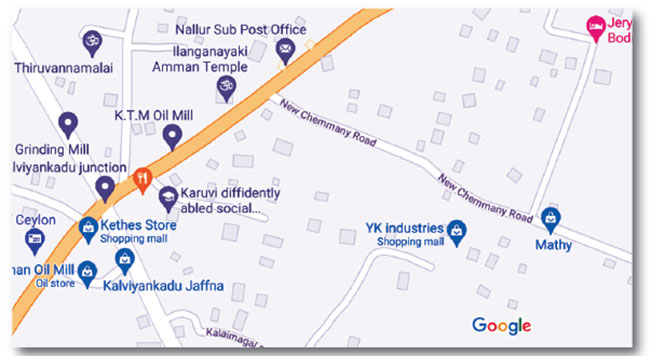
The attempt to replace “Chemmany Road” with the name “New Chemmany Road” elsewhere is ongoing. A road by this name is seen as having been started from Kaikulanj Chanthai. It does not even reach Chemmany. The Nallur sub-Post Office was within the circle by Chattanaathar Kovil. That has been moved to Kaikulanj Chanthai diminishing the claims of the original Nallur.
When I returned to Sri Lanka and was looking for land close to St. James’, my Hindu relations told me my Hindu cousin in new Nallur was selling his land. When I inquired, he denied it. My relations said he was untruthful. Three months later he had sold it to a Hindu. There is an ongoing attempt to call the temple area Siva Boomi. So meat-eating Christians are not welcome (although I am vegetarian when most Hindus re not). Even the strict king of Kannaki’s, Pandiyan Nedunj Chelian, permitted mutton-vendors and fishmongers; but not the Velllalas of Nallur Temple. Eating-houses are vegetarian. A meat-eating German Shepherd on Siva Boomi has been switched to vegetarian.
The real Nellore is vanishing. The usurper Nallur stands on sufi soil and is in bad hands.

Independent trade unions cry foul
The government has launched a far-reaching overhaul of the electricity industry, breaking up the Ceylon Electricity Board (CEB) into six fully state-owned companies, claiming to rein in chronic losses and mounting debt.
Under the Preliminary Transfer Plan, the newly incorporated entities, namely, Electricity Generation Lanka (Pvt) Ltd (EGL), National Transmission Network Service Provider (Pvt) Ltd (NTNSP), National System Operator (Pvt) Ltd (NSO), Electricity Distribution Lanka (Pvt) Ltd (EDL), CEB Employees Funds (Pvt) Ltd (CEBEF) and Energy Ventures Lanka (Pvt) Ltd (EVL), will take over the assets, liabilities and operations of the CEB from the appointed date.
Independent trade unions have opposed the restructuring programme.
At the core of the new model is the creation of an independent National System Operator, which will handle power system planning and competitively procure electricity from Electricity Generation Lanka, Independent Power Producers and non-conventional renewable energy developers. Power will be wheeled through the national grid operated by the NTNSP and sold to distribution companies.
Explaining the economic rationale, Eng. Pubudu Niroshan Hedigallage said the separation of functions was critical to restoring cost discipline in the sector.
“Electricity planning and procurement will now be carried out independently, based on least-cost principles. That is essential if we are to control generation costs and ease the upward pressure on tariffs,” he said.
Electricity Generation Lanka, though a successor to the CEB, will compete with private and renewable energy producers for projects, a move expected to curb inefficiencies and end guaranteed returns enjoyed under earlier arrangements.
“There will be no automatic allocation of projects. EGL must compete in the market like any other generator,” Eng. Hedigallage said.
According to officials, the Preliminary Transfer Plan provides for one generation and one distribution company initially, with further unbundling planned under the Final Transfer Plan to introduce sharper financial accountability at operational level.
Economists note that the restructuring is closely watched by multilateral lenders and investors, who have repeatedly flagged the power sector as a major fiscal risk.
The government has insisted that the reforms do not amount to privatisation, stressing that all six entities remain 100 percent state-owned. However, independent trade unions are of the view that what the government has undertaken is divestiture in all but name.
By Ifham Nizam
News
India, Sri Lanka speakers discuss technology-driven parliamentary innovation, including AI-enabled systems
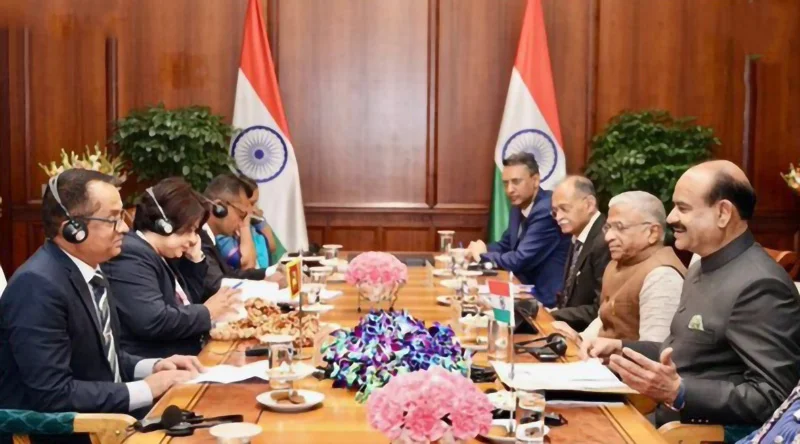
Speaker of Lok Sabha Om Birla and Sri Lankan Speaker (Dr.) Jagath Wickramaratne recently discussed the possibility of expanding parliamentary cooperation through regular exchanges, formation of friendship groups, collaboration in policy and programme design and deeper engagement in technology-driven parliamentary innovation, including AI-enabled systems, real-time multilingual translation, and capacity building through Parliamentary Research and Training Institute for Democracies (PRIDE).
The discussion took place on the sidelines of the 28th Conference of Speakers and Presiding Officers of the Commonwealth (CSPOC) held in New Delhi recently.
The following is the text of the statement issued by the Indian High Commission in Colombo: ” Speaker of the Parliament of Sri Lanka (Dr.) Jagath Wickramaratne concluded his visit to India from 14-18 January 2026, for participation in the 28th Conference of Speakers and Presiding Officers of the Commonwealth (CSPOC) held in New Delhi. This was his first visit to India after assuming office. He was accompanied by Secretary-General of Parliament Kushani Rohanadeera and Assistant Director, (Administration) of the Parliament of Sri Lanka Kanchana Ruchitha Herath. Following the 28th CSPOC from 14-16 January 2026, Speaker and his delegation visited Jaipur, Rajasthan as a part of a two-day tour for CSPOC delegates from 17-18 January 2026.
The 28th CSPOC was inaugurated by Prime Minister of India Narendra Modi on 15 January 2026 at the Central Hall of Samvidhan Sadan, Parliament House Complex, New Delhi. Welcoming parliamentary leaders from across the Commonwealth, Prime Minister Modi highlighted the success of Indian democracy in providing stability, speed, and scale. He shared India’s efforts at giving voice to the Global South and forging new paths of cooperation to co-develop innovation ecosystems. He underlined the use of Artificial Intelligence by the Parliament of India to attract youth to understand Parliament. Prime Minister expressed his confidence in the CSPOC platform for exploring ways to promote knowledge and understanding of parliamentary democracy.
The conference, chaired by Lok Sabha Speaker Om Birla, convened 44 Speakers and 15 Deputy Speakers from 41 Commonwealth countries, along with representatives of four semi-autonomous Parliaments. The theme of the conference was “Effective Delivery of Parliamentary Democracy.” During the conference, participants addressed the role of Speakers in reinforcing democratic institutions, the integration of artificial intelligence in Parliamentary functions, the influence of social media on Members, approaches to enhance public engagement with Parliament, and measures to ensure the security, health, and wellbeing of Members and Parliamentary staff.
The visit marked a significant milestone in the evolving parliamentary partnership between India and Sri Lanka. Last year, two Parliamentary Delegations visited India for Orientation Programmes in May 2025 and August 2025 respectively. These visits, in line with the intent of the India – Sri Lanka Joint Statement on ‘Fostering Partnerships for a Shared Future’, further reinforce the strong democratic ethos and enduring friendship shared between the two nations.”
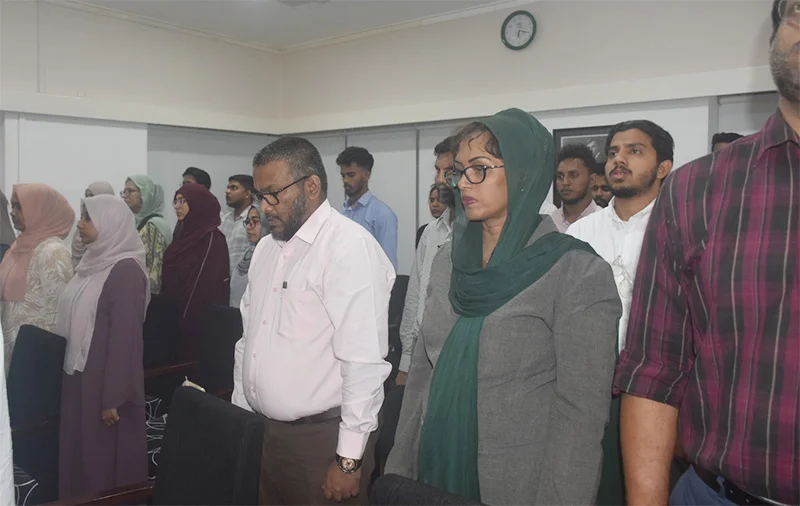
The High Commissioner of Pakistan in Sri Lanka hosted a special reception on Friday (16) for Sri Lankan alumni who have recently returned from their studies in Pakistan. The event, held at the Pakistan High Commission, celebrated the academic achievements of the graduates and reinforced the deep-rooted educational ties between the two nations.
The Allama Iqbal Scholarship Programme, a flagship initiative launched in 2019, has become a vital pillar of bilateral cooperation. The High Commissioner highlighted that Pakistan offers 1,000 fully funded scholarships at graduate, postgraduate, and PhD levels, with over 500 Sri Lankan students currently pursuing their education in Pakistan’s premier universities.
“Sri Lanka and Pakistan share an enduring friendship rooted in a shared history of mutual respect and culture,” the High Commissioner remarked during the address. “Education is the key to unlocking the success of your brilliant futures and creating bonds that extend well beyond the classroom”.
Addressing the alumni as “custodians” of a noble cause, the High Commissioner urged the alumni to act as brand ambassadors by sharing their knowledge to guide deserving students toward academic opportunities in Pakistan.
He emphasised their responsibility to mentor young minds, ensuring no capable student misses the chance for a promising future. Furthermore, the alumni were encouraged to take an active role in organising frequent educational and cultural engagements to inspire and enlighten others while strengthening the ties between the two nations.
The High Commissioner emphasized that each graduate serves as a “bridge” between the two countries, playing a meaningful role in uplifting Sri Lanka while further strengthening Pakistan–Sri Lanka relations. The alumni were invited to remain closely connected with the High Commission to facilitate future initiatives that strengthen people-to-people ties.
The evening concluded with a traditional Pakistani dinner, where the alumni shared stories of their academic growth and cultural experiences in Pakistan in a spirit of friendship and togetherness.

Red-hot Royal Challengers Bengaluru stay perfect ain 20nd march into playoffs

Zadran, Rasooli power Afghanistan to commanding win over West Indies

Italian fashion designer Valentino dies aged 93

U – 19 World Cup: Sri Lanka beat Ireland by 106 runs

U – 19 World Cup: Rowles, Bulbulia star in South Africa’s big win over Tanzania

U – 19 World Cup: Raza, Usman steer Pakistan to victory over Scotland

‘Dates have the highest sugar content to fight Coronavirus’

Sunday Island 27 December – Headlines

#SundayIsland 17th December – Headlines

Sunday Island – 28th March

Sunday Island Headlines – 21 March

Sunday Island – 21st February – Headlines
-

 Editorial3 days ago
Illusory rule of law
-
 News4 days ago
UNDP’s assessment confirms widespread economic fallout from Cyclone Ditwah
-

 Business6 days ago
Koaloo.Fi and Stredge forge strategic partnership to offer businesses sustainable supply chain solutions
-
 Editorial4 days ago
Crime and cops
-
 Features3 days ago
Daydreams on a winter’s day
-

 Editorial5 days ago
The Chakka Clash
-
 Features3 days ago
Surprise move of both the Minister and myself from Agriculture to Education
-

 Features2 days ago
Extended mind thesis:A Buddhist perspective