
Business
Pan Asia Bank posts steady performance during FY 2023 –


Profit before Tax increases by 258% amidst external challenges
Pan Asia Banking Corporation PLC reflected a steady performance amidst multitude of adversities emerging from challenging macro-economic conditions as the Bank reported its financial performance during 2023, which showed judicious portfolio management and prudency exercised in dealing with possible fallout on its asset quality in challenging times.
The Bank reported a Pre-tax Profit of Rs. 2,328 Mn for the year ended 31st December 2023, which is 258% increase compared to corresponding period last year, supported by improved net interest income, increased trading gains from government securities and reduced exchange losses.
The Sri Lankan economy has experienced some positive signs of gradual economic recovery and a measure of stability in macro-economic factors compared to the previous year, with the appreciation of LKR against USD and the IMF bailout followed by the Domestic Debt Optimization (DDO) announcement. The multiple economic scenario models used regarding collective impairment in 2022 were continued in 2023 to ensure that adequate buffers were in place to absorb any potential credit risk that could arise in the future. The allowance for overlays applied in previous year was continued and maintained during 2023 too. Meanwhile, the Bank managed to end the year with healthy credit quality matrices due to improved credit underwriting standards and concerted collection & recovery efforts despite the contraction in the loan book during 2023 which impacted the Bank’s Stage 3 Loan Ratio adversely.
Furthermore, the Bank increased impairment provision buffers held regarding investments in International Sovereign Bonds of Government of Sri Lanka (SLISBs) further during 2023 with the expectation of possible adverse outcomes of the on-going government External Debt Restructuring (EDR) programme. The Bank recognised an impairment charge of nearly Rs. 2 Bn regarding International Sovereign Bonds during 2023.
The interest income for the year 2023 rose by 39% due to the high interest rates that prevailed during the period under review compared to corresponding period of the last year and the re-pricing effect of facilities in response to the market conditions. Further, the growth in interest income was supported by the increased interest income from Rupee denominated securities of the Government of Sri Lanka (T-Bills & Bonds) due to increased investments and high interest rates offered on such new investments compared to the previous year. Consequently, the net interest income increased by 9% in 2023 compared to the last year. (Pan Asia Bank)









Sri Lanka needs to build awareness, effective policies and encourage regional multilateral frameworks to develop a multi-pronged approach to secure its national interest and safeguard regional stability in the Indian Ocean Region (IOR), as the region together with its seabed have become an area of strategic competition, former Assistant Chief Cabinet Secretary to former Japanese Prime Minister Shinzo Abe, Prof Nobukatsu Kanehara said.
“The Indian Ocean has been a maritime highway for millennia, with Sri Lanka being a midway point of the flow of trade, culture, technology and intellectual progress, Prof Kanehara said at the 4th Pathfinder Foundation Sri Lanka Indian Ocean Security Council Conference held recently at the Cinnamon Grand Hotel. The forum was presided over by Pathfinder Foundation Sri Lanka Chairman Ambassador (retd.) Dr. Bernard Goonetilleke.
The forum’s purpose was to obtain expert commentary regarding the need for Sri Lanka to ‘up its game’ in the IOR.
Abe said that from the 1870s onwards, the Indian Ocean had become the global communications highway, with the British Empire laying submarine cables from Aden to Mumbai, linking Europe to South Asia.
‘Since then, with the passage of time, Ceylon, and later Sri Lanka, has seen the bulk of the global digital communications umbilical laid through its maritime domain of influence, with over a dozen such cables laid over the island’s Exclusive Economic Zone (EEZ) thus far, he said.
Prof. Kanehera added: ” With the rise of Artificial Intelligence (AI) and increasing digitisation, such submarine cables have become critical strategic infrastructure for the island nation as well as the region.
‘This timely conference came as world powers rushed to secure critical minerals needed to maintain a technology edge over rivals, both militarily and economically, disrupting the longstanding rules-based order, especially at sea and in trade.
‘The lack of cognition regarding how to understand and navigate the return to a near Cold War era strategic competition in the Indian Ocean, and increasingly in the sub-surface domain and the seabed, among Sri Lanka’s policy making community, bureaucrats and public leaves the economically weakened island nation more vulnerable to geopolitical coercion, shocks and tug-o-war, which will likely increase in the coming decade.’
By Hiran H Senewiratne
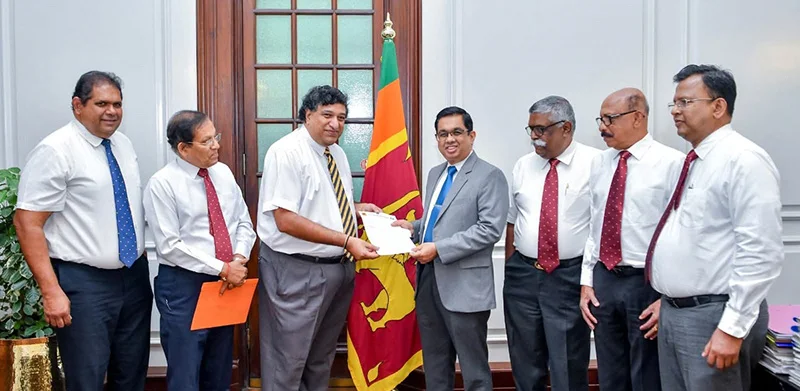
Automobile Association of Ceylon (AAC) donated Rs. 25 Million towards the Disaster Relief Support Fund to assist the Ditwah Cyclone victims.
A donation was handed over to Dr. S N Kumanayake, Secretary to the President of Democratic Socialistic Republic of Sri Lanka by Dhammika Attygalle, President – AAC at the Presidential Secretariat on the 19th February 2026 in the presence of Executive Committee members.
Dhammika Attygalle President AAC (third from Left) handing over the cheque to Dr S N Kumanayake, Secretary to the President of Democratic Socialistic Republic of Sri Lanka.
In the picture L-R Lasitha Gunaratne- EXCO Member – AAC, Devapriya Hettiarachchi – Secretary -AAC, P H Liyanage, P B Kulatunga & Indunil Udaya – Members of the EXCO – AAC
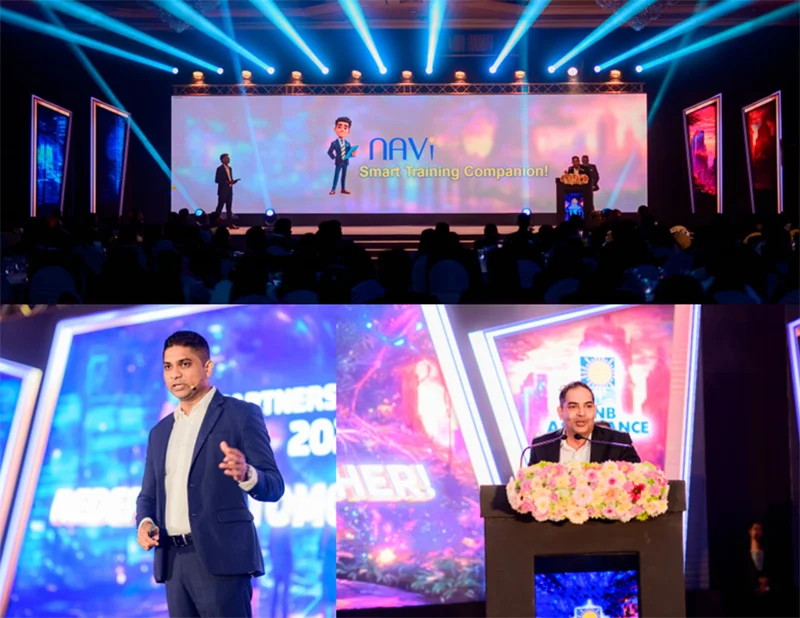
HNB Assurance PLC recently introduced NAVI, The Digital Trainer, a new AI-powered training companion designed to support its banca staff with instant, reliable access to knowledge, whenever they need it. The solution was unveiled at Partnership Life, the company’s annual forum dedicated to celebrating the performance of its Partnership Channel.
Built to make learning simpler and more accessible, NAVI is a voice-enabled AI chatbot that helps banca staff quickly find product information, policy details, and process-related guidance by drawing from a centralized knowledge bank. Whether on the go or at the point of customer interaction, NAVI ensures that answers are never out of reach.
Sharing his thoughts, Sanesh Fernando, Chief Business Officer / GM – Partnership Channel at HNB Assurance, opined, “With NAVI, our intention is to make learning a part of everyday conversations. By combining chat and voice capabilities, we are making it easier for our officers to learn on demand and perform with greater confidence.” He further noted that it is this continuous focus on meaningful innovation that has consistently set HNB Assurance apart within the bancassurance space. “Solutions like NAVI reflect the way we think and operate as a Partnership Channel. This commitment to enabling our partners and bancassurance officers through practical, forward-thinking initiatives has been a key driver in our journey, one that has seen us being recognized as the Best Life Bancassurance Provider for five consecutive years, while also delivering strong and sustained growth year after year.”
Commenting on the launch, Suneth Jayamanne, Chief Information Officer / GM of HNB Assurance, said, “We see NAVI as a support system rather than a piece of technology. Our Bancassurance officers operate in fast-paced environments and having instant access to the right information can make all the difference. NAVI is about helping our people feel more prepared, more confident, and more connected to the knowledge they need to serve customers better.”
The launch of NAVI was marked by an engaging reveal featuring an AI-generated avatar that introduced the digital trainer and its capabilities, symbolizing a shift towards a more intuitive and people-friendly approach to learning.
As HNB Assurance continues to expand its Partnership Channel, innovations such as NAVI highlights the company’s focus on building strong, well-supported partnerships, blending technology with a deep understanding of how people learn, and work.
HNB Assurance PLC (HNBA) is one of the fastest growing Insurance Companies in Sri Lanka with a network of 79 branches. HNBA is a Life Insurance company with a rating of ‘A’ (lka) by Fitch Ratings Lanka for ‘National Insurer Financial Strength Rating’. Following the introduction of the segregation rules by the Insurance Regulator, HNB General Insurance Limited (HNBGI) was created and commenced its operations in January 2015; HNBGI continues to specialize in motor, non-motor and Takaful insurance solutions and is a fully owned subsidiary of HNB Assurance PLC. HNB General Insurance has been assigned a ‘National Insurer Financial Strength Rating’ of ‘A’ (lka) by Fitch Ratings Lanka Limited. HNBA is rated within the Top 100 brands and Top 100 companies in Sri Lanka by LMD and HNB Assurance has won international awards for Brand Excellence, Digital Marketing and HR Excellence including the Great Place To Work® Certification, and won many awards for its Annual Reports at award ceremonies organized by the Institute of Chartered Accountants of Sri Lanka.

Classy Brook century puts nervy England in the semi-final

More than 5,000 flights cancelled as US east coast digs out of record snow

Pakistan bat vs unchanged England with Afridi back

Navy seize an Indian fishing boat poaching in Mannar seas

Fair weather will prevail except for showers in the Southern province and in Rathnapura, Monaragala and Kaluthara districts after 2.00 p.m

Families of those sentenced to death for killing MP Atukorale seek AKD’s intervention

‘Dates have the highest sugar content to fight Coronavirus’

Sunday Island 27 December – Headlines

#SundayIsland 17th December – Headlines

Sunday Island – 28th March

Sunday Island Headlines – 21 March

Sunday Island – 21st February – Headlines
-

 Features3 days ago
Why does the state threaten Its people with yet another anti-terror law?
-
 Features3 days ago
Reconciliation, Mood of the Nation and the NPP Government
-

 Features3 days ago
Victor Melder turns 90: Railwayman and bibliophile extraordinary
-

 Features2 days ago
LOVEABLE BUT LETHAL: When four-legged stars remind us of a silent killer
-
 Features3 days ago
Victor, the Friend of the Foreign Press
-

 Latest News4 days ago
New Zealand meet familiar opponents Pakistan at spin-friendly Premadasa
-

 Latest News4 days ago
Tariffs ruling is major blow to Trump’s second-term agenda
-

 Latest News4 days ago
ECB push back at Pakistan ‘shadow-ban’ reports ahead of Hundred auction