
News
Opp. parties ask for external pressure on Prez to conduct LG polls


JJB not among the signatories to appeal
Opposition political parties, except the JVP-led NPP, have appealed to the international community to exert pressure on the Wickremesinghe-Rajapaksa government to conduct the local government polls, scheduled for 09 March.
The following is the text of the letter addressed to heads of diplomatic missions in Colombo. It has been signed by General Secretary, Freedom People’s Alliance Thilanga Sumathipala, Convener Freedom People’s Congress MP Prof. G L Peiris, Leader of the Freedom People’s Congress MP Dullas Alahapperuma, Chairman Uttara Lanka Sabaghaya MP Wimal Weerawansa, Sri Lanka Freedom Party General Secretary MP Dayasiri Jayasekara, Leader Jana Jaya Front MP Anura Priyadarshana Yapa, MP Freedom People’s Front Leader Dr. Nalaka Godahewa, Sri Lanka Mahajana Party General Secretary MP Asanka Navarathne, and Uttara Lanka Sabaghaya General Secretary Dr. G. Weerasinghe: “We would like to express to you our deep concern about the unprecedented situation which has currently arisen in our country with regard to so basic a matter as the franchise of the People.
As you are aware, the time frames for the conduct of elections, at all levels -Presidential, Parliamentary, Provincial Councils, and local government authorities – are defined by the Constitution of Sri Lanka, and other applicable statutory regimes. Compliance with these requirements is mandatory, there being no flexibility or scope for exercise of discretion.
Elections have consistently taken place in our country, at regular intervals, and the nation is justly proud of its rich and vibrant democratic tradition, which is an integral part of our culture.
For the first time in our history, the government of the day has adopted the startling position that an election cannot be held because the financial resources required are not available. The implications of this will be apparent upon a moment’s reflection.
It would now seem, in accordance with the government position that it is for the incumbent administration to decide whether resources can or cannot be utilized for the holding of an election. The matter, consequently, is entirely in the hands of the government in power.
At its sole discretion, the government of the day will be entitled to postpone any election, on the ground of unavailability, or inadequacy of resources – a power which it will no doubt be tempted to exercise in any circumstances, where imminent defeat is probable.
This will inevitably result in withholding from the people their cherished right of suffrage, the source from which all other democratic rights and freedoms flow.
The funds required for the election, scheduled to be held on 9th March, 2023, have been allocated by Parliament in the Annual Appropriation Act, which was passed in December last year.
It is the imperative duty of the Secretary to the Ministry of Finance to place these resources at the disposal of the Election Commission. Failure to do so, manifestly, exposes this official to serious consequences arising from intentional violation of the Constitution.
Article 3 of the Constitution which deals with the Sovereignty of the People, makes reference to “the franchise” which has been authoritatively interpreted by the Supreme Court as including elections to local government bodies. Article 3 is entrenched by Article 83 which has the effect that the former Article can be amended, or repealed, only by a two–thirds majority in Parliament, followed by acceptance by the People at a referendum.
In Mohamed Hussain vs Election Commission of Sri Lanka, the Supreme Court observed: “Local authorities have a long history and play an important role at the grassroots level. Their functions are regulation, control and administration of all matters relating to the public health, public utility services and public thoroughfares and generally with the protection and promotion of comfort, convenience and welfare of the people and the amenities of the town or village. By delay in holding elections people are deprived of representatives who could have addressed their grievances and attended to their welfare and needs”. The Court explicitly held: “The failure to hold elections on the due date or postponing is a violation of the fundamental rights of the people”.
It is clear that every conceivable form of pressure has been brought to bear by the Executive on the Election Commission to prevent them from fulfilling their constitutional obligations. The Commission has publicly referred to more than 20 attempts by the government to thwart the holding of the election.
The result of these sustained initiatives is to erode core democratic values and to place in jeopardy the very survival of the democratic system of governance in Sri Lanka. Entrenchment of this dangerous precedent has incalculable consequences for the wellbeing of our people.
We ask Your Excellencies to bring this distressing state of affairs to the notice of your respective capitals, with a view to prevailing on the government of Sri Lanka to desist from a course of action, gravely detrimental to the nation.”








News
The leader of the indigenous Vedda community Uru Warige Wannila Aththo Meets Prime Minister Dr. Harini Amarasuriya

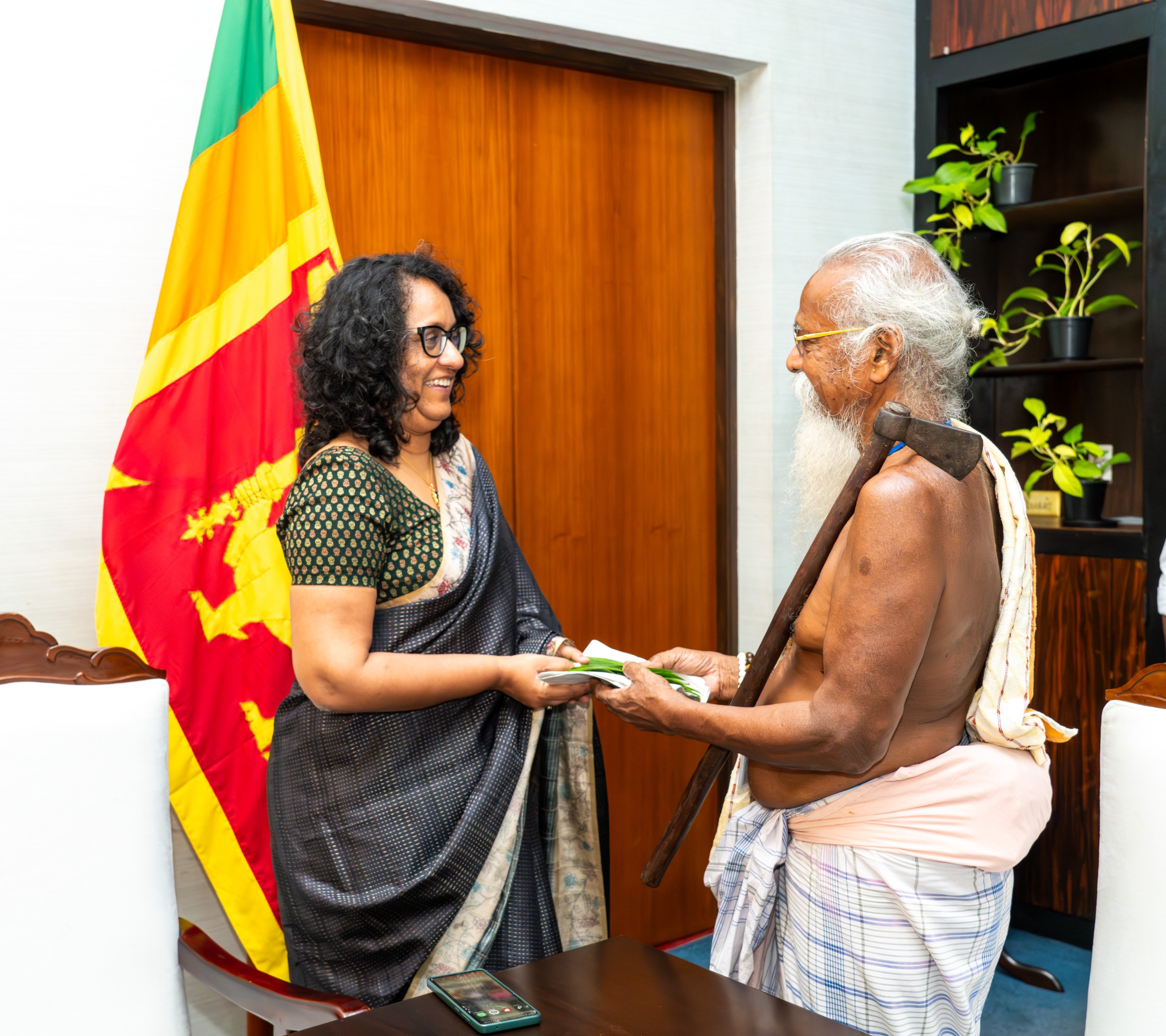
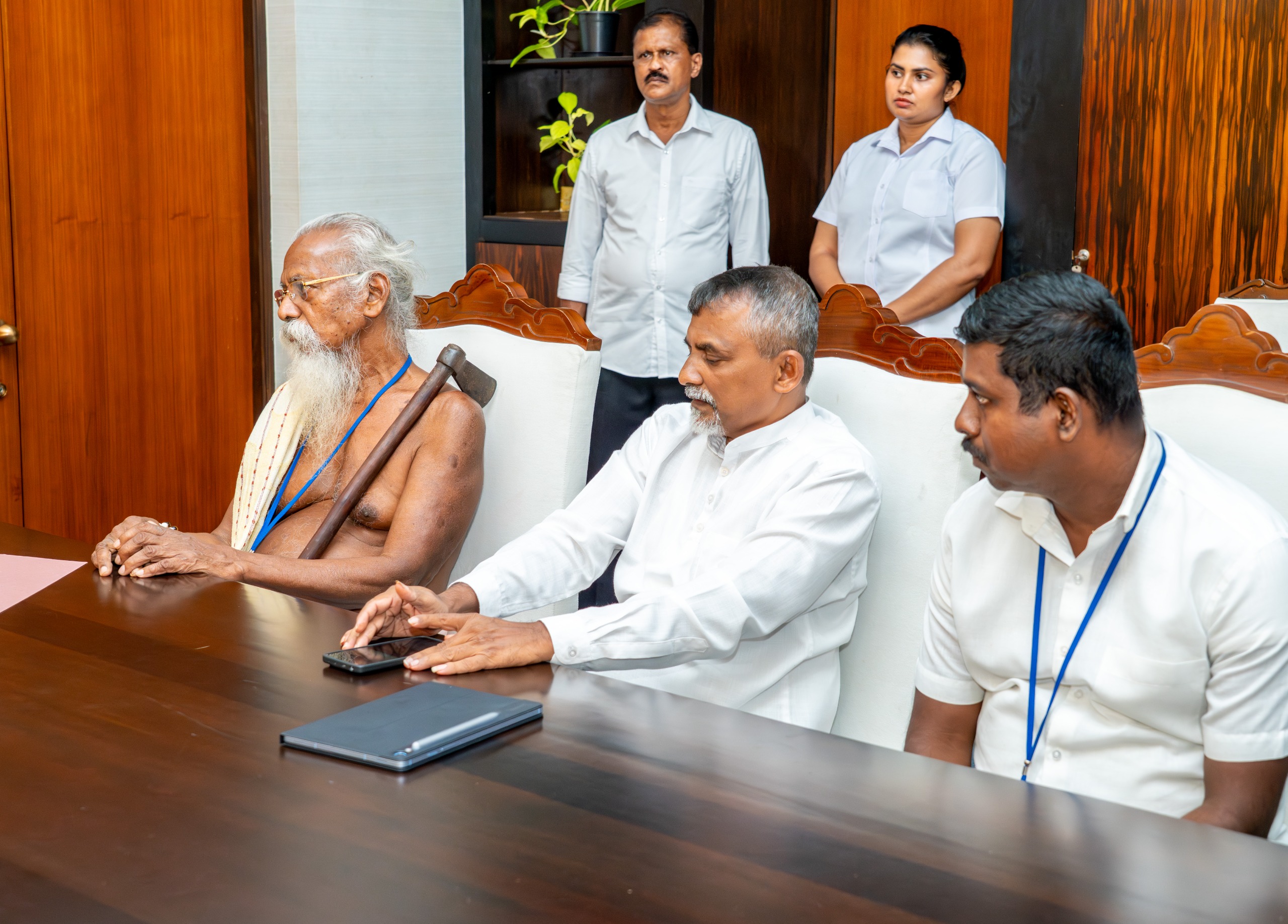
A meeting between the Leader of the indigenous Vedda community, Uru Warige Wannila Aththo and Prime Minister Dr. Harini Amarasuriya was held on Friday (12) at Parliament.
During the meeting, discussions focused on the challenges faced by the indigenous community and the Leader of the community, Uru Warige Wannila Aththo drew the Prime Minister’s attention to the difficulties encountered by indigenous people in accessing and using their traditional ancestral lands.
The Prime Minister emphasized that the indigenous community has the right to enjoy and use its traditional lands without obstruction and stated that the necessary legal measures to safeguard these rights would be expedited.
The Indigenous Leader also raised concerns over the lack of relief assistance provided so far to the residents of Hennanigala who were affected by the recent Cyclone Ditwah. The Prime Minister immediately instructed the relevant officials to ensure that these families receive proper relief assistance without delay.
The discussion also focused on the shortcomings and needs of the Dambana School, and the Prime Minister emphasized that the matter would be looked into and that the necessary measures would be taken.
[Prime Minister’s Media Division]

CLA backs concerns raised by BASL over move to increase retirement age of senior judges
The Commonwealth Lawyers Association (CLA) on Thursday noted concerns raised by the Bar Association of Sri Lanka (BASL) over a reported move to amend the Constitution to increase the retirement age of judges of the Court of Appeal and the Supreme Court.
In a statement, the CLA said the BASL, in a letter dated May 25, 2026, addressed to the President, had expressed grave concern that the Government was considering a constitutional amendment to extend the retirement age of senior judges, currently fixed under Article 107(5) of the Constitution.
Full text of CLA statement: The Commonwealth Lawyers Association (CLA) notes the letter of the Bar Association of Sri Lanka (BASL) issued on 25th May 2026 to His Excellency the President of Sri Lanka. The BASL has expressed grave concern that the Government of Sri Lanka is considering the introduction of an amendment to the Constitution to increase the retirement age of the Judges of the Court of Appeal and the Supreme Court.
The retirement age of senior judges is presently fixed by Article 107(5) of the Constitution. Any amendment would require a Constitutional Amendment. Constitutional amendments should not be made in a piecemeal or ad hoc manner as this could reduce the sanctity of the Constitution. Further, constitutional reform must be foreshadowed by adequate public and stakeholder consultation, as a requirement of due process in a democracy.
The Constitution of Sri Lanka recognizes the Independence of the Judiciary and its importance in preserving and maintaining the rule of law.
The Commonwealth (Latimer House) Principles on the three Branches of Government state in Principle IV that:
“An independent, impartial, honest and competent judiciary is integral to upholding the rule of law, engendering public confidence and dispensing justice.”
The CLA’s Goa Declaration 2023 states that:
“The independence and impartiality of the judiciary must be upheld and protected by governments, including under domestic laws, regulations and policies “
The CLA considers that any steps to diminish public confidence in the judiciary is antithetical to the rule of law and must be avoided.
The letter from BASL to the President of Sri Lanka states:
“Extending the retirement age of the sitting Judges of these Courts at this point of time is likely to be viewed by the public as a blatant attempt to interfere with the judiciary.”
The BASL letter goes on to state:
“The independence of the Judiciary and the public confidence reposed in it, are indispensable pillars of the rule of law and the democratic framework of (Sri Lanka). In that regard it is of paramount importance that the Judiciary must not only remain independent in fact but also must be seen by the public to be wholly independent, impartial, and free from even the slightest perception of influence, favour, accommodation, or impropriety.”
The CLA supports the reasoned and principled position adopted by BASL and calls upon the authorities in Sri Lanka:
To refrain from proceeding with the proposed constitutional amendments seeking to increase the retirement age of members of the Judiciary;
To resist piecemeal and ad hoc amendments to the Constitution of Sri Lanka.
To adhere to due process of consultation and stakeholder engagement in constitutional reform;
To desist from taking any steps which would undermine confidence in the Judiciary and irreparably diminish the independence of the judiciary; and
To ensure adherence to the rule of law and respect for the independence of the judiciary.

Sri Lanka has recorded 122 human drownings so far in 2026, with Police urging the public to exercise greater vigilance, particularly during school holidays and the forthcoming Poson festival period.
Addressing the media yesterday, Police Spokesman ASP F.U. Wootler said the deaths reported this year included 113 men and nine women.
He also disclosed that 595 drowning deaths had been recorded in 2024, comprising 510 men and 85 women.
According to Police data, 376 drowning deaths were reported in 2025, including 309 men and 67 women.
The Police Spokesman said that a total of 1,093 lives had been lost to drowning between 2024 and 2026, with many of the victims being youth.
He called on parents and elders to remain alert and ensure close supervision of children and young people when visiting rivers, reservoirs, beaches and other water bodies.
ASP Wootler stressed that increased caution was essential during the holiday season and the upcoming Poson festival in order to prevent further tragedies.
By Norman Palihawadane

The leader of the indigenous Vedda community Uru Warige Wannila Aththo Meets Prime Minister Dr. Harini Amarasuriya

SpaceX IPO debuts in US markets, Musk becomes world’s first trillionaire

Fans on concourses instead of in seats, claims FIFA

Co-hosts Canada begin 2026 World Cup campaign with a draw against Bosnia-Herzegovina.

Showers will occur at times in the Western, Sabaragamuwa and North-western provinces and in Galle, Matara, Kandy and Nuwara-Eliya districts

Wyatt-Hodge century drives England to statement victory in tournament opener

‘Dates have the highest sugar content to fight Coronavirus’

Sunday Island 27 December – Headlines

#SundayIsland 17th December – Headlines

Sunday Island – 28th March

Sunday Island Headlines – 21 March

Sunday Island – 21st February – Headlines
-

 News6 days ago
Women’s T20 World Cup 2026 warm-up: Chamari Athapaththu’s 94 helps Sri Lanka beat Pakistan
-

 News6 days ago
Lankan-Canadian inducted to Toronto Sports Hall of Fame
-

 Editorial5 days ago
Probe Sallay’s complaint
-
 News3 days ago
Local firms move millions of dollars overseas for phantom imports: Govt.
-

 Editorial6 days ago
Prez in the dock
-

 Features6 days ago
Entering MIT for my Ph.D program, coping with harsh Boston winter and breasting the tape
-
 Midweek Review3 days ago
July 09: An inexcusable overall security failure and exceptional contingency plan
-

 Opinion4 days ago
Could Sri Lanka once again face an economic crisis similar to 2022?