
Business
Oil prices steady despite Middle East tensions, but risks are rising

In recent weeks, missile and drone attacks on cargo ships crossing the Red Sea have caused the biggest disruption to global trade since the COVID-19 pandemic. Despite delayed supplies, however, oil prices have remained surprisingly stable.
In response to Israel’s war on Gaza, Houthi rebels – the Iran-aligned Shia movement that controls northern Yemen and its western coastline – have launched a wave of assaults on ships in the Red Sea. By targeting vessels with perceived links to Israel, they are attempting to force Tel Aviv to stop the war and admit full humanitarian aid into Gaza. Houthis have launched at least 26 separate attacks since November 19 on merchant freighters.
Though no ships have yet been sunk, the United States recently dispatched a multinational naval task force to the region. On December 31, American Navy helicopters killed 10 Houthi fighters and sank three of the group’s speedboats.
The following day, Iran dispatched its Alborz warship to the Red Sea, compounding an already volatile situation. The government did not provide information on the vessel’s mission.
On Wednesday, Houthi rebels fired their largest barrage of projectiles yet, forcing an engagement with US and British naval forces. On Thursday night, the US and UK led a bombing campaign against multiple Houthi facilities in Yemen.
While Brent crude briefly topped $80 per barrel after Thursday’s air strikes, oil prices have mostly trended sideways in recent weeks. Market fundamentals suggest a balanced, or slightly surplus, market. And until there is a clear threat to global supply, traders appear to have relegated tensions in the Middle East to background noise.
Houthi activity has so far been concentrated in the narrow strait of Bab al-Mandab, which connects the Gulf of Aden to the Red Sea. Approximately 50 ships sail through the strait every day, heading to and from the Suez Canal – a central artery for global trade.
Some of the world’s largest shipping companies have suspended transit in the region, forcing vessels to sail around the Cape of Good Hope in Southern Africa. The lengthier route has raised freight rates due to higher fuel, crew and insurance costs.
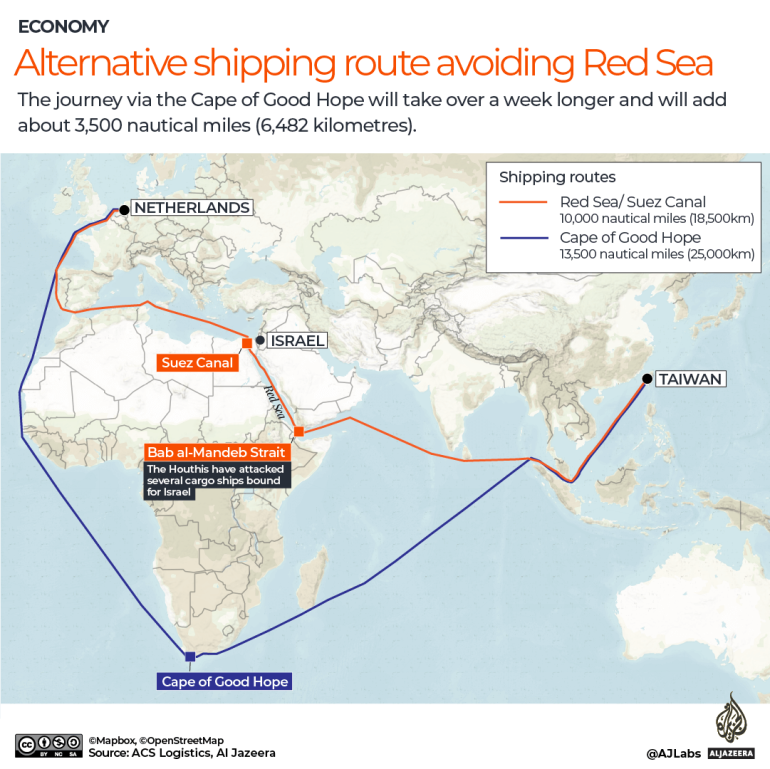
According to Clarksons, a shipbroker, roughly 24,000 vessels crossed the Suez Canal last year. That amounts to one-tenth of global trade, including 10 percent of seaborne oil and 8 percent of liquefied natural gas.
Ships travelling through the Suez Canal have taken on greater strategic significance since the war in Ukraine, as Russian sanctions have made Europe more dependent on oil from the Middle East, which supplies one-third of the world’s Brent crude, the international benchmark.
“The region is an important channel for freight, representing almost one-third of global container capacity. As such, Houthi-linked bottlenecks pose a new risk to inflation,” said Rahul Sharan, a senior manager for maritime consultancy Drewry.
“We’ve seen hundreds of vessels rerouted from the Suez Canal in recent months. We don’t yet have visibility on which industries have been most severely affected, but consumer goods costs could rise if oil and gas prices increase.”
Despite diverting supplies from the Suez Canal, tensions in the Red Sea have so far had a muted impact on energy prices. “We’ve seen plenty of volatility, so geopolitical risks are being considered. But not enough to lift prices,” says energy trader Mohammed Yagoub.
“The truth is that headline fatigue has set in. There’s been a lot of coverage on tensions in the Red Sea, especially today. But global supplies have remained broadly steady in recent weeks,” Yagoub told Al Jazeera.
“You have to remember that the oil can still travel around Africa, as well as from ports in western Saudi Arabia, bypassing the need to cross Bab al-Mandeb.” The Houthis, he said, were also unlikely to attack ships from friendly oil and gas-producing countries in the region.
There are other factors at play – recent record US production, the lifting of oil sanctions in Venezuela and tepid global demand, Yagoub added.
However, looking ahead, he warned that “tensions in Iran, especially around Hormuz, could move the needle on prices.”
Approximately 17 million barrels of crude oil, nearly one-sixth of global supply, are transported on a daily basis through the Strait of Hormuz, between the Arabian Gulf and the Gulf of Oman. If Iran became actively engaged in the conflict, Tehran could threaten to close this vital channel.
Any such closure could see crude prices surge by 20 percent in a month and higher thereafter, according to Callum Bruce, an analyst at Goldman Sachs. “It would be a huge, huge shock. For now, though, the implied market probability of that happening is less than 1 percent,” he said. Tehran has appeared reluctant to engage in military conflict with the US military and its economy remains fragile.
Bruce pointed out that “oil traders will continue paying close attention to activity in the Middle East. Gaza is ground zero. Then, you have the Red Sea. Tensions across the region have also ratcheted up in recent weeks.”
On January 2, senior Hamas leader Saleh al-Arouri was killed in Beirut by an Israeli drone raid following three months of hostilities at the Lebanon-Israel border. It was the first air raid on Beirut since 2006.
This past week, Israel assassinated a Hezbollah commander in south Lebanon, while Hezbollah, which has Iranian support, struck a sensitive Israeli base with rockets. Meanwhile, Iran-backed groups in Iraq have stepped up attacks on US military bases.
For his part, US President Joe Biden has said he is keen to prevent the war on Gaza from spiralling into an all-out regional conflagration, though the bombing of Yemen has been viewed by the Houthis as an escalation. On Sunday, US Secretary of State Anthony Blinken was dispatched to the Middle East on a diplomatic trip for the fourth time in three months.
“Israel’s war with Hamas seems to have energised already existing tensions,” said Bruce. “And while US naval activity in the Red Sea provoked headlines, economic essentials are continuing to dictate oil prices.”
Mohammed Yagoub added, “It’s true that mega-trends are pre-occupying traders. But the likelihood of a regional conflict will increase the longer the fighting in Gaza persists. Yemen is proving that. So, you could make the case that oil traders are too sanguine right now.”
(Aljazeera)








Escalating geopolitical tensions in the Middle East involving Iran are beginning to raise concerns here, with analysts warning that the fallout could affect not only the island’s tourism industry but also its energy sector.
Tourism stakeholders say the first signs of a slowdown in visitor arrivals have begun to emerge as airlines and travel operators adjust to disruptions across key Middle Eastern aviation corridors.
According to Harsha Suriyapperuma, Chairman of the Sri Lanka Tourism Development Authority, the current tensions could temporarily influence travel flows mainly due to disruptions affecting major transit hubs in the Gulf region.
A significant share of travellers heading to Sri Lanka from Europe and other long-haul destinations transit through aviation hubs such as Dubai, Doha and Abu Dhabi.
Industry analysts say that when geopolitical tensions escalate in the Middle East, airlines often revise flight paths, cancel services or adjust schedules due to security concerns and airspace restrictions, which can slow tourism flows to destinations like Sri Lanka.
According to a Tourism industry leader, global travel demand is highly sensitive to geopolitical developments affecting major aviation corridors.
He noted that disruptions to Middle Eastern airspace could result in longer travel routes, higher airline operating costs and increased airfares, which may influence the travel decisions of tourists planning long-haul holidays.
At the same time, economists and energy analysts warn that the conflict could also create ripple effects in global energy markets.
Sri Lanka is heavily dependent on imported fuel, and any instability in the Middle East — particularly involving a major oil producer like Iran — could push global crude oil prices upward.
Energy sector sources said rising oil prices would increase the cost of fuel imports and place additional pressure on the country’s foreign exchange reserves.
Higher global oil prices could also raise operational costs in the power generation sector, particularly for thermal power plants operated by the Ceylon Electricity Board, which relies on fuel and coal imports to meet electricity demand.
Analysts say increased fuel costs could eventually translate into higher electricity generation costs and additional financial pressure on the national power utility.
The tourism sector had entered 2026 on a strong recovery trajectory after attracting more than two million visitors last year, with authorities targeting three million arrivals this year.
However, industry experts caution that prolonged geopolitical instability in the Middle East could slow the momentum of Sri Lanka’s tourism recovery while simultaneously creating new challenges for the country’s energy sector.
Despite these emerging risks, officials remain cautiously optimistic that the impact will be temporary if tensions in the region stabilise in the coming weeks.
They stress that Sri Lanka continues to be viewed internationally as a safe and attractive destination, while authorities are closely monitoring developments in global energy markets and aviation networks.
By Ifham Nizam

National Development Bank PLC (NDB/ the Bank) recently announced that it successfully raised LKR 16.0 billion through the issuance of Basel III-compliant Tier II Rated Unsecured Subordinated Redeemable GSS+ Bonds (the GSS+ Bonds), to be listed on the Colombo Stock Exchange (CSE). This issuance marks a major milestone in thematic fundraising within Sri Lanka’s capital markets landscape, signaling the country’s growing progress in the increasingly important segment of sustainable finance.
The GSS+ Bonds issue opened on 10 March 2026 and was oversubscribed within the same day, demonstrating strong demand from both retail and institutional investors. This response reaffirms the confidence investors place in NDB and its overall financial strength and stability. The issuance of the GSS+ Bonds reflects the Bank’s strong environmental and social considerations embedded in its lending practices. For many years, NDB has maintained a robust Environmental and Social Management System (ESMS) ensuring that funds are directed toward environmentally and socially responsible projects and causes.
NDB’s GSS+ Bonds will be deployed to finance eligible Green (including Blue), Social, Sustainability, and Sustainability-Linked projects, supporting environmentally responsible, socially impactful, and sustainable economic development.
Business
HNB General Insurance fastest in reaching LKR 11 Bn. revenue (GWP) within 10 years of operations


HNB General Insurance Limited (HNBGI) announced its financial results for the year ended 31 December 2025, marking a milestone year of accelerated growth, strengthened financial resilience, and sustained business momentum.
The Company recorded a Gross Written Premium (GWP) of LKR 11.0 billion for 2025, reflecting a robust 21% growth compared to LKR 9.1 billion in 2024. This performance significantly outpaced the industry’s growth of 15%, demonstrating the Company’s strong competitive positioning, disciplined execution, and continued customer confidence. With this achievement, HNBGI becomes the first general insurer in Sri Lanka to reach the LKR 11 billion GWP milestone within ten years of operations. The Company also improved its market position, moving up to 6th place from 7th in Sri Lanka’s general insurance sector.
The Fire segment emerged as a standout contributor with a 27% growth, reaching LKR 2.4 billion, while the Motor portfolio grew by 25% to LKR 6.0 billion. Marine recorded a steady 16% increase to LKR 378 million, and the Miscellaneous segment contributed LKR 2.2 billion. The broad-based growth across segments reflects HNB General Insurance’s balanced portfolio, effective distribution reach, and strong customer confidence.
The Company demonstrated its unwavering commitment to customers through timely and efficient claims management, committing LKR 2.5 billion towards Ditwa cyclone-related claims. In addition, a further LKR 4.7 billion was paid in claims across all other segments during the year, underscoring the Company’s financial strength and reliability in times of need.
The Company’s financial strength further consolidated during the year, with Total Assets growing by a significant 31% to LKR 13.38 billion, while Funds Under Management increased by 9% to LKR 6.74 billion. The Capital Adequacy Ratio remained well above regulatory requirements at 190%, reflecting a solid capital base to support future growth.

Israel says it’s killed Ali Larijani, Iran’s security chief and Basij commander

Devon Conway, bowlers star as New Zealand make it 1-1

Israel claims to have assassinated commander of Iran’s Basij militia unit

Trump seeks to delay meeting with Xi in China

Pakistan lodge official complaint about Bangladesh’s review at end of chase

Showers or thundershowers will occur at several places in the Central, Sabaragamuwa, Southern and Uva provinces after 2.00 pm.

‘Dates have the highest sugar content to fight Coronavirus’

Sunday Island 27 December – Headlines

#SundayIsland 17th December – Headlines

Sunday Island – 28th March

Sunday Island Headlines – 21 March

Sunday Island – 21st February – Headlines
-

 Business7 days ago
BOI launches ‘Invest in Sri Lanka’ forum
-

 News6 days ago
Historic address by BASL President at the Supreme Court of India
-

 Sports6 days ago
The 147th Royal–Thomian and 175 Years of the School by the Sea
-

 Sports7 days ago
Royal start favourites in historic Battle of the Blues
-

 News7 days ago
CEBEU warns of operational disruptions amid uncertainty over CEB restructuring
-
 Features7 days ago
Indian Ocean zone of peace torpedoed!
-

 News6 days ago
Power sector reforms jolted by 40% pay hike demand
-

 News4 days ago
Crypto loopholes funnel Lankan funds abroad