
Business
CIPM to host World HR Congress 2021 from December 6 – 8 in virtual mode

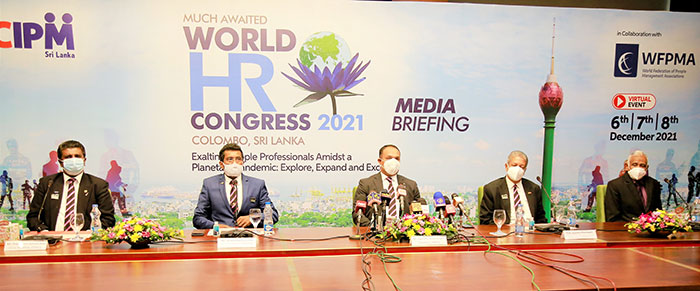
CIPM Sri Lanka – the Nation’s leader in human resource management together with the World Federation of People Management Associations (WFPMA) and Asia Pacific Federation of Human Resource Management (APFHRM) announced that the world’s most premier people event “World HR Congress 2021” will be held from December 6 to 8 2021 as a virtual conference experience in Colombo, Sri Lanka.
The theme of the congress “Exalting People Professionals Amidst a Planetary Pandemic: Explore, Expand and Excel” is aptly selected as the people factor is at the pinnacle of limelight amid the planetary pandemic. The 3 value-packed days will deliberate on digitalization, disruption, diversity, and diligence regarding the distinct dimensions of human resource management with a select panel of world-renowned speakers lined up to share insights and thought-provoking ideas enabling thought leadership in the new world of work. The prospectus, registration, numerous sponsorship opportunities available, and more information can be found at https://wfpmacongress.com/ which is the dedicated website for Word HR Congress 2021.
“We take pride in hosting this prestigious people event in Sri Lanka. In a world disrupted by the pandemic, we need resilience as well as inspirational leadership to proceed into the future. New expectations and challenges have emerged in a new world of work and life. Innovation, best practices in people engagement, and trust are critical to achieve sustainable growth and rebuild our future. The World HR Congress 2021 is the apt place to deliberate the challenges and opportunities to strategize the New HR Agenda” said Jayantha Amarasinghe-President, CIPM Sri Lanka.
“The World Congress is an opportunity to bring together the continental federations and the national associations of 93 countries which make up the WFPMA. As the premier federation of people management associations, we are a globally recognized authority to support the people management profession throughout the world. Blending thought-provoking speakers with networking opportunities, this is a ‘must-attend’ congress that presents some of the best and brightest minds in the global people profession who will share the latest practices, research, and innovations to develop your knowledge and help you shape your organization’s future” said Bob Morton – President, WFPMA inviting people professionals and business leaders to participate in the Congress.
The virtual conference will consist of 4 plenary sessions, 4-panel discussions, and 4 rounds of concurrent technical sessions. The line-up of 21 experienced international panel of speakers, presenters, and panelists includes Johnny C. Taylor, Jr – President and CEO, Society for Human Resource Management-USA, Peter Cheese – CEO, Chartered Institute Personnel Development-UK, Sunita Bhuyan-Violinist & HR Practitioner on Wellness, Prof. TV Rao – Chairman, TVRLS-India, Paul Mills – Chief People Officer Mercedes AMG Petronas F1 Team, and Dr. Archana Arcot – Assoc. VP HR Business Leader, Infosys McCamish-USA amongst many more experienced speakers.
“The World HR Congress is being held at a very crucial juncture of mankind. We are dealing with many complexities on top of this pandemic, juggling with people, planet, and profits. The new industrial era has already dawned, and we are on the brink of the next big thing, the 5th industrial revolution, where the human and machine will dance together as technology will help humans to vastly increase labor productivity and to align return on investment with purpose. However, it will require intentionality and moral clarity. Now that we are grappled with the corona pandemic, we shall overcome by getting used to the next normal where the world of work is challenged the most. The World HR Congress 2021 premier people event will explore, expand and excel in what matters in the new world of work and life” said Dhammika Fernando-Chairman, World HR Congress 2021 and Immediate Past President-CIPM Sri Lanka, President- Asia Pacific Federation of Human Resource Management, Board Director- WFPMA.
“Despite the doom of a devastating pandemic, we see the boom of people factor in corporates with a deeper realization of the value of human wellbeing. World HR Congress 2021 invites people professionals to engage in a cutting-edge learning endeavor towards expansion” said Prof. Ajantha Dharmasiri, Co-chair of the World HR Congress 2021, who as a Past President of CIPM was instrumental in receiving the hosting rights during the previous World HR Congress, held in Chicago, USA in 2018.
With the impressive line-up of speakers and panelists sharing insights and experiences, networking opportunities with like-minded professionals to share best practices in people management in the new world of work, the World HR Congress 2021 provides a rare opportunity for people professionals and business leaders to mitigate the risks and challenges in a new world of work.


The much discussed latest electricity tariff debate has taken a controversial turn, with senior power sector officials and independent energy analysts questioning whether opaque fuel pricing mechanisms are artificially inflating the cost of electricity generation while shielding politically sensitive petroleum losses.
At the centre of the controversy is the widening gap between diesel pricing and the steep increases imposed on Heavy Fuel Oil (HFO) and naphtha — two fuels heavily used by the Ceylon Electricity Board (CEB)� for thermal power generation.
Energy analysts argue that while electricity tariffs are officially calculated on a “cost reflective” basis, the fuel pricing structure feeding into those calculations appears far from transparent.
A senior CEB official told The Island Financial Review that the present fuel pricing pattern raises “serious economic and policy concerns.”
“The entire electricity tariff framework is built on the assumption that fuel supplied to the power sector reflects actual import costs. But if fuel pricing itself is distorted, then tariff calculations become distorted too,” the official said.
According to CEB operational data reviewed by sector analysts, the utility regularly consumes nearly two-and-a-half times more HFO than diesel for thermal generation. Yet recent fuel revisions saw diesel prices rise only marginally — despite allegations that diesel cargoes had been procured at extraordinarily high dollar values.
Industry analysts pointed out that diesel imported at around USD 286 per barrel resulted in only about a Rs. 10 domestic price increase, while HFO prices surged by nearly Rs. 42 per litre and naphtha by around Rs. 34 — increases estimated at roughly 25 percent.
“This creates the impression that losses on diesel are being absorbed by overpricing HFO and naphtha,” an energy economist said.
“If CPC is maintaining artificially low diesel prices for political or inflation management reasons, the burden appears to be transferred to electricity consumers through thermal generation costs.”
The analyst noted that because the CEB relies heavily on HFO for regular dispatch operations, even relatively small increases in HFO pricing can translate into billions of rupees in additional annual generation costs.
In dollar terms, the implications are substantial.
Power sector officials estimate that every major upward revision in HFO pricing adds several billion rupees to annual generation expenditure, particularly during periods of low hydro availability. Given the depreciation pressures on the rupee and the dollar-denominated nature of fuel imports, the resulting tariff burden on consumers becomes even more severe.
A second senior CEB official expressed concern that institutional checks and balances within the energy sector appeared to be weakening.
“There is growing concern within the industry that the electricity sector regulator is no longer functioning with the level of independence expected of it,” the official said, referring to the Public Utilities Commission of Sri Lanka (PUCSL).
“The regulator’s responsibility is to independently scrutinise cost submissions, fuel assumptions and tariff calculations. But many in the sector now feel there is inadequate challenge or verification of the numbers being presented.”
The official warned that if regulatory independence is perceived to be compromised, public confidence in tariff revisions could deteriorate further.
A senior engineer attached to the CEB said the issue goes beyond tariff formulas.
“What is missing is cost transparency. There is no publicly accessible breakdown showing actual landed fuel costs, financing charges, hedging exposure, exchange losses, or refinery margins. Without that, nobody can independently verify whether the fuel pricing is truly cost reflective.”
Analysts also questioned the apparent disparity between crude oil acquisition costs and refined fuel pricing adjustments.
“If crude was purchased at almost the same price range, why are HFO and naphtha seeing disproportionate hikes while diesel remains comparatively protected?” one analyst asked.
Several observers believe the answer may lie in broader political and financial calculations.
Keeping diesel prices artificially low helps contain inflationary pressure across transport, logistics and food supply chains. However, critics say it may also help suppress scrutiny over controversial diesel procurements carried out at elevated international prices.
Energy sector sources further alleged that maintaining a lower diesel benchmark may also indirectly soften calculations linked to the long-running coal procurement controversy, where comparative generation cost modelling often references diesel-based thermal pricing.
“This has major political implications because lower diesel benchmarks can influence public perception regarding coal generation economics,” an analyst said.
By Ifham Nizam

BETSS.COM, the digital platform of Sporting Star, is ushering Sri Lanka’s horse racing into a new era through a landmark three-year title sponsorship of the BetSS Governor’s Cup and BetSS Queen’s Cup.
This long-term commitment by Sports Entertainment Services (Pvt) Ltd, operators of BETSS.COM, marks a significant step in elevating two of the country’s most prestigious racing events—enhancing their visibility, engagement, and relevance in a digitally connected world. As a brand positioned as a “Patron of Elite Sri Lankan Sports & Heritage,” BETSS.COM continues to support and transform iconic sporting platforms that carry deep cultural significance.
The Governor’s Cup and Queen’s Cup are the flagship “blue riband” races of the Nuwara Eliya Racecourse and remain central to the town’s April holiday season—where sport, fashion, and highland tourism converge. Horse racing was first introduced to Sri Lanka in the 1840s by Mr. John Baker, brother of the renowned explorer Samuel Baker, who established a training course for imported English thoroughbreds in the hills of Nuwara Eliya. The inaugural race at the Nuwara Eliya Racecourse was held in 1875, organised by the Nuwara Eliya Gymkhana Club. In 1910, the then Governor of Ceylon, Sir Henry Edward McCallum, inaugurated the prestigious Governor’s Cup and Queen’s Cup. Now in its 153rd year of racing, the event stands as an enduring symbol of Sri Lanka’s rich thoroughbred heritage.
Business
Siam City Cement (Lanka) officially enters into Memorandum of Understanding with Chief Secretary of Southern Province

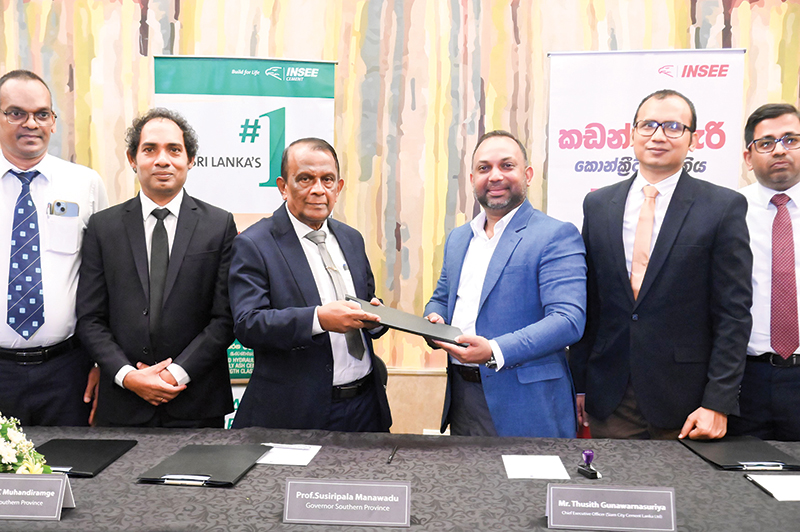
The MoU was signed by Thusith Gunawarnasuriya (CEO, Siam City Cement (Lanka) Ltd) and Chandima C. Muhandiramge (Chief Secretary, Southern Province), under the patronage of Governor Prof. Susiripala Manawadu, in the presence of many distinguished government officials.
The event was held at the Radisson Blu Hotel, Galle, with the participation of engineers and technical officers from government institutions, including local government bodies, the PRDA, the Building Department, and the Irrigation Department. This underscored the importance of strong public–private collaboration to elevate industry standards and empower technical professionals with the latest knowledge in the Southern Province.
This initiative will be delivered as a series of three (03) continuous training programmes in the coming months, aimed at upskilling engineers and technical officers across the province. The sessions will cover key areas such as SLS 573, quality control, construction management, waterproofing, durable concrete, and concrete mix-design optimisation.
Together, we are shaping a more knowledgeable and resilient construction industry for the future.

Construction and Concrete waste recycling centre opened in Ekala under the Clean Sri Lanka programme

President of the Socialist Republic of Vietnam pays floral tribute to the Ho Chi Minh Statue

Urgent reforms needed to eradicate drug menace, says President

Warm welcome extended to the President of the Socialist Republic of Vietnam at the Presidential Secretariat

BCCI to conduct surprise checks on IPL teams over compliance of guidelines

President of the Socialist Republic of Vietnam arrives in Sri Lanka on State Visit

‘Dates have the highest sugar content to fight Coronavirus’

Sunday Island 27 December – Headlines

#SundayIsland 17th December – Headlines

Sunday Island – 28th March

Sunday Island Headlines – 21 March

Sunday Island – 21st February – Headlines
-

 News2 days ago
MIT expert warns of catastrophic consequences of USD 2.5 mn Treasury heist
-
 News4 days ago
CJ urged to inquire into AKD’s remarks on May 25 court verdict
-

 News5 days ago
USD 3.7 bn H’tota refinery: China won’t launch project without bigger local market share
-
 News6 days ago
Easter Sunday Case: Ex-SIS Chief concealed intel, former Defence Secy tells court
-

 News7 days ago
Ten corruption cases set for court in May, verdict ordered in one case – President
-

 Business6 days ago
Dialog Surpasses 1,000 5G Sites, Strengthening Nationwide 5G Coverage
-

 Editorial2 days ago
Clean Sri Lanka and dirty politics
-

 Editorial5 days ago
Deliver or perish