
Features
NU AT THE London School of Economics

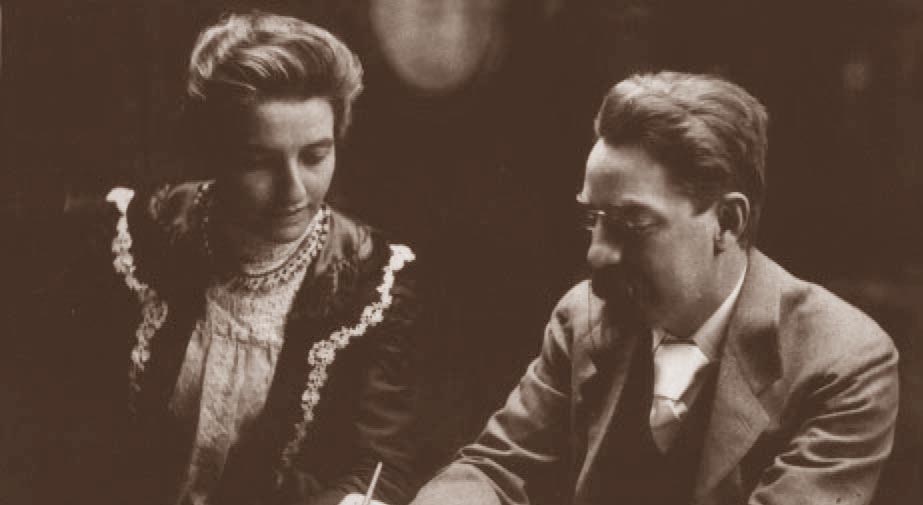
CHAPTER 10
[The London School of Economics] seems to prefer intense, committed, often workaholic scholars and public figures.
(Dahrendorf, 1995, History of the LSE, p.191)
NU in London
NU’s next big break came in 1938, when aged 30, he received a scholarship and leave to pursue postgraduate studies at the London School of Economics (LSE) as an internal student. The government was in the early stages of setting up a new Commerce and Industry Department, and NU’s superiors had selected him to undertake the special one-year course of training in Business Administration offered by the LSE, to make NU’s services “more useful to the department.” He was expected to: “make a closer acquaintance with modern business methods and to acquire training in practical commerce”(N.U. Jayawardena Personal Files).
In his admissions application, NU stated that he was interested in acquiring “a close acquaintance with the foreign marketing of primary agricultural products”; and that the Sri Lankan government would make arrangements with the recently established Colonial Empire Marketing Board to enable NU to familiarize himself with their marketing surveys. His special interest was the marketing of “oil seeds,” since Sri Lanka was the leading exporter of copra and coconut oil (letter to Prof. Arnold Plant, 18 Jan. 1938).
LSE records indicate that NU received a scholarship of £300 for the year as well as half-pay as an allowance. The cost of the course was £30. Whereas his leave was for one year, NU provisionally sought permission to extend his studies for a further year. With his sights set high – as they always were – he had ideas of completing a Ph.D. in two years if the LSE allowed it. For NU, this would not have seemed an unusual goal. However, there were strict rules and he was advised that he could apply for the M.Sc. degree concurrently with the Business Administration course – which he did. He also had not given up his ambition of obtaining a law degree. Accordingly, NU almost immediately sought and obtained permission from the LSE to register and study for the (London) Bar examinations.
NU’s selection for the special Business Administration course was fortuitous. His theoretical and practical exposure to business and commercial studies at the LSE would equip him for the second half of his life as a business and financial entrepreneur. The opportunity to study at the LSE as an internal student gave him the chance to devote himself to his studies without the added pressures of work and family commitments, and to attend lectures by eminent economists and social scientists (some of whose works he had already read for his B.Sc. (Econ.) degree). Furthermore, to attend a prestigious university and to make use of its facilities, while living in London a commercial and an intellectual hub – was for him a great opportunity. NU arrived in Britain in September 1938 for the LSE term that began in October and ended in June 1939.

LSE staff and students
This was NU’s first experience as a full-time student, and the excitement he felt at that prospect is not hard to imagine. His period in London was to have a profound effect on his intellectual life and professional career. As part of the process of setting up the Department of Commerce and Industry, the Sri Lankan government had recently established Trade Commissions abroad, one of which was located at “Ceylon House” in London at 28 Cockspur Street, SW1, which served as NU’s mailing address.
The LSE
The London School of Economics and Political Science, better known as the LSE, and a part of the University of London, was founded in 1895 by a group of Fabian socialists, notably Sidney and Beatrice Webb, Graham Wallas and George Bernard Shaw. The LSE aimed to provide a theoretical understanding of the political economy of Britain and the world that could also be of use to the emerging labour movement in Britain, where there was plenty of action but less in the way of theoretical insights. Trade union militancy had developed rapidly in Britain from the 1880s onwards; and the Labour Party, formed in 1906, was composed of Fabian socialists, along with representatives of the trade unions and the cooperative movement.
The older universities of Oxford and Cambridge were elitist, and mainly geared to the humanities, classics and philosophy, with a strong emphasis on sports. They had their ancient buildings and chapels, rivers, boat races, lawns, and historic rituals. These universities had traditionally produced the ‘mandarins’ who would rule Britain and its colonies. In contrast to such ‘ivory towers’ and bastions of privilege, the LSE was down-to-earth, non-elitist, and an urban institution that reflected the shifting needs of the times. As society and the economy became more complex and industrialized, a broad classics-based education, to produce ‘cultivated’ gentlemen to help run governments, was no longer adequate.

There was a growing need for specialization and applied knowledge, as governments began to administer and build new and more complex political and economic institutions. Max Weber, the pioneer sociologist, noted this clash of the two approaches to education: the first being the traditional approach, of which “the goal consisted of “‘the quality of a man’s bearing in life,’ which was considered ‘cultivated;’” and the modern view, which valorized “specialized training for expertness” (Weber, 1948, p.243). The 1930s and 1940s were the period when this transition became more solidified, even in the colonies; and after his return from the LSE, NU, who exemplified the “specialist type of man,” would soon incur the resentment of the older type of “cultivated man” in the bureaucracy.
The LSE seemed an ideal place for a person with NU’s qualifications, outlook and work experience. It was policy-oriented and had new courses in sociology, political science, business, commerce, and other subjects, such as statistics, not taught in the longer-established universities. As a “total institution,” it had a certain vibrancy – one entered it in the morning and left at night. Apart from lectures, tutorials and discussions, students could use the library and canteen, attend lunchtime dances, participate in student societies, and listen to guest speakers – including British and foreign politicians, and from the colonies, agitators for independence.
Outside the LSE complex, students were part of the capital city of London, with its several attractions and distractions – political, social and cultural. The LSE was in the ‘heart’ of London, within walking distance of a cluster of historic monuments and institutions,
such as the BBC, the Bank of England and commercial banks (Threadneedle Street), newspaper offices (Fleet Street,) the Law Courts, Bloomsbury, the British Museum, Trafalgar Square, Whitehall, the House of Commons, the theatres of the West End, the multi-ethnic restaurants of Soho, and the great bookshops (notably Foyles) on Charing Cross Road.

Class room at the LSE
Supported by grants and bequests, the LSE developed as a part of the London University and developed a character of its own. The LSE motto was “rerum cognoscere causas” (to know the cause of things), and it had as its logo, a beaver – an animal that burrows. “The School” (as it was known) attracted teachers in the newer disciplines of economics and political science, and became associated with many famous and controversial names – which added to its attraction for students. LSE’s director from 1920 to 1937 was Lord William Beveridge – the author of the Beveridge Report, which launched the welfare state in Britain after World War II. Ralf Dahrendorf, who served as Director from 1974 to 1984 (and became author of the authoritative history of the LSE), states that it did not exactly “invent” the social sciences, but “brought them together like no other university in Europe (and) led them to full bloom in all their variety” (Dahrendorf, 1995, p.vii).
The diversity of the LSE was partly due to its internationalism, which was “one of its greatest strengths” and “widened the horizons of hundreds of students and many young members of staff” (ibid, p.223). Moreover, in the 1930s the LSE benefited from the flight of European scholars escaping Fascism, who injected “a new energy” into the university (ibid, p.296). According to economist Harry Johnson, the “essential thing” about the LSE was that it was “the one centre of economic teaching and research” in Britain that was “genuinely international”:
…it is not merely an established British university that allows itself the luxury of a few foreign staff-members and students for the sake of variety and balance, but a world university that tries both to keep in touch with whatever of intellectual importance is going on elsewhere in the world, and to admit to its scholarly fellowship students of quality whatever their origin may be. (Johnson, quoted in Dahrendorf, p.223)
In the LSE of the 1920s and 1930s, the Department of Economics was renowned and “acted as a magnet for bright students from many parts of the world” (Dahrendorf, p.215). There were African, Asian, Middle Eastern, and North and South American students at the LSE – many of them eventually becoming eminent politicians, bureaucrats, university teachers or diplomats in their countries. Among them in the 1930s were Krishna Menon, N.M. Perera, R.N. Haksar, Doreen Wickremasinghe, and B.K. Nehru. NU would have known many such students at the LSE, for as B.K. Nehru (later an Indian diplomat) remarked, “foreign students tend to form their own groups for they are all homeless and rootless and friendless” (ibid, p.190).

Fabian Society logo
The LSE possessed a remarkable diversity in terms of race and class, in contrast to the privileged old universities. B.K. Nehru commented on its “pervasive atmosphere of learning” and the “absence of distractions” (ibid, p.185). Kingsley Martin (editor of New Statesman), who studied at LSE, found it “a wonderful home of free discussion, happily mixed races, and genuine learning” (ibid, p.187). According to Dahrendorf, the LSE “did not necessarily produce well-rounded personalities,” as it seemed to attract committed single-minded and hard-working scholars and public figures (ibid,p.191). He also remarks that:
Real life was never far away… LSE was… more serious and also more seriously cherished by its students even if they were desperately poor or felt that their ‘delight’ was almost outweighed by ‘drudgery’… The school produced a particular frame of mind. (ibid, p.301, emphasis added)
Unlike the prestigious universities, many poor students attended the LSE, and others doing daytime jobs followed the evening classes. “Some students were poor, very poor,” Dahrendorf wrote, and also noted that it hurt to read how “Nell McGregor worked her way out of a Manchester working-class family in the middle of the depression to the LSE… [and] got her degree on tea and buns and baked potatoes and not much else” (ibid, p.299). NU would have empathized with the problems of such students, who struggled against all odds to pursue their studies, much like he himself had once done. Years later, in a taped interview, NU would recall walking from one end of London to the other and being struck by the contrasts of wealth and poverty he encountered along the way.
A student’s assessment of the LSE around the time that NU was there, was that, “the closed mind was alien to everything about the LSE” (ibid, p.299). The LSE economists regarded themselves as “the centre of the school, if not the universe” (ibid, p.298). Some of the great lecturers were described as “spell-binders,” “great showmen” with “beautiful speaking voices” (ibid, p.297).
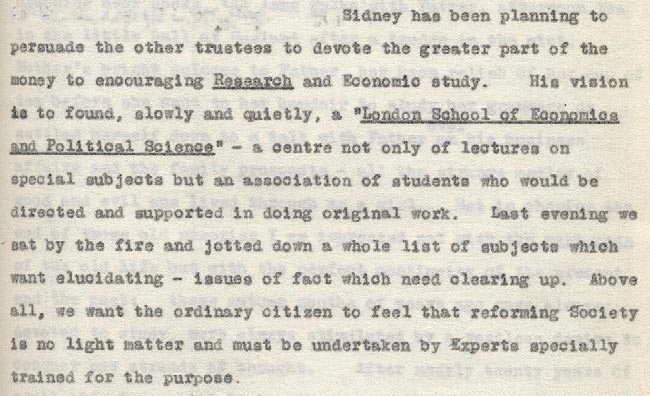
Extract from Beatrice Webb’s typescript diary
The Economics Department
In the 1930s, the LSE, which had started with a social-democratic vision, veered to the right in economics and to the left in political science, whereas the older Cambridge University ironically absorbed the left-inclined economists. Controversies raged between LSE and Cambridge on the respective virtues of the ‘free market’ and of the Keynesian model (ibid, p.219). In “the second dispute between London and Cambridge,” the chief interest was “the way to combat [the Depression of 1929], by deflation or by expanding public expenditure” (ibid, p.218).
NU, who had lived through the Depression and also written about it, would have been avidly reading about these debates, and he almost certainly gravitated more towards the LSE viewpoint. These debates and polemics (and quarrels) of the 1930s were a “turbulent episode in the history of economics” (ibid, p.217). The issues were “broad, including methodology, theory, policy, ideology, and the role of the economist in public life” (ibid, p.218). Since politics was ever present at the LSE, these ‘great
debates’ reflected a political divide.
Robbins and Hayek Lionel Robbins and Friedrich von Hayek formed the bulwark in the LSE of traditional liberalism against Keynesian interventionism and socialism, which were the dominant creeds of the day. Robbins was head of the Economics Department. He was born in 1898 in a village near London, the son of a market-gardener who was a “liberal activist” and “strict Baptist.” He used to cycle five miles to a local school. In 1920 he entered the LSE as a student, and was later appointed to the staff. In 1929 he became Professor of Economics (Dahrendorf, p.214). By all accounts, he was a fine teacher, known for his “great seminar in economic theory” (ibid). Students doing other courses sat in at his seminar – and not to have attended it, was said to be as bad as not having been at the LSE (S.B.D de Silva, 2007, personal communication).
The philosophy and theories of Friedrich von Hayek, whom Robbins invited to join the department in 1931, would make one of the most significant impacts on the discipline of economics and economic policy. He was an émigré economist, formerly a citizen of the collapsed Austro-Hungarian Empire, and belonged to the Austrian School of Economics. Though scoffed at by mainstream economists at the time, his ideas gained ascendance in the 1980s, half a century later.
Hayek won the Nobel Prize in Economics in 1974, and is best known for his book on the dangers of central planning, The Road to Serfdom (1944). He came from a family of biologists, and was second cousin to the philosopher Ludwig Wittgenstein. As a young man serving in the army during World War I, he had felt the “compulsion to find an answer to ‘the burning question’ of how to build a ‘juster society’” ( Interestingly, NU’s 232-page economic magnum opus, written in 1977 (which coincided with the liberalization of the economy when the UNP formed the government in a landslide victory), was similarly entitled An Agenda for a Just Society.) (Yergin, 1998, p.123). According to Hayek:
The desire to reconstruct society led many of us to the study of economics. Socialism promised to fulfil our hopes for a more rational, more just world… [it was] almost inevitable… [that any] warm-hearted person, as soon as he becomes conscious of the existing misery, should become a socialist. (ibid, pp.125-26)
As an Austrian, however, his direct experience with the hyperinflation that occurred in his country after World War I, alerted him to its dangers. Hayek was wary of state interference and believed the open-market system was the most effective means, not only of promoting individual freedom, but also of regulating demand and supply – or as pithily summed up by the US economist Larry Summers, many years later – the “invisible hand was better than the hidden hand” (ibid, p.132). Hayek thought of the price system as being “nothing less than a marvel.

Lionel Robbins
” (According to Hayek: The marvel is that in a case like that of a scarcity of one raw material, without an order being issued, without more than perhaps a handful of people knowing the cause, tens of thousands of people whose identity could not be ascertained by months of investigation, are made to use the material or its products more sparingly; that is, they move in the right direction (Yergin, 1998, p.125). His main contention against Keynesian interventionism and other centrist approaches was that information was lacking about markets to enable planners to adjust them. Later, Hayek became “increasingly apprehensive about what he saw as the advance of collectivism, central planning and Keynesian interventionism” (ibid, p.125).
The famed Keynes-Hayek debates that took place between Cambridge and the LSE today still shape the two major schools of economic thought regarding the merits of the welfare state versus a market-controlled economy. The LSE’s influence upon modern economics became the basis of the modern perceptions of free-market economics, with an influence almost around the globe.
Business Administration
While the courses at the LSE were mainly ‘academic,’ the university also provided some that were of an applied and practical nature in business and commercial subjects. One of these was the special course in Business Administration, which NU followed in 1938. The Business Administration Department was set up in 1931, somewhat on the lines of the Harvard Business School programme. Bothuniversities took a less traditional, more hands-on approach to education,
centred around ‘case studies.’ The course at the LSE involved study tours of and internships with British business firms, government departments and similar organizations, and discussions led by
business leaders.
The LSE Business Administration course was unique in Britain at this time, and was a precursor to the MBA (Masters in Business Administration). Competition to enrol in it was high, with entry restricted to 20 students per year. NU was the first Asian to be admitted to the programme after its inception in 1931 (N.U. Jaywardena Personal Files). It involved an amazing range and number of subjects: Business Relations, Business Finance, Cost and Marketing Problems of Manufacturers, Cost and Marketing Problems of Distributors, Business Statistics, Management Accounting, Industrial Psychology and Personnel Management, and included factory visits. Students were also required to attend other lectures in Business Administration and in Economic Principles. The course was a “full session of daytime study” extending over 29 weeks (Pamphlet of the Dept. of Business Administration, Session 1939-40, p.6).
NU recorded that he visited many factories and firms, “with a view to studying their systems of business organization, personnel management and factory administration.” These included wellknown companies of the time such as the Ford Motor Co., Harrods, Lyon’s, and Metal Box. He also visited the Colonial Office, Department of Overseas Trade, and Colonial Empire Markets Board.
Students of the Business Studies course had full access to the LSE’s facilities, including the library and membership of the Students’ Union. The faculty was composed of some eminent teachers and its head was Arnold Plant, the Professor of Commerce and Business Administration, “an outstanding teacher” in Economics (Dahrendorf, p.205). The Business Studies students also had access to the lectures of other distinguished economists and statisticians in this ‘heroic age’ of the LSE. They included, besides Robbins and Hayek, F.W. Paish, Vera Anstey, A.M. Carr-Saunders, Professor R.H.Tawney (famed for his classic book Religion and the Rise of Capitalism), and many more illustrious persons.
Teachers from other disciplines whose lectures attracted students were Harold Laski (Political Science), A.J. Toynbee (International History), Morris Ginsberg (Sociology), B. Malinowski (Anthropology), Karl Manheim (Sociology) and Ivor Jennings (English Law) (Calendar of the LSE 1938-39, pp.24-29). The latter deserves special mention because of the important role he was to play in Sri Lanka’s university and constitutional affairs. Jennings came to Sri Lanka during the war in 1941, to serve as the Principal of Ceylon University College, and was instrumental in setting up the Universities in Colombo and later, Peradeniya. He also served as the chief legal advisor to Oliver Goonetilleke (see Chapter 11), and played a major role in helping substantially in drafting the Soulbury Constitution of independent Sri Lanka. Among the younger lecturers at the LSE of the time who later became eminent in their fields were R.G.D. Allen (Statistics), R.W. Firth and M. Fortes (Anthropology), DudleyStamp (Geography), and H. Finer (Public Administration)
NU deepened his interest in economic theory during his period at the LSE, benefiting from the lectures and seminars of eminent economists and social scientists, and from the ongoing debates on economic theory and policy. He also widened his experience through his contact with students from different countries. The LSE library contained a vast collection of nearly three quarters of a million books and journals in the social sciences (Pamphlet of the Dept. of Business Administration, Session 1939-40, p.23). NU – whose love of books dated from his early school days, when he used the Library and Reading Room of St. Aloysius’ College – would have been in his element there. One can imagine the delight and wonder that NU would have felt at having this world of knowledge laid out before him.
As mentioned earlier, during NU’s stay in London he perhaps for the first time felt a measure of freedom. His correspondence from this period shows that, while he was trying to make maximum use of this time to advance in his studies, he also took time off to visit new places. During the holidays, he travelled to Cornwall, as well as to Switzerland, where he went during his summer break. But the changing events in Europe brought his stay to a sudden end.
With war looming on the horizon in the wake of the rise of Fascism, London became a politically tense city. After the declaration of war against Nazi Germany in September 1939, the situation changed irrevocably. As a precaution, the LSE temporarily moved its campus to Cambridge. Although there was no bombing of London or fighting for the rest of that year, foreign students, for fear of becoming stranded, quickly prepared to return home. In spite of the danger, NU desired to stay on at the LSE in Cambridge for the 1939/40 term. The Colonial Office initially had no objection, but in early October 1939, it wrote a letter to the LSE informing them that NU should return “as soon as possible.” He was in Switzerland at the time this letter arrived, and could not immediately find his way back to London – he had a problem about obtaining a visa from the French authorities. However, by December 1939, he managed to obtain passage to Colombo.
The Family Back Home
While NU had been in England at the LSE, Gertrude with their children, Lal aged 4 and Nimal aged 2, moved to Colombo from Lunava (their daughter, Neiliya would be born in the year following NU’s return to Colombo). Gertrude, the boys and their nanny stayed in a guesthouse called “Killarney” in Kollupitiya. Lal attended his first school, St. Clares’, also popularly known after its principal, Ruth Marshall, as “Miss Marshall’s School.” In the evenings, the family went to Victoria (Vihara Maha Devi) Park, which had swings and other equipment for children to play on. NU’s sister Rosalind was close to Gertrude, and when NU went to Britain, Gertrude spent a day or two at Rosalind’s home in Ratmalana to observe sil for poya. Rosalind’s daughter Chandrani (born 1930), dressed in white, accompanied Gertrude to the temple. After NU’s return, as he moved up in his career, the family rented a house on Police Park Avenue. It would not have been easy for a young mother with two infant sons to cope on her own. NU later, recalling this period years later, remarked that:
I did not realize how much I had neglected my family in those distant days while I studied and fully spent my time at the London School of Economics. (Roshan Peiris, Sunday Observer, 13 Dec. 1987)
A great support to Gertrude was the nanny who worked for her, Jane Cornelia Atale, a Eurasian Christian, who was a widow. Mrs. Atale came to work for the Jayawardenas before the birth of the elder boy Lal, and stayed with the family long after Neiliya (the youngest in the family) was married. Born around 1880, her father was a British planter, and like many Eurasian ‘orphans’ she was brought up in a Catholic convent. Fluent in English, she had worked as a nanny for a planting family – the Ogilvys – and also at the “House of Joy,” an orphanage in Talava run by a missionary, Miss Evelyn Kearney. Mrs. Atale had also been a hospital attendant. She was married to a Sinhala employee in the Prisons Department, and had two daughters. She was a strong presence in the Jayawardena household helping to bring up the three children, who were greatly attached to
her. Neiliya recalls that she was the only one able to calm NU down when he lost his temper. Mrs. Atale never left the Jayawardenas, until her death in 1970, aged 90, at the home of Nimal.
A crucial phase in NU’s life began after this brief interlude in London as a student. The war and postwar years in Sri Lanka were when NU’s talents as an economist and an administrator would be increasingly recognized and utilized to the fullest. (N.U. JAYAWARDENA The First Five Decades Chapter 9 can read online on https://island.lk/in-west-asia-india-could-be-the-impartial-arbitrator/
(Excerpted from N.U. JAYAWARDENA The first five decades)
By Kumari Jayawardena and Jennifer Moragoda ✍️

Prof. Ranjith Senaratne,
Emeritus Professor in Crop Science and former Vice-Chancellor,
University of Ruhuna and General President of the Sri Lanka Association for the Advancement of Science (2023) and
Prof. Prasad Jayaweera,
Dean, Faculty of Computing, University of Sri Jayawardenapura
Rice is not merely another crop in Sri Lanka. It is our staple food, an integral part of our history and culture, and a foundation of the civilisation that flourished around our ancient hydraulic systems. Revered as Buddha Bhogaya, the Buddha’s crop, rice has sustained our people for more than two millennia. Yet, remarkably, a country with such a profound relationship with rice continues to lurch from one rice crisis to another.
At one time, we have a surplus. At another, we face shortages. Prices rise sharply, consumers complain, farmers struggle to obtain remunerative prices, millers and traders become the focus of public attention, imports are hurriedly arranged, and governments announce yet another set of measures to contain the crisis. Then, after the immediate problem subsides, the matter recedes from the national agenda, until the next crisis arrives.
Why does this keep happening despite decades of agricultural research, policy interventions, expert committees and public debate?
Perhaps because we have been asking the wrong question. The fundamental problem is not simply how to produce more rice. Nor is it merely a question of prices, imports, fertiliser, farmers, millers or markets. The rice conundrum is a complex national systems problem.
We cannot solve a system by fixing its parts in isolation
Sri Lanka’s rice sector is an intricate web of interconnected systems involving agriculture, land, water, climate, technology, finance, energy, transport, markets, trade, governance, institutions and consumer behaviour. A decision made in one part of this system can have consequences, sometimes unintended, in another.
A change in fertiliser policy, for example, can affect productivity and production costs, which in turn influence farmer profitability, market prices and the need for imports. Irrigation decisions affect not only production, but also water availability, energy use and environmental sustainability. Guaranteed prices influence farmers’ cropping decisions, while import policies can simultaneously protect consumers and weaken incentives for domestic production. Likewise, market concentration can affect both the price received by farmers and the price paid by consumers. This is precisely why isolated interventions so often produce disappointing results. We keep treating symptoms while leaving the underlying system largely untouched.
For decades, we have generated valuable scientific knowledge on individual aspects of rice production and marketing. But knowledge generated within disciplinary and institutional silos does not automatically translate into solutions to complex real-world problems. What is needed now is a fundamentally different way of thinking.
From a “rice crop” to a “rice system”
The first step is to stop looking at rice simply as something that is grown in a paddy field.
The rice system begins with land, water, seed, inputs, technology and finance. It extends through cultivation, harvesting, drying, milling, storage, transport, wholesale and retail marketing, and finally to the consumer’s table. At every stage, there are different interests, incentives, constraints and actors: farmers, farmer organisations, input suppliers, machinery operators, millers, traders, wholesalers, retailers, financial institutions, government agencies, researchers and consumers.
And hovering over the entire system are climate change, changing consumer preferences, technological transformation and national economic conditions. A weakness anywhere in this chain can compromise the performance of the whole system.
Consider post-harvest losses. If significant quantities of rice are lost because of inadequate drying, storage or processing facilities, increasing production alone cannot solve the problem. Similarly, if farmers produce efficiently but face weak markets and poor bargaining power, productivity gains may not translate into improved livelihoods.
The question, therefore, should not be “How much rice can we produce?” but “How can we make the entire rice system work better?”
That requires us to see the connections.
The missing ingredient: reliable, real-time information
There is another fundamental weakness that deserves urgent attention: we still lack a comprehensive, integrated, interoperable and reliable national information system for rice. Information is scattered among different institutions, often collected using different methodologies and not necessarily available when decisions need to be made.
How much rice will actually be produced? How much is in storage? What is the likely demand? Where are the emerging production shortfalls? What are the stocks held by different actors? How are prices moving along the value chain? What are the likely consequences of climate conditions? Without timely and reliable answers to such questions, policymakers are forced to make critical decisions with incomplete information. This is not merely an administrative inconvenience. It is a national food-security vulnerability.
Sri Lanka should therefore seriously consider establishing a National Rice Intelligence and Decision Support System (NRIDSS), an integrated digital platform that brings together relevant real-time information from agriculture, meteorology, irrigation, markets, trade, statistics and other institutions. Such a system could support production forecasting, market monitoring, import decisions, early warning and evidence-based policy formulation. In an increasingly uncertain climate and volatile global economy, this should no longer be regarded as a luxury. It is becoming an essential component of national food-system governance.
The deeper problems cannot be ignored
A systems approach would also force us to confront some uncomfortable structural realities. Why does productivity remain relatively low despite decades of research? Why are so many holdings too small to achieve economies of scale? Why are modern technologies and precision agriculture not being adopted more rapidly? Why do farmers often have limited bargaining power? Why do substantial losses occur after harvesting? Why can market power become concentrated in a relatively small number of actors? Why are guaranteed prices sometimes announced too late to influence farmers’ production decisions? Why are policy interventions so often reactive rather than proactive? And how will droughts, floods, temperature extremes, changing rainfall patterns and emerging pests affect the stability of rice production in the years ahead? These are not separate questions. They are parts of the same system.
From crisis management to systems governance
Sri Lanka does not need another isolated discussion about rice. What is needed is a national policy dialogue and action forum that brings all relevant actors together, not merely to exchange speeches, but to develop a shared understanding of the system and agree on what needs to be done. Such collaboration must go beyond consultation or the exchange of views. The different parties need to work together from problem definition through to implementation, bringing their diverse knowledge, perspectives, interests and practical experience into a common process.
Farmers bring contextual and experiential knowledge; industry actors understand market realities and operational constraints; scientists contribute evidence and analytical capabilities; policymakers bring institutional and regulatory perspectives; while technology and data specialists can provide new tools for understanding and managing the system. When these different perspectives are brought together systematically, they can reveal interdependencies, challenge assumptions, identify feasible interventions and generate solutions that are evidence-based, practically implementable and socially acceptable.
This is the essence of a transdisciplinary systems approach: not simply working across disciplines, but bringing together multiple stakeholders and multiple forms of knowledge to co-create solutions and share responsibility for outcomes. The process should therefore go beyond presentations and speeches. It should involve systems mapping, causal analysis, stakeholder dialogue, scenario planning and the participatory identification of the critical bottlenecks and leverage points in the rice system. Most importantly, it should distinguish between what is urgent and what is important, and between interventions that merely alleviate symptoms and those capable of changing the underlying behaviour of the system itself.
We need an implementation roadmap, not another report
There is, however, one important caveat. Sri Lanka has no shortage of reports, recommendations and policy documents. What we often lack is sustained implementation. Any national initiative on the rice conundrum must therefore end not with another set of broad recommendations but with a prioritised national action roadmap. It should identify short-, medium- and long-term actions, assign institutional responsibilities, establish timelines and define measurable indicators of progress. The ultimate objective should be to move Sri Lanka from reactive crisis management to proactive systems governance.
A national opportunity
The rice conundrum may, in fact, provide Sri Lanka with an opportunity that extends well beyond rice to deal with other important crops. If we can demonstrate that a complex national problem can be addressed by bringing together science, policy, stakeholder knowledge, real-time information and systems thinking, the approach could become a model for addressing other persistent challenges, from climate resilience and water security to energy, food systems and disaster risk.
The choice before us is therefore quite stark. We can continue responding to each rice crisis as it emerges, adjusting prices, arranging imports, appealing to millers, reassuring consumers and supporting farmers, only to repeat the cycle later. Or we can step back and ask a more fundamental question:
What is it about the way our rice system is structured and governed that continually produces these crises?
That is the question that needs to be answered. Sri Lanka has the scientific expertise, institutional capacity and stakeholder knowledge required to do so. What is needed now is the willingness to bring these fragmented sources of knowledge together and examine the rice sector as one interconnected system.
Our ancient civilisation understood the importance of interconnectedness: land, water, agriculture and society were organised as parts of a larger whole. Perhaps, in confronting the modern rice conundrum, we need to rediscover that systems wisdom, this time supported by modern science, technology, real-time data and transdisciplinary thinking. The time has come to stop merely managing the rice crisis. It is time to fix the system that keeps producing it.
It is against this backdrop that the Sri Lanka Association for the Advancement of Science (SLAAS) proposes to convene shortly a “National Policy Dialogue and Action Forum on the Rice Conundrum in Sri Lanka”, bringing together the key stakeholders across the rice system. The Forum is intended to provide a platform for moving beyond piecemeal and reactive interventions towards a coordinated, evidence-based and transdisciplinary systems approach, one capable of generating lasting and pragmatic solutions to what has become an “island-shaking national issue”.
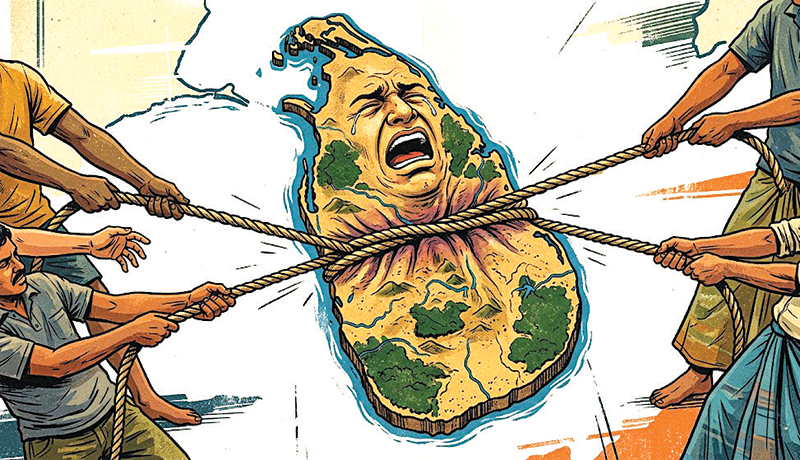
78 Years of Demagoguery, Not Democracy
by Brigadier Ranjan de Silva
rpcdesilva@gmail.com
On the 4th of February every year, we raise the lion flag and speak of democracy. We speak of 78 years of “self-rule.” But honesty demands we ask: what kind of rule have we actually had? It was not democracy. Democracy is government for the common good, constrained by law, informed by reason, and accountable to truth.
What Sri Lanka has had for 78 years is demagoguery — government by manipulation, by party, and by passion.
Defining the Curse:
The dictionary defines demagoguery as “political activity that seeks support by appealing to the desires and prejudices of ordinary people rather than by rational argument.” Its tools are simple: divide the people, promise the impossible, demonize the opponent, and govern for the next election, not the next generation. That is the political culture we inherited in 1948 and perfected since.
78 Years of Evidence:
The record is not ambiguous. Policy by Pendulum – 1948–2024. Instead of a national development plan, we got a partisan wrecking ball. 1956: The “Sinhala Only Act” was passed not after linguistic study, but as an election mobilization tool. 1970-77: The SLFP nationalized private enterprise and imposed import controls. 1977: The UNP reversed course with an open economy overnight. 2005-2014: Mega infrastructure was built on Chinese loans with no feasibility transparency. 2015-2019: Those same projects were called “white elephants” and stalled. 2020-2021: The organic fertilizer ban was announced as a populist “green” policy, reversed 6 months later after it collapsed agriculture and food prices. The Colombo Port City, Hambantota Port, and the Central Expressway all followed the same pattern: started, stopped, rebranded. The country pays twice. The party takes credit once. Economics as Election Candy. Demagoguery is expensive. 1960s: Subsidized rice to win rural votes, leading to the 1971 food crisis.
2005-2014:
Fuel subsidies and public sector hiring sprees that doubled the wage bill. 2019:
Unfunded tax cuts that removed Rs. 500 billion in annual revenue with no offset. By April 2022, external debt hit $51 Billion and we defaulted for the first time. The party that cut taxes was not in power to manage the IMF program. The party that inherited it was blamed for the austerity. This is the cycle. Institutions captured. A democracy needs referees. We turned them into party cadres. The 17th Amendment 2001 created independent commissions. The 18th Amendment 2010 abolished them. The 19th 2015 restored them. The 20th 2020 gutted them again. Police transfers, university vice-chancellors, and state bank chairmen have all been decided by party headquarters, not merit.
When the institution serves the party, the citizen gets leftovers.
Identity over Ideas: From 1956 to 1983 to 2009 to 2022, our elections have been won on fear, not spreadsheets. “They will erase your language.” “They will sell the country.” “Only we can protect Buddhism/the minorities/the nation.”
Rational debate on debt, productivity, or climate adaptation never wins a rally. Prejudice does. That is demagoguery by definition.
Party Interest subverted the National Interest. The core damage of 78 years of partisan politics is this: the nation became secondary to the party. Need power sector reform? Impossible, because our unions will strike. Need to cut 300,000 ghost employees? Impossible, because our voters will defect. Need a 20-year education and export plan? Impossible, because it won’t show results before the next election. So, we borrowed. We patched. We lied. The result: a railway system that still runs on 1950s engines, hospitals without paracetamol in 2022, and a brain drain of 300,000+ skilled workers since the crisis. The parties rotated. The country declined.
The Opposition’s Original Sin and here, all parties share guilt equally. In opposition, the job is not to govern. It is to destroy. The UNP in the 60s called the SLFP “communist.” The SLFP in the 70s called the UNP “imperialist.” The JVP called both “traitors.” The SJB, SLPP, and NPP today use the same script with new logos. Every tax is “anti-people.” Every reform is “a sell-out.” Every crisis is proof the other side is evil and must be removed at any cost. Then they win. And implement 80% of what they opposed. Because demagoguery has no principles, only positions. 78 years of unmerciful, bad-faith criticism has not produced accountability. It has produced cynicism. The public now believes all politicians are the same — because for 78 years, they have behaved the same.
Breaking the Curse:
Changing the party in power will not end this. We must change the incentives that reward demagoguery. Three reforms are non-negotiable: Bind future Parliaments to national policy. Pass 10-year frameworks for energy, education, and public debt with 2/3 majority protection. Infrastructure and fiscal rules should outlast one government, as they do in Chile and New Zealand. Depoliticize the state. Independent commissions for police, elections, public service, and bribery must have constitutional budgets and appointment panels that exclude MPs. No more 18th/20th Amendment style rollbacks. Demand better from voters We must stop rewarding the best slogan and start demanding the best spreadsheet. Town halls over rallies. Costings over promises. A 5-year plan over a 5-minute speech.
In 1948, we did not inherit democracy. We inherited an election. For 78 years we have used that election to choose our favourite demagogue. The prize has been debt, division, and decay. The curse of partisan politics will only end when citizens and leaders agree on one principle: Party second. Country first. Until then, February 4th will remain a ceremony, not a celebration.
Export diversification – Missing the wood for the trees – Part II
by Gomi Senadhira
Sri Lanka established its diplomatic presence in the Gulf region only in the early 1980s. First, a small embassy was opened in Abu Dhabi, covering the UAE. Then in 1982, embassies were opened in Jeddah and Kuwait. The embassy in Jeddah covered Saudi Arabia while Kuwait was responsible for Kuwait, Oman, Qatar and Bahrain. Commercial Diplomats were also assigned to these two embassies. A senior private sector executive, with experience in marketing, was posted to Jedda as the commercial counsellor. I was posted to Kuwait as a second secretary (Commercial). Our instructions were very clear. Focus not only on traditional exports. Product diversification was a priority.
Developing Markets for Agricultural Products
At that time, Minister Lalith Athulathmudali had just launched his Export Production Villages (EPV) programme. He believed that the EPVs working closely with the exporters would provide an ideal opportunity for rural households to directly benefit from the government’s new open trade policy. Agricultural products, particularly fruits and vegetables, were a key component of this approach and the ministry thought that the Gulf countries, with large Sri Lankan communities, would have a ready-made market for these items. Thus, from day one we were compelled to explore the market for nontraditional exports; fruits and vegetables (F&Vs) were on the top of our priority list.
From cane baskets to cardboard boxes
Fortunately, the market for the F&Vs products in the region was at a very early stage of development. That provided an opportunity for Sri Lankan exporters, who were also inexperienced, to work with the importers and grow together. For example, in Kuwait, one of our first customers for F&Vs was a small supermarket where the manager was a Sri Lankan. After the first shipment arrived, he invited me to inspect the shipment. I visited the supermarket and was shocked by what I saw. While produce from other countries was packed nicely in cardboard boxes, our packaging mirrored transport to Manning market, cane baskets! As a result, fresh produce had suffered significant damage. A long report, with photographs, to the trade ministry produced an immediate response. After all, this was a pet project of the Minister. Within weeks, shipments were packed in cardboard boxes. Immediately afterwards, an expert on packaging from the Commonwealth Secretariat was sent to Kuwait with an official from the EDB to study the problem.
By then, we had also managed to develop a friendship with the management of the Salmiya supermarket, a large upmarket supermarket patronised by wealthy Kuwaitis and expats. It was a cooperative and the chairman was a Kuwaiti public servant. I could only meet him after 6 PM when his large office functioned as a diwaniya, a cherished cultural space in Kuwaiti society. Guests moved in and out the room. I had to spend time with them sipping many cups of tea. Though that meant at least two hours on each visit, it helped greatly to develop a close relationship. The general manager was an efficient and friendly Palestinian. After many visits we had succeeded in getting an order for F&Vs. The day after the first shipment arrived, I got an urgent call from the GM to come and inspect it. Once again, I was in for a surprise. Inside the cold room, the consignments from other countries were stacked neatly on top of each other, while vegetable boxes from Sri Lanka had collapsed once placed on top of each other, crushing the produce within.
Fortunately, our packaging experts arrived in Kuwait soon after this incident. They spent two days in the Salmiya Supermarket, studying the packaging from other origins. We were also successful in assuring the GM our packaging would improve. After that, packaging improved and exports moved smoothly. With that, Sri Lanka emerged as a small but reliable supplier to the mainstream market, not just the ethnic segment of the market.
Export of Fresh Vegetables by Sea
Towards the end of my tour, a Sri Lankan businessman requested me to find a buyer for cabbages, which he was prepared to export in large quantities by sea. I introduced him to the largest fruit and vegetable importer in Kuwait. Their regular suppliers of similar vegetables were Jordan, Lebanon and Syria. Luckily, the company was keen to diversify the supply sources. A few weeks later, the first container load of cabbages from Sri Lanka arrived in Kuwait. Immediately after the arrival of the container, I visited the company. They were pleased with the quality and the price and were looking forward to importing more fruits and vegetables. Unfortunately, that turned out to be a one-off event. Later on, when I was back in Sri Lanka, the exporter informed me that he couldn’t continue with it due to the problems with the local supply chains.
Floriculture
During the period I was asked by the EDB to explore the market for floricultural products, more particularly for cut flowers. At that time Kuwait was a relatively large importer of cut flowers and live plants. The main suppliers were the Netherlands and Colombia. Importers were also reluctant to move out of the established supply chain, particularly due to “snob value” associated with the product from Europe. However, after some difficulties, one importer agreed to place a pre-paid trial order. After the arrival of that shipment, he was impressed by the quality of the product and the orders expanded rapidly. As a result, by the end of 1985 Kuwait had become a major buyer of Sri Lanka’s floricultural products.
From village to global markets
As a result of the proactive promotional work undertaken by the EDB and the embassies in the region, by 1985, Sri Lanka had managed to acquire a small but significant share of the F&V and floriculture markets in the GCC countries. We had also identified domestic supply chain issues that hindered exports. All that was done, long before Southeast Asian or African countries even entered into that market. In fact, my Southeast Asian colleagues used to contact me often to reserve “durian” for them at the “Sri Lankan supermarket”.
Most importantly, a substantially large share of produce from Sri Lanka in Kuwaiti supermarkets originated in the EPVs. Of course, that didn’t just happen. The ministry (or the minister) using the carrot and stick approach “encouraged” exporters to buy the produce directly from the newly established EPVs. (The writer can be reached at senadhiragomi@gmail.com)

SLPP MP Namal Rajapaksa arrested by CIABOC

Devapathiraja clinch U15 Division I title with 33-run win over Royal

Mandhana’s record ton powers India into semi-finals

Sun directly overhead Nittambuwa, Algama, Malwana, Aranayake, Meegahakiula and Panamkadu about 12.09 noon today (04)

Showers expected in the Uva, Central and Eastern provinces and in Polonnaruwa and Mullaittivu districts after 2.00 p.m

Norochcholai digs into dwindling coal stocks, two units slash generation

‘Dates have the highest sugar content to fight Coronavirus’

Sunday Island 27 December – Headlines

#SundayIsland 17th December – Headlines

Sunday Island – 28th March

Sunday Island Headlines – 21 March

Sunday Island – 21st February – Headlines
-

 Features6 days ago
“Wrap Me Up in My Blazer”— A Gentlemanly Bradby Reminiscence
-

 Features5 days ago
When Sri Lankan stories find their own voice
-
 Features6 days ago
JVP/NPP government as seen from outside by Lionel Bopage now domiciled in Australia
-

 News5 days ago
BASL takes exception to Justice Ganepola being denied a place in SC
-

 Editorial7 days ago
Govt. trying to dupe UN Rapporteur?
-
 Features6 days ago
Prof. Savitri Goonesekere: What has she done?
-

 News2 days ago
Denied of promotion to SC despite vacancies, justice Gurusinghe retires
-

 Features6 days ago
World Trade Politics: Canada rebuffs Trump’s tariff blackmail