
News
NSB’s GM/CEO Shashi Kandambi wins Business Leader of the Year Award

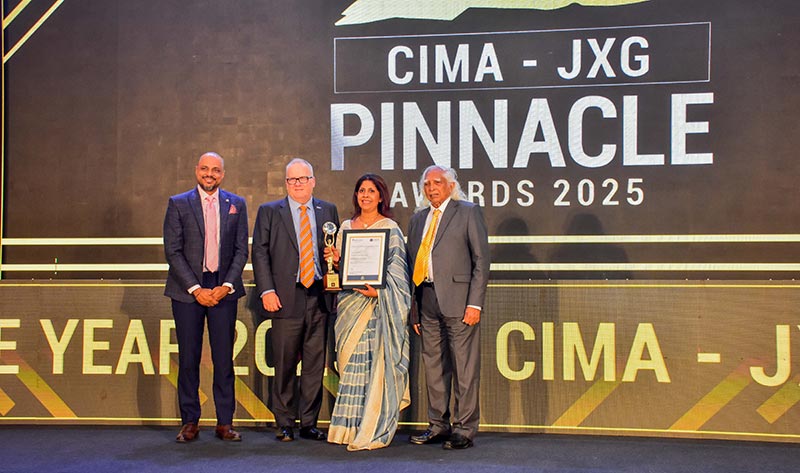
The National Savings Bank (NSB) Friday announced that the General Manager/Chief Executive Officer, Sharmila Shashi Prabha Kandambi Jassim, has been awarded the prestigious Business Leader of the Year 2025 (Gold) at the CIMA–JXG Pinnacle Awards, held recently at Cinnamon Life, Colombo.
Organized jointly by the Chartered Institute of Management Accountants (CIMA), Janashakthi Group (JXG), and AICPA & CIMA Sri Lanka, the event brought together over 250 leaders, professionals, and visionaries from across the country to recognize leadership excellence and strategic innovation in Sri Lanka’s corporate and public sectors.
Shashi Kandambi was recognized for her outstanding contributions towards public sector leadership, her transformative role at NSB, and her dedication to purpose-driven banking that extends beyond profit to national impact. The independent judging panel, chaired by the former Chairman of the Securities and Exchange Commission (SEC), Mr. Faizal Salieh, commended her for driving significant growth, ethical governance, and modernization within one of the country’s most vital state financial institutions.
Shashi Kandambi has over 35 years of experience in the banking and financial services sector, with a portfolio that includes international banking, financial risk, retail development, and institutional strategy. She currently serves as the General Manager/CEO of the National Savings Bank and has been instrumental in driving NSB’s digital evolution and policy alignment with national development goals. She is widely recognized for her integrity, humility, and vision—and is a strong advocate for building resilient, inclusive, and future-ready institutions.
Her recognition at the awards ceremony is not only a personal milestone but also a symbol of excellence for Sri Lanka’s public institutions, proving that visionary, ethical, and strategic leadership can thrive in the state sector.
Since her appointment as the General Manager/CEO, Shashi Kandambi has guided the National Savings Bank through a transformative period marked by rapid digital innovation and cultural renewal. Her leadership has redefined the Bank’s strategic direction, aligning operational goals with national priorities and customer needs. In 2024, NSB recorded a remarkable 516% surge in Profit Before Tax (PBT), reaching Rs. 26.4 billion, a testament to prudent decision-making, disciplined financial stewardship, and strategic adaptability. This exceptional financial performance was reflected in substantial improvements across a wide array of key performance indicators, reinforcing the Bank’s position as a pillar of stability and growth.
Demonstrating its enduring commitment to national development, NSB contributed Rs. 19.5 billion in taxes and levies during the year, affirming its integral role as a state-owned institution in supporting the country’s fiscal framework. These outstanding results are a direct reflection of the Bank’s visionary leadership and its steadfast dedication to generating sustainable value for the nation and its people.
Kandambi has also championed a people-centric approach to banking, expanding rural outreach, improving digital accessibility, and promoting inclusive financial practices. Through these efforts, NSB has not only modernized its service delivery but has also deepened its engagement with communities across Sri Lanka.
Accepting the award, Kandambi reaffirmed her commitment to institutional integrity, stakeholder trust, and service-oriented leadership. She highlighted the role of leaders in cultivating new talent, embracing change, and balancing innovation with deep-rooted ethics.
“Leadership is not about position or power—it is about responsibility. We must lead with empathy, act with integrity, and build institutions that will outlast us,” she noted during her acceptance. She also emphasized her strong belief in the collective strength of her team at NSB, “This award is not mine alone—it belongs to the dedicated teams at NSB, whose commitment, resilience, and unwavering focus have made this achievement possible. It also belongs to the people of Sri Lanka who inspire us every day to serve better and strive higher. Together, we have proven that excellence in public service is not only possible—it is powerful.”








If India defied losing the toss and getting the worst of the conditions, theoretically, in Cuttack, South Africa did the same in New Chandigarh to come roaring back into the T20I series, which is now locked 1-1 with three matches to go.
India captain Suryakumar Yadav noted at the toss that the outfield was already dewy when the players were going through their pre-match warm-ups. It was a no-brainer to chase. But Quinton de Kock put India under pressure with a 46-ball 90 studded with seven sixes, and Donovan Fererrira finished brilliantly with an unbeaten 16-ball 30, taking South Africa to an imposing total of 213 for 4.
Imposing, but not dew-proof; certainly not given how India’s bowlers had struggled with the conditions and bowled 15 wides — including seven in one Arshdeep Singh over — and 13 full-tosses.
But the dew never got a chance to test South Africa, as their new-ball bowlers made the best possible use of early movement to take three wickets in the first four overs. These included the Test-match-style dismissals of both India openers.
It was all steeply uphill from 32 for 3, and India never really challenged the visitors, with Tilak Varma’s 34-ball 62 standing out for its fluency and enterprise on a difficult night for his team. South Africa bowled India out with five balls still remaining, with Ottneill Baartman hastening their end with three wickets in the 19th over.
This pitch wasn’t a complete featherbed, with the ball occasionally stopping on the batters and making them mistime shots. Two members of South Africa’s top three, Reeza Hendricks and Aiden Markram, scored 37 off 36 balls between them.
The other member, however, was in an entirely different mood, taking full toll of anything remotely too short, too full, or especially too straight. De Kock kept clearing the ropes whenever he had half a chance, particularly with his pulls and pick-up shots square and behind square on the leg side.
This put India’s bowlers under tremendous pressure. They couldn’t attack de Kock’s stumps, because that ran the risk of being whisked over the leg side, and they couldn’t afford to give him width either. This pressure led India to attempt yorkers and wide yorkers frequently, and the pressure combined with the dew to produce errors in the form of wides and full-tosses.
Arshdeep suffered the most from this, sending down seven wides in the 11th over — all to de Kock – and nine in all.
Jitesh Sharma’s alert run-out of de Kock — who wandered out of his crease instinctively after bottom-edging the ball towards the keeper — in the 16th over, followed by Axar Patel’s dismissal of Dewald Brevis in the 17th threatened to stall South Africa at a critical stage of their innings. But Ferreira and David Miller made sure they cleared 200 by a good margin, putting on an unbroken 53 off 23 balls for the fifth wicket.
The highlight of the partnership was an 18-run final over during which Ferreira hit Jasprit Bumrah for two sixes: a full-toss drilled straight, and a good short ball that followed the batter’s premeditated movement pulled authoritatively over the leg side.
In all, Bumrah conceded four sixes, the most he has gone for in a T20I.
Given all the dew around, it was imperative that South Africa made the new ball count. They did that emphatically. Ngidi set things in motion with a first-over jaffa to Shubman Gill, squaring him up in defence with one that straightened from a good length and having him caught at slip. Jansen followed up in the next over with the mirror-image dismissal of Abhishek Sharma; angling in, straightening, squaring up the batter and catching the outside edge.
Abhishek’s wicket was particularly crucial, since he’d already hit two sixes, in just eight balls.
Suryakumar followed the openers to the dressing room in the fourth over, sending a thin edge to the keeper — confirmed after South Africa reviewed the not-out decision — while looking to steer Jansen behind point.
India never threatened to make a match of it, particularly with Axar Patel — promoted to No. 3 — and Hardik Pandya struggling for fluency, scoring 41 off 44 balls between them.
But there was one bright spot for the home team in the form of Tilak, who looked in excellent rhythm right from the time he walked in, and combined that with his awareness of the field to find the boundary frequently even while his partners got stuck. Against Ferreira’s 110kph offspin rockets, for example, he made room to use the pace and steer him behind point, off the stumps. Then, against George Linde’s left-arm spin, he collapsed his back knee smartly to reverse-sweep over backward point for six. A slog-swept six off an Ngidi slower ball took him to a 27-ball half-century in the 14th over.
Jitesh, who came in at No. 7, also made good use of the V behind the wicket, scoring 27 off 17, but the result was already certain by the time he walked in, with India needing 96 off 34 balls at that point.
Brief scores:
South Africa 213 for 4 in 20 overs (Quinton de Kock 90, Aiden Markram 29, Dewald Brevis 14, Donovan Ferreira 30*, David Millerr 20*; Varun Chakrawarthy 2-29, Axar Patel 1-27 ) beat India 162 in 19.1 overs (Abhishek Sharma 17, Axar Patel 21, Tilak Varma 62, Hardik Pandya 20, Jitesh Sharma 27; Ottneil Baartman 4-24, Marco Jansen 2-25, Lungi Ngidi 2-26, Sipamla 2-46) by 51 runs
[Cricinfo]

Several ex-Cabinet ministers questioned; Ranil, Sajith, too likely to be summoned
The Commission to Investigate Allegations of Bribery or Corruption (CIABOC) has initiated an inquiry into the shifting of the Agriculture Ministry situated at Rajamalwatte, to a building belonging to the D. P. Jayasinghe Group of Companies, at Rajagiriya, during the Yahapalana government.
The building was rented for a five-year period at a cost of over Rs 1 bn by the yahapalana government within months after the then President Maithripala Sirisena declared opened the 10-storey building complex.
The CIABOC yesterday morning recorded former yahapalana minister Gayantha Karunatilleke’s statement in connection with the investigation. Later in the day, CIABOC recorded the statement of SJB General Secretary Ranjith Maddumabanadara. Earlier CIABOC summoned former ministers Thalatha Atukorale, Wajira Abeywardena and Lakshman Kiriella. At the time of the finalisation of the deal, KIriella was in the UNP.
Sources said that former PM and President Ranil Wickremesinghe, too, was likely to be questioned in this regard. Responding to The Island queries, sources pointed out even SJB leader Sajith Premadasa was expected to be questioned.
The then Speaker Karu Jayasuriya is on record as having said that the building was rented in keeping with a decision taken by the government and not Parliament.
The UNP-SLFP coalition shifted the Agriculture Ministry to accommodate 16 Sectoral Oversight Committees therein.
Although the government paid as much as Rs. 21.5 mn monthly rent to D.P.A. Jayasinghe Company, the Agriculture Ministry failed to move in for over a year. The then Agriculture Minister Duminda Dissanayake sought Cabinet approval on Dec 1, 2015 to rent the building.
According to inquiries conducted earlier by the Presidential Commission appointed to probe state sector corruption, the Agriculture Ministry sought Cabinet approval for a new building after the then Prime Minister Wickremesinghe submitted a cabinet proposal on 21 September, 2015, to use the Agriculture Ministry building for Parliament’s sectoral oversight committees.
PM Wickremesinghe’s Secretary Saman Ekanayake has told the Commission that public funds could have been saved if the several vacant floors of Suhurupaya belonging to the Defence Ministry had been made available to the Agriculture Ministry.
By Shamindra Ferdinando ✍️
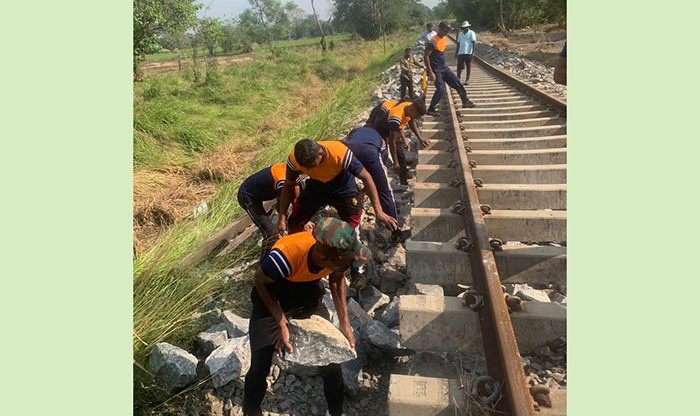
Railway sources said that the damages caused to railway tracks could be more than USD 300 mn.
According to UNDP Rapid Crisis Assessment Sri Lanka’s railroad system, over 278 km of railways were exposed to cyclone-related flooding, including 35 railroad bridges nationwide. This figure reflects flooding only, but other hazards (such as localised debris, landslides, or damage to a single bridge) can also disrupt operations, meaning that even relatively small obstructions can render long stretches of railway non-operational. Like road exposure, railway exposure limits mobility and the capacity of affected populations to access key services and infrastructure.
At the level of divisional secretariats, Colombo and Thimbirigasyaya in Colombo District, Ja Ela in Gampaha District, as well as Mannar Town and Nanaddan in Mannar District all registered over 10 km of exposed railways each.
Commissioner-General of Essential Services B.K. Prabath Chandrakeerthi is on record as having said that only 478 kilometers of Sri Lanka’s 1,593-km railway network were currently usable following extensive damage caused by the recent cyclone.

Quinton de Kock’s 90 powers South Africa to massive win

Duffy five-for triggers West Indies slide to give New Zealand first win of WTC cycle

Showers or thundershowers will occur at times in the Northern, North-Central, Eastern and Uva provinces and in Puttalam, Matale and Kurunegala districts

Rs 1. 3 bn yahapalana building deal under investigation

SL Railways suffers staggering losses; more than 2/3 of rail tracks out of service

US, SL advancing free, open, and resilient Indo-Pacific region: Embassy

‘Dates have the highest sugar content to fight Coronavirus’

Sunday Island 27 December – Headlines

#SundayIsland 17th December – Headlines

Sunday Island – 28th March

Sunday Island Headlines – 21 March

Sunday Island – 21st February – Headlines
-

 News4 days ago
Over 35,000 drug offenders nabbed in 36 days
-

 Features2 days ago
Finally, Mahinda Yapa sets the record straight
-

 News3 days ago
Cyclone Ditwah leaves Sri Lanka’s biodiversity in ruins: Top scientist warns of unseen ecological disaster
-

 Business6 days ago
LOLC Finance Factoring powers business growth
-

 News6 days ago
CPC delegation meets JVP for talks on disaster response
-
 News6 days ago
A 6th Year Accolade: The Eternal Opulence of My Fair Lady
-

 News4 days ago
Rising water level in Malwathu Oya triggers alert in Thanthirimale
-
 Features5 days ago
The Catastrophic Impact of Tropical Cyclone Ditwah on Sri Lanka: