
News
NPP can’t sidestep Anti-Corruption Act:Ex-Justice Minister


Former Justice Minister Dr. Wijeyadasa Rajapakshe, PC, says the National People’s Power (NPP) government cannot sidestep Anti-Corruption Act No 09 of 2023.
The former parliamentarian said that the Act made it mandatory for the Commission to Investigate Allegations of Bribery or Corruption (CIABOC) to disclose the asset declarations of all, regardless of their standing.
The disclosure of NPP Minister Wasantha Samarasinghe having assets worth Rs 275 mn wouldn’t have happened if not for the new Anti-Corruption Act approved by Parliament on July 19, 2023, Rajapakshe said.
The ex-Minister said that the main Opposition Samagi Jana Balawegaya (SJB) had, in writing, already requested the CIABOC to ascertain how several NPPers amassed so much wealth. According to the SJB letter, addressed to Director General of CIABOC, Ranga Dissanayake, they had named Ministers Wasantha Samarasinghe, Sunil Handunetti, Bimal Rathnayake, Nalinda Jayatissa and Punyasiri Jayakody and Deputy Minister Sunil Watagala. “The NPP will have to live with it. CIABOC will also have to ensure that all are treated alike”
Asked to explain the circumstances the Wickremesinghe-Rajapaksa government introduced that Act, Rajapakshe said that in spite of opposition within the parliamentary group, Wickremesinghe gave him the go ahead to introduce three new Acts, namely the Anti-Corruption Act, Regulation of Election Expenditure Act and the Proceeds of Crime Act.
“We have to discuss the enactment of those Acts, taking into account the pathetic state of the economy and the persistent accusations that the executive and the legislature caused the economic crisis against the backdrop of the failure on the part of the Central Bank at that time,” Rajapakshe said. Th proposed new laws facilitated our talks with the International Monetary Fund (IMF) as the latter emphasised the responsibility on our part to instill financial discipline across board, Rajapakshe said, adding that they decided to first introduce the Regulation of Election Expenditure Act.
All political parties, regardless of whatever differences they had with regard to other issues at hand, could have unanimously approved the Regulation of Election Expenditure Bill, Rajapakshe said. But, consensus among political parties couldn’t be achieved, the ex-Minister said, adding that finally only 97 voted for the Bill whereas 36 voted against when it was taken up on 19 January, 2023. Among those who opposed that vital piece of legislation were NPP parliamentary group leader Anura Kumara Dissanayake, SJB leader Sajith Premadasa and veteran politician Lakshman Kiriella.
The former Minister pointed out a staggering 92 lawmakers skipped that important vote. Then, the Parliament, on 19 July, without a vote, approved the Anti-Corruption Act but, regardless of determined efforts, the Proceeds of Crime Bill couldn’t be enacted during Wickremesinghe tenure as the President.
Rajapakse appreciated the NPP after having won both presidential and parliamentary polls in 2024 enacted the Proceeds of Crime Bill on April 8, 2025. Responding to another query, the PC said that the three laws could make significant and fundamental changes in the political scene.
The former Minister said that the UNDP has got involved in the anti-corruption fight here with an unprecedented USD 2.5 mn Japanese funding made available for the high profile project, whereas the CIABOC held talks with the World Bank on how the latter could support Sri Lanka’s efforts with the focus on action taken in line with the Proceeds of Crime Act.
Rajapakshe said that Sri Lanka initiated, during President Chandrika Bandaranaike Kumaratunga’s presidency in 2004, and signed and ratified the United Nations Convention Against Corruption (UNCAC). According to Rajapakshe, in terms of the UNCAC, Sri Lanka had to introduce an Anti-Corruption Act but with the change of government in 2005, that initiative was discarded. Rajapakshe said that following the change of government in 2015, an effort was made to take tangible measures in this regard but the project suffered again when he lost the Justice Ministry portfolio over his opposition to the deal on Hambantota port.”
Rajapakshe said that the Anti-Corruption Act may never have been enacted if not for the Aragalaya that brought Wickremesinghe to power in July 2022.
Former Minister Rajapakshe emphasised the importance of the enactment of 21st Amendment to the Constitution on 21 Oct., 2022, before the passage of three previously discussed Acts. The 21st Amendment received 179 votes in favour and one against while 45 abstained, Rajapakshe recalled declaring that it was aimed at restoring and strengthening the balance of powers among the executive, legislature, and judiciary, sharply eroded by the enactment of the 20th Amendment that expanded the powers of the presidency.
Rajapakshe alleged that the then Premier Dinesh Gunawardena made a last minute bid to put off the vote by compelling Wickremesinghe to come to Parliament for a meeting. “I steadfastly refused to join that meeting,” Rajapakshe said, asserting that whatever the shortcomings and faults of the post-Gotabaya administration, it enacted critically important laws that had brought immense pressure on those in power today.
By Shamindra Ferdinando


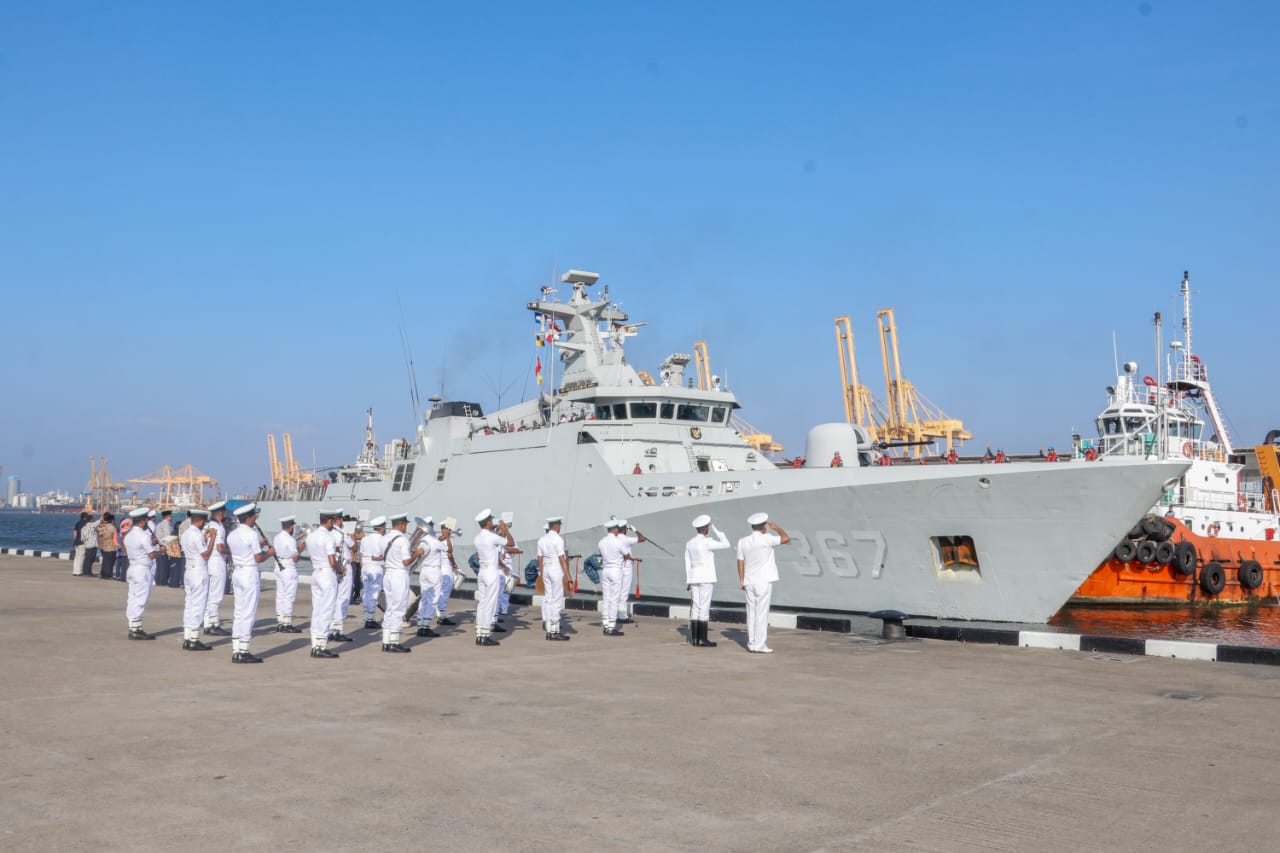
The Royal Navy of Oman Ship ‘AL SEEB’ concluded a logistics replenishment visit to Sri Lanka and departed the Port of Colombo on 24 Jan 26.
In accordance with naval tradition, the Sri Lanka Navy extended a customary farewell to the departing ship.

The price of gold has risen above $5,000 (£3,659) an ounce for the first time, extending a historic rally that saw the precious metal jump by more than 60% in 2025.
It comes as tensions between the US and NATO over Greenland have added to growing concerns about financial and geopolitical uncertainty.
US President Donald Trump’s trade policies have also worried markets. On Saturday he threatened to impose a 100% tariff on Canada if it strikes a trade deal with China.
Gold and other precious metals are seen as a so-called safe-haven assets that investors buy in times of uncertainty.
Demand for gold has also been driven by a range of other factors including higher-than-usual inflation, the weak US dollar, buying by central banks around the world and as the US Federal Reserve is expected to cut interest rates again this year.
Wars in Ukraine and Gaza, as well as Washington seizing Venezuelan President Nicolás Maduro, have also helped push up the price of gold.
On Friday, silver topped $100 an ounce for the first time, building on its almost 150% rise last year.
[BBC]
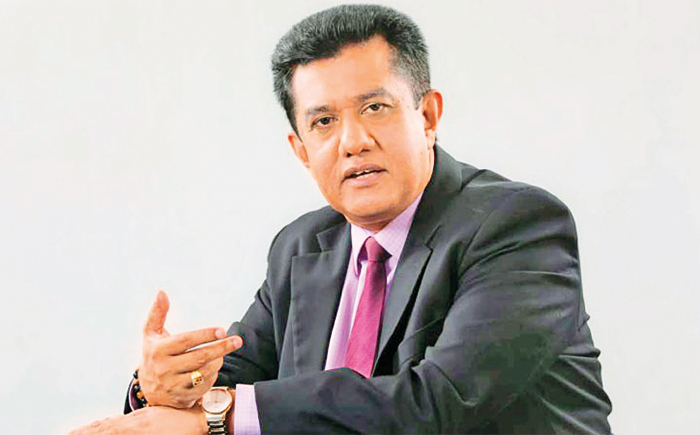
SJB Working Committee member and ex-SLPP lawmaker Charitha Herath says that all eyes are on the newly constituted Constitutional Council (CC) as to how it will handle the dispute between President Anura Kumara Dissanayake, and the previous CC, over the appointment of Auditor General (AG).
The former parliamentarian said so in response to The Island query yesterday (25). In terms of the Constitution, Prime Minister Dr. Harini Amarasuriya and Opposition Leader Sajith Premadasa last week agreed on the appointment of former civil servant Austin Fernando, Professor Wasantha Seneviratne and Ranjith Ariyaratne as non-MP members of the CC.
They replaced former Ministry Secretary Dr. Prathap Ramanujam, former Chairperson of the Sri Lanka Medical Association Dr. Dilkushi Anula Wijesundere and Dr. Dinesha Samararatne of the University of Colombo. Pointing out that they rejected the President’s nominees for the AG’s post on several occasions, Herath emphasised the pivotal importance of the appointment of a person with impeccable credentials.
The other CC members are the Prime Minister, Speaker Dr. Jagath Wickremaratne (Chairman), the Opposition Leader, the President’s nominee Bimal Rathnayake and five persons appointed by the President, upon being nominated as follows: one MP nominated by agreement of the majority of the MPs representing the Government (Aboobucker Athambawa, MP), one MP nominated by agreement of the majority of the Members of Parliament of the political party, or independent group, to which the Leader of the Opposition belongs (Ajith P. Perera, MP), and one MP nominated by agreement of the Members of Parliament other than those representing the Government and those belonging to the political party or independent group to which the Leader of the Opposition belongs, and appointed by the President ( Sivagnanam Shritharan, MP.)
The present CC was established on October 31, 2022 in terms of the 21st Amendment to the Constitution. The Attorney General heads the National Audit Office (NAO). One-time COPE Chief said that it would be the responsibility of the government to ensure the integrity of the NAO.
Chulantha Wickramaratne, who served as AG for a period of six years, retired in April 2025. Following his retirement, President Dissanayake nominated H.T.P. Chandana, an audit officer at the Ceylon Petroleum Corporation as the AG. The CC rejected that nomination. Subsequently, President Dissanayake appointed the next senior-most official at the NAO Dharmapala Gammanpila as Acting Auditor General for a period of six months. Then, the President nominated Senior Deputy Auditor General L.S.I. Jayarathne to serve in an acting capacity, but her nomination, too, was also rejected. Many an eyebrow was raised when the President nominated O.R. Rajasinghe, the Internal Audit Director of the Sri Lanka Army for the top post. That nomination too was rejected. As a result, the vital position remains vacant since 07 December, 2025.
Herath said that the government was in a bind over the Auditor General’s appointment and the disgraceful campaign launched against Attorney General Parinda Ranasinghe, Jr, PC.
The ex-lawmaker said that JVP/NPP loyalists masquerading as journalists and civil activists had launched the protest against the Attorney General. Herath said that the decision to send Deputy Secretary General of Parliament Chaminda Kularatne, on compulsory leave, too, was a matter of serious concern.
Herath said: “This is the same government that campaigned strongly on non-interference, institutional independence, and respect for the rule of law—principles they used to criticise every previous administration. Now, they appear to be doing exactly what they once opposed, only more openly. If this pattern continues, these undemocratic actions will eventually lead to their own downfall.”
BASL in late December, 2025 urged President Dissanayake and others, including the Opposition Leader, to consult civil society and professional bodies, including them, before the appointment of civil society representatives.
Herath said that the newly constituted CC would face its first acid test when it addressed the Auditor General issue.
by Shamindra Ferdinando

Royal Navy of Oman Ship ‘AL SEEB’ leaves island

Gold tops $5,000 for first time ever, adding to historic rally

Showers will occur in the Northern, North-central, Eastern, North-western, Western, Sabaragamuwa and Uva provinces and in Matale, Matara, Galle and Nuwara-Eliya districts

U – 19 World Cup: Andrew, McKenzie deliver West Indies comfortable win

U – 19 World Cup: Bowlers, Hogan help Australia breeze past South Africa

Abhishek blasts 14-ball fifty to hand India unassailable 3-0 lead against New Zealand

‘Dates have the highest sugar content to fight Coronavirus’

Sunday Island 27 December – Headlines

#SundayIsland 17th December – Headlines

Sunday Island – 28th March

Sunday Island Headlines – 21 March

Sunday Island – 21st February – Headlines
-
 Business18 hours ago
ComBank, UnionPay launch SplendorPlus Card for travelers to China
-

 Business2 days ago
ComBank advances ForwardTogether agenda with event on sustainable business transformation
-

 Opinion7 days ago
American rulers’ hatred for Venezuela and its leaders
-
 Opinion5 days ago
Remembering Cedric, who helped neutralise LTTE terrorism
-
 Business5 days ago
CORALL Conservation Trust Fund – a historic first for SL
-

 Opinion4 days ago
A puppet show?
-
 Opinion2 days ago
Conference “Microfinance and Credit Regulatory Authority Bill: Neither Here, Nor There”
-

 Opinion7 days ago
History of St. Sebastian’s National Shrine Kandana