
Latest News
New leader’s promises will be tricky to keep in crisis-hit Sri Lanka

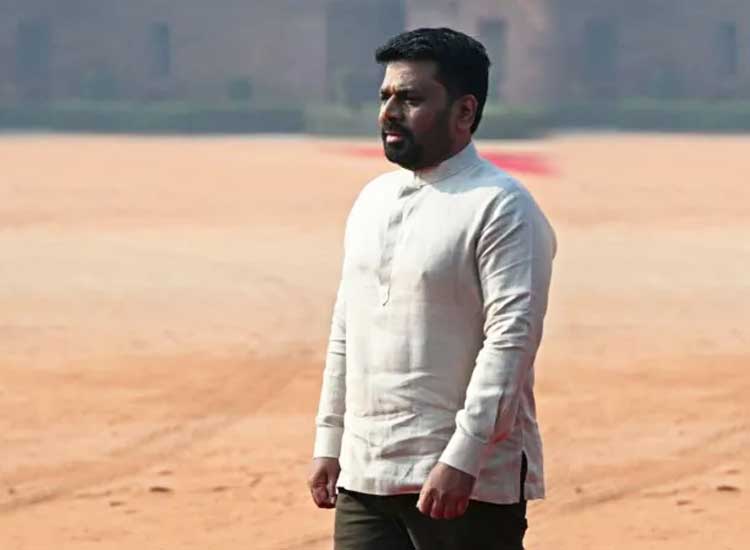
Stunning election wins by a new left-leaning president and his party have changed Sri Lanka’s political landscape – but the cash-strapped island’s new rulers are quickly realising that campaign promises are easier to make than to keep.
Anura Kumara Dissanayake’s remarkable victory in the presidential election in September was swiftly followed by a landslide for his National People’s Power (NPP) alliance in parliamentary elections.
As a new year starts, he and his supporters want this to be a turning point for the country, which is trying to recover from devastating economic crisis and years of misrule.
However, they have limited room for manoeuvre to make good on pledges to voters, whose expectations from the new government are high.
Since the financial meltdown of 2022, economic recovery has been fragile and Sri Lanka is far from out of the woods.
The NPP won 159 seats in the 225-member assembly in November – an unprecedented two-thirds majority – giving Dissanayake a sweeping mandate to push through major economic and constitutional reforms.
However, even as the results were coming in, the new president had to gear up for a meeting with a visiting delegation from the International Monetary Fund (IMF), with which the outgoing government had negotiated a $2.9bn (£2.31bn) bailout package. The IMF deal became controversial as it led to severe austerity measures, tax rises and cuts in energy subsidies – hitting common people hard.
During the campaign Dissanayake and his alliance promised that they would re-negotiate parts of the IMF agreement.
But in his address to the new parliament, he performed a U-turn. “The economy is in such a state that it cannot take the slightest shock… There’s no room to make mistakes,” Dissanayake said.
“This is not the time to discuss if the terms [of the IMF loan] are good or bad, if the agreement is favourable to us or not… The process had taken about two years, and we cannot start all over again.”
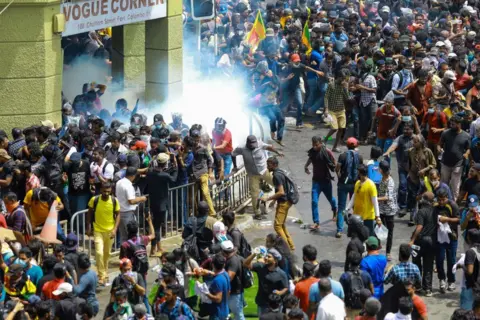
The voters’ overwhelming verdict for the NPP is seen as the culmination of a people’s uprising triggered by the economic crisis. The uprising toppled president Gotabaya Rajapaksa in the summer of 2022, when Sri Lanka ran out of foreign currency and struggled to import food and fuel.
The country had earlier declared bankruptcy after defaulting on its external debt of about $46bn. India, China and Japan are among those who have loaned billions of dollars.
The recent election results also reflected people’s anger towards established political parties – of former presidents Mahinda Rajapaksa and Ranil Wickremesinghe and others – for failing to handle the economic meltdown.
“One of the priorities for Dissanayake will be to give some economic relief to the people due to excessive taxation and the cost-of-living crisis. Debt management is another big challenge,” veteran political analyst Prof Jayadeva Uyangoda told the BBC.
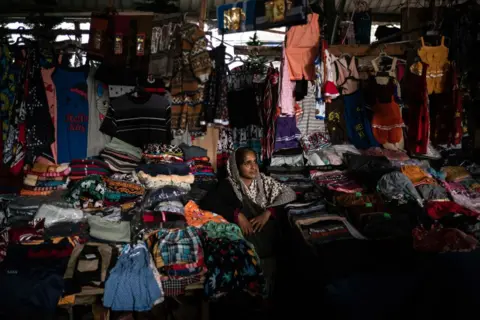
So far the massive political changes don’t seem to have had any impact on people like Niluka Dilrukshi, a mother-of-four who lives in a suburb of the capital Colombo. Her husband is a daily-wage labourer and the family still find it hard to get by.
The BBC spoke to her about the soaring cost of living in January 2022, months before mass protests erupted. At that time, she said her family was eating only two meals a day, instead of three, and they were giving only vegetables and rice to their children due to the high cost of fish and meat.
“We are still struggling to make ends meet and nothing has changed. The price of rice, which is the staple food, has increased further. We are not getting any relief from the government,” Mrs Dilrukshi said.
People like her want the new government to take immediate steps to bring down the cost of essentials. Sri Lanka is an import-dependent nation, and it needs foreign currency to bring in items like food and medicine.
For now, Colombo is able to hold on to its currency reserves as it has suspended its debt repayments.
The real struggle, experts point out, will start probably in the next three or four years when it starts repaying its debt.
People’s perception of President Dissanayake and his new government could change if there’s no visible change in their standard of living in the next two or three years.
“People have given him a huge mandate. The IMF should respect that by allowing him to give some relief to the people through social welfare programmes,” says Prof Uyangoda.
Dissanayake must also contend with India and China, which are jostling for influence in Sri Lanka, where both have invested heavily in recent years.
“Both India and China will try to bring Colombo under their sphere of influence. I think the new government’s foreign policy will be very pragmatic without aligning with anyone,” says Prof Uyangoda.
In a careful diplomatic manoeuvre, Dissanayake chose Delhi as his first official overseas destination in mid-December. During the visit, India promised to supply liquefied natural gas for Sri Lankan power plants and work on connecting the power grids of the two countries in the long run.
China’s increasing foothold in Sri Lanka, especially calls by Chinese “research” vessels to the island’s ports – so close to India’s southern tip – has triggered concern in Delhi.
“I have given an assurance to the prime minister of India that we will not allow our land to be used in any way in a manner that is detrimental to the interest of India,” Dissanayake said after talks with Narendra Modi. Delhi will no doubt be pleased with the assurance, but Dissanayake will find out what Beijing expects when he visits China in mid-January.
[BBC]

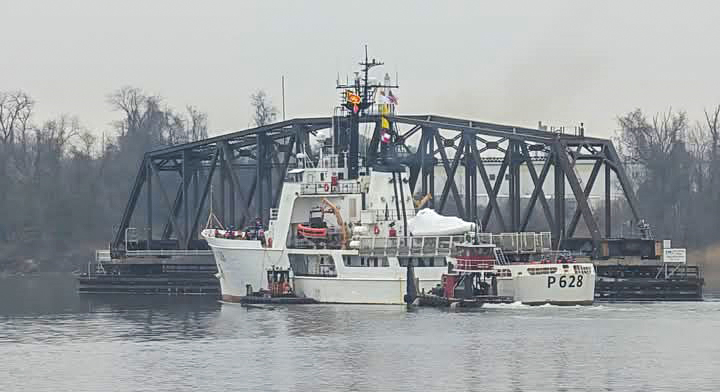
The Offshore Patrol Vessel P 628, which was formally handed over to the Sri Lanka Navy by the U.S. Coast Guard in December 2025, departed for Sri Lanka from Baltimore, United States on 20th February 2026. The home bound journey began, after the modernization work of the ship to suit the operational needs of the Sri Lanka Navy.
The EX-United States Coast Guard Cutter, USCGC Decisive was officially handed over to the Sri Lanka Navy on 02 Dec 25, as the latest addition to the SLN fleet under the Pennant Number P 628. Upon her arrival in Sri Lanka, the ship is scheduled to be formally commissioned into the fleet.
Measuring 64 metres in length, this ‘B-Type Reliance Class 210-foot Cutter’ is equipped with advanced technological systems and facilities, capable of conducting extensive surveillance operations spanning up to 6,000 nautical miles per patrol.
The vessel’s voyage to Colombo is historic, possibly marking the longest-ever passage undertaken by a Sri Lanka Navy ship. Covering approximately 14,775 nautical miles, the journey will see the P 628 navigate from Baltimore through the Atlantic Ocean, the Panama Canal (a first for a Sri Lankan naval vessel), the Pacific Ocean, and into the Indian Ocean via the Straits of Malacca. The ship is expected to arrive in Sri Lanka during the first week of May 2026.
During the transit, the P 628 is scheduled to make port calls to replenish supplies and services, providing opportunities to further strengthen diplomatic ties with partner nations.
This transfer represents the fourth vessel provided to the Sri Lanka Navy by the United States Coast Guard, reinforcing a long-standing partnership aimed at addressing common maritime challenges.
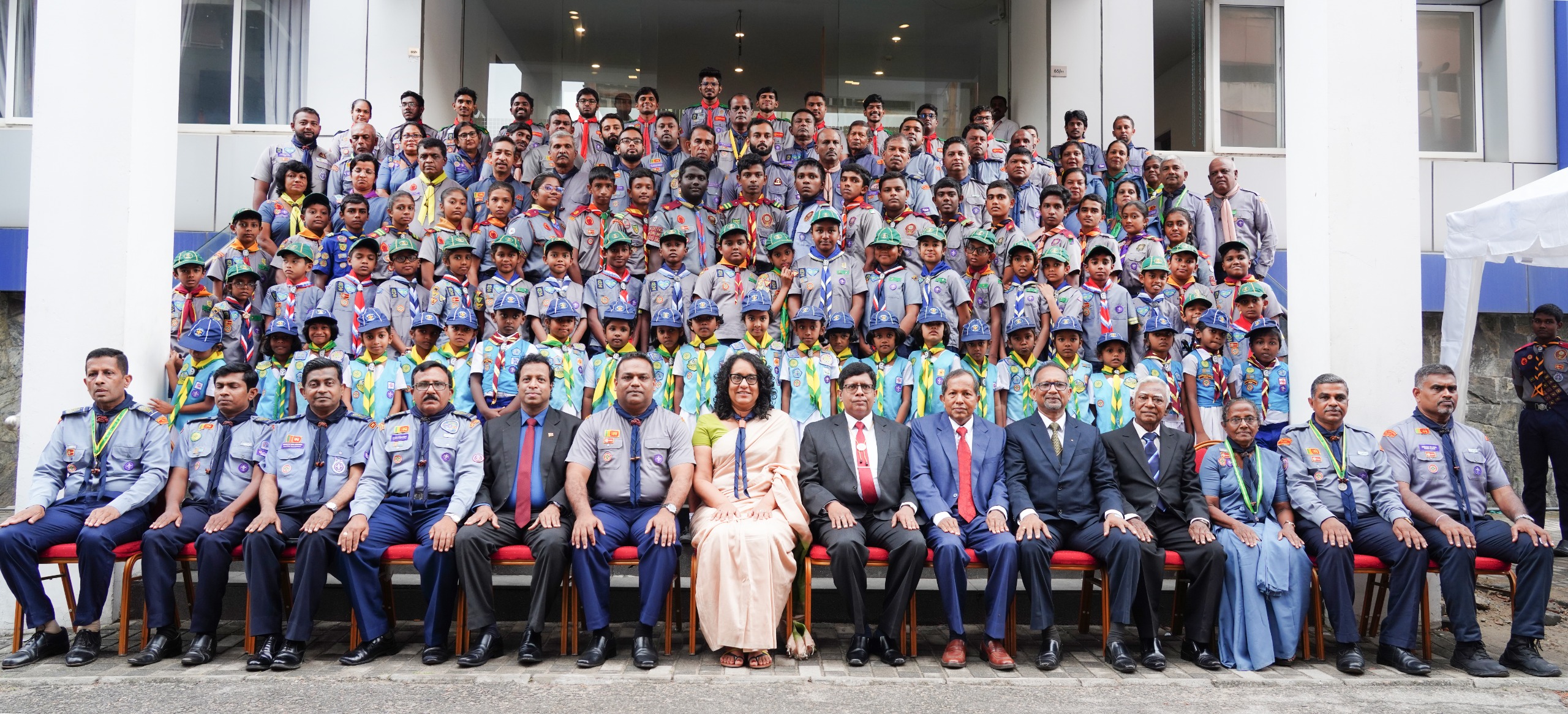
The 169th birth anniversary celebration of Lord Baden-Powell, the founder of the World Scouting Movement, and World Scout Thinking Day, was held on 22 February at the National Scout Headquarters, with the participation of Prime Minister Dr. Harini Amarasuriya.
Addressing the gathering, the Prime Minister emphasized that the Scouting Movement is not merely about holding positions, but a noble form of training that nurtures readiness to help others and to serve society while “being prepared.”
She further highlighted the importance of serving society as a disciplined and intelligent “smart” Scout who respects others while effectively using modern technology. The Prime Minister also called upon Scouts to contribute responsibly to safeguarding the nation’s future through environmentally friendly initiatives such as tree planting and the protection of water resources.
During the event, laptops were symbolically distributed to several districts under the Scout Digitalization Project, along with the provision of first-aid kits. Additionally, Chief Scout Commissioner Attorney-at-Law Manoj Nanayakkara presented the Prime Minister with a special Scout stamp collection and a commemorative cover.
The occasion was attended by the Secretary to the Prime Minister Pradeep Saputhanthri, officials of the Sri Lanka Scout Association, and a large number of Scouts from across the island.
(Prime Minister’s Media Division)
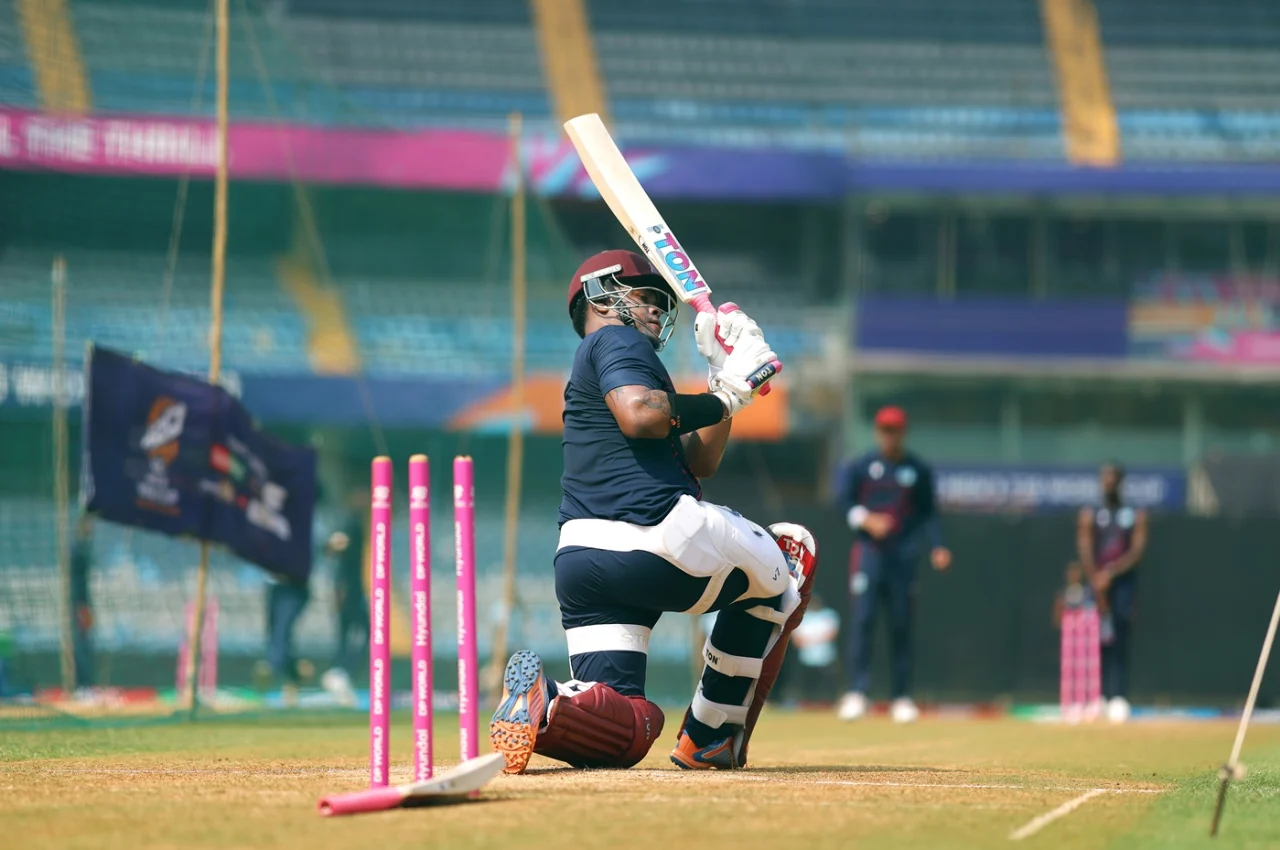
Two years ago, Zimbabwe failed to qualify for the T20 World Cup. Not only did they make the competition this time, they entered the Super Eights unbeaten.
First, it was Blessing Muzarabani who shut Australia down on a slow pitch in Colombo. Then their top four silenced the Khettarama crowd by chasing down 189 against Sri Lanka. The common factor in those wins were also Brian Bennett’s fifties and Sikandar Raza’s quick cameos. Muzarabani and Brad Evans are also among the top ten wicket takers in the tournament.
With contributions from several players, Zimbabwe could prove a handful for West Indies in Mumbai. They will have to make a quick adjustment, though, having played all their group matches in Sri Lanka, while West Indies have already played twice at the Wankhede.
These two sides have faced each other only four times in T20 internationals. When lined up player-against-player, West Indies – also undefeated – look stronger with bat, with an in-form Shai Hope, a rejuvenated Shimron Hetmyer at No. 3, and a solid finisher in Sherfaine Rutherford.
Having as many as three allrounders – with Romario Shepherd in line to return after injury – gives them the option of playing three fast bowlers and three spinners. It’s an ideal mix in Mumbai, where the quicks (35 wickets) and spinners (34) have been equally effective, averaging 26.28 and 26.25 respectively this tournament.
It’s a big game for both sides, with matches against India and South Africa to follow next. Who will get on the points table first?
Blessing Muzarabani is an early wicket-taker and a serial wicket-taker. He has height, pace and discipline on lengths that can be threatening, especially with the new ball. He also bowls at the death where he generally goes on the shorter side peppered in with the odd slower ball. That’s as all-conditions as it gets in T20s, and form is on his side too.
West Indies have a clear batting approach outlined by regular boundary hitting, and Shai Hope is the initiator and the glue as he sets up and builds innings. He has the virtues of an upgraded anchor who doesn’t have to shut down when the team is on the back foot. He is coming off two fifties, the second of which against Nepal saw him power through even as wickets fell at the other end.
Shepherd is fit again. He had strapping on his right leg as he bowled and batted for a while on Saturday. He hit one over the roof, but wasn’t as comfortable while bowling. If fit, he could replace Matthew Forde.
Zimbabwe haven’t tinkered with their squad much and that’s likely to remain the case. They could bring back Richard Ngarava for Graeme Cremer if they feel the need for pace.
West Indies (probable): Brandon King, Shai Hope (capt & wk), Shimron Hetmyer, Roston Chase, Rovman Powell, Sherfane Rutherford, Jason Holder, Romario Shepherd/Matthew Forde, Akeal Hosain, Shamar Joseph, Gudakesh Motie.
Zimbabwe (probable): Brian Bennett, Tadiwanashe Marumani (wk), Dion Myers, Sikandar Raza (capt), Ryan Burl, Tony Munyonga Tashinga Musekiwa, Brad Evans, Wellington Masakadza, Graeme Cremer/Richard Ngarava, Blessing Muzarabani
[Cricinfo]

Dottin out obstructing the field as Sri Lanka clinch series

Prime Minister Attends the 40th Anniversary of the Sri Lanka Nippon Educational and Cultural Centre

Navy’s latest addition P 628 sails for Colombo from Baltimore

Commander of the Navy attends International Fleet Review

Prime Minister attends 169th birth anniversary celebration of Lord Robert Baden-Powell

Coal ash surge at N’cholai power plant raises fresh environmental concerns

‘Dates have the highest sugar content to fight Coronavirus’

Sunday Island 27 December – Headlines

#SundayIsland 17th December – Headlines

Sunday Island – 28th March

Sunday Island Headlines – 21 March

Sunday Island – 21st February – Headlines
-
 Features2 days ago
Why does the state threaten Its people with yet another anti-terror law?
-

 Features2 days ago
Victor Melder turns 90: Railwayman and bibliophile extraordinary
-
 Features2 days ago
Reconciliation, Mood of the Nation and the NPP Government
-
 Features2 days ago
Victor, the Friend of the Foreign Press
-
 Latest News3 days ago
New Zealand meet familiar opponents Pakistan at spin-friendly Premadasa
-

 Features14 hours ago
LOVEABLE BUT LETHAL: When four-legged stars remind us of a silent killer
-

 Latest News3 days ago
Tariffs ruling is major blow to Trump’s second-term agenda
-

 Latest News3 days ago
ECB push back at Pakistan ‘shadow-ban’ reports ahead of Hundred auction