
Sports
Nadal wins 21st Grand Slam title


Rafael Nadal took all-time ownership of the record for men’s Grand Slam singles titles as the Spaniard earned his record 21st major crown with an extraordinary 2-6, 6-7(5), 6-4, 6-4, 7-5 come-from-behind victory over Daniil Medvedev at the Australian Open men’s singles final at Rod Laver Arena on Sunday.
Nadal looked down and out after dropping the opening two sets, but steeled himself to snap a three-way tie with Novak Djokovic and Roger Federer on 20 major singles titles, winning the match in five hours and 24 minutes.
Thirteen years since he denied Federer on Rod Laver Arena, the 35-year-old became just the fourth man in the open era to capture every major twice following a remarkable 2-6 6-7(5) 6-4 6-4 7-5 victory.
It was his first comeback from two sets down in a major final and first at any stage of a Grand Slam since the fourth round at Wimbledon in 2007.
“I know it’s a tough moment, Daniil. You’re an amazing champion. I’ve been in this position a couple of times trying to have the trophy with me,” Nadal said. “It has been one of the most emotional nights in my tennis career, and to share the court with you is just an honour.
“For me it’s just amazing. A month-and-a-half ago I didn’t know if I’d be back and today I’m back here with you holding this trophy.”
Nadal admitted serious conversations had been held within his team about whether he could ever compete at the highest level again following a chronic footy injury.
An unprecedented 21st major, his first since Roland-Garros in 2020, gave the Spaniard the outright lead over his great rivals Federer and Djokovic for the first time.
“What you did today I was amazed. During the match I tried to play tennis but after the match I asked him ‘Are you tired?’,” Medvedev said. “You raised your level after two sets for the 21st Grand Slam… you’re an amazing champion. Congrats. It was unbelievable.
“I’m going to try to be better next time.”
Three years ago, Medvedev played up to the role as the Flushing Meadows villain, but won over a new legion of fans when he surged back from a two-set deficit only to fall narrowly short to Nadal.
Medvedev was under no illusion he would have it easy winning over a crowd intent on seeing one of the greats stand triumphant for the first time since 2009 on the final Sunday at Melbourne Park.
He cared not for sentiment though and a 136km/h backhand winner down the line was a warning sign he was taking the early initiative.
Sweat-soaked in the heat of battle on a humid summer’s night, the Spaniard was desperate to stem the flow when he rushed the net only to push a forehand volley wide.
It handed the Russian a 5-2 lead and he landed the set in 42 minutes.
Where Nadal’s heavy, higher-kicking blows typically proved so effective at wearing down challengers, Medvedev represented the modern prototype, a 1.98m tormentor with seamless movement and exceptional baseline consistency.
He was a formidable prospect, particularly on hard courts, and the sixth seed was under the pump.
Despite landing little more than half his first deliveries and spending more than twice as long on serve, Nadal was hanging tough.
His first break point arrived via a punishing 40-shot rally, ended on a backhand drop-shot winner, and he brought the crowd to its feet two points later when he opened up a 3-1 lead.
A set point slid by in a 12-minute battle on serve and, having survived Felix Auger-Aliassime from match point down in in a four-hour-plus quarterfinal, Medvedev was emboldened.
Thirty minutes later, he held a two-set advantage.
It was a sizeable summit for Nadal from here.
Not since a round of 16 clash against Mikhail Youzhny at the All England Club 15 years ago had he recovered from two sets down in a major.
With the pair locked at 4-all in the fourth, a first sniff of a chance arose.
A bold attempt off a poor drop shot backfired badly on Medvedev when it caught the net cord.
It proved pivotal as Nadal capitalised and after three hours and 12 minutes, Rod Laver Arena erupted when the 35-year-old landed the third set.
Medvedev’s woes were only mounting.
As the match passed the four-hour mark, Nadal appeared physically fresher of the two and 14 minutes later, the contest was all square.
A forehand winner to break at two-all in the decider came as a telling blow to his opponent’s fading hopes.
Twice before Nadal had led a break in the deciding set of an Australian Open final only to lose with victory in sight – to Djokovic in 2012 and to Federer in 2017.
It was an ominous sign when he failed to serve out the match at the first time of asking.
But Medvedev was unable to carry the fleeting momentum any further.
After five hours and 28 minutes Nadal had completed one of his greatest triumphs against extraordinary odds.
That number, 21, had never seemed further but had a sounded pretty sweet as it rang around Rod Laver Arena.
“All the support I have received since I arrived here, you are just amazing,” Nadal said. “Without a doubt, probably one of the most emotional ones in my tennis career.
“Having the huge support I received in those three weeks will stay in my heart the rest of my life.”



by Reemus Fernando
A combined bowling effort and top order batting anchord by Ranmith Senarath powered Nalanda to a vital six wickets win over St. Joseph’s in the Under-19 Division I Tier A Limited Overs Tournament match at Campbell Place on Friday.
Ranmith struck an unbeaten 51 to steer the team to victory in the 30th over as Nalanda completed their group matches unbeaten.
Earlier they beat Thurstan (155) by seven wickets, St. Servatius’ Matara (187) by four wickets and Gurukula (113) by nine wickets.
Ranmith’s composed knock which came in 69 balls included six boundaries and a six.
Nadul Jayalath provided an aggressive start with 27 off 23 balls, including five boundaries, while Nemindu Akmeemana contributed 25 off 41 deliveries. Lithum Wijekumara added 14, and Rusandu Silva remained unbeaten on eight.
St. Joseph’s, batting first, struggled to build momentum and were restricted to 135 for nine in 47.2 overs. Pamoda Dalpadado top-scored with 36 off 59 balls, while Kavith Fernando made 24 and Vishwa Peiris contributed 17 off 63 deliveries.
Nalanda’s bowlers maintained control throughout the innings, with Santhul Wijeyarathne leading the attack with two wickets for 19 runs from nine overs. Osanda Pamuditha, Nadul Jayalath, Rusandu Silva, Methuka Perera, Sadew Indeepa and Lithum Wijekumara claimed a wicket apiece.

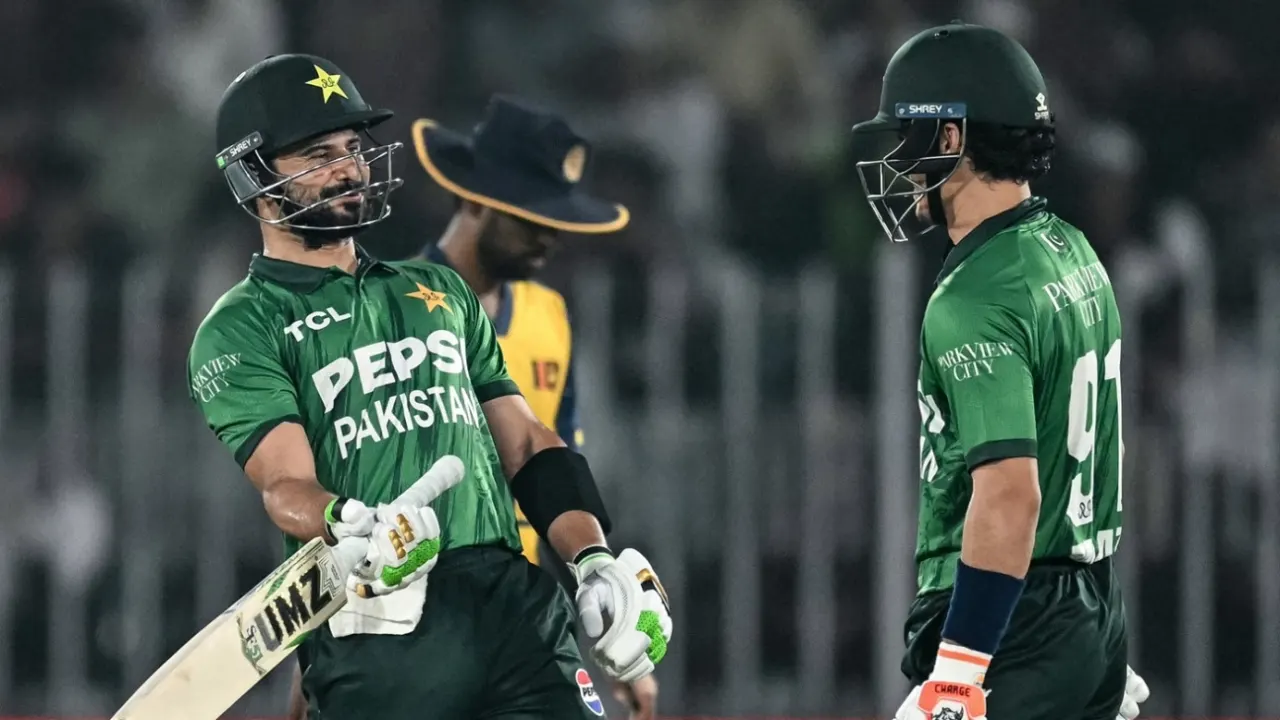
Sahibzada Farhan celebrated his ascension to the captaincy in grand style, smashing a 53-ball 89 that blazed his side to a comprehensive win in the first T20I against Sri Lanka . After Sri Lanka won the toss in Rawalpindi and somewhat curiously opted to set a target, the 182 they put up was made to look inadequate by a bellicose Pakistan’s showing up top that put up 70 in the powerplay and scarcely slowed down after. Maaz Sadaqat, who needed just 28 balls to bring up his half-century, put up a 92-run stand with Farhan after Fakhar Zaman’s cameo up top, flaying a lacklustre bowling attack.
Pakistan’s efforts with the ball were altogether more impressive, if sullied by bursts of untidiness that saw a whopping 29 extras conceded. But they reined Sri Lanka in from time to time, stifling their momentum and keeping the score within chasing range. Mohammad Imran’s 2-21 on debut was the pick of the bowling efforts, and while Lahiru Udara kept Sri Lanka afloat almost single-handedly with 91 off 55, the support he needed from the other end never quite came.
When Sri Lanka batted after winning the toss, it took Kamil Mishara nine deliveries to get off the mark. By the end of the fourth over, Sri Lanka were scoring at a run-a-ball, and had lost two wickets. Pakistan, by contrast, took just 2.2 overs to match that score; by the end of the sixth, they had powered through at dazzling speed thanks to Farhan and Zaman’s onslaught.
Sri Lanka took far too long to begin taking advantage of the powerplay. They struggled to find their timing, the powerplay littered with multiple plays and misses, and extravagant, low-percentage shots that bore no fruit. While they did launch a bit of a recovery in the final two overs, the slow start would end up proving costly as Sri Lanka left runs on the table.
To say Mohammad Imran wasn’t the most exciting debutant from Pakistan this game would be stating the obvious. That title belonged to Razaullah – the fast-bowling, six-hitting, sharp-jawed Edgbaston slayer Razaullah – who appears to have parlayed his stunning Test debut into white-ball call-ups. Imran, who also made his Test debut in that game and ended up being a footnote, instead found his feet in T20I cricket in Rawalpindi today.
Opening the bowling alongside Naseem Shah, he was the more effective bowler, utilizing sideways movement that more than made up for a lack of pace. He conceded just the one run in his opening over and 19 in three powerplay overs. As Sri Lanka found their feet at the halfway stage of the innings, Farhan turned back to him and Imran did not disappoint his captain. He struck with his first delivery upon return and allowed just two in the over, halting Sri Lanka’s momentum once more and capping a stellar debut.
Sri Lanka will want to move quickly on from this game, but to wipe it completely from the record would be a disservice to their opener. Confronted with a decent bowling attack on an off-day for his fellow batters, Udara almost batted through the Sri Lankan innings, playing just about every role a batter can in T20 innings.
He was the flashy starter, before shepherding his side through the early stages of the powerplay. He became an anchor for a bit before churning through the gears in the latter half of the powerplay. At times, he did so with strokes so classical they could be set to music, especially pleasing when he made some room and cleared extra cover off both pace and spin.
While support from Kamindu Mendis and Dasun Shanaka existed, it was fleeting. Soon enough, those wickets would fall, leaving Udara with the delicate dance of keeping the run rate up without letting the innings implode. That was especially true – and shown to be crucial at the death – because Sri Lanka were arguably playing a batter too light. When he finally holed out in the penultimate over, Sri Lanka ended up losing three wickets in five balls, the innings petering out on a surface where batting inadequacy was always going to be punished.
Scores:
Pakistan 187 for 6 in 18.5 overs (Sahibzada Farhan 89, Fakhar Zaman 21, Maaz Sadaqat 50, Khawaja Nafay 12*; Nuwan Thushara 1-32, Dushmantha Chameera 1-40, Eshan Malinga 2-33, Maheesh Theekshanan 2-36) beat Sri Lanka 182 for 8 in 20 overs (Lahiru Udara 91, Kamindu Mendis 23, Dasun Shanaka 18; Naseem Shah 3-36, Mphammad Imran 2-21, Rasaullah 1-29, Shadab Khan 1-33, Saim Ayub 1-17) by 4 wickets
[Cricinfo]
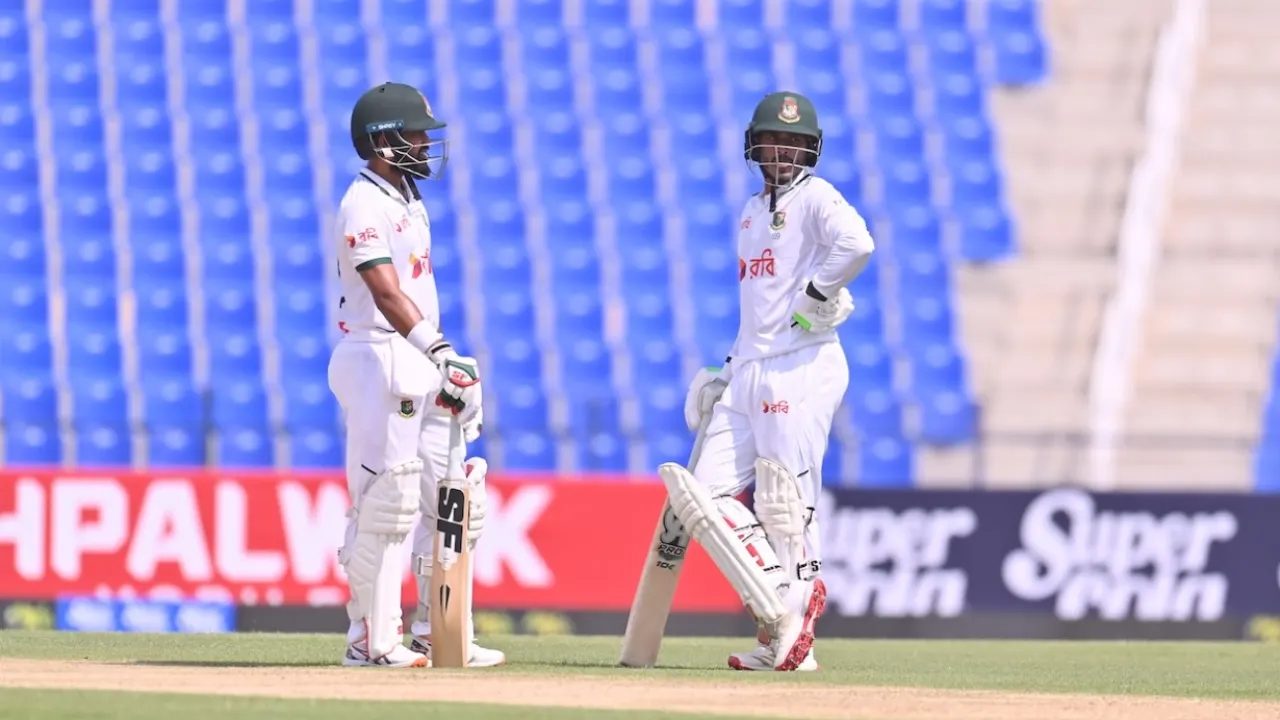
Afghanistan’s pace attack fought back late in the day as Bangladesh went to stumps on 317 for eight on day one in Abu Dhabi.
Mohammad Saleem, Yamin Ahmadzai and Ismat Alam combined to take seven out of the eight wickets that fell on the day. For Bangladesh, Shadman Islam, Tanzid Hassan and Litton Das made fifties.
Saleem targeted the shorter length after lunch, while Ahmadzai found success pitching the ball fuller. Ismat, meanwhile, bowled within himself and was rewarded with the wickets of both set batters Tanzid and Mehidy Hasan Miraz as he drew errors from each.
Tanzid was Bangladesh’s enforcer earlier in the day, hitting eight fours and four sixes in his 71-ball 83 in the first session. He looked set to get to a century in the first session, only for Ismat to thwart his charge.
Later, Shadman Islam and Litton Das struck fifties on either side of Bangladesh’s mini collapse. They lost three wickets for just four runs after they were 221 for two in the second session.
Bangladesh 317 for 8 in 84 overs (Shadman Islam 67, Tanzid Hasan 83, Litton Das 53; Yahmin Ahmadzal 2-62 , Mohmmad Saleem 3-70, Ismat Alam 2-20) vs Afghanistan
[Cricinfo]

Sri Lanka ITEC Alumni Association formally launched

Measures underway to protect Diyagama Forest as a Reserve — Deputy Minister of Environment

Showers or thundershowers will occur in most parts of the island after 1.00 p.m.

NPP govt. reminded of its responsibilities as US warship leaves Colombo

CERT: Beware of foreign Uni. scams on social media

Shiranthi receives treatment at National Eye Hospital

‘Dates have the highest sugar content to fight Coronavirus’

Sunday Island 27 December – Headlines

#SundayIsland 17th December – Headlines

Sunday Island – 28th March

Sunday Island Headlines – 21 March

Sunday Island – 21st February – Headlines
-

 News5 days ago
Geneva takes up Sallay’s case and govt. ignores opportunity to answer accusations
-

 Features6 days ago
The first woman in the foreign service or Ceylon Overseas Service it was then called
-

 News6 days ago
Nearly 20 Iranian tankers stranded off Lanka amid US sanctions
-

 Features4 days ago
Preventing grievances from becoming communal
-

 Sports2 days ago
Nissanka absence opens door for Sri Lanka’s young guns
-

 Features5 days ago
Sri Lanka Cricket Bill: Governance reform is not yet a cricket strategy
-

 News3 days ago
Gnansara Thera to be assigned to prison printing section: Officials
-

 News6 days ago
Lanka enters new phase of prosecutions as hurdles clear