
News
MPs demand probe into COPE Chief’s conduct at meeting with SLC bigwigs

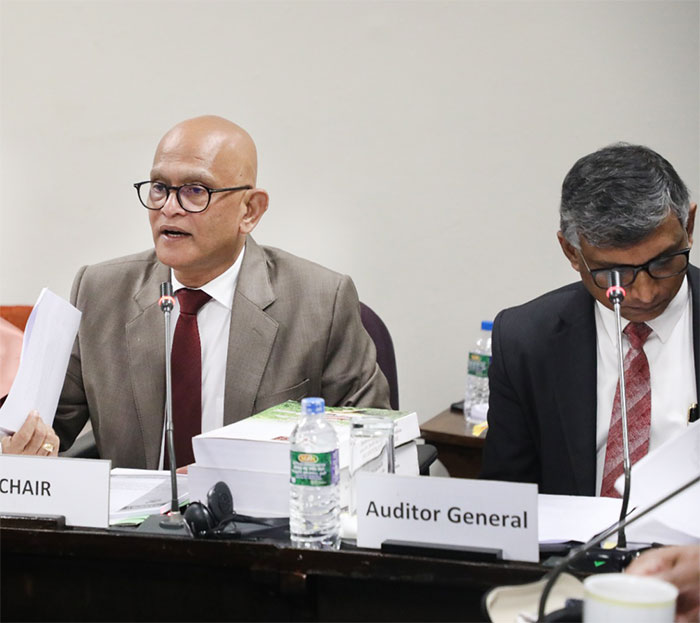
Prof. Bandara denies allegations as baseless
By Saman Indrajith
Opposition and SJB leader Sajith Premadasa yesterday told Parliament that Chairman of the Committee on Public Enterprises (COPE) Prof Ranjith Bandara had tried to cover up Sri Lanka Cricket’s frauds and corruption, during a meeting with SLC officials on Tuesday.
Premadasa said that the video recording of the COPE session on SLC held on Tuesday showed that the COPE Chairman prevented MPs from questioning SLC officials and gave SLC representatives cues to refrain from disclosing some information.
Premadasa urged the Speaker to investigate the matter, pointing out that the actions of the COPE Chairman had violated the rights and privileges of the other members of the COPE Committee.
Premadasa said: “The COPE Chairman used cues to make SLC members skip questions raised by MPs at Tuesday’s meeting. This is clearly visible in the videos that are being circulated via social media,” Premadasa said.
“The COPE Chairman uses his position to manipulate the testimonies by the witnesses at the COPE meetings. He has violated the privileges of not only MPs Hesha Withanage and S.M. Marikkar but also all members of this House. This matter needed to be investigated,” the Opposition Leader said.
SJB MPs Withanage, Marikkar, Chaminda Wijesiri and Nalin Bandara, speaking after the Opposition leader, claimed that the COPE Chairman had acted in a manner that was favourable to the SLC officials and demanded action against him.
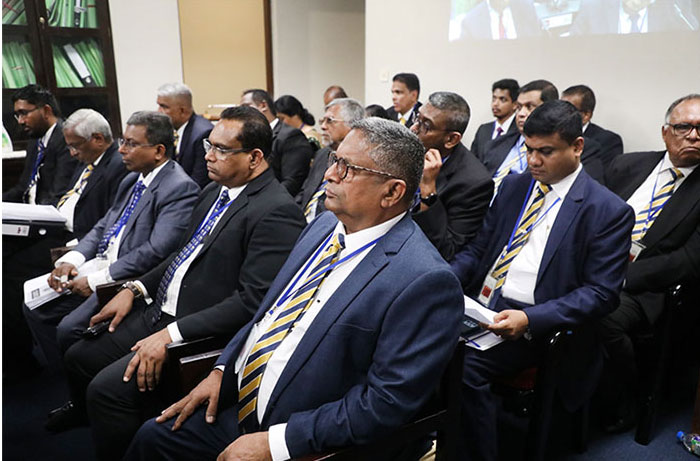
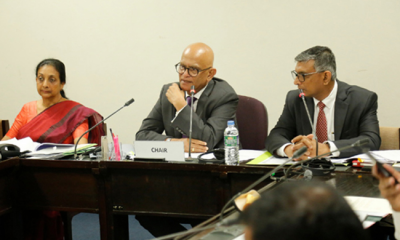
A section of SLC representatives appearing before the parliamentary watchdog committee (pic courtesy parliament)
SJB MP Hesha Vithanage said Prof. Bandara should not be allowed to chair future meetings with SLC. “I request the Speaker to watch the video footage of Tuesday’s COPE session.
MP Marikar said he and some other members of COPE would not attend COPE meetings chaired by Prof. Bandara. “The COPE Chairman is appointed out of all the MPs named to be in that committee. Every member of the committee has a right to ask questions. The incumbent Chairman has not acted impartially. We once asked in writing to summon officials and conduct a probe into a controversial fertilizer shipment, but the Chairman has not complied with our request. We have been asking him to summon the representatives of gas companies and the CPC, but in vain. We make our requests on the basis of the Auditor General’s reports.”
Kuruengala District SJB MP Nalin Bandara said that the video showing COPE Chairman’s conduct had gone viral on the Internet. “The COPE Chairman on Tuesday used his powers to prevent the MPs from raising questions. He should be removed immediately,” MP Bandara said. “We may need another committee to probe the conduct of the COPE Chairman.”
SJB Badulla District MP Chaminda Wijesiri accused Prof Bandara of violating the privileges of COPE members. “The COPE Chairman could be dealt with under Section 18 of the Privileges Act. As per this Act, the Speaker is empowered to take actions in respect of matters of this nature. The Speaker can remove the COPE Chairman and get the committee to elect a new head,” MP Wijesiri said.
Government MP Premnath C Dolawatte, too, spoke in favour of the Opposition MPs’ proposal. He said the government wil not object if the Opposition MPs move a motion to remove the incumbent COPE Chairman. I, too, saw the video and it is clear that the concerns raised by the Opposition MPs are genuine. The incumbent Chairman could be suspended for the probe to be conducted on Nov 27, 28 and 29,”MP Dolawatte said.
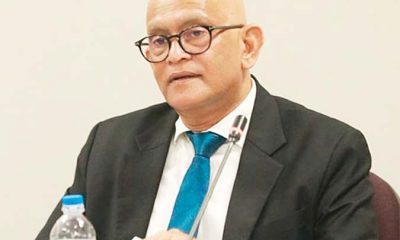
Chairman Prof Ranjith Bandara denied the allegations. He insisted that he had only signalled them to speak one at a time. He said that the COPE needed to function independently without political interference and accused the Opposition members of trying to politicise the probe.








[Prime Minister’s Media Division]
[Prime Minister’s Media Division]


… warn of dire consequences
A group of trade unions and civil society groups has requested President Anura Kumara Dissanayake to abandon his government’s controversial plan for the proposed tripartite management of the EPF.
The group has told the President: “We strongly object to the government’s plan to transfer the EPF to a tripartite board—jointly promoted by the Employers’ Federation of Ceylon (EFC), International Monetary Fund (IMF) and the International Labour Organisation (ILO)—and to increase the investments of those funds within private equity and debt markets.
“While the EFC and the government jointly project this plan as a ‘modern governance framework’, it poses a serious threat to the EPF’s financial stability, fiduciary conduct, and returns to workers’ life savings, with severe consequences for broader macroeconomic stability. Rather than replacing the corruption existing in the public sector, this tripartite framework paves the way for a corporate takeover of the EPF. Through this, the fund is exposed to unlawful business practices such as insider trading using internal information of EPF investments, conflicts of interest and corporate bailouts of unstable private companies.
“Sri Lanka’s corporate sector has a tremendously negative track record, which you alluded to during your victorious election campaign in 2024. This was recently unravelled by the multi-billion-dollar illicit capital flight through trade misinvoicing, which your administration is now actively working to curb in the imports sector.
“The recent banking sector fraud exceeds Rs. 13 billion; widespread corporate tax evasion destabilised the fiscal position (Sri Lanka Auditor General’s Department Annual Reports) and consequently inflated the tax burden on the general public. The EFC has found it convenient to remain silent about these crimes, possibly assuming that their silence would preserve their social standing. Considering this inherent corruption within Sri Lanka’s corporate sector and its disregard to the living standards of the general public, there is no realistic basis to integrate corporate interests to actively manage the EPF. The corporate sector of Sri Lanka has not developed sufficiently on technical and ethical grounds to safely entrust the largest retirement savings pool in the country. The EPF is a captive fund that has no mechanism for the owners to divest if the management is corrupt. This further increases the possibility of corporate fraud when the management of the fund is jointly held with the corporate sector.
“Furthermore, during the recent public discussion with trade unions, Deputy Minister of Finance Dr. Anila Jayantha pointed out that the domestic debt restructuring (DDR) would inflict a loss of Rs. 600 billion to the EPF. Our independent calculations—formally submitted as an affidavit to the Supreme Court approved by the Federation of University Teachers’ Associations in 2024—reveal that nominal loss alone is Rs. 634.4 billion. When factoring in foreclosed reinvestment returns, the true loss skyrockets to Rs. 1,711 billion, wiping out 48% of the fund’s projected gross income for the 2023 – 2028 period. Under the pretext of safeguarding the banking system, this colossal robbery preserved high yields on government bonds held by commercial banks and high-net-worth individuals, subsequently reaping them astronomical profits. Now, the exact same plunder is rearing its head again disguised as a tripartite committee.”
“The main arguments supporting our resistance and viable alternatives for optimising EPF management directly under the Central Bank of Sri Lanka (CBSL), are outlined below.
“Objections to the government’s tripartite proposal:
1. The “International best practice and conflict of interest fallacies”
The government holds that tripartite management of pension funds is the “international best practice” and that there is a “conflict of interest” in CBSL managing the EPF. They are key pillars justifying government’s tripartite proposal.
These two positions are shockingly misleading given that four of the five largest pension funds in the world, in Norway, Japan, the U.S., and Singapore, are managed directly by state bodies or central banks. Therefore, ‘international best practice’ in pension fund management is the exact opposite of what the government and the IMF are proposing. We hence reject these baseless positions.
2. Corporate captivity and bailouts
It is clear that the EFC is desperately pushing for this proposal at a time of global uncertainty, to cushion the effects of the crisis and maximise gains. Under corporate influence within the proposed tripartite board, the private conglomerates can use the multi-trillion-rupee EPF to continue their unstable commercial operations without having to risk their own capital or savings to do so. This will severely erode the financial stability of the EPF and its returns.
3. Risk of front running
“Because the EPF is a colossal fund, its investment decisions can alter asset prices. This creates immense monetary value for the information generated by its investment decisions. Corporate representatives on the proposed tripartite board will be perfectly positioned to use this information to trade ahead of the EPF (front-running), buying assets cheaply and dumping them onto the EPF at inflated prices for guaranteed corporate gain, resulting in a reduction of returns to the EPF.
4. Unavoidable loopholes
“Presence of a separate group of investment analysts, trade union representatives and government officials within the proposed tripartite structure cannot prevent pre-market corporate access to EPF’s investment decisions. Investment proposals made by the analysts has to be first approved by the proposed tripartite committee, making it impossible to prevent corporate access to insider information on EPF investments.”

Ambassador of the UAE to Sri Lanka meets with the Prime Minister

EU rejects Trump’s diesel demand amid Iran war shortages

Sineth Jayawardena, Vijayakanth Viyaskanth in Sri Lanka squad for Pakistan T20Is

Bronze at stake as Bangladesh, Sri Lanka look to bring cheer to Asian Games contingents

Wanderers to host 2027 men’s ODI World Cup final as well as India vs Pakistan

Prime Minister joins Gandhi Jayanti Commemoration

‘Dates have the highest sugar content to fight Coronavirus’

Sunday Island 27 December – Headlines

#SundayIsland 17th December – Headlines

Sunday Island – 28th March

Sunday Island Headlines – 21 March

Sunday Island – 21st February – Headlines
-

 Editorial7 days ago
Birth of a bad law
-

 News5 days ago
Police remove Thileepan statue in Jaffna
-

 News7 days ago
TIN mandatory for key transactions from Nov. 1
-

 Features5 days ago
The 22nd Amendment, constitutional recovery and illiberal slippage
-

 Features5 days ago
Of foreigners as CEOs of Lankan ventures
-

 Latest News3 days ago
Gold winner Tharanga gets brand-new Honda Vezel from SLAAJ
-

 News5 days ago
Sajith rejects Jt. Opp. protest sabotage claim; SJB TU chief demands remedial action
-

 Features4 days ago
Thailand’s biggest new global star …