
Opinion
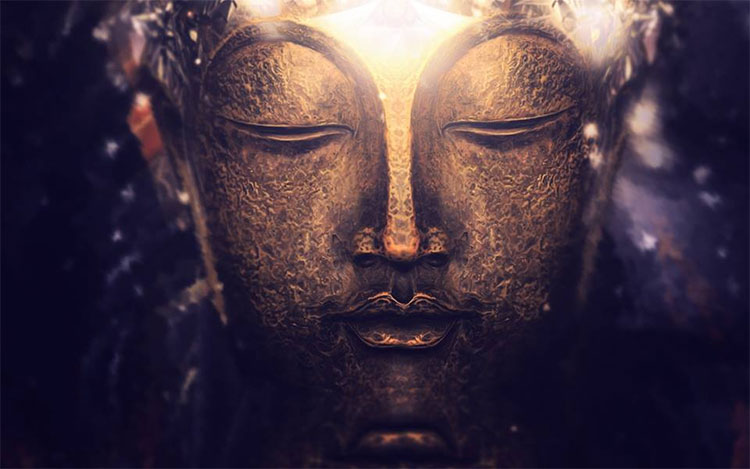
Morality and ethics in Buddhism

By Dr. Justice Chandradasa Nanayakkara
The decline in moral and ethical values is a global phenomenon. The erosion of moral values has become a very disturbing feature in our society. We live in a hedonistic materialistic world in which the acquisition of material possessions and otherworldly things takes pride of place over pursuing ethical and spiritual values. Society today is wreaked by violence and other heinous crimes. Crimes such as murder, sexual harassment, drug addiction, theft, and corruption have become the order of the day. Great moral and ethical values that existed in traditional Buddhist societies seem to have been replaced by selfish motives and egoistic drives of human beings. People’s insatiable avarice and greed have eroded time-honoured ethics and moral values. They have little concern for spiritual and ethical values. The world has become so competitive that people have the audacity to lie, cheat, and bribe to get what they want. Even people in leadership positions lack integrity and lie and distort the truth for the purpose of achieving their objectives. Moreover, indiscipline on the road is worsening by the day. As a result. driving on our roads has become a stressful experience.
It goes without saying, that the decline of moral and ethical values is bound to impact negatively modern society and impede its progress destroying everything in a nation. Today, a lack of moral and ethical values can be seen in every sphere of life in our society. It is an objective reality that no one can deny. Most of the problems that society experiences today can be attributed to the non-observance of good moral and ethical principles. It is by the standards of morality that people maintain that the fabric of any society can be held together.
Moral values are standards by which we distinguish between right and wrong, good and evil. Many people use the words morality and ethics interchangeably. Like morality, ethics is basically concerned with what is right or wrong in human conduct. Ethics and morality play a crucial role in guiding people to live a harmonious life and how to interact with each other. Ethical and moral principles guide people’s behaviour, decisions, and actions. Throughout human history, moral and ethical values have always been important for interfaith harmony, peace, and progress. Both ethics and morality help you to abandon the distorted projections that our thoughts and emotions create and also to promote collaboration and community existence. But ethics should not be identified only with religion, as ethics can apply even to an atheist. Religion is the basis for morality and it is the religion that can set high standards and provide intense motivation for ethical behaviour. Most of the ethical and moral values that people observe today are those preached by the founders of dominant religions in the world. In essence, morality is a practice that maintains your status as a decent human being.
Buddhism upholds lofty and demanding moral and ethical values in many of its scriptures and codes of precepts. Buddha declared in many of his discourses that true happiness could only be realised by leading a life of moral rectitude or virtue.
The five precepts in Buddhism, which are known as Pancasila in Pali and Sanskrit constitute the minimal standard of morality that Buddhists are expected to observe in their day-to-day lives. They represent Buddhism’s core values, which can be followed not only by Buddhists but also by people belonging to other religious persuasions. The precepts are of normative character They are analogous to the spirit of the Ten Commandments of Christianity and the codes of conduct of many other religions. Unlike the Ten Commandments precepts are accepted voluntarily by the person himself, as undertakings rather than commandments enforced by divine authority. Precepts are forms of restraint on our conduct formulated in negative terms. They are guides to help follow the path to enlightenment., and accumulate good kamma. Morality in Buddhism is essentially practical in that it is only a means leading to the final goal of ultimate happiness. The five precepts as a disciplinary code enable laymen to live a virtuous and noble life without renouncing worldly life.
In Buddhism, the quality of any act depends on the intention of the person who commits it. If a person performs an action out of greed, hatred, and delusion his action is considered to be unwholesome. Therefore, in the practice of the five precepts underlying intention with which one practices it would be important. Consciousness is considered the forerunner of our actions.
Dhammapada states, “Mind is the forerunner of all things, mind is their leader; they are made by the mind. When someone speaks or acts with impure thoughts, suffering follows, like the wheel follows the hoof of the ox.”
The morality of buddhism that Buddha propounded thousands of years ago offers timeless wisdom that resonates just as much today. By following the basic principles of morality, we can prevent destructive unwholesome, and negative emotions from taking hold and maintain inner peace regardless of the problems we face today.
The objective of Buddhist morality (sila) is to eliminate crude passions that are expressed through thought, word, and deed. It is by these three means a person’s morality is measured. Therefore, as Buddhists, we are expected to examine regularly whether or not what we think, do, and say causes harm to ourselves and others. This is known as training in virtue (sila sikka).
The three factors of the noble eightfold path form the Buddhist code of conduct.(sila). They are right speech, right action, and right livelihood. Observance of the five precepts is considered the stepping stone for the cultivation of higher virtues and mental development.
The Five Precepts also embody the spirit of fundamental human rights that are of universal nature. The extent to which people observe the Five Precepts differs from person to person, from society to society, and from country to country. According to Buddhism, living a life in violation of the precepts is believed to lead to rebirth in an unhappy destination. The five precepts form the part of eight precepts that Buddhists observe particularly on poya days.
Morality ( Sila ) as the most important step on the spiritual path contributes to harmonious and peaceful co-existence among diverse communities. In a society where morality prevails members are conscious of their respective roles and duties essential for mutual trust and security, leading to the prosperity and progress of society. Non-adherence to principles of morality can often bring about unrest and turmoil in a country.
Morality (Sila) is closely related to the practice of mindfulness (sati) High morality requires a high degree of mindfulness to continuously monitor the mind, speech, and actions.
Therefore, the whole teaching of Buddhist morality can be summed by one stanza. ” Sabbapapassa akaranam, kusalassa upasampada, sacittapriyodapaanam, etam Buddhana sasanam.” Abandoning what is evil, cultivating what is good, purifying one’s mind, that is the teaching of the Buddhas.”.
Core principles of buddhism focus on how to live a virtuous life by practicing self-control and letting off destructive emotions like anger and other three unwholesome roots. This enables adherents to gain an objective perspective and tranquility in the face of many problems in life.
A life grounded in morality is always free from mental restlessness, turmoil, and anxiety. Observing the Five precepts has been shown to buffer the effects of perceived stress on depression. It is believed that people with high levels of observing the five precepts in their day-to-day lives would be less likely to develop depressive symptoms (Wongpakran). Moreover, the five precepts along with the triple gem are the required conditions for the practice of buddhism and the formal initiation to become a Buddhist. The Buddhists normally remind themselves of their commitment to keeping these precepts by observing them at least once a day.
By the first precept, we undertake to refrain from taking the life of a living being. it is based on the belief that all life is precious and sacred. Aiding and abetting someone to kill a living being is no different from killing yourself. It is a commitment to non-violence and compassion for living beings and is not limited to human beings but extends to all sentient beings. It presupposes that all life is interconnected and any harm done to a living being can have an impact on the ecosystem. It encompasses a wide range of acts such as violence, murder capital punishment, and disapproval of abortion, euthanasia, and suicide.
By the second precept, we undertake to refrain from taking what is not given. It underscores the respect for the rights of others. It signifies an individual right to possession as well as the protection of wealth rightly acquired. It encompasses acts such as deception, coercion, misappropriation, and exploiting another’s vulnerability. The precept promotes fairness integrity and respect for others’ property.
By the third precept, we undertake to refrain from sexual misconduct that causes harm and distress to others. It includes actions like adultery and sexual exploitation. Sexual misconduct stems from sensory desire. Rape, prostitution, incest, bigamy, and seduction are all violations of this precept.
By the fourth Precept, we undertake to abstain from falsehood and to speak the truth. The Precept covers such acts as tale-bearing, harsh and abusive speech, idle chatter, vain talk, and gossip which brings about discord and disharmony between families, friends even nations. Observance of this precept is conducive to concord harmony.
By the fifth precept, we undertake not to consume alcoholic drinks and other stimuli that cause loss of conscience. Substances like marijuana, opium, and morphine heroin come under this precept. People tend to think taking a drink once in a way is not harmful, but the real problem is what they do when they are under the influence of alcohol. When a person is under the influence of liquor he is no longer in full control of his mental faculties. Because of that, he would do things that he would never otherwise do. The breach of this precept leads to the degradation of the individual, disruption of the family life, and the degeneration of society.










Beyond hype and headlines:
Media Sensationalism,Hyperbolic Language, and the Fragile Psychology of High-Performance Athletes – From the Cricket Pitch to the Javelin Runway
By a Sporty Enthusiast
When a nation’s heroes and heroines in sport step onto the intensely competitive national and international stage, they carry far more than their sporting attire, athletic gear, and personal ambitions. On their shoulders rests the weight of millions of hopes, hyper-fixated media coverage, and unprecedented national expectations. Yet in modern sport, the boundary between healthy national pride and destructive psychological pressure has become alarmingly thin.
High-performance athletes often operate on extremely fragile mental ground, are exposed to continuous public scrutiny, subject to unyielding media hype, and even volatile public commentary. In Sri Lanka, where sport, particularly cricket and track events, is practically elevated to the status of a national religion, this phenomenon has reached a critical juncture that demands urgent re-examination.
The rise and fall of national icons across various disciplines reveals a troubling cycle. When an athlete or a team achieves a sensational performance, the media creates a frenzy of adulation and then the public demands continuous perfection. Then, at the first sign of human vulnerability, accolades turn into brutal criticism.
To build a sustainable, world-class athletic culture in Sri Lanka, we must dismantle this toxic cycle. We must temper sensationalist reporting, eliminate violent and hyperbolic terminology from sports discourse, integrate professional Sports Medicine and Sports Psychology into athlete care, and recognise that failures are not national disgraces, but the indispensable stepping stones toward true athletic greatness.
The Double-Edged Sword of Media Hype: Lessons from Sri Lankan Cricket
There is perhaps no clearer illustration of the volatile relationship between media hype and performance pressure than the experiences of the Sri Lankan Men’s and Women’s National Cricket Teams. For decades, cricket has been the epicentre of Sri Lankan sporting identity. However, the relentless media spotlight on these teams has created a high-pressure crucible-type environment where players are subjected to extreme emotional swings. A victory is met with extravagant headlines, parades, and declarations of undisputed dominance; conversely, a defeat triggers public inquests, powerful vitriolic criticism, and extremely harsh media condemnations. Add to this challenge the ubiquitous social media, which can be totally heartless, and the picture becomes even more gloomy and even more powerfully destructive.
This culture of extreme publicity and hype places an unbearable burden on both veteran players and young talents entering the national sports system. When a young batter or bowler scores a brilliant century or takes a match-winning haul, he or she is instantly anointed as the next national saviour. Yet, cricket is inherently a game of fine margins and unpredictable conditions. When form inevitably fluctuates, as it does for even the greatest legends of the game, the very media outlets that elevated these athletes to deity status often lead the charge in pulling them down.
Our Women’s Cricket Team, which has made remarkable strides on the global stage in recent years through sheer grit and resilience, now faces a similar peril. As their profile rises and international victories mount, the general public’s attention on them has intensified. While recognition and equitable coverage are vital and long overdue, the accompanying hyper-fixation risks creating the same pressure-cooker environment that has long plagued the men’s game.
A case in point is the banner headline on the Sports Page of a national daily (Not The Island Newspaper) published on the morning of 22nd September 2026, when the Sri Lanka-India Final of the Asia Cup T20 was to be played in Japan. The two teams had met less than 10 days ago in the Asia Cup Final in Dubai, and India won it easily. For the T20 Final on the 22nd of September, too, we were meeting a very strong Indian team performing superbly well. To make matters worse, two of our really good players were sidelined with injuries. The banner headline of the newspaper alluded to above, screamed on the 2nd of September 2026, “History to repeat or rewrite today in Japan.” The mental pressure that would have been inflicted by that headline on our team is indescribable. A much more encouraging line would have been “Go for it, Girls: We believe in you.” India became the champions with a stellar performance by midday in Sri Lankan time. The very same newspaper, in its sports page on the very next day, reported in banner headlines that Sri Lanka was “thrashed” by India. I do hope the readers would understand what I am pointing to. Our girls would have been heartbroken at the loss to India, and the newspaper goes and rubs salt into the wound.
When media narrative shifts from constructiveness to hysteria, athletes begin playing and trying to perform out of fear: the fear of failure, fear of public humiliation, and fear of media backlash. Playing out of fear is the absolute antithesis of elite athletic performance. When a narrative shifts from constructive analysis to sensational hysteria, athletes stop playing to win and start competing out of fear. Fear is the ultimate enemy of elite performance.
Sensationalism and the Language of Excess: Unpacking Sports Terminology
A central contributor to this unhealthy atmosphere is the vocabulary employed by sports journalists, commentators, and headline writers. In the competitive race for clicks, clichés, television ratings, and newspaper sales, sports reporting has increasingly adopted violent, destructive, and aggressive language. Headlines routinely declare that one team has “thrashed,” “annihilated,” “demolished,” or “overwhelmed” another. Such terminology is not only inappropriate for describing sporting contests, but it is also fundamentally intellectually dishonest and psychologically damaging. It must be pointed out that the very same team or the player who was at the receiving end of such vitriolic comments may turn around and produce a scintillating and victorious performance in the very near future. The fundamental truth of athletic competition is that those who “thrash” an opponent today may well find themselves on the receiving end of a bitter defeat tomorrow. High-performance sport is fluid; conditions change, opponents adapt, and physical capacity fluctuates, a set of variables that ultimately determine the outcome.
When headlines use words like “annihilated,” they inflict deep psychological wounds on losing teams and losing players, only to instil an unwarranted sense of invincibility in winners. For the defeated athlete, reading that they were “demolished” deepens feelings of shame and embarrassment, making psychological recovery infinitely more difficult. For the victor, hyperbolic praise creates an unsustainable baseline of expectation that makes subsequent performance drop-offs feel catastrophic. Responsible sports journalism requires precision, respect, and restraint. Describing a match through technical accuracy, focusing on tactical execution, physical endurance, and strategic decisions, elevates the reader’s understanding without degrading the dignity of the competitors.
Sports are meant to celebrate human physical excellence, discipline, tactical skill, and camaraderie. Describing a match with terms borrowed from warfare reduces a nuanced athletic competition to a spectacle of subjugation. Furthermore, this language fails to account for the cyclical nature of elite sport.
Protecting Our Gems: The Case of Rumesh Tharanga Pathirage
This tendency toward excessive hype is currently playing out in real time with Sri Lanka’s latest athletic sensation, Rumesh Tharanga Pathirage. As a champion javelin thrower, Pathirage has demonstrated world-class technique, phenomenal physical power, and an extraordinary capacity for international competition. He represents a really magnificent gem in the future of Sri Lankan athletics, possessing the talent and discipline required to compete at the absolute highest levels of track and field.
Predictably, the media machine has begun to spin rather spectacularly around him. Rumesh has quickly become the new darling of national sports pages and television sports segments. While celebrating his achievements is entirely and utterly justified, there is an urgent need to caution against making an overwhelming “song and dance” around his every movement. Converting an intensely promising young athlete into an overnight national messiah places an unnecessary psychological burden on his shoulders just as he enters the most delicate phase of his elite career development.
Javelin throwing, like all technical field events, requires precise biomechanics, intense nervous system focus, and long-term physical conditioning. It is a discipline where fractions of a second in release timing can mean the difference between a podium finish and a modest throw. What Rumesh Tharanga Pathirage needs right now is not relentless media circuses, commercial distractions, and lofty public demands for instant Olympic medals. Instead, he requires a quiet, structured, and fully funded support ecosystem that allows him to train without distraction, refine his technique under intense specialised guidance, and build physical and mental resilience over time.
The Imperative of Science: Sports Physicians and Sports Psychologists
If we are to be serious about sustaining elite athletic performance and protecting the well-being of our athletes, Sri Lanka must modernise its sporting infrastructure by prioritising two essential fields: Sports Medicine and Sports Psychology. Historically, sports administration in developing nations has treated these disciplines as secondary luxuries rather than non-negotiable fundamentals. This outdated perspective must change.
A qualified Sports Physician is far more than a medical doctor who treats injuries after they occur. They are medically trained experts in exercise physiology, injury prevention, biomechanics, recovery science, and clinical nutrition. They are most definitely not Glorified Physiotherapists, although physiotherapy is an essential component of an athletic training programme. Elite modern sports demand that the human body to perform at its absolute physical limit. Without dedicated and extensively trained Medical Sports Physicians managing physical workloads, monitoring overtraining syndromes, and designing individual recovery protocols, athletes are exposed even to career-ending injuries and physical burnout. Treating an international athlete’s body without specialised medical oversight is akin to driving a Formula 1 car without a team of extremely competent mechanical engineers.
Equally critical, and often even more neglected, is the role of the qualified Sports Psychologist. The mental strain under which international athletes operate is absolutely immense. They have to cope with performance anxiety, fear of failure, recovery from traumatic injury, public criticism, media pressure, and the personal sacrifices required by elite training schedules. A qualified Sports Psychologist works proactively with athletes to build cognitive resilience, develop emotional regulation techniques, enhance focus under pressure, and construct healthy self-identities independent of competitive outcomes.
Mental toughness is not an innate trait that an athlete either possesses or lacks; it is a psychological skill set that must be systematically as well as studiously developed, trained, maintained, and nurtured. Expecting athletes to endure immense public pressure through sheer willpower alone is naive and negligent. Integrating specially trained mental health professionals into every national squad is an essential duty of care that national sporting bodies owe to their performers. Mental toughness is a trainable science, not an innate miracle.
Redefining Failure: The True Path to Greatness
To foster a healthier sporting culture, society as a whole must undergo a fundamental shift in how it views athletic failure. In Sri Lankan sports culture, failure is too frequently treated as an unforgivable defect or a national disgrace. In reality, failure is an indispensable structural element of true athletic excellence. The much-bandied adage that “failures are the pillars of success” is not merely a cliché; it is a proven historical reality observed in every legendary sporting career.
Consider the career of Usain Bolt, universally acknowledged as the greatest sprinter in human history. To the casual observer, Bolt’s career appears to be an uninterrupted chain of golden glory. However, the path to his transcendent dominance was paved with repeated setbacks, physical injuries, and international defeats. Before he ever won his first Olympic Gold medal in Beijing in 2008, Bolt suffered around 13 high-profile losses in international events. Early in his career, at the 2004 Athens Olympics, a young Bolt was eliminated in the very first round of the 200-metre sprint event due to a hamstring injury. He faced severe criticism from domestic fans and media who questioned his big-stage composure.
Had Usain Bolt broken under the weight of those early failures and the accompanying media criticism, world sport would have been deprived of one of its greatest icons. Instead, supported by a structured coaching system, medical care, and psychological fortitude, Bolt used those 13 international defeats as diagnostic tools. He analysed his technique, improved his physical strength, refined his mental preparation, and eventually emerged to secure 8 Olympic Gold medals and establish 3 World Records that still stand untouched today. Failure was not the opposite of Bolt’s success; it was the raw material from which his success was forged and the golden thread that was used to weave an amazing tapestry of an unmatched sporting career.
Rewards, Support, and the Way Forward
None of this suggests that athletic success should go unrecognised. That is as far away as one could get from it. When our sportspersons achieve spectacular victories on the continental or global stage, rewarding them with financial security, national honours, and public recognition is entirely fitting and absolutely necessary. Rewards provide tangible validation for years of unseen sacrifice and inspire the next generation of youth to pursue athletic excellence.
However, rewards must be accompanied by sustainable structural support. Financial compensation after a medal win cannot compensate for a lack of professional coaching, inadequate medical infrastructure, or absent psychological support during the years leading up to that victory. We must invest in the process, not merely celebrate the result. As that great actor Tom Cruise once said, “Success is rarely achieved overnight. Behind every achievement are years of dedication, persistence, setbacks, and continuous learning. People celebrate the final result, but they may not always see the effort, sacrifices and determination that made it all possible.”
For national heroes like Rumesh Tharanga Pathirage, our cricket teams, and emerging athletes across all sporting disciplines, the message must be crystal clear: the nation stands behind you not because you are invincible, but because you represent the best of our national effort. The media must commit towards balanced, constructive, and dignified reporting, abandoning violent headlines and hyperbolic worship. Sporting administrators, in addition to everything else they are supposed to do, must invest in qualified Sports Physicians and Sports Psychologists as mandatory pillars of athlete development. As fans, we must learn to celebrate victories with humility, accept defeats with empathy, and understand that every great champion must first master the art of standing up after a fall before he or she can soar to even greater heights.
Appreciation
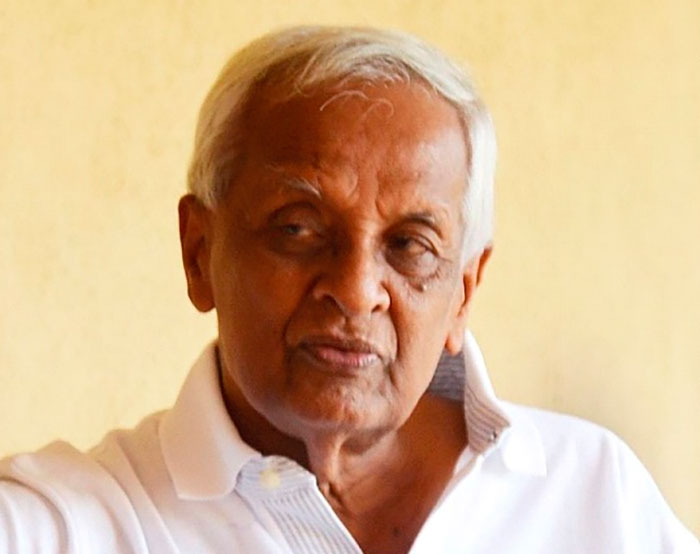
R. S. (Siri) Palihawadana received his early education at the school now known as Malimbada North Maha Vidyalaya. The school was founded by Siri’s father, D. C. Palihawadana, on a plot of land donated by him, and Siri was the first student entered in its student register.
Siri entered Kotte Ananda Shasthralaya in 1940 and continued his education there until 1949. In 1950, he entered Ananda College, Colombo, to sit the Advanced Level examination. He later obtained an Honours Degree in Economics from the University of London.
During his distinguished career, he served as Chief Accountant and Business Manager of the Ceylon Plywood Corporation, Director of Investments at the Greater Colombo Economic Commission (now the Board of Investment of Sri Lanka), Deputy Executive Director of the Sri Lanka Centre for Business Development, Consultant to the World Institute for Development Economics Research in Finland, and Director of a professional services and consultancy firm.
On days when Siri had to work until very late at the Greater Colombo Economic Commission, his driver would drop him home in his official car. Siri would then get into his own car and drive the driver all the way back to his home in Homagama, even in the dead of night. Such was his sense of responsibility and integrity. On these occasions, Dr. Adikaram would ask me to accompany Siri, in case of an emergency such as a flat tyre.
It is said that to be universally interesting, one has to be universally interested. Siri was just such a person. He was an award-winning orchid grower and a key member of the well-known cooperative orchid nursery and florist, Lakmalsala. He had a deep interest in organic farming and freely shared his knowledge and advice with many budding organic farmers.
Siri was also an enthusiastic photographer during the era of black-and-white film photography and had his own darkroom where he developed his photographs. He took a keen interest in the socio-economic developments taking place in Sri Lanka and served as the Honorary Treasurer of the Dr. E. W. Adikaram Foundation. I also had many illuminating discussions with Siri on the teachings of J. Krishnamurti.
From 1945 to 1975, Siri Palihawadana lived in the house on Pagoda Road, where Dr. E. W. Adikaram also resided. In 1975, a large jak tree fell onto the house, rendering it unfit for further occupation.
Siri subsequently built a new house on Mirihana Road in the remarkably short period of about four months and moved there with Dr. Adikaram. Until the new house was completed, Dr. Adikaram and the Palihawadana family stayed at the residence of Professor Mahinda Palihawadana on Pamunuwa Road, Maharagama.
Dr. Adikaram lived in Siri Palihawadana’s Mirihana Road home from 1975 until his death in 1985. Siri and his wife, Lakshmi, cared for Dr. Adikaram with great love, affection and devotion, treating him with the same respect and care they would have given to their own father.
Siri Palihawadana will be remembered not only for his distinguished professional career, but also for his integrity, generosity, wide-ranging interests and deep concern for the welfare of others.
Ravi Palihawadana
A monk’s four days in Jaffna, another monk’s restored prison term, and a party visit to Delhi are one argument: trust follows conduct, and the North will not be healed by a file.
By Mahil Dole
Senior Superintendent of Police (Retd.)
The sea, the monk writes, brings us all sorts of things. One slipper arrived five days after the other, and he was wearing the pair. It is a small opening for a large account, and it is the right one. What Ven. Dhammananda Thero brought back from four days at Thapovanam, an ashram beside a lagoon in Allaippiddi, is not a matched set of slogans. It is two things that arrived separately and only make sense together: an extraordinary welcome, and a street that would not smile.
I write this as a Muslim, and I write it as a citizen. I served this country in law enforcement and in intelligence, with the duty of keeping the peace, the security and the sovereignty of the republic. For service in the operational districts I was awarded the Purna Bhumi Padakkama. I do not mention the medal to decorate a paragraph. I mention it so that what follows is not mistaken for a petition from outside the state. The North and East are not a foreign file to me. They are districts in which I served, and people among whom the peace of this country is either kept or lost.
I know the difference between a communiqué and a witness. The piece published by the Walpola Rahula Institute on 20 September 2026 is a witness. From dawn on 22 August until the night of 25 August, a Buddhist monk stayed with Professor Daya Somasundaram, formerly Professor of Psychiatry at the University of Jaffna, in a fishing village the war emptied more than once. He peeled onions. He sat mindfulness with Sinhala, Tamil and Muslim medical students. He chanted the Karaniya Metta Sutta while a former combatant’s lotus seeds went into a pond. On the last day, at Tellippalai, he met faces of unease, dislike and rejection, and was told why. That sequence is what we need today. Not another resolution. The action, and the moral sense, of the prelate.
What he showcased was not Buddhism as a heritage claim. It was Buddha Dhamma as conduct, and ahimsa as a method rather than a motto. He left Wellawatte late on 21 August, reached Jaffna at dawn, and was taken by Mariyadas of Batticaloa, who speaks Sinhala, through Mandaitivu and Kayts. The man who opened the gate, bare-chested, in a short sarong, about seventy-five, was the professor. He sleeps on a concrete terrace under a palmyrah slope too small for a night of rain, eats one meal a day, wakes to yoga, and swims in the lagoon for about two hours each afternoon. None of this is theatre. It is the opposite of possession.
Policy makers should not skip what the place actually does. Allaippiddi was forced out more than once. Many lived in the Vanni before they returned. Almost all the men, the monk was told, are heavily addicted to alcohol. Crystal methamphetamine, the drug our streets call ice, is widespread. Domestic violence is extremely high. Some children do not sleep at home. They go to their grandparents to escape the fighting. Surroundings of that kind teach a child that drunkenness is normal, and that a man who does not beat his wife is weak. In the holidays the children come to Thapovanam for drama, dance, music, drawing, karate, swimming and sand sculpture. The characters are animals. The stories are the real problems of the families. Nothing is aimed at an examination. Each child is fed. On 22 August about fifty came. The monk joined the kitchen and chopped some forty onions for a tomato sambol, beside Mariyadas, his wife Tamil Selvi of Mannar, and women of the village. Selvi’s father supported a separate state, and began each child’s name with the word Tamil. On the evening of 25 August, she still knelt, and so did her husband. No communiqué I have sat through has produced a moment of that weight.
A second classroom answers who a Sri Lankan is more honestly than any clause we have drafted. Dr S. Sivadas, once Somasundaram’s student and now a consultant psychiatrist at Jaffna Teaching Hospital, brought medical students to the ashram — Sinhala, Tamil and Muslim, curious about mindfulness. The next day, at the hospital, the monk guided twenty minutes of anapanasati for first-year students of all three communities. They issued no statement. They breathed in the same room. That is a wider definition than the one announced from Colombo: not a bloodline, not a language, not a monument on a contested coast, but a person willing to sit with the other long enough to become real.
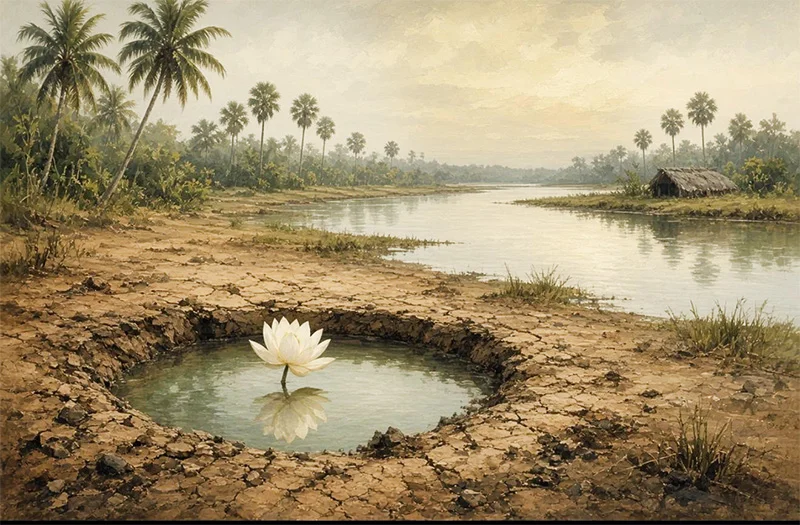
The lotus planting carries the lesson onto scorched ground. The seeds were brought by a former combatant living with post-traumatic stress, who on some nights wakes on the battlefield again. From the bank the monk recited the Karaniya Metta Sutta. He adds what commemorations omit. Former soldiers carry the same nights, known mostly to their families. Ahimsa that cannot see both is not ahimsa.
Then Tellippalai, and the account refuses to flatter us. The town lies about fifteen kilometres from Jaffna, on the road to Kankesanthurai. At midday on 25 August the monk went alone to meet a group of the Chelvanayakam Memorial Trust. At the junction the faces showed unease, dislike and rejection. Not a single smile. Inside, they did not console him. After he left, they said, they too would have to answer the questions people asked. The reason they named was Tissa Raja Maha Vihara, about four kilometres away. Because of that temple, people there have come to see Buddhist monks as persons who arrive to seize land. His sentence belongs in every secretariat and every chapter house. What a terrible misfortune. He asks that it be read by the officers who built the temple, by the monks who live there, and by the lay devotees who travel from Colombo for sil on poya days. The more we try to possess, the more we lose. When we let go, a whole world becomes ours.
The same weeks have given us the opposite conduct, and the country should be made to look at both robes together. Ven. Galagoda Aththe Gnanasara Thero was sentenced in 2018 to an effective six years for contempt of court, over his conduct at the Homagama Magistrate’s Court in 2016 during proceedings on the disappearance of Prageeth Ekneligoda. In May 2019 a presidential pardon released him. On 10 September 2026 the Supreme Court held that pardon unlawful. He did not appear when called on 29 September. An open warrant and a travel ban followed. Police arrested him on 3 October at an aranya in Thiniyawala, Kalutara. Today, 5 October, the Court of Appeal ordered the remaining period of that sentence enforced. A separate warrant had already been issued after he failed to appear in a case concerning an alleged statement insulting Islam.
I am not interested in a further quarrel with the man. I am interested in the robe. The Buddha’s instruction on who may wear it is not obscure. The robe is for a life of restraint, of truthfulness, of harmlessness, and of respect for the discipline that keeps a community from fear. It is not a costume in which to storm a courthouse, to be pardoned out of a sentence, and then to stay away when the highest court restores the sentence. Dhammananda Thero took the night bus to Jaffna, chopped onions, chanted metta over a former fighter’s seeds, and wrote down the street that would not smile. Gnanasara Thero’s recent path was the avoidance of a warrant. One conduct leads human beings towards a peaceful path. The other teaches every community, mine included, to distrust the cloth. Religious leaders who still share a platform with that second example should ask which of the two they are prepared to defend.
This contrast is not a private matter for the Sangha. It lands in the same week in which the North has again become a diplomatic file. Tilvin Silva, general secretary of the Janatha Vimukthi Peramuna and a powerful figure in the ruling National People’s Power, has just concluded a five-day visit to India, from 27 September to 1 October, at the invitation of the Bharatiya Janata Party under its Know BJP programme. He met senior party figures, among them B. L. Santhosh and the BJP’s national president, and on the last morning he met External Affairs Minister S. Jaishankar, who described India as a trusted partner in Sri Lanka’s progress. The shift is real. The JVP was for years sharply critical of India’s stance on devolution. In 2008 Vijitha Herath, now our foreign minister, called Indian ideas on devolution an indirect support to the LTTE ideology, and said no country had a right to interfere in our problem. New Delhi is now courting the party it once found obstructive.
The hope in Delhi, as set out by those watching the visit, is that JVP leaders can be brought to see devolution not as a stepping stone to separation but as a counter to it, and as necessary to the economic progress of the Northern and Eastern provinces. India has pressed for early Provincial Council elections and for the constitutional provisions that meet Tamil aspirations to be made real. Its interest in the North is not sentimental.
It is geopolitical and practical: connectivity, projects such as the Jaffna airport expansion, a shipping link towards Kankesanthurai, and a stable Tamil-majority littoral that does not become anyone else’s lever. That interest is legitimate for a neighbour. It is not a substitute for our own policy.
The stance of our government is the unfinished half of this story. The party that once treated Indian devolution as a foreign design is now the dominant partner in office, and its general secretary has gone to Delhi as a guest of the ruling party there. Cordiality is not a policy.
Colombo has yet to say, in language a villager in Allaippiddi or Tellippalai can test, whether the North and East are to be governed as equal parts of the republic, with elections and a share of development, or managed as a sensitive file between two capitals. Devolution sold only as an answer to separatism will be heard, in the North, as a security device. Devolution refused because a foreign capital favours it will be heard, in Delhi and in Jaffna, as the old refusal. Neither reading builds the confidence the monk found only when he arrived without a claim.
I say this as an officer who spent his service against separatism in arms, and who does not confuse a provincial council with a separate state. The armed challenge to the sovereignty of this country was defeated. What was not defeated was the inference a street draws from conduct. Tellippalai did not close its face because a constitution was incomplete. It closed its face because a temple was read as seizure. Allaippiddi did not open its kitchen because a delegation had been to Delhi. It opened its kitchen because a monk chopped onions and left. India’s diplomatic approach can support ports, power and elections. It cannot supply the trust. That remains a Sri Lankan task, and it will not be performed by a government that is eloquent in New Delhi and silent on the robe that frightens its own citizens.
The eye-opener is therefore for more than one audience. It is for the Buddhist clergy and laity, who have been shown two paths in the same season and must choose which one the robe will mean. It is for the imam, the priest and the Hindu leader who still announce coexistence and rarely cross the village they have stereotyped. It is for a government that can sit with Jaishankar and has not yet sat, in policy, with the meaning of Tellippalai. And it is for Delhi, which is entitled to its interests and not entitled to mistake a party visit for the healing of a province. Trust is an inference from conduct. People who never enter the room can revoke it.
What is required is a team, in little steps, not a new ministry and not a new patron. Somasundaram has made that team for years. Dr Sivadas carried it into a hospital classroom. Mariyadas and Selvi carried it onto a doorstep. A Muslim leader can take students and stay long enough to work. Trustees of a contested site can say plainly what is worshipped and what is not being taken. A government can enforce a court order without selectivity, and can say what it will and will not devolve without waiting to be asked in Delhi. None of this is a giant leap. Giant leaps here have never been legislated. They are the late result of people who refused, in small rooms, to behave as the stereotype predicted.
The hope is real, and conditional. A lotus pond does not cancel a war, and one cold junction is not the North. The space remains large. It closes where we possess, where a robe is worn against the discipline of the robe, and where the North is discussed over our heads. It opens where someone arrives without a claim. Who a Sri Lankan is will not be settled by a gazette, or by a photograph in New Delhi. It will be settled by whether the next visitor to Tellippalai meets a question or a closed face. Little steps of that nature make the leaps of tomorrow. When we let go, a whole world becomes ours. It was true on a pond bank in Allaippiddi. It remains the only terms on which this island will hold.
( This analysis is offered in the interest of national security, institutional reform, and public safety)
Notes
Dhammananda Thero. (2026, September 20). A lotus pond on scorched earth: A few days of healing at Thapovanam. Walpola Rahula Institute.
Court of Appeal order of 5 October 2026 enforcing the remainder of the sentence on Galagoda Aththe Gnanasara Thero, following the Supreme Court ruling of 10 September 2026 that the pardon of 23 May 2019 was unlawful. Arrest reported on 3 October 2026 at Thiniyawala, Kalutara.
Tilvin Silva led a JVP delegation to India from 27 September to 1 October 2026 at the BJP’s invitation under the Know BJP programme, and met External Affairs Minister S. Jaishankar on 1 October. The reading of New Delhi’s hope on devolution follows M. R. Narayan Swamy, “Why India is wooing Sri Lanka’s JVP,” Rediff, 5 October 2026.
The Purna Bhumi Padakkama was awarded to police and service personnel for qualifying service in designated operational districts between 1977 and 2010.
The writer is a retired Senior Superintendent of Police, former head of the counter terrorism desk at the state intelligence service, a former member of the Sri Lanka Wakfs Board, and the author of Security Beyond Enforcement: Practical Approaches for a Safer Nation (2026).

Showers above 75 mm are likely at some places in the Western, Sabaragamuwa, Central, Uva and North-Western provinces and in Galle, Matara, Anuradhapura and Mannar districts.

Iranian ships stranded, Lanka fears US sanctions

Sri Lanka CERT warns of overseas university admission scams

Navi Pillay’s Lankan affairs in focus as she wins 2026 Nobel Peace Prize

Lanka welcomes Indian SC remarks on Katchatheevu dispute

UN at Crossroads, Trump nearing End of the Road

‘Dates have the highest sugar content to fight Coronavirus’

Sunday Island 27 December – Headlines

#SundayIsland 17th December – Headlines

Sunday Island – 28th March

Sunday Island Headlines – 21 March

Sunday Island – 21st February – Headlines
-

 News6 days ago
Geneva takes up Sallay’s case and govt. ignores opportunity to answer accusations
-

 Features5 days ago
Preventing grievances from becoming communal
-

 Features3 days ago
The Sri Lankan who made Scottish history
-

 Sports3 days ago
Nissanka absence opens door for Sri Lanka’s young guns
-

 News4 days ago
Gnansara Thera to be assigned to prison printing section: Officials
-

 Features6 days ago
Sri Lanka Cricket Bill: Governance reform is not yet a cricket strategy
-

 News2 days ago
NDB fraud Rs 60mn more than reported
-

 Features3 days ago
Future of Sri Lanka’s state university system: Should it be shut down and reopened?