
News
Mini Cabinet reshuffle: Ramesh becomes Health Minister

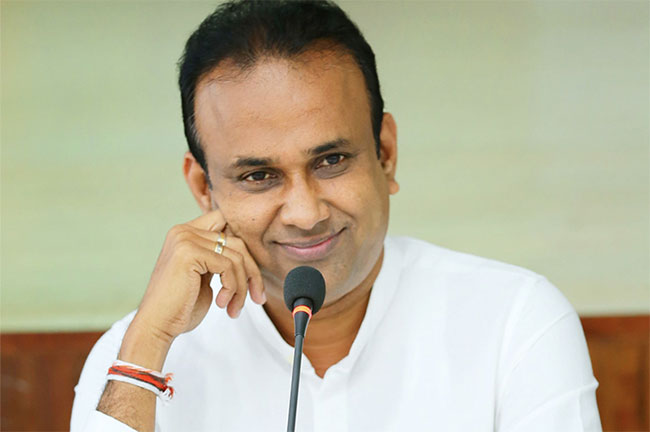
Keheliya gets Environment portfolio
President Ranil Wickremesinghe effected a minor Cabinet reshuffle yesterday.
Dr. Ramesh Pathirana was appointed as the Minister of Health in addition to his portfolio as Minister of Industries and took his oaths before the President at the Presidential Secretariat.
Dr. Pathirana was the Minister of Plantation Industries and Industries previously.
Mahinda Amaraweera was sworn in as the new Minister of Agriculture and Plantation Industries. Former Health Minister Keheliya Rambukwella took oaths as the new Minister of Environment. Ranjith Siyambalapitiya was sworn in as Non-Cabinet Minister of Plantation Enterprises in addition to his current post as State Minister of Finance.

Latest News
Sun directly overhead Cheddikulam, Kebithigollewa, Gomarankadawala and Nilaveli about 12:11 noon. today [12]


On the apparent northward relative motion of the sun, it is going to be directly over the latitudes of Sri Lanka from 05th to 15th of April in this year.
The nearest areas of Sri Lanka over which the sun is overhead today (12th) are Cheddikulam, Kebithigollewa, Gomarankadawala and Nilaveli about 12:11 noon.


The Ceylon Electricity Board (CEB) has directed owners of large-scale rooftop solar systems to temporarily disconnect their installations for a 10-day period beginning from Friday (April 10), citing growing concerns over grid stability amid low electricity demand and high solar generation.
The directive applies to rooftop solar systems exceeding 300 kW capacity, which are required to remain switched off until April 20. The move coincides with the extended holiday season, during which national electricity demand typically declines, alongside prevailing sunny weather conditions that significantly increase solar output.
Senior electrical engineers told The Island that the decision, though exceptional, was necessitated by operational risks posed to the national grid.
“We are seeing a pronounced imbalance between supply and demand,” a senior CEB system control engineer said. “With industries and commercial establishments operating at reduced levels during the holidays, demand drops. At the same time, solar generation remains high, creating excess power that the grid struggles to absorb.”
He explained that such imbalances could lead to fluctuations in system frequency, potentially threatening the stability of the grid. “If generation exceeds demand, frequency rises beyond acceptable limits.
This can trigger automatic protection mechanisms or, in extreme cases, lead to partial outages.”Another senior engineer attached to the transmission division noted that managing distributed solar generation remains a technical challenge.
“Unlike conventional power plants, rooftop solar systems are not centrally dispatchable. We cannot directly control their output in real time. This limits our ability to balance the system during periods of excess generation,” he said.
He added that the country’s grid infrastructure is still adapting to the rapid growth of renewable energy. “We lack sufficient large-scale battery storage and advanced grid management systems to effectively handle these fluctuations. Until such capabilities are enhanced, temporary curtailment becomes necessary.”
Engineers also pointed out that conventional thermal plants cannot be abruptly shut down or adjusted to compensate for sudden surges in solar generation.
“These plants require minimum stable operating levels. When solar floods the grid during low demand, it creates operational constraints that are not easy to manage,” one official said.
The CEB, in its statement, expressed appreciation for the cooperation of solar system owners affected by the measure, stressing that it is a short-term intervention aimed at ensuring uninterrupted and stable electricity supply across the country.
Energy experts say the development underscores the urgent need for grid modernization, including investment in battery energy storage systems, smart grid technologies, and improved demand-side management.
“This is part of the transition challenge,” an independent analyst noted. “As solar penetration increases, the grid must evolve to become more flexible. Otherwise, curtailment will remain a recurring necessity.”
Despite the temporary shutdown, CEB engineers reaffirmed their commitment to expanding renewable energy.
“Solar power is a key pillar of Sri Lanka’s future energy mix,” a senior engineer said. “But integration must be carefully managed. Grid stability cannot be compromised.”
The temporary disconnection order, which took effect yesterday, marks a critical moment in Sri Lanka’s energy transition—highlighting both the progress made in renewable energy adoption and the technical hurdles that remain.
By Ifham Nizam

The cost of preparing a traditional kevili table for the Sinhala and Tamil New Year has risen by 7 per cent in 2026 compared to 2025, according to price data compiled by the Department of Census and Statistics (DCS).
The estimate is based on Open Market Weekly Average Retail Prices in the Colombo District for April 2019 (Week 1), March 2025 (Week 3), and March 2026 (Week 4).
A kevili table, a customary feature of New Year celebrations in Sri Lanka, consists of an assortment of traditional sweetmeats symbolising prosperity and goodwill.
According to the data, prices increased for six of the eight items included in the basket in 2026. The sharpest rise was recorded in aluwa, which surged by 25.8 per cent, driven by a 43.6 per cent increase in cashew prices.
In contrast, the steepest decline was seen in milk rice, which fell by 14.1 per cent, largely due to a 17.5 per cent drop in coconut prices from the elevated levels recorded in 2025.
Overall, the increase in the cost of the 2026 kevili table was mainly driven by higher prices of coconut oil and rice flour, which together accounted for nearly 80 per cent of the total rise.Compared with the pre-crisis year of 2019, the cost of a kevili table has more than doubled, increasing by around 2.5 times in 2026, the data showed.

Sun directly overhead Cheddikulam, Kebithigollewa, Gomarankadawala and Nilaveli about 12:11 noon. today [12]

Peru holds presidential election amid decade of political tumult

CEB orders temporary shutdown of large rooftop solar systems

Cost of Sinhala-Tamil New Year ‘Kevili Table’ up 7% in 2026 – DCS Data

Kiriella calls for court ruling on Easter Attack mastermind

Govt to appoint special Presidential Commission to probe coal deals since 2009

‘Dates have the highest sugar content to fight Coronavirus’

Sunday Island 27 December – Headlines

#SundayIsland 17th December – Headlines

Sunday Island – 28th March

Sunday Island Headlines – 21 March

Sunday Island – 21st February – Headlines
-

 News5 days ago
Lankan-origin actress Subashini found dead in India
-

 News3 days ago
AG: Coal procurement full of irregularities
-

 Business2 days ago
Israeli attack on Lebanon triggers local stock market volatility
-

 Business3 days ago
Hayleys Mobility introduces Premium OMODA C9 PHEV
-

 Business2 days ago
HNB Assurance marks 25 years with strategic transformation to ‘HNB Life’
-

 Sports3 days ago
DS to face St. Anthony’s in ‘Bridges of Brotherhood’ cricket encounter
-

 News4 days ago
AKD admits import of substandard coal, blames technicalities and supplier
-

 News5 days ago
UN Regional Director launches SL’s first Country Gender Equality Profile during official visit