
Sports
Memories down under

by Rex Clementine
There have been some sensational stories coming out of Australia during cricket contests. A recollection of some of them is not a bad idea at a time when the national cricket team is down under.
It is a tradition in Australia after a game for the losing team to visit the winning team and have a beer or just have a chat. This has been a practice that has been in place for decades and once at the SCG when the Sri Lankans were in the Australian dressing room, a message had come through that the Prime Minister of Australia John Howard was coming over to meet them.
As Howard entered the dressing room, straight away the Sri Lankans were on their feet to greet the PM, who was a cricket buff. From a corner someone raised his voice, ‘Hey John, come mate, come. Grab a beer mate!’ It was Matthew Hayden. And he was in his underpants. The Sri Lankans couldn’t believe it. One of them whispered to the team manager, ‘Imagine this happening in our country.’ John Howard did share a beer with the players.
Howard had a 11 year stint as the Australian PM and when he stepped down, there was move to make him the President of International Cricket Council. He had agreed to come on board provided member countries elected him unanimously. Sadly, SLC objected to him becoming the ICC chief on flimsy grounds. What most fans aren’t aware is that India was using SLC as a cat’s paw.
 Several years later, in 2010 Julia Gillard had become the first female Prime Minister of Australia. This was half a century after Sri Lanka had elected a female Prime Minister. Gillard had been born in Wales in the UK before migrating to Australia and she loved her cricket too. She was not in the habit of walking into the dressing room like Howard but invited teams to her residence in Canberra for tea. The Sri Lankan team were her guests in 2012. Team Manager Charith Senanayake was introducing his players. The PM came up to a famous cricketer who recently retired. She shook his hands and asked, ‘How are you keeping.’ Our champion replied, ‘I am not keeper, I am an all-rounder.’ Poor Charith, a good man who loves a laugh, didn’t know where to hide.
The closest Sri Lanka came to winning a Test match in Australia was in 2012 in the final Test in Sydney. A rash shot from Tilan Samaraweera triggered a sensational collapse after several young players had fought bravely. It was a remarkable effort given the fact the team’s best batsman Kumar Sangakkara was out injured. It was an absorbing Test match but some of us remember it for the wrong reasons.
After second day’s play, late in the night, a social media post had suggested that spinner Rangana Herath and fast bowling coach Chaminda Vaas had met with a road accident and Herath had died on the spot. It was midnight in Australia but newspapers in Colombo had several hours to go to print. There were calls from editors asking reporters covering the series in Australia what’s going on and in the middle of the night the team manger had to be woken up. He eventually woke up Herath and confirmed that this was a false alarm. It turned out to be that both Herath and Vaas had not stepped out of the hotel that night. Poor Herath was being bombarded with phone calls and he had to keep up the whole night to tell family, friends and everyone who called him not to take what’s in social media seriously.
Marvan Atapattu was one of the finest gents to play the game and as Sri Lanka captain he set new standards. It was obvious that towards the tail end of his career he was getting a raw deal. After being overlooked for several home series, he was called up for the toughest assignment in cricket – tour of Australia in 2007.
At the Gabba after the first Test ended he vented his anger attending the press conference calling the selectors a bunch of puppets headed by a joker. This became headline news not just in Australia but all over the world. It was a rare indiscretion by someone who always played the sport in the right spirit.
The next Test match in Hobart was Marvan’s swansong. In his last innings in Test cricket, he produced a masterclass 80 with Sri Lanka chasing a huge target of 507. Marvan’s father was there too to see his son going out on a high. However, his knock was overshadowed by Kumar Sangakkara’s classy 192. Sanga had been wrongly given out by umpire Rudi Koertzen. Adam Gilchrist did not cover himself in glory as he was the first to appeal and the Aussies were in no mood to withdraw the appeal with the game at stake.
During the same game, Percy Abesysekara, the cheerleader was arrested by the police for ‘intruding’ the pitch. Now Tasmania is a tiny island and people are often laid-back including the cops. While Percy would have got away in any major Australian city or for that matter anywhere in the world, in Hobart they considered him an intruder.
Percy being Percy wasn’t grumbling. He reminded the cops that his friends included Bob Hawke to John Howard, two Australian PMs who frequented cricket. He also added that since his high profile political friends are unable to come down to Hobart in a hurry to bail him out, he would get two famous Tasmanians in David Boon and Ricky Ponting to get him out of trouble. Sanity prevailed and uncle Percy was let off. Percy continued to be cheeky. ‘When I applied for the Australian visa, they asked me whether I have a criminal record. Now, gentlemen, do you still require to have a criminal record to enter Australia?
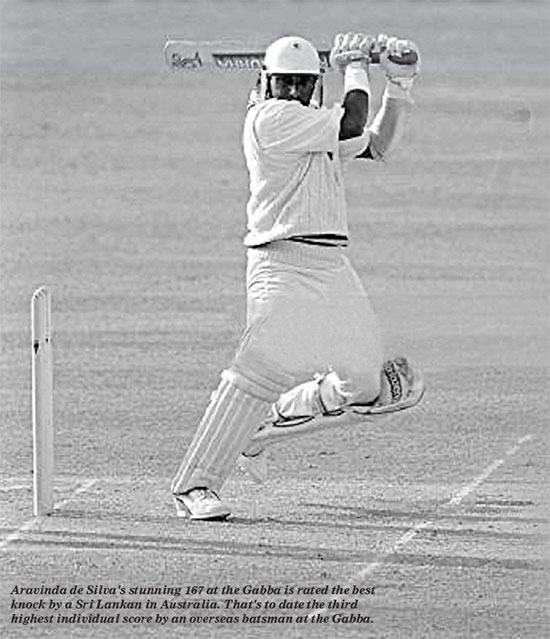
Several Sri Lankan batsmen have come up with some memorable batting feats in Australia and some outstanding bowling efforts. The first century in Australia by a Sri Lankan stands out of them all. Aravinda de Silva scored a spectacular 167 in the Gabba Test of 1989 and his superb counterattack with the team in trouble made the world take note of his exceptional talent.
Aravinda has many friends and fans in Brisbane. When someone had asked for match tickets, he had kindly obliged. The friends had brought to his notice that there were tickets for only the first four days. Upon inquiring, Aravinda had got to know that the Australian board didn’t expect the Test match to go beyond day four. He needed little motivation after that. The Aussie bowlers were at the receiving end.


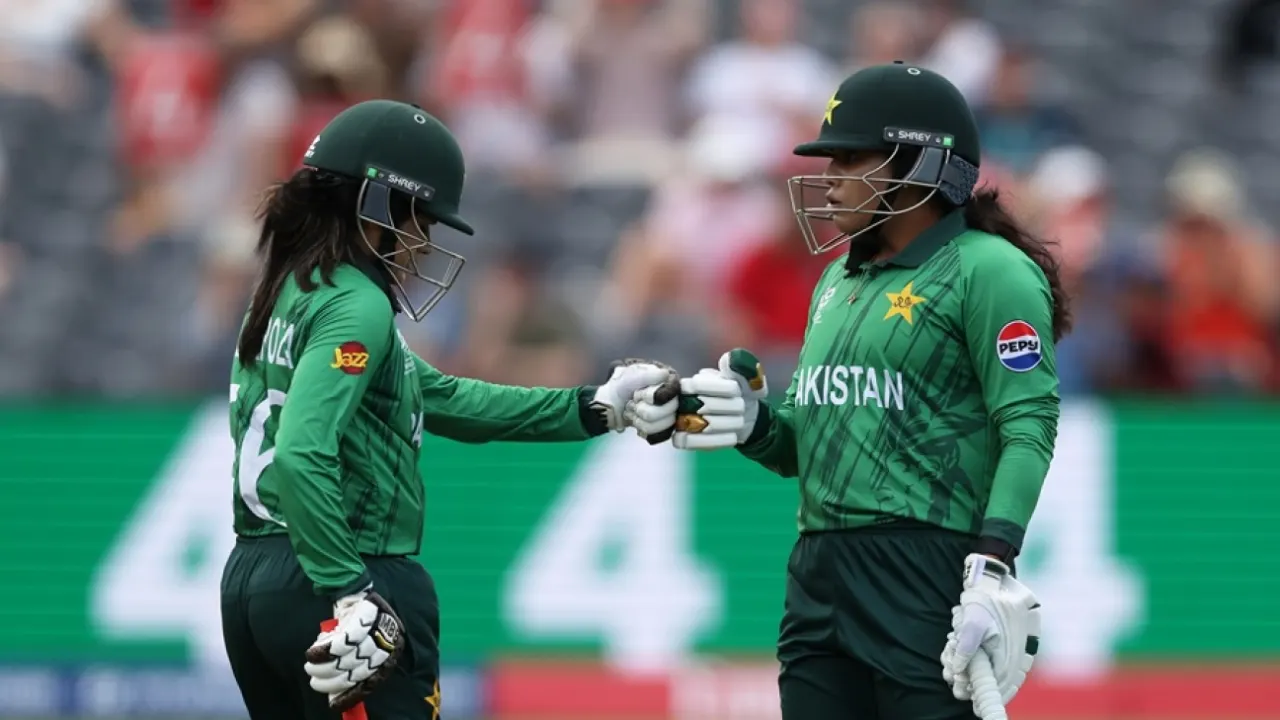
Pakistan won the basement battle against Netherlands in a low-scoring game, with Gull Feroza’s half-century inspiring them to a 37-run win. In a low-scoring contest where momentum ebbed and flowed, Feroza held the first innings together to put on 126 for Pakistan, their joint-highest score this tournament.
Netherlands appeared on course initially with a bright start from Heather Siegers, but lost their way dramatically after she was dismissed as Pakistan squeezed them through spin. The last seven wickets fell for just 13 runs, with Fatima Sana returning to the attack to apply the coup de grace, knocking back the stumps three times in the final over to send Netherlands’ last three batters on their way as they folded for 89.
Pakistan won the toss and opted to bat, recovering from an uninspiring start thanks to a 79-run second-wicket stand between Feroza and Ayesha Zafar. But the Netherlands hit back through Silver Siegers and Iris Zwilling, the latter arguably the pick of the Netherlands attack. They triggered a Pakistani collapse which saw them lose 5 wickets for 24 runs, including the early loss of Sana, who had promoted herself up to four, her highest T20I batting position. It pegged Pakistan back from what had looked like a score in excess of 140 to one Netherlands genuinely fancied chasing.
Heather Siegers breezy start meant it was the Netherlands who looked as if they might pip Pakistan, but there wasn’t much to back her up after Diana Baig sent her on her way. Pakistan’s spinners asphyxiated the Dutch, and as the asking rate ballooned, the Netherlands began to shrink away. It was, in the end, a tame capitulation from a Dutch side that promised so much more for the best part of this game.
Feroza stands tall
Trying to remain oblivious to the bedlam all around is among Pakistan cricket’s more challenging tasks, but Gull Feroza managed exactly that. With Pakistan managing only a sedate start and suffering the early loss of Muneeba Ali, Feroza put on a 79-run partnership with Ayesha Zafar. She was the more aggressive partner through that second-wicket stand, particularly after the halfway mark.
The attack was launched with a couple of nifty boundaries off Hannah Landheer in the tenth over, and another pair against Heather Siegers in the one that followed. Between the tenth and 14th overs, Pakistan enjoyed their best spell with the bat, smashing 36 in four. Though a collapse would soon follow, they had, thanks to Feroza, built up just about enough of a buffer to give their bowlers breathing space.
The review that almost wasn’t
Netherlands made an inspired start against South Africa on Thursday, and were aware anything close to that would virtually guarantee victory in pursuit of 127 today. Heather Siegers began threatening just that racing along to 24 in 15 with the side racking up 31 in the first 20 balls. But Diana Baig came back from being smashed for two boundaries off her first two balls strongly, in perhaps the most consequential moment of the match.
Siegers missed an attempted steer into the onside, and it hit her high on the pad. The umpire was quick to turn down Pakistan’s half-hearted appeal, but Sana reviewed at the last moment, and Hawk-Eye spat out three reds. Netherlands brightest spark was gone, and they never recovered that position of strength in the game again.
Pakistan’s spinners overrun Netherlands
Once Siegers departed, a thin layer of pressure appeared to descend on the Dutch, one they could never quite shrug off. The following over saw a hare-brained attempt at a single end up in a run-out thanks to a direct hit from Eyman Fatima. A Sana over aside, Pakistan turned almost exclusively to spin, rushing through their overs and watching the asking rate pile up. Nashra Sandhu was most effective at stifling the batters, maintaining a tight line that gave nothing away. She would end up registering figures of 3-0-8-1 through the middle, with the Netherlands managing just 23 in seven overs since Siegers’ dismissal.
Scores:
Pakistan Women 126 for 6 in 20 overs (Muneeba Ali 12, Gull Feroza 63*, Ayesha Zafar 32; Iris Zwilling 2-19, Heather Siegers 1-28, Hannah Landheer 1-19, Caroline de Lange 1-24, Silve Seigers 1-17) beat Netherlands Women 89 all out in 18 overs (Babette de Leede 30, Steere Kalis 12; Fatima Sana 3-12, Diana Baig 1-11, Nashra Sandhu 1-08, Ayesha Zafar 3-13) by 37 runs
[Cricinfo]
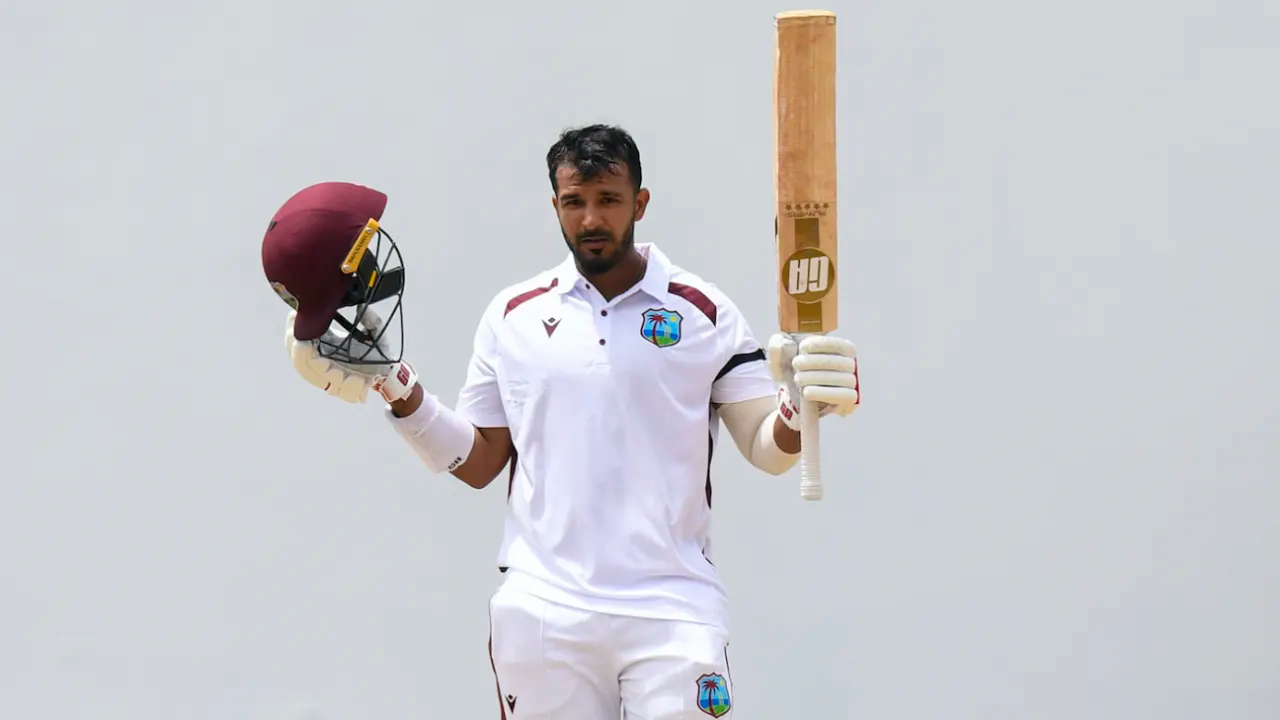
Amir Jangoo amassed 233, RostonChase hit 194, and through a record-breaking 401-run partnership, the pair slow-roasted Sri Lanka on day three in Antigua. Their gargantuan stand delivered West Indies to a position of extraordinary strength, securing them a 318-run first innings lead. That in the four overs they got to bowl at Sri Lanka, West Indies dismissed the dangerous Pathum Nissanka, and created other chances, buoying them further heading into day four.
Jangoo and Chase now not only have the highest sixth wicket stand in the history of Test cricket, they also have the second highest partnership for West Indies, behind only Garfield Sobers and Conrad Hunte. Both batters improved on their previous first-class high scores, Chase easily beating his 137 not out, and Jangoo surpassing his domestic 218.
That Jangoo produced a knock of such astonishing concentration, and expansive range, in just his third Test innings was especially impressive. Until he got out attempting to accelerate about midway through the last session, his innings was largely chanceless. He batted 373 deliveries on his own, and he and Chase batted 100.2 overs, seeing out three complete sessions together. Though they had begun slowly, both batters sped up through the day and were finding boundaries off both the quicks and spinners through the second and third sessions of the day.
Sri Lanka’s attack found the pitch utterly docile for most of day three. They were missing their fastest quick Lahiru Kumara, who went off the field with a hamstring niggle early the previous day. Their quicks were earnest in the first hour, but once Jangoo and Chase saw out the second new ball (the ball was four overs old when day three began) with a period of disciplined batting, Sri Lanka’s quicks lost some venom, and captain Dhananjaya de Silva went increasingly to his spinners – Sonal Dinusha in particular.
The one exception for Sri Lanka was Milan Rathnayaka, who was intense in each of his day three spells, and created chances even in a dreary second session, having Chase dropped by a diving wide slip for 108. Later in the day, it would be Rathnayaka who would break the enormous stand, and would go on to complete a well-deserved five-wicket haul, finishing with 5 for 124. Dinusha, the left-arm spinning allrounder, conceded 234 runs himself in this innings, though he did also pick up two wickets, including that of Chase.
Patience had defined Jangoo and Chase’s batting in the first hour. Jangoo, for example, didn’t score off the first 15 deliveries he faced on day three, while Chase was only marginally less defensive. When conditions began to ease after the first hour, however, they began to slip into more fluent modes of operation. In the afternoon session, when the pair really propelled West Indies into the ascendancy, they plundered 136 runs at a rate of more than five an over. Jangoo was especially strong square of the wicket on the offside and down the ground. Chase was excellent through the covers. Jangoo, additionally, would sometimes tonk the spinners over the straight boundary.
Right through the day the pair would notch up milestones – both for themselves, and the partnership. The milestone that drew the most raucous celebration came soon after tea, when Jangoo completed his double with a sweep through square leg, leaping in the air as he took off for the run. Although only hundreds were in attendance, the house was on its feet for him, coach Daren Sammy and the West Indies dressing room giving him an especially warm ovation. Having come into the XI only as a replacement player for the injured Shai Hope, Jangoo has essentially made himself undroppable for the second Test.
After tea the pair took the scoring up even one further gear, Jangoo hitting some memorable sixes over square leg, while Chase continued to drive powerfully. Jangoo was out attempting to repeat a pulled six though the ball was not quite short enough for that shot. The resultant top-edge was gobbled up by the wicketkeeper. Chase was out much later, under-edging Dinusha into his stumps when a sweep went awry. He was six short of what would also have been his first double century.
Rathnayake would take two further wickets before West Indies declared the innings. Nissanka was out caught behind feeling for a Jayden Seales away-swinger first ball of the second over. Nightwatcher Kasun Rajitha could have been out too, had Jangoo at short leg held a sharp, low chance off the bowling of Kemar Roach.
Scores:
Scores: Day 3 Stumps
Sri Lanka 308 and 15 for 1 (Kasun Rajitha 4*, Nishan Madushka 2*; Jayden Seales 1-5) trail West Indies 626 for 9 dec (Amir Jangoo 233, Roston Chase 194; Milan Rathnayaka 5-124) by 303 runs
[Cricinfo]

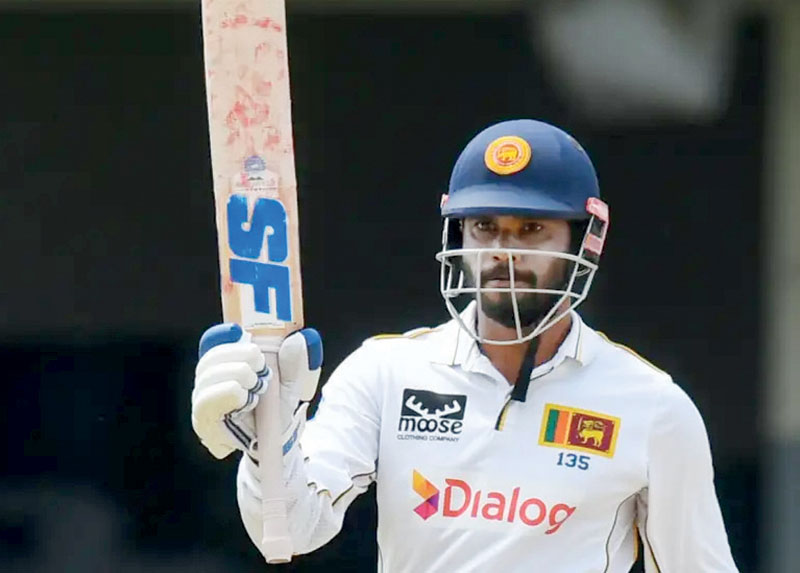
This week, Sri Lanka returned to Test cricket in the Caribbean after an absence of exactly one year. To think that the national team has gone a full 12 months without playing a single Test is staggering. The administrators who run the game have let down both the players and the fans.
It is equally disturbing to think that players like Dinesh Chandimal and Kasun Rajitha, who are specialists in the longest format, have effectively been left without work for an entire year. Let us hope the new administration gives Test cricket the respect it so richly deserves.
Cricket boards such as Sri Lanka’s and even South Africa’s seem content to play only the bare minimum required for the World Test Championship – 12 Tests in a two-year cycle. To make matters worse, there appears to be little appetite to organise matches outside the championship. Three-Test home series have become a distant memory, while a five-Test series is little more than a fantasy. At this rate, it is unlikely to happen in our lifetime.
For a nation that fought so hard to gain Test status, the way we now treat the format is deeply disappointing. Gentlemen like Gamini Dissanayake must surely be spinning in their graves.
Sri Lanka Cricket’s stock response is that Test cricket does not make money. Someone needs to remind them that SLC is not a business enterprise but a sporting body. Had they shown the same enthusiasm for nurturing the game’s foundations as they did for building cricket grounds to satisfy the whims and fancies of politicians, Sri Lankan cricket would be in a far healthier place today.
The authorities argue that, unlike the last 12 months, the next year looks promising, with the team scheduled to play 10 Tests. That may well be true, but it does not erase the fact that their attitude towards Test cricket has been woefully lackadaisical.
Cricket officials cling to statistics like a drunkard clings to a lamp post – for support rather than illumination.
We play so little Test cricket these days that we may never again produce a player who reaches 100 Tests or a bowler who claims 300 wickets. Great careers are built on opportunity, and opportunity is becoming increasingly scarce.
India, despite reserving more than two months of the calendar for the IPL, still manages to play a healthy number of Test matches each year. The number of nations playing Test cricket has grown in recent times, so logic dictates that the number of Tests Sri Lanka plays should also increase. Sadly, the opposite has happened, with the fixture list shrinking year after year.
One small ray of hope is the assurance given by Sidath Wettimuny that the issue will be addressed. As Chairman of the Cricket Committee, he is in a position to push the board’s executives to find ways and means of ensuring Sri Lanka plays more Test cricket.
by Rex Clementine ✍️

Zafar, Feroza lead Pakistan to consolation win

Jangoo 233, Chase 194 put West Indies in commanding position

Showers will occur at times in the Western, Sabaragamuwa and North-western provinces and in Galle, Matara, Kandy and Nuwara-Eliya districts

Venezuelans dig for earthquake survivors as death toll rises to 1,430

Chemmani mass graves: Govt to seek international forensic help

ADB approves $57.4 million package to boost Lanka’s rooftop solar drive

‘Dates have the highest sugar content to fight Coronavirus’

Sunday Island 27 December – Headlines

#SundayIsland 17th December – Headlines

Sunday Island – 28th March

Sunday Island Headlines – 21 March

Sunday Island – 21st February – Headlines
-

 Features7 days ago
Sri Lanka developing independent hydrographic capabilities
-
 Opinion6 days ago
Ranasinghe Premadasa: The man who would not take ‘No’ for an answer
-
 News2 days ago
Another 1,132 Sri Lankan Personnel to be deployed for United Nations Peacekeeping Missions
-

 Opinion5 days ago
Sri Lanka’s national security: Justice, reconciliation, and forward-looking vigilance
-

 News6 days ago
US Assistant Secretary of State for South and Central Asian Affairs meets President
-

 News3 days ago
Kelaniya emerges as highest ranked Lankan uni in Times Higher Education Sustainability Impact Ratings
-

 Opinion4 days ago
A triumph for Pakistan’s skilled diplomacy at Iran-US talks
-

 Business7 days ago
University of West London opens Sri Lanka’s first full UK university branch campus