
Features
“MAY THEY ALL ROT IN HELL, AGAIN, MERRY CHRISTMAS”

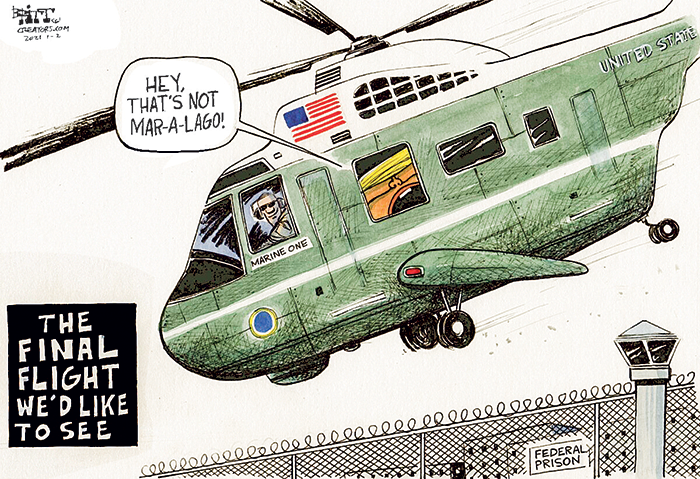
TRUMP’S CHRISTMAS MESSAGE OF PEACE AND GOODWILL TO OPPONENTS:
by Vijaya Chandrasoma
As we complete another eventful year, I would like to apologize for the many shortcomings I have displayed over the years. The most common complaint has been that my essays are tediously lengthy and boring.
The second complaint is that my obsession with Trump has become annoyingly tiresome. In my defense and contrary to the teachings of psychiatry and all religions, that hatred is self-destructive, my loathing of Trump has been of enormous therapeutic relief to me. Hatred that has made me a better person, because all the evil in my heart is reserved exclusively for the “Stable Genius”.
Trump’s unhinged and profane Christmas message on his Truth Social media network is addressed to those who recognize him for the narcissistic crook he is. He chooses this time of sanctity, not only for Christians but to people of every faith, who embrace and celebrate the universal message of Peace on Earth and Goodwill to All, to spew the very essence of blasphemy.
“Merry Christmas to Crooked Joe, the out-of-control Deranged Jack Smith….and the SICK THUGS who are looking to destroy our once great USA”. Ending with “ROT IN HELL” as headlined above. Trump is a sick psychopath, nutty as a Christmas fruitcake.
Sadly, his visions of dictatorship and revenge appeal to his Republican base, who see him as the Savior who will take Hitler-like steps to save their worst nightmare of the loss of white privilege; that the country will fall under the yoke of an invasion of brown-skinned immigrants who will poison the pure blood of the rightful owners of the USA, the Christian white supremacists.
I thought it would be appropriate to end the year with a record of the legislative inaction of the Republican House, with just 22 laws passed this year, out of a total of 700 laws pending. The previous record for legislative inactivity was in 2011, when 73 laws were passed. Brevity would therefore be a given, and my best intentions to contain my propensity for prolixity would have been admirably served.
Unfortunately, the vulgarity of the Christmas wishes of the crass Trump hit the headlines, and I could not resist the temptation of reporting on a subject that highlights, as if any more highlighting were necessary, the vengeful lunacy of the former president. So brevity again went down the tubes.
Conservative Republican Congressman from Texas, Chip Roy agrees with my contention that the Republican Party has done very little this year. He recently took to the House floor to tear into his fellow Republicans. “Our party has become a complete, useless dumpster fire that does nothing to help the American people; because it is too busy investigating the president’s son, kissing the last president’s ass, and fighting each other….For the life of me, I want my Republican colleagues to give me one thing – just one – that I can say to my constituents that we have done to help the American people”.
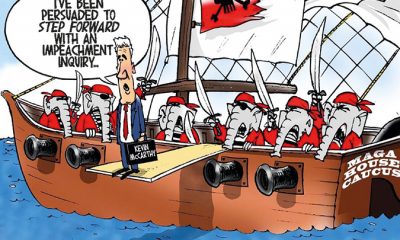
I can give him three, but instead of helping the American people, they have only focused on the Party’s disunity, in competition as to who kissed the former president’s ass most unctuously, initiated an evidence-free Impeachment Inquiry against President Biden and ruined Santa’s Christmas.
For starters, Republicans fired Speaker Kevin McCarthy, whose ten-month tenure ended when he became the first Speaker in history to be ousted by members of his own party, hardline Trumpers with the brownest of noses.
On September 30, in a rare moment of empathy for his fellow Americans, McCarthy acted against the wishes of Trump, voting with the Democrats to avoid a government shutdown that would have caused chaos and embarrassed the Biden administration. Unfortunately for him, this is the only goal, the raison d’etre of Trump and his party. So he had to go.
In a poignant speech when he surrendered the Speaker’s gavel, McCarthy stated, to an almost empty chamber, “Do not be fearful if you believe your philosophy brings people more freedom. Do not be fearful that you could lose your job over it”.
We all remember McCarthy pleading with Trump over the telephone to call off the rioters, from the floor of Congress, during the January 6 insurrection. An expletive-filled shouting match resulted when Trump refused, ending with a furious McCarthy shouting at Trump, as the rioters were breaking into his office, “Who the f… do you think you are talking to”, before fleeing to safety.
Directly after the insurrection, McCarthy excoriated Trump, in Congress, for his complicity in the assault on the Capitol. Three weeks later, however, fearful of losing his job, he visited Trump at Mar a Lago, cap in hand and kissed the ring, showing us exactly who the f… he really was, how fearful he was about losing his job and how little he cares about the freedom of the people.
After ejecting McCarthy, the Republicans elected as their new Speaker Louisiana Congressman and avid Trumper, Mike Johnson, a backbencher who suddenly found himself to be second-in-line to the presidency, after VP Kamala Harris. Part of his six years’ experience in the House was his ardent support of Trump’s violent January 6, 2021 insurrection. Johnson is a devoted Christian who believes that the US is governed not by the Constitution but by the Bible, the current Republican version, according to which the “Orange Jesus” is the Son of God.
The Republicans, who have been trying to impeach President Biden since the day of his inauguration, voted, on December 13 to formally authorize an Impeachment Inquiry into President Biden. An evidence-free Inquiry into the yet unknown high crimes and misdemeanors (the constitutional requirement for the impeachment of a president) committed by the President. An earlier Inquiry fell through when the first of their “expert witnesses” opened with the admission that their investigation had uncovered no impeachable evidence against President Biden.
Republican Congressman James Comer, chief architect of the current Inquiry, was asked by Steve Doocy during an interview on Republican-friendly Fox News, for details of the high crimes and misdemeanors committed by Biden. Comer said that such evidence was what the Inquiry was intended to find, based on that famous American legal principle that “a man is guilty until proved innocent”.
Maryland Democratic Congressman Jamie Raskin compared the proposed impeachment to one of Agatha Christie’s famous “Whodunit” mystery novels. The only difference being that the “who” and the “dun” are known, but the “it” is the real mystery.
The real reason for the impeachment of Biden was Trump’s plaintive, kindergarten cry: “Mommy, mommy, he started it. He did it to me, so we must do it to him!”
The Republicans enacted earth-shattering legislation last week, that public schools should serve schoolkids whole milk instead of low-fat milk, which had hitherto been on the cafeteria menu. Legislation that took precedence over funding for Ukraine and Israel, the climate crisis, gun violence and other relatively insignificant problems that could easily be postponed till after the holidays.
In an attempt to promote a healthy diet in school meals, Republican Congresswoman from North Carolina, Virginia Foxx, waxed eloquent on the benefits of whole milk in one of the finest political orations since Rev. Martin Luther King’s “I have a dream” speech in 1963.
“It’s Christmas time in America, with the tradition of leaving milk and cookies out for Santa and his reindeer to enjoy. It is a tradition in my family to leave only whole milk with the cookies. We only want the best nutritional option for Santa.
“Whole milk provides the nutrients like calcium, protein and Vitamin D to enable Santa to circle the globe in one night. It helps build and repair his muscles, necessary for hoisting heavy sacks of gifts up and down chimneys; it keeps Santa’s bones strong as he dashes from rooftop to rooftop; and whole milk is essential to keep Santa warm as he braves the cold wintry night.
“You see, it’s just not the magic of the season that helps Santa deliver presents worldwide – it’s also the fortifying nutrients of whole milk”.
Ms. Foxx’s dream was that one day, all public schools in America will recognize the value of whole milk, which will surely provide the nutrition necessary for all children to successfully complete their math homework, irrespective of the color of their skin or the content of their character.
Santa had heard rumors about the Republican whole milk plans before embarking on his annual trek. Shivers ran down his spine, not only because it was freezing cold in the North Pole. He had sent an urgent message to Congresswoman Foxx, long before Christmas Eve, that his reindeer, except for Rudolf, whose nose was suspiciously red, did enjoy whole milk during their arduous journey. As for himself, he would appreciate it if the nice people would leave him a large shot of single malt Scotch whiskey with the cookies, which would more effectively fortify him, and keep him snug and warm while dashing on rooftops and down chimneys on that cold wintry night.
Santa made this earnest request because Mrs. Claus, in her capacity as President of the North Pole, had recently enforced Prohibition in that continent. Santa had been forced to drink bootleg booze the past few months, and had been looking forward to a decent drink on Christmas Eve, as do we all.
Alas, his message had fallen on deaf years, and he had to drink that awful whole milk with his cookies. His traditionally booming “Ho Ho Ho” was strangely muted.
The Republican Congress added to their “achievements”, the denial of a woman’s fundamental rights to reproductive freedom, with a decision that could only be described as sadistically inhumane. A cynical ruling made by a few old white geezers who barely know what the hell a uterus is.
Ms. Kate Cox, married with two children, is a resident of Texas. A deep-red state with Draconian laws, Texas banned abortion under virtually any and all circumstances last year.
Ms. Cox sued to obtain an abortion after learning that her fetus had a fatal chromosomal condition and spinal abnormalities. Her doctor had informed her that there was no chance her unborn baby would survive birth or live for a few hours afterwards. A continuing pregnancy would jeopardize not only her own life, but also her future fertility. Tragically, abortion was her only option.
A lower court judge ruled in favor of Ms. Cox’s immediate abortion, but the Texas Supreme Court overruled that decision. Ken Paxton, the Texas Attorney General, threatened to punish any doctor who provided Ms. Cox an abortion. Ms. Cox was forced to flee Texas and have the procedure done in a state with more humanitarian values.
With the election looming in November, the Republican House will likely continue to block every progressive measure proposed by the Biden administration. We can only hope that the economy will continue to thrive in the new year. More importantly, that moderate Republicans and Independents will finally realize that Trump, if allowed to contest and is elected to the presidency, will bring about an era of authoritarian terror, the white supremacist version of the Spanish Inquisition, from which the nation may never recover.
There are hopeful signs that many such moderate Republicans and Independents are beginning to feel apprehension and tiring of Trump’s continuing dangerous rhetoric, his monotonous whining that he is the victim of a perennial witch-hunt. Rival Republican candidate Nikki Haley seems to be gaining momentum to be a live threat to eat into Trump’s substantial lead in the Republican polls.
If she upsets Trump for the Republican nomination, or if Trump is constitutionally or criminally disqualified from seeking re-election, she would be a worthy, moderate candidate, a skilled politician to challenge President Biden, whom she currently leads by double digits in the polls in a head-to-head presidential race. In fact, she may attract votes from many Democrats who feel that Biden’s advanced age is a distinct problem.
And happily, Trump will finally face accountability for all the violent and treasonous crimes he has committed in a desperate attempt to remain in power and so avoid certain imprisonment.I wish readers a happy, healthy, Trump-free 2024, more with trepidation than confidence for the democratic future of the United States.




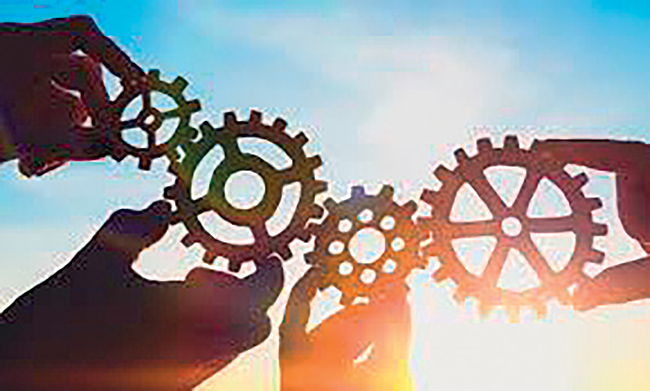
Sri Lanka’s industrial sector has historically been an engine of growth, employment, and exports. Yet today, many industries face structural challenges, outdated practices, and intense global competition. Immediate and comprehensive policy reforms are, therefore, both urgent and essential—not only to revive growth but also to secure the future prosperity of the country.
Strengthening economic growth and diversification
Industries contribute significantly to GDP and export earnings. They create value-added products, reduce import dependency, and improve trade balances. Sri Lanka’s economy remains overly reliant on a few traditional sectors, such as garments and tea. Industrial reforms can encourage diversification into higher-value manufacturing, technology-driven production, and knowledge-based industries, increasing resilience against global shocks.
Job creation and social stability
The industrial sector is a major source of formal employment, particularly for youth and women. Small and medium-sized enterprises (SMEs) provide both direct and indirect jobs. Without reforms, job creation is limited, pushing young people to seek opportunities abroad, which drains talent and exacerbates social and economic inequality. By modernising industries and supporting SME growth, the country can create high-quality, sustainable employment, reduce migration pressures, and promote social stability.
Competitiveness and export expansion
Sri Lanka faces stiff competition from countries such as Vietnam, Bangladesh, and India in textiles, garments, and other manufacturing exports. Many local industries struggle with outdated technology, high production costs, and weak supply chains. Urgent reforms—such as improving industrial infrastructure, incentivising technology adoption, and simplifying trade regulations—are critical to enhancing competitiveness, retaining market share, and expanding exports.
Attracting domestic and foreign investment
Investors require clarity, stability, and efficient regulatory processes. Complex licensing, bureaucratic delays, and inconsistent policies deter both domestic and foreign investment. By implementing transparent and predictable industrial policies, the government can attract capital, encourage innovation, and accelerate industrial modernisation. Investment is not just about funding production—it is also about transferring technology and upgrading skills, which is essential for long-term industrial development.
Promoting innovation and technological upgrading
Many Sri Lankan industries continue to rely on outdated production methods and low-value processes, limiting productivity, efficiency, and global competitiveness. Comprehensive industrial reforms can incentivise research and development, digitalisation, automation, and adoption of green technologies, enabling local industries to move up the value chain and produce higher-value goods. This is particularly urgent as global competitors are rapidly implementing Industry 4.0 standards, including AI-driven production, smart logistics, and sustainable manufacturing. Without modernisation, Sri Lanka risks not only losing export opportunities but also falling permanently behind in technological capabilities, undermining long-term industrial growth and economic resilience.
Strengthening supply chains and local linkages
Effective industrial reform can improve integration between agriculture, services, and manufacturing. For example, better industrial policies can ensure that local raw materials are efficiently used, logistics systems are modernised, and SMEs are integrated into global supply chains. This creates multiplier effects across the economy, stimulating productivity, innovation, and competitiveness beyond the industrial sector itself.
Environmental sustainability and resilience
Global trends demand green and sustainable industrial practices. Sri Lanka cannot afford to ignore climate-friendly production methods, energy efficiency, or waste management. Reforms that promote sustainable manufacturing, circular economy principles, and renewable energy adoption will future-proof industries, improve international market access, and ensure compliance with global trade standards.
Institutional capacity and governance
Industrial reforms are not just about incentives; they require strong institutions capable of policy design, monitoring, and enforcement. Weak governance, policy inconsistency, and politicisation have historically undermined industrial development in Sri Lanka. Strengthening industrial institutions, simplifying bureaucracy, and ensuring accountability are essential components of meaningful reform.
Responding to global technological and trade shifts
The industrial landscape is rapidly changing due to digitalisation, automation, AI, and new global trade patterns. Sri Lanka must adapt quickly to benefit from global industrial trends rather than risk falling behind regional competitors. Immediate reform will allow industries to adopt modern production systems, integrate with global value chains, and improve export competitiveness.
Conclusion
Industrial policy reforms in Sri Lanka are urgent because delays threaten employment, competitiveness, and investment. They are important because a modern, resilient industrial sector is crucial for economic growth, export expansion, technological advancement, social stability, and environmental sustainability. Strategic, forward-looking reforms will not only save existing industries but also position Sri Lanka for a prosperous, resilient, and inclusive future.
(The writer is a former senior public servant and policy specialist.)
BY Chinthaka Samarawickrama Lokuhetti
US President Donald Trump is insulting friends and intimidating others. Perhaps. Following his rare feat of securing a non-consecutive second term, one would have expected Trump to be magnanimous, humble and strive to leave an imprint in world history as a statesman. However, considering the unfolding events, it is more likely that he will be leaving an imprint but for totally different reasons!
From the time of his re-election, Trump has apparently been determined to let the world know who the ‘boss’ is and wanted to Make America Great Again (MAGA) by economic measures that were detrimental even to his neighbours and friends, totally disregarding the impact it may have on the world economy. Some of his actions were risky and may well have backfired. Businessmen are accustomed to taking risks and he appears to behave as a businessman rather than as a politician. There was hardly any significant resistance to his arbitrary tariff increases except from China. He craved for the Nobel Peace Prize, claiming to have ended and prevented wars and, and unashamedly posed for a picture when the Nobel Peace Prize was ‘presented’ to him by the winner! To add insult to injury, Trump demonstrated his ignorance by blaming the Norwegian Prime Minister for having overlooked him for the Nobel Peace Prize. He should surely have known, before the Norwegian PM pointed out, that the awardee was chosen by a non-governmental committee.
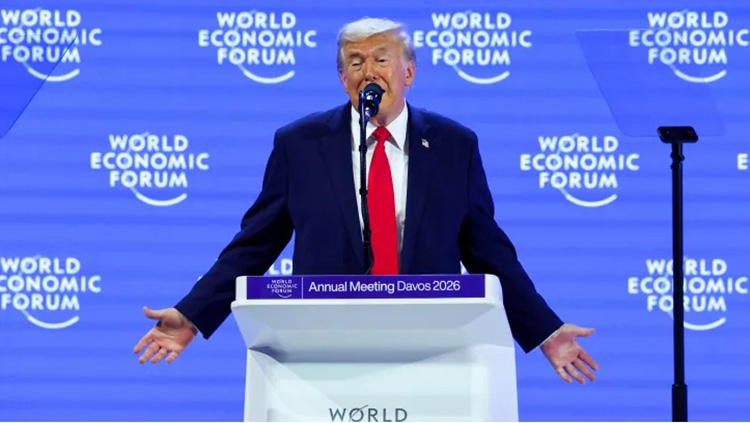
Trump’s erratic behaviour reached its climax in Davos. He came to Davos determined to railroad the European leaders into accepting his bid to acquire Greenland and seemed to do so by hurling insults left, right and centre! Even before he started the trip to Davos, Trump had already imposed a 10% tariff on imports from seven European countries including the UK, increasing to 25% from the beginning of February, until he was able to acquire Greenland. In a rambling speech, lasting over an hour, he referred to Greenland as Iceland on four different occasions.
Exaggerating the part played by the US in World War II Trump proclaimed “Without us right now, you’d all be speaking German and a little Japanese”. After making a hideous claim that the US had handed Greenland to Denmark, after World War II, Trump said, “We want a piece of ice for world protection, and they won’t give it. You can say yes and we will be very appreciative. Or you can say no and we will remember”. A veiled threat, perhaps!
However, the remark that irked the UK most was his reference to the war in Afghanistan. He repeated the claim, made to Fox News, that NATO had sent ‘some troops’. but that they ‘had stayed a little back, a little off the front line’. On top of politicians, infuriated families of over 500 soldiers who sacrificed their lives in the front-lines in Afghanistan, started protesting which forced the British PM Keir Starmer to abandon the hitherto used tactic of flattery to win over Trump, to state that Trump’s remarks were “insulting and frankly appalling.” After a call from Starmer, Trump posted a praise on his Truth Social platform that UK troops are “among the greatest of all warriors”!
The resistance to Trump’s attempts at reverting to ‘unconstrained power of Great Powers’, which was replaced by the ‘rule-based-order’ after World War II, was spearheaded from an unlikely quarter. It was by Mark Carney, financier turned politician, PM of Canada. He was the Governor of the Bank of England, during the disastrous David Cameron administration, and left the post with hardly any impact but seems to have become a good politician. He apparently has hit Trump where it hurts most, as in his speech, Trump stated that Canada was living on USA and warned Carney about his language!
Mark Carney’s warning that this was a moment of “rupture” with the established rules-based international order giving way to a new world of Great Power politics and his rallying cry that “the middle powers” needed to act together, need to be taken seriously. What would the world come to, unless there is universal condemnation of actions like the forcible extraction of the Venezuelan President which, unfortunately, did not happen maybe because of the fear of Trump heaping more tariffs etc? What started in Venezuela can end up anywhere. Who appointed the US to be the policeman of the world?
With words, Trump gave false hope to protesters rebelling against the theocracy in Iran but started showing naval strength only after the regime crushed the rebellion by killing, according to some estimates, up to 25,000 protesters. If he decides to attack, Iran is bound to retaliate, triggering another war. In fact, Trump was crass enough to state that he no longer cares for peace as he was snubbed by the Nobel Peace committee! Trump is terrorising his own people as is happening in Minnesota but that is a different story.
Already the signs of unity, opposing Trump’s irrationalities, are visible. Almost all NATO members opposing Trump’s plans resulted in his withdrawal from Greenland acquisition plans. To save face, he gave the bogus excuse that he had reached an ever-lasting settlement! Rather than flattery, Trump’s idiosyncrasies need to be countered without fear, as well illustrated by the stance the British PM was forced to take on the Afghan war issue. For the sake of world peace, let us hope that Trump will be on the retreat from now.
Mark Carney’s pivotal speech received a well-deserved and rare standing ovation in Davos. One can only hope that he will practice what he preached to the world, when it comes to internal politics of his country. It is no secret that vote-bank politics is playing a significant role in Canadian politics. I do hope he will be able to curtail the actions of remnants of terrorist groups operating freely in Canada.
by Dr Upul Wijayawardhana

One wonders why the people of the US, who have built the most technologically and economically advanced country, ever elected Donald Trump as their President, not once, but twice. His mistakes and blunders in his first term are too numerous to mention, but a few of the most damaging to the working people are as follows:
Trump brought in tax cuts that overwhelmingly favour the wealthy over the average worker. The Tax Cuts and Jobs Act (TCJA) signed into law, at the end of 2017, provides a permanent cut in the corporate income tax rate that will overwhelmingly benefit capital owners and the top one percent. His new laws took billions out of workers’ pockets by weakening or abandoning regulations that protect their pay. In 2017 the Trump administration hurt workers’ pay in many ways, including acts to dismantle two key regulations that protect the pay of low- to middle-income workers. These failures to protect workers’ pay could cost workers an estimated $7 billion per year. In 2017, the Trump administration—in a virtually unprecedented move—switched sides in a case before the US Supreme Court and fought on the side of corporate interests and against workers.
Trump’s policies on climate change could ruin the global plans to cut down emissions and reduce warming, which has already affected the US equally badly as anywhere else in the world. Trump ridiculed the idea of man-made climate change, and repeatedly referred to his energy policy under the mantra “drill, baby, drill”. He said he would increase oil drilling on public lands and offer tax breaks to oil, gas, and coal producers, and stated his goal for the United States to have the lowest cost of electricity and energy of any country in the world. Trump also promised to roll back electric vehicle initiatives, proposed once again the United States withdrawal from the Paris Agreement, and rescind several environmental regulations. The implementation of Trump’s plans would add around 4 billion tons of carbon dioxide to the atmosphere by 2030, also having effects on the international level. If the policies do not change further, it would add 15 billion tons by 2040 and 27 billion by 2050. Although the exact calculation is difficult, researchers stated: “Regardless of the precise impact, a second Trump term that successfully dismantles Biden’s climate legacy would likely end any global hopes of keeping global warming below 1.5C.” ( Evans, et al, 2024). Despite all these anti-social policies Trump was voted into power for a second term.
Arguments suggesting the USA is a decadent society, defined as a wealthy civilisation in a state of stagnation, exhaustion, and decline, are increasingly common among commentators. Evidence cited includes political gridlock, economic stagnation since the 1970s, demographic decline, and a shift toward a “cultural doom loop” of repeating past ideas (Douthat, 2024, New York Times).
First, we will look at the economic aspect of the matter though the moral and spiritual degradation may be more important, for it is the latter that often causes the former . The reasons for the economic decline, characterised by increase in inequality, dates back to the seventies. Between 1973 and 2000, the average income of the bottom 90 percent of US taxpayers fell by seven percent. Incomes of the top one percent rose by 148 percent, the top 0.1 percent by 343 percent, and the top 0.01 percent rose by 599 percent. The redistribution of income and wealth was detrimental to most Americans.
If the income distribution had remained unchanged from the mid-1970s, by 2018, the median income would be 58 percent higher ($21,000 more a year). The decline in profits was halted, but at the expense of working families. Stagnant wages, massive debt and ever longer working hours became their fate.
Since 1973, the US has experienced slower growth, lower productivity, and a diminished share of global manufacturing, notes the (American Enterprise Institute). Despite the low growth, the rich have doubled their wealth. In our opinion this is due to the “unleash of a culture of greed” that Joseph Stiglitz spoke about.
Nobel Prize winning economist Joseph Stiglitz has frequently argued that the United States has unleashed a culture of greed, selfishness, and deregulation, which he blames for extreme inequality, financial crises, and environmental destruction.
Income stagnation is not the only quality of life indicator that suffered. In 1980, life expectancy in the US was about average for an affluent nation. By the 2020s, it dropped to the lowest among wealthy countries, even behind China or Chile, largely due to the stagnation of life expectancy for working-class people. With regard to quality of life the US has fallen to 41st in global, UN-aligned, sustainable development rankings, highlighting issues with infrastructure and social systems, (The Conversation). The political system is described as trapped in a “stale system” with high polarisation, resulting in inaction rather than progress, (Douthat, New York Times).
It is often the moral and spiritual degradation that causes an overall decline in all aspects of life, including the US economy. Statistics on crime, drug and alcohol addiction, suicide rate and mental health issues in the US, which are the indicators for moral and spiritual status of a society, are not very complimentary. The Crime Index in the US is 49 while it is 23 in China and 32 in Russia. Drug abuse rate is 16.8% in the US and alcohol addiction is 18%. Mental illness in adults is as common as 23%. Only about 31% follow a religion. Erich Fromm in his book, titled “Sane Society,” refers to these facts to make a case that the US and also other countries in the West are not sane societies.
Let us now look at Joseph Stiglitz’s thoughts on greed which is the single most important factor in the aetiology of moral degradation in the US society. Stiglitz has directly linked corporate greed and the pursuit of immediate, short-term profits to accelerating climate change and economic failure for the majority of Americans. He argues that “free” (unregulated) markets in the US have not led to growth, but rather to the exploitation of workers and consumers, allowing the top 1% to siphon wealth from the rest of society. Stiglitz argues that neoliberalism, which he calls “ersatz capitalism,” has fostered a moral system where banks are “too big to fail, but too big to be held accountable,” rewarding greedy, risky behaviour. He contends that US economic policies have been designed to favour the wealthy, creating a “rigged” economy where the middle class is shrinking. In essence, Stiglitz argues that the US has allowed a “neoliberal experiment” to turn capitalism into a system focused on greed, which is harming the economy, the environment, and the social fabric.
Big oil companies spent a stunning $445m throughout the last election cycle to influence Donald Trump and Congress, a new analysis has found. These investments are “likely to pay dividends”, the report says, with Republicans holding control of the White House, House and Senate – as well as some key states. Trump unleashed dozens of pro-fossil fuel executive actions on his first day in office and is expected to pursue a vast array of others with cooperation from Congress (The Guardian, Jan 2025).
Trump himself has accumulated wealth just as much as the rest of billionaires, and his poor voters are becoming poorer. He is greedy for wealth and power. He is carving up the world and is striving to annex as much of it as possible at the expense of sovereignty of other countries, the US allies, and international law.
Greed is an inherent human character which when unfettered could result in psychopathic monsters like Hitler. A new world order will have to take into serious consideration this factor of greed and evolve a system that does not depend on greed as the driver of its economy.
by N. A. de S. Amaratunga

Showers expected in the Northern, North-central, Eastern, Western, Uva, Sabaragamuwa, Southern and Central provinces

Development Officers threaten to intensify their protest

Auditor General to be appointed tomorrow

Two arrested for aiding and abetting murder

CID summons former First Lady again

Remembering Upali Wijewardene, founder of Upali Group of Companies

‘Dates have the highest sugar content to fight Coronavirus’

Sunday Island 27 December – Headlines

#SundayIsland 17th December – Headlines

Sunday Island – 28th March

Sunday Island Headlines – 21 March

Sunday Island – 21st February – Headlines
-

 Business4 days ago
Climate risks, poverty, and recovery financing in focus at CEPA policy panel
-

 Opinion3 days ago
Sri Lanka, the Stars,and statesmen
-

 Business2 days ago
Hayleys Mobility ushering in a new era of premium sustainable mobility
-

 Business2 days ago
Advice Lab unveils new 13,000+ sqft office, marking major expansion in financial services BPO to Australia
-

 Business2 days ago
Arpico NextGen Mattress gains recognition for innovation
-

 Business1 day ago
Altair issues over 100+ title deeds post ownership change
-

 Business1 day ago
Sri Lanka opens first country pavilion at London exhibition
-

 Editorial2 days ago
Govt. provoking TUs