
Latest News
Maxwell massacre downs Ruturaj masterclass in Guwahati

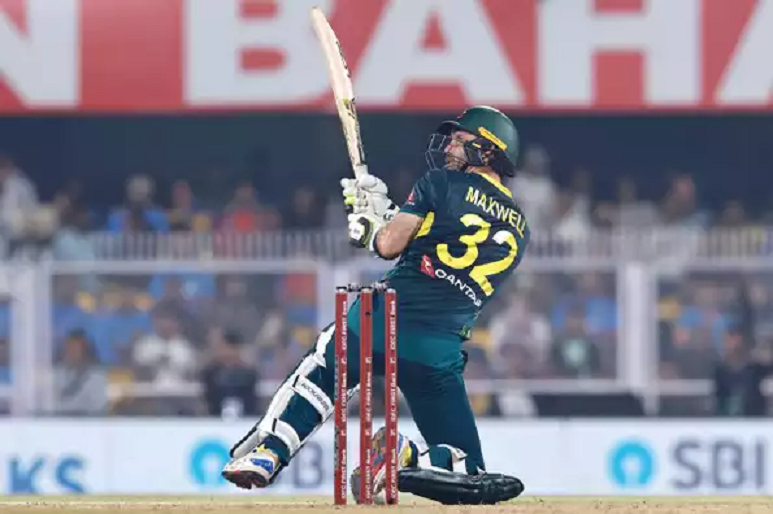
Glenn Maxwell’s third T20I ton, the joint-fastest by an Australian in the format, headlined Australia’s imperious chase of 223 in a last-ball finish against India in Guwahati on Tuesday (November 28). Skipper Matthew Wade played the ideal foil with a 16-ball 28 as the duo got Australia home after having joined hands with 89 needed off 39 balls. The Maxwell special overshadowed a masterly maiden T20I ton from Ruturaj Gaikwad earlier in the evening. This result keeps the series alive at 2-1 in India’s favour with two games to go.
Australia seize the early advantage
Unlike the T20I at Trivandrum, Australia started proceedings with a bang here with two of last game’s stars, Yashasvi Jaiswal and Ishan Kishan, both perishing well inside the first six overs. With a hint of swing on offer, Jason Behrendorff got one to shape away past a charging Jaiswal who could only nick a slash through to Wade. Shortly, Kane Richardson got a gifted wicket as Kishan’s back foot cut found short extra cover to perfection. It was just the start Australia needed after Wade had opted to bowl in dewy conditions
Ruturaj, Suryakumar do the rebuild act
With early wickets lost, India needed a partnership to launch at the back end. Ruturaj along with skipper Suryakumar Yadav steadied the ship with a partnership of 57 that came off just 47 balls. The latter was the aggressor as he took the bowling on from the get-go, even as Ruturaj dropped anchor with the aim to bat through the innings. Slowly but steadily the duo managed to infuse impetus into the innings as the pitch eased out into a batting beauty after the initial swing had disappeared.
A maiden T20I wicket to remember for Hardie
With the partnership between Ruturaj and Suryakumar looking ominous, Australia were desperate for a breakthrough. In his second spell, Hardie did just that by dismissing Suryakumar through a soft dismissal. It was the pacer’s first wicket in the format and one that he’ll cherish for a long time. The breakthrough also gave Australia some respite going into the back end.
Ruturaj shifts into top gear
Till Suryakumar’s dismissal, Ruturaj had been the silent partner although he also steadily upped his strike rate. But after losing his skipper, the 26-year-old took center stage and went into overdrive in the back end of the innings. For the record, the first 22 balls of Ruturaj’s innings produced 22 runs and he then went on to hammer 101 off the next 35 balls. His innings was studded with 13 fours and seven sixes as Ruturaj dominated the 141-run stand off just 58 balls with Tilak Varma.
Maxwell’s 20th over
As if Ruturaj’s blitzkrieg wasn’t bad enough for Australia, captain Wade was forced to give Maxwell the ball for the final over after Kane Richardson suffered an undisclosed injury. Not only was it an unfavourable matchup with the off-spinner bowling to the right-hander in Ruturaj amidst heavy dew, Maxwell also hadn’t bowled an over in the game prior to that point. The visitors paid dearly for the move as a whopping 30 runs came off the over as India soared past the 220-run mark.
Australia start off with a bang
Travis Head’s first game of the series wasn’t as memorable as his outing in the ODI World Cup final but the left-hander gave the Aussies much-needed momentum early in the run chase. There were a lot of his signature cuts and pulls as he backed away to upset the rhythm of India’s bowlers.
India chip away at the wickets
Makeshift opener Hardie and Head fell after providing a brisk start while Josh Inglis suffered a failure as India hit back with regular wickets. The decision to promote Marcus Stoinis to no.5 proved to be a tactical failure as the all-rounder simply struggled to get going, thereby heaping the pressure of the asking rate on Maxwell. At 128/5 in the 14th over, the target seemed a long way away despite the favourable chasing conditions on offer.
Maxwell unleashes the ‘Big Show’
Like in the game against Afghanistan in the ODI World Cup, the game wasn’t finished till Maxwell was around. He constantly found the ropes and also cleared it at will to keep Australia afloat, even if only just. Australia went into the final five overs needing 78 and despite getting 13 off the 16th over bowled by Avesh Khan, the asking rate surged past 16 runs per over. Understandably, Suryakumar gambled by bringing Arshdeep Singh in the 17th over to ramp up the required rate but that over went for 18 including huge sixes off the first two balls. India were clearly feeling the heat now. Prasidh Krishna, however, calmed the hosts’ nerves with a solid 18th over that went for just six runs leaving 43 to get off the last 12 balls.
Did Suryakumar miscalculate?
With just five specialist bowlers to work from and given that none of the part-time options had bowled, it meant that Suryakumar was forced to bowl Axar Patel in the penultimate over of the innings with the left-hander Wade taking strike. The over went for 22 including a pivotal no-ball moment when Ishan Kishan’s stumping appeal on being sent upstairs had the third umpire changing the initial wide call to a no-ball. The keeper had collected the ball marginally in front of the stumps, a matter that may not have been noticed if not for his stumping appeal. Australia and Wade didn’t mind it one bit as the Free Hit went sailing for six. Australia needed 21 off the final over.
The full circle moment for Maxwell and Prasidh
After bowling an impressive 18th over, Prasidh would have felt quietly confident of defending 20 in the final over even with the wet ball, dew and a rampaging Maxwell to contend with. However, the young pacer wilted under pressure from the get-go. Wade hammered the first ball for four and then unintentionally got a single to get Maxwell on strike. The equation came down to 16 needed off four balls. Earlier on with the ball, Maxwell had conceded 18 off the last four legal balls he bowled including a wide. It was his chance to redeem himself and that’s exactly what he did. A widish hard length ball was slapped over deep point for six and another slower widish ball found the fence again. After potentially bowling a clinching 18th over, Prasidh had lost the plot. An agricultural slog from Maxwell found the fence again, meaning that just two were needed off the final ball. Perhaps, the game was done even before Prasidh bowled the final ball and the inevitable slot ball was pumped back over the bowler’s head leaving the bowler with the most expensive figures for an Indian bowler in a T20I. Australia had survived through a Maxwell miracle yet again.
Brief scores:
India 222/3 in 20 overs (Ruturaj Gaikwad 123*, Suryakumar Yadav 39, Tilak Varma 31*) lost to Australia 225/5 in 20 overs (Glenn Maxwell 104*, Travis Head 35, Matthew Wade 28*; Ravi Bishnoi 2-32 ) by five wickets










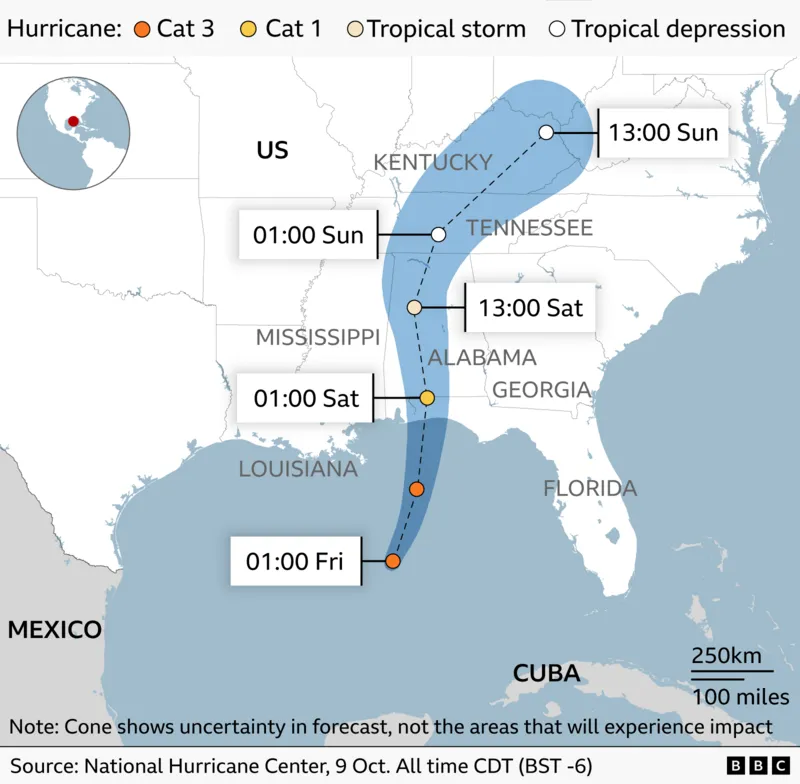
Hurricane Isaias has been downgraded to a post-tropical cyclone the day after it made landfall along the northern Gulf Coast of Florida, bringing with it heavy rains and powerful winds.
Isaias – which is the first of the 2026 Atlantic season – is still surging across south-eastern parts of the US.
Hundreds of thousands of households in Florida, Alabama and Georgia are without power, and each state has issued a state of emergency. There are currently no warnings in places after they ended on Saturday.
Isaias is one of three storm systems affecting North America this weekend, with the two others hitting Mexico and Southern California in the El Niño fuelled warm waters of the Pacific Ocean
Both Florida and Alabama instituted mandatory evacuations to thousands of people due to the storm.
In Florida, those evacuations included coastal communities in direct aim of the powerful storm. Senator Rick Scott encouraged residents in designated areas to evacuate as soon as possible, as he warned in a social media post: “DO NOT WAIT! Get out NOW!
Governor of Alabama Kay Ivey issued a mandatory evacuation for all non-residents, tourists and visitors in key counties likely to be heavily affected by the storm.
On Saturday, Homeland Security Secretary Markwaynet Mullinan said the US president had approved emergency declarations for the two states to “ensure federal resources are available” for support.
Hurricane Isaias is the first hurricane in the Atlantic’s hurricane season, which largely has been delayed due to El Niño conditions in the Pacific.
It marks the first time in more than 30 years that a hurricane did not form before October.
Ahead of the storm, the National Hurricane Center (NHC) warned it was likely to bring “life-threatening storm surge” to the US Gulf Coast.
All warnings pertaining to Isaias had been discontinued on Saturday morning, the NHC said.
The post-tropical cyclone is currently moving north and is expected to cross Alabama and into the Tennessee Valley later on Saturday and Sunday, according to the National Weather Service.
Hurricane-force winds on Friday evening extended outward up to 35 miles (55 km) from Isaias’ centre, and tropical storm-force winds extended as far as 205 miles (335 km).
However, hundreds of thousands are currently without power in the country’s southeast – and Alabama, Florida and Georgia have issued states of emergency as they brace for heavy rains and flooding.
On Saturday morning, more than 400,000 were in the dark in Florida and just over 300,000 customers in Alabama were experiencing outages, according to PowerOutage.us. In Georgia, more than 100,000 customers were without power.
Ahead of the hurricane, Pensacola resident John Guoth, told the BBC that he and his wife would remain at home despite the rest of his street having already left.
“It’s a hurricane, we get them all the time… we kind of knew that when we moved here,” he said, explaining that they have “battened down” anything that “can fly”.
Guoth said he put his ducks and chickens in the bathroom and weighed down his boats and trailers so “nothing flips over”.
A few households remained in the area, describing themselves as “long-term locals” who are “going to protect our homes”.
People in the Florida city who had “seen bad storms before” were still “bunkering up”, Brandin Ruth said. She told the BBC: “You don’t want to underestimate a storm like this”.

One indicator of a storm’s severity to southern communities was Friday’s closure of Stalwart restaurant chain, The Waffle House.
A Waffle House spokesperson confirmed to the BBC that the chain had already closed a number of locations in the hurricane’s path and “will continue monitoring conditions”.
US President Donald Trump also cancelled plans to attend a major American football college game in Tuscaloosa, Alabama because of the hurricane, shifting plans to attend a rally in Tennessee instead.

Two other storms are also forecast to batter North America this weekend.
Hurricane Simon is bearing down on the Pacific coast of Mexico as a category one hurricane. It is set to pick up speed and become category four by Saturday, eventually making landfall near Puerto Vallarta on Sunday, according to Reuters.
Further north, Tropical Storm Rachel, a downgraded hurricane, is heading toward landfall around the US-Mexico border, along the Pacific.
While, Rachel is expected to reach the coast late on Saturday, the impact of the storm is already being felt due to high tides in southern California.
Video footage and photos show several streets under water in Newport Beach, California, through a combination of the tropical storm swells at sea and high tide.
Posting on its account on X, the City of Newport Beach advised people to “avoid the Balboa Peninsula due to street flooding caused by recent storm conditions and elevated tides”.
It also urged people not to drive through flooded streets. Bulldozers have been shoring up the beach to try and prevent further flooding.
(BBC)
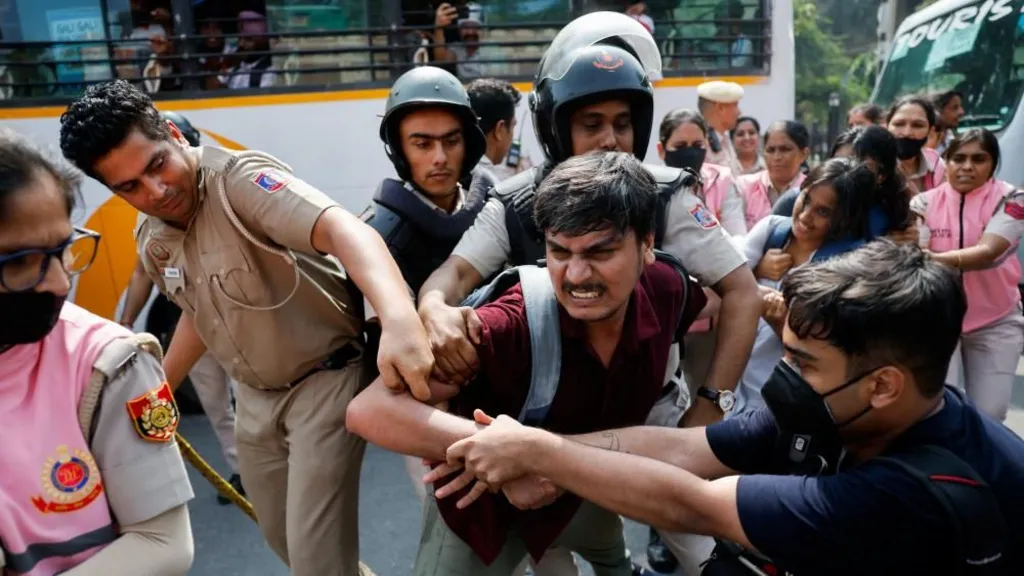
Hundreds of protesters have been detained in Delhi during the latest demonstration by the Gen-Z led Cockroach Janta Party (CJP) over electoral reforms.
The group said its founder Abhijeet Dipke, who began the movement in May after India’s Chief Justice likened some jobless young people to “cockroaches”, was detained with other leaders shortly after landing in Delhi.
Tens of thousands of security personnel were deployed and roads barricaded ahead of the demonstration, though the CJP insisted it would go ahead.
Delhi Police has not commented on the detentions, but had refused permission for the protest to take place at Jantar Mantar, a landmark in the Indian capital.
The group – who are not registered as a political party in India – are seeking electoral reforms just months before crucial state elections.
It has also demanded the resignation of Chief Election Commissioner (CEC) Gyanesh Kumar over allegations of manipulating voters’ lists – which the Election Commission has denied.
Under Kumar’s leadership, India’s election commission has undertaken a mammoth exercise to update electoral rolls nationwide – it said this was a routine exercise to weed out dead, duplicate or ineligible voters.
But in many states, the exercise has been shrouded in controversy, with tens of thousands of people alleging they have been wrongly removed.
The CJP – and opposition parties – accuse Kumar of favouring Prime Minister Narendra Modi’s Bharatiya Janata Party (BJP) in the way the electoral rolls are being updated.
The Election Commission and the BJP have denied this.
Before arriving in Delhi, the CJP’s founder Dipke said: “If you think you can stop us by threatening us with jail or trying to intimidate us with the fear of imprisonment, you are mistaken.”
He and and two other leaders, Saurav Das and Ashutosh Ranka, were detained on their flight from Mumbai on Saturday.
The group claimed the three men have been taken to an undisclosed location. Delhi Police have not commented.
Ajinkya Shinde, the CJP’s new designated leader while the others are in detention, released a video telling protesters that “if Delhi Police tries to stop you, wherever they stop you will become your Jantar Mantar”.
Student activist Neha Bora, who had also been detained by Delhi Police, urged demonstrators to “hold the line”.
The large number of protesters expected to descend on Delhi were unable to get anywhere close to Jantar Mantar due to the heavy security presence and road blocks.
Announcements could be heard across the city, asking people to co-operate with the police.
One protester, Sabika Muzaffar, told the BBC she and her mother expected to be detained.
“On the way to the protest site, instead of reciting hymns and verses as we usually do, my mother and I were rote learning our lawyer’s number,” she said.
She said that showing up to protest was “her way of defending the country and its democracy”.
A few minutes after Muzaffar spoke to the BBC she was taken away by police.
Several trains to and from major Delhi stations had been cancelled and dozens of metro stations were closed from Friday night.
Buses packed with detained protesters were seen being driven away from the protest site.

The CJP first emerged as a major protest movement during weeks of demonstrations over the summer demanding education reforms and the resignation of Education Minister Dharmendra Pradhan.
The group stemmed from a joke made by Dipke in response to a remark by India’s Chief Justice Surya Kant, who had likened jobless youngsters to “cockroaches”. He later said the comments were misinterpreted.
Dipke, who previously worked with the opposition Aam Aadmi Party (AAP), had just completed a master’s degree at Boston University when he posted a question on X in May: “What if all cockroaches come together?”
The post went viral, and the CJP was born. Momentum built around the movement which tapped into anger over over unemployment, exam paper leaks and government accountability.
In July, Dipke watched from the stage as the five-week-long protest ended in celebration after the resignation of India’s education minister.
(BBC)
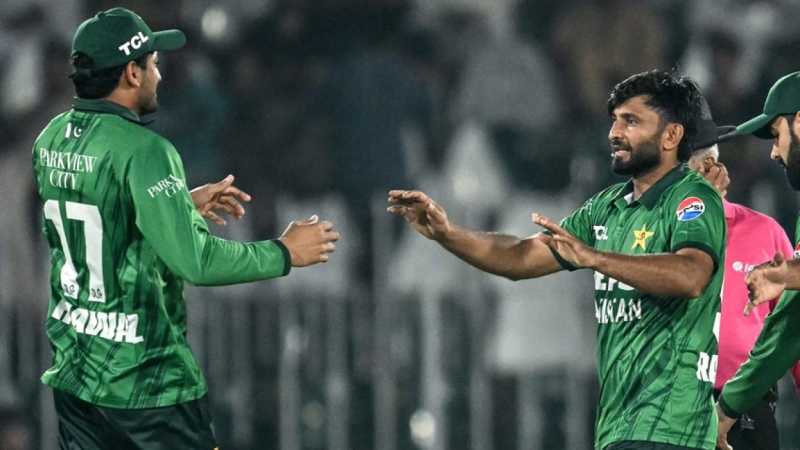
During the f8rst T20I against Sri Lanka on Friday, Pakistan demonstrated that 2026 is not quite like 2019. Back then, they had stumbled in pursuit of three Sri Lankan totals in succession – two of them lower than the 182 they gunned down with relative ease two days back, while the third was exactly 182. With that series perhaps fresher in Sri Lanka’s mind than it needed to be, Kusal Mendis’ side opted, against conventional wisdom, to bat first after winning the toss in Rawalpindi this time, hoping to recreate the magic formula from seven years earlier.
There were a few things we learned from the first game, though. The Rawalpindi surface isn’t quite as partial to fingerspin as T20 pitches in the subcontinent have been, which induced the hosts into playing three frontline seamers. Pakistan, who were playing with at least five potential opening batters, appear to have rejigged their batting order by pushing the timeless Fakhar Zaman up top and sending Saim Ayub at No. 5.
Sri Lanka, meanwhile, may have learned that while 32-year old Lahiru Udara hasn’t played much international cricket, his talent in this format is unmistakable, as is his temperament under pressure. Udara was the lone fighting hand for his side across much of the innings, though that shines more of a light on Sri Lanka’s batting order as a whole. With Dunith Wellalage, whose power-hitting abilities are limited, batting at No. 7, the visitors might want to beef up their batting order.
But there’s only so much that can be read into a lone T20I at the start of a long tour for Sri Lanka. Pakistan have an opportunity to wrap the series up by winning the second game, also in Rawalpindi, on Sunday, and will be favourites to do so after a dominant performance in the first. The worry for Sri Lanka is that their own indifferent showing comes on the back of three crushing defeats in England. On Sunday, they will try to show this is more of a temporary rut than a fair representation of their current T20I state.
Before playing on Friday, Naseem Shah’s last T20I came seven months ago. Even that game was against Sri Lanka, and as Pakistan bowed out of the T20 World Cup, he conceded 36 runs in four overs – exactly what he did in Rawalpindi. But two days back, Naseem had two more wickets to his name in a patchwork of a spell that shed a little more light on where his T20 game currently is. It is representative of a curious year for him as he works his way back after falling foul of the PCB at the PSL, before an injury sidelined him for months.
Naseem has worked his way back with respectable showings at a domestic 50-over tournament and the CPL. There might be hope of a foundation for a good run beginning to take shape, but it remains far too early to say.
Maheesh Theekshana too, conceded 36 runs in his four overs in the first T20I against Pakistan, but Sri Lanka may want more from the man who has become their lead spinner in Wanindu Hasaranga’s injury-enforced absence. More than any specifics about Theekshana’s spell, it was his bowling style that caught the eye – a poorly concealed imitation of Sikandar Raza’s rather than the more conventionally oriented action that he is recognisable in.
It appeared to have deprived Theekshana of the ability to slow the ball down as required, with Sahibzada Farhan often picking off the quicker pace with relative ease. Whether this remodelled action sticks will be a point of intrigue in this series.
Pakistan captain Farhan said he was thoroughly pleased by the performance in the first T20I. So an unchanged Pakistan side for the second T20I would not be a massive surprise.
Pakistan: Sahibzada Farhan (capt), Fakhar Zaman, Maaz Sadaqat, Hasan Nawaz, Saim Ayub, Khawaja Nafay (wk), Shadab Khan, Mohammad Imran, Razaullah, Naseem Shah, Abrar Ahmed
Wellalage at No. 7 might be a position too high. So Sri Lanka could look to add batting depth to their side by including Sineth Jayawardena instead of Nuwan Thushara, who went for 32 runs in three overs on Friday.
Sri Lanka: Lahiru Udara, Kusal Mendis (capt, wk), Sineth Jayawardena, Kamindu Mendis, Kamil Mishara, Sahan Arachchige, Dasun Shanaka, Dunith Wellalage, Dushmantha Chameera, Maheesh Theekshana, Eshan Malinga

Hurricane Isaias downgraded after making landfall in Florida

‘Cockroach’ group leaders among hundreds detained in Delhi protest

Sri Lanka hope to get out of T20I rut and keep series alive

Sri Lanka ITEC Alumni Association formally launched

Measures underway to protect Diyagama Forest as a Reserve — Deputy Minister of Environment

Showers or thundershowers will occur in most parts of the island after 1.00 p.m.

‘Dates have the highest sugar content to fight Coronavirus’

Sunday Island 27 December – Headlines

#SundayIsland 17th December – Headlines

Sunday Island – 28th March

Sunday Island Headlines – 21 March

Sunday Island – 21st February – Headlines
-

 News6 days ago
Geneva takes up Sallay’s case and govt. ignores opportunity to answer accusations
-

 Features7 days ago
The first woman in the foreign service or Ceylon Overseas Service it was then called
-

 News7 days ago
Nearly 20 Iranian tankers stranded off Lanka amid US sanctions
-

 Features5 days ago
Preventing grievances from becoming communal
-

 Sports3 days ago
Nissanka absence opens door for Sri Lanka’s young guns
-

 News4 days ago
Gnansara Thera to be assigned to prison printing section: Officials
-

 Features6 days ago
Sri Lanka Cricket Bill: Governance reform is not yet a cricket strategy
-

 News7 days ago
Lanka enters new phase of prosecutions as hurdles clear