
Midweek Review
‘Masterpiece: The Origin and Evolution’ – II

(Part 1 of this article was published in Midweek Review on 25 June 2025.)
French sculptor and painter Marcel Duchamp say, “a Masterpiece is created by the viewer, not by the artist”. He highlights the idea that the interpretation as well as deriving meanings of art are subjective and embedded within the viewer’s experience, rather than being solely determined by the discretion of the artist. Former Director of the Louvre Museum Henri Loyrette once stated, “It became evident that it is extremely difficult, if not impossible, to articulate a definition of masterpiece that could be accepted universally”.
In terms of body of work, three conducive elements exercise a significant influence over recognising and positioning a creative work in the realm of art as a ‘Masterpiece’.
Firstly, a work of Art which showcases technical and artistic innovation is indelible from history books and capable of earning substantive accolades from the spectators. These conditions entitle a work of Art to continue to endure as a ‘Masterpiece’.
Created in 1872, Impressionist painter Claude Monet’s ‘Impression Sunrise’ is a work of art which received universal recognition as a ‘masterpiece’ for its innovative artistic and conceptual approach and technical amelioration. The ‘Name’ of this artistic tradition derives from the title of Monet’s ‘Impression Sunrise’. The name was coined by French art critic and journalist Louis Leroy, referring to the Impressionist style in a derisory manner at the first Impressionist exhibition in Paris in 1874. Monet’s ‘Impression Sunrise’ was accompanied by remarkable technical advancement which resulted from research in Optics. Eugene Chevre, a French chemist, discovered that optical illusions could be created by placing certain colors next to each other. Taking advantage of this finding, Impressionists combined visible, short and thick brush strokes with glowing vibrant colors to create a sense of light and darkness, movement of objects and sense of distance.

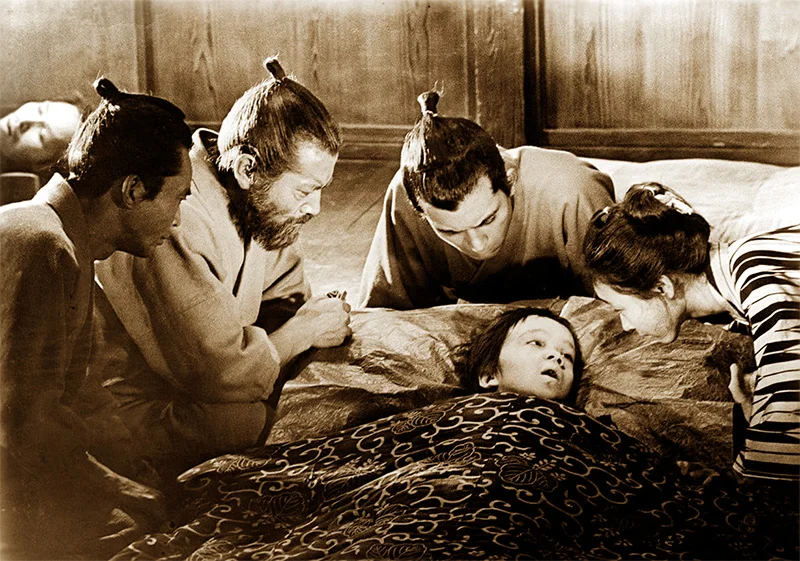
Tomoko in Her Bath
Another key example of the innovative application of technical and artistic developments is D.W. Griffith’s silent cinematic anthology ‘The Intolerance’. Released in September 1916, with an enormous production cost of 2.5 million dollars, it is considered to be a bold step by a filmmaker in the history of creative filmmaking. Despite the movie’s commercial failure, considering its narrative style, sophisticated editing techniques, innovative cinematography, expensive costume design, massive set designs and 3000 extra cast, it consistently receives appraisal and recognition as a benchmark in film history. Many European and Soviet filmmakers drew inspiration from its unconventional editing and historical storytelling. In 1989, the American Library Congress recognized ‘Intolerance’ as “a film with lasting social and cultural significance”.
Russian filmmaker Sergei Eisenstein’s silent film ‘Battleship Potemkin’ (1925) continues to be recognized as a cinematic ‘Masterpiece’ and persists as one of the greatest even to this day for its groundbreaking editing technique. The ‘Soviet Montage Theory’ developed by Eisenstein highlights the power of editing to create meanings and evoke audience’s emotional response. The essence of the theory suggests the juxtaposition of distinct shots to create a new meaning or effect, often conveying a specific meaning or emotion more powerfully than the individual shots alone.
Secondly, an artistic work with a strong emotional appeal tends to endure, transcending the spatial and temporal boundaries as a Masterpiece. A work of Art which evokes strong emotions in the human mind never fades away from the person’s emotional sphere. Profound human dynamics depicted in an artistic composition prompt the spectator to reflect on their own personal human dynamics. A work of art interacts with the viewer using a visual language. This enables the viewer to perceive and interpret the ideas as well as emotions that might be difficult to articulate through words.
The poignant historical photographic essay ‘Tomoko in Her Bath’, captured by American photojournalist Eugene Smith, manifests a strong emotional statement of profound love, tenderness and compassion between a mother and her child who is severely paralyzed and deformed, being bathed in a bath tank . The photographic composition, reminiscent of Michelangelo’s Pietà, reveals the traumatic story of Tomoko, who lived in the Minamata fishing Village in Japan and was crippled by mercury poisoning after consuming contaminated fish. The fish were contaminated with tonnes of industrial wastewater containing mercury dumped into the marine area of Minamata Bay by a chemical factory between the period of 1932 and 1968. Smith’s artistic and symbolic expression of the dimensions of human suffering caused by the devastating industrial pollution elevated this powerful image to the status of a ‘Masterpiece’.
The aesthetically expressed subliminal human conditions in cinema continue to endure in the human sphere, transcending all boundaries. They provide a strong catalyst for the viewer to be companionate, empathetic and humane towards the ‘other’. One such example is the outstanding cinematic expression Red Beard (1965) by Akira Kurosawa, who reflects the importance of empathy and compassion to the greatest extent possible. Kurosawa’s incomparable humanistic approach in this movie contemplates a simple humanist gesture of kindness that could give solace to humans who are bereft of attention, love and respect. This in turn awakens a profound sense of compassion and sympathy in the viewer.

The Green Mile
“I am always hungry, so are my siblings. I wish I was a horse. Horses eat grass; we have plenty of that”. These heart-wrenching words were from the outspoken little one called ‘Chobo ’in the movie. The character of ‘Chobo’ who is driven by hunger steals food for him and his family, reflects the magnitude of human suffering, helplessness and the depth of human misery in a poverty-stricken social backdrop. The weight of the humanist theme of the movie enables the viewer to deeply immerse and resonate with the narrative and characters, which eventually ensures the cinematic expression lasts as long as a ‘Masterpiece’.
Another cinematic creation which delves deeper into themes such as compassion, injustice and empathy is Frank Darabont’s ‘The Green Mile’ (1999), which signifies the importance of being humane towards the ‘other’ at any moment in life. The execution of wrongly convicted ‘John Coffey’, a man with a physically imposing figure and a childlike gentle soul, by electrocution is one of the most powerfully constructed and poignant scenes in cinema history. This scene made the audience deeply saddened and sustained a lasting impact on the human mind, making ‘The Green Mile’ stay among the most emotionally impactful movies of all time.
Thirdly, the ‘Creative Excellence’ reflected by a Work of Art holds authority to declare itself a ‘Masterpiece’. Such ‘Masterpieces’ shine bright as ‘Artistic Exceptions’. These exceptional works have a unique way of initiating an impressive conversation with the viewer using their iconic visual language enriched with aesthetic elements. These extraordinary pieces of Art possess a certain charisma to attract the viewer while allowing the viewer to find meanings and insights through interpreting them over time. Some of the prime examples found in the global realm of art include ‘David’ by Michelangelo, Leonardo da Vinci’s ‘Mona Lisa’ (1503-1506), Johannes Vermeer’s ‘Girl with a Pearl Earring’ (1665) and ‘Guernica’ (1937) by Pablo Picasso. And powerful cinematic expressions such as ‘Doctor Zhivago’ (1965) by David Lean, a movie based on the novel by Boris Pasternak of the same name ‘Doctor Zhivago‘ (1957), ‘The Mirror’ (1975) by Andrei Tarkovsky, Terrence Malick’s ‘The Tree of Life’ (2011) and Christopher Nolan’s “Oppenheimer” (2023) continues to carry a powerful artistic charisma and enduring influence and considered masterpieces, regardless of critical acclaim or widespread criticism. These masterpieces often inspire prospective artists, while remaining inimitable and irreplaceable. The confluence of the extraordinary creativity of the artist and the unparalleled creative appeal reflected in the work elevate it to the state of eternity. The visual language of artistic creations, which is considered eternal, encompasses multiple inherent ambiguities. They evoke mystery, enigma and sense of wonder in the viewer and never allow the viewer to interpret or comprehend it extensively. The intriguing and enigmatic portrayal of visual symbolism in such masterpieces reflects the hidden mysteries of human nature which trigger curiosity in the spectator.
Leo Tolstoy, in one of his diary notes on May 17, 1896, writes ” the principal aim of art, if there is art, and if it has an aim, is to manifest and express the truth about man’s soul, to express those mysteries which it is impossible to express simply by speech. From this spring’s Art. Art is a microscope which the artist fixes on the mysteries of his soul and shows to people those mysteries which are common to all”.
The meaning of ‘Masterpiece’ evolved through temporal stages, from a term devised within Craft Guilds in the 12th century to a modern definition encompassing a wider range of creative genres in the subjective space. The possibility for a work of Art to reign in authority as a masterpiece is determined by the amplitude of recognition, appreciation and its ability to resonate deeply with the viewer’s artistic and emotional perceptions, otherwise it is bound to fade into oblivion. The creative work’s visual power is a crucial factor for fostering an interrelationship with the viewer. This interrelationship could last for centuries. British historian and broadcaster Kenneth Clarke, in his 1979 book’ What is a Masterpiece’, mentioned the “extraordinary fact that they can speak to us, as they have spoken to our ancestors for centuries”.
by Bhagya Rajapakse
bhagya8282@gmail.com

JVP leader Somawansa Amarasinghe, who returned to Sri Lanka in late Nov, 2001, ending a 12-year self-imposed exile in Europe, declared that India helped him flee certain death as the government crushed his party’s second insurrection against the state in the ’80s, using even death squads. Amarasinghe, sole surviving member of the original politburo of the JVP, profusely thanked India and former Prime Minister V.P. Singh for helping him survive the crackdown. Neither the JVP nor India never explained the circumstances New Delhi facilitated Amarasinghe’s escape, particularly against the backdrop of the JVP’s frenzied anti-India campaign. The JVP has claimed to have killed Indian soldiers in the East during the 1987-1989 period. Addressing his first public meeting at Kalutara, a day after his arrival, Amarasinghe showed signs that the party had shed its anti-India policy of yesteryears. The JVPer paid tribute to the people of India, PM Singh and Indian officials who helped him escape.
By Shamindra Ferdinando
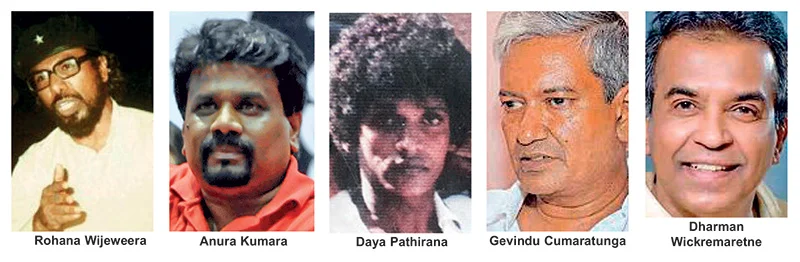
Forty years after the killing of Daya Pathirana, the third head of the Independent Student Union (ISU) by the Socialist Students’ Union (SSU), affiliated with the JVP, one-time Divaina journalist Dharman Wickremaretne has dealt with the ISU’s connections with some Tamil terrorist groups. The LTTE (Liberation Tigers of Tamil Eelam) hadn’t been among them, according to Wickremaretne’s Daya Pathirana Ghathanaye Nodutu Peththa (The Unseen Side of Daya Pathirana Killing), the fifth of a series of books that discussed the two abortive insurgencies launched by the JVP in 1971 and the early ’80s.
Pathirana was killed on 15 December, 1986. His body was found at Hirana, Panadura. Pathirana’s associate, Punchiralalage Somasiri, also of the ISU, who had been abducted, along with Pathirana, was brutally attacked but, almost by a miracle, survived to tell the tale. Daya Pathirana was the second person killed after the formation of the Deshapremi Janatha Vyaparaya (DJV), the macabre wing of the JVP, in early March 1986. The DJV’s first head had been JVP politburo member Saman Piyasiri Fernando.
Its first victim was H. Jayawickrema, Principal of Middeniya Gonahena Vidyalaya, killed on 05 December, 1986. The JVP found fault with him for suspending several students for putting up JVP posters.
Wickremaretne, who had been relentlessly searching for information, regarding the violent student movements for two decades, was lucky to receive obviously unconditional support of those who were involved with the SSU and ISU as well as other outfits. Somasiri was among them.
Deepthi Lamaheva had been ISU’s first leader. Warnakulasooriya succeeded Lamahewa and was replaced by Pathirana. After Pathirana’s killing K.L. Dharmasiri took over. Interestingly, the author justified Daya Pathirana’s killing on the basis that those who believed in violence died by it.
Wickremaretne’s latest book, the fifth of the series on the JVP, discussed hitherto largely untouched subject – the links between undergraduates in the South and northern terrorists, even before the July 1983 violence in the wake of the LTTE killing 12 soldiers, and an officer, while on a routine patrol at Thinnavely, Jaffna.
The LTTE emerged as the main terrorist group, after the Jaffna killings, while other groups plotted to cause mayhem. The emergence of the LTTE compelled the then JRJ government to transfer all available police and military resources to the North, due to the constant attacks that gradually weakened government authority there. In Colombo, ISU and Tamil groups, including the PLOTE (People’s Liberation Tigers of Tamil Eelam) enhanced cooperation. Wickremaretne shed light on a disturbing ISU-PLOTE connection that hadn’t ever been examined or discussed or received sufficient public attention.
In fact, EROS (Eelam Revolutionary Organisation of Students), too, had been involved with the ISU. According to the author, the ISU had its first meeting on 10 April, 1980. In the following year, ISU established contact with the EPRLF (Eelam People’s Revolutionary Liberation Front). The involvement of ISU with the PLOTE and Wickremaretne revealed how the SSU probed that link and went to the extent of secretly interrogating ISU members in a bid to ascertain the details of that connection. ISU activist Pradeep Udayakumara Thenuwara had been forcibly taken to Sri Jayewardenepura University where he was subjected to strenuous interrogation by SSU in a bid to identify those who were involved in a high profile PLOTE operation.
The author ascertained that the SSU suspected Pathirana’s direct involvement in the PLOTE attack on the Nikaweratiya Police Station, and the Nikaweratiya branch of the People’s Bank, on April 26, 1985. The SSU believed that out of a 16-member gang that carried out the twin attacks, two were ISU members, namely Pathirana, and another identified as Thalathu Oya Seneviratne, aka Captain Senevi.
The SSU received information regarding ISU’s direct involvement in the Nikaweratiya attacks from hardcore PLOTE cadre Nagalingam Manikkadasan, whose mother was a Sinhalese and closely related to JVP’s Upatissa Gamanayake. The LTTE killed Manikkadasan in a bomb attack on a PLOTE office, in Vavuniya, in September, 1999. The writer met Manikkadasan, at Bambapalitiya, in 1997, in the company of Dharmalingham Siddharthan. The PLOTE had been involved in operations in support of President Chandrika Bandaranaike Kumaratunga’s administration.
It was President Premadasa who first paved the way for Tamil groups to enter the political mainstream. In spite of some of his own advisors expressing concern over Premadasa’s handling of negotiations with the LTTE, he ordered the then Elections Commissioner Chandrananda de Silva to grant political recognition to the LTTE. The LTTE’s political wing PFLT (People’s Front of Liberation Tigers) received recognition in early December, 1989, seven months before Eelam War II erupted.
Transformation of ISU
The author discussed the formation of the ISU, its key members, links with Tamil groups, and the murderous role in the overall counter insurgency campaign during JRJ and Ranasinghe Premadasa presidencies. Some of those who had been involved with the ISU may have ended up with various other groups, even civil society groups. Somasiri, who was abducted along with Pathirana at Thunmulla and attacked with the same specialised knife, but survived, is such a person.
Somasiri contested the 06 May Local Government elections, on the Jana Aragala Sandhanaya ticket. Jana Aragala Sandhanaya is a front organisation of the Frontline Socialist Party/ Peratugaami pakshaya, a breakaway faction of the JVP that also played a critical role in the violent protest campaign Aragalaya against President Gotabaya Rajapaksa. That break-up happened in April 2012, The wartime Defence Secretary, who secured the presidency at the 2019 presidential election, with 6.9 mn votes, was forced to give up office, in July 2022, and flee the country.
Somasiri and Jana Aragala Sandhanaya were unsuccessful; the group contested 154 Local Government bodies and only managed to secure only 16 seats whereas the ruling party JVP comfortably won the vast majority of Municipal Councils, Urban Councils and Pradeshiya Sabhas.
Let us get back to the period of terror when the ISU was an integral part of the UNP’s bloody response to the JVP challenge. The signing of the Indo-Lanka accord, in late July 1987, resulted in the intensification of violence by both parties. Wickremaretne disclosed secret talks between ISU leader K.L. Dharmasiri and the then Senior SSP (Colombo South) Abdul Cader Abdul Gafoor to plan a major operation to apprehend undergraduates likely to lead protests against the Indo-Lanka accord. Among those arrested were Gevindu Cumaratunga and Anupa Pasqual. Cumaratunga, in his capacity as the leader of civil society group Yuthukama, that contributed to the campaign against Yahapalanaya, was accommodated on the SLPP National List (2020 to 2024) whereas Pasqual, also of Yuthukama, entered Parliament on the SLPP ticket, having contested Kalutara. Pasqual switched his allegiance to Ranil Wickremesinghe after Gotabaya Rajapaksa’s ouster in July 2022.
SSU/JVP killed K.L. Dharmasiri on 19 August, 1989, in Colomba Kochchikade just a few months before the Army apprehended and killed JVP leader Rohana Wijeweera. Towards the end of the counter insurgency campaign, a section of the ISU was integrated with the military (National Guard). The UNP government had no qualms in granting them a monthly payment.
Referring to torture chambers operated at the Law Faculty of the Colombo University and Yataro operations centre, Havelock Town, author Wickremaretne underscored the direct involvement of the ISU in running them.
Maj. Tuan Nizam Muthaliff, who had been in charge of the Yataro ‘facility,’ located near State Defence Minister Ranjan Wijeratne’s residence, is widely believed to have shot Wijeweera in November, 1989. Muthaliff earned the wrath of the LTTE for his ‘work’ and was shot dead on May 3, 2005, at Polhengoda junction, Narahenpita. At the time of Muthaliff’s assassination, he served in the Military Intelligence.
Premadasa-SSU/JVP link
Ex-lawmaker and Jathika Chinthanaya Kandayama stalwart Gevindu Cumaratunga, in his brief address to the gathering, at Wickremaretne’s book launch, in Colombo, compared Daya Pathirana’s killing with the recent death of Nandana Gunatilleke, one-time frontline JVPer.
Questioning the suspicious circumstances surrounding Gunatilleke’s demise, Cumaratunga strongly emphasised that assassinations shouldn’t be used as a political tool or a weapon to achieve objectives. The outspoken political activist discussed the Pathirana killing and Gunatilleke’s demise, recalling the false accusations directed at the then UNPer Gamini Lokuge regarding the high profile 1986 hit.
Cumaratunga alleged that the SSU/JVP having killed Daya Pathirana made a despicable bid to pass the blame to others. Turning towards the author, Cumaratunga heaped praise on Wickremaretne for naming the SSU/JVP hit team and for the print media coverage provided to the student movements, particularly those based at the Colombo University.
Cumaratunga didn’t hold back. He tore into SSU/JVP while questioning their current strategies. At one point a section of the audience interrupted Cumaratunga as he made references to JVP-led Jathika Jana Balawegaya (JJB) and JJB strategist Prof. Nirmal Dewasiri, who had been with the SSU during those dark days. Cumaratunga recalled him attending Daya Pathirana’s funeral in Matara though he felt that they could be targeted.
Perhaps the most controversial and contentious issue raised by Cumaratunga was Ranasinghe Premadasa’s alleged links with the SSU/JVP. The ex-lawmaker reminded the SSU/JVP continuing with anti-JRJ campaign even after the UNP named Ranasinghe Premadasa as their candidature for the December 1988 presidential election. His inference was clear. By the time Premadasa secured the presidential nomination he had already reached a consensus with the SSU/JVP as he feared JRJ would double cross him and give the nomination to one of his other favourites, like Gamini Dissanayake or Lalith Athulathmudali.
There had been intense discussions involving various factions, especially among the most powerful SSU cadre that led to putting up posters targeting Premadasa at the Colombo University. Premadasa had expressed surprise at the appearance of such posters amidst his high profile ‘Me Kawuda’ ‘Monawada Karanne’poster campaign. Having questioned the appearance of posters against him at the Colombo University, Premadasa told Parliament he would inquire into such claims and respond. Cumaratunga alleged that night UNP goons entered the Colombo University to clean up the place.
The speaker suggested that the SSU/JVP backed Premadasa’s presidential bid and the UNP leader may have failed to emerge victorious without their support. He seemed quite confident of his assertion. Did the SSU/JVP contribute to Premadasa’s victory at one of the bloodiest post-independence elections in our history.
Cumaratunga didn’t forget to comment on his erstwhile comrade Anupa Pasqual. Alleging that Pasqual betrayed Yuthukama when he switched allegiance to Wickremesinghe, Cumaratunga, however, paid a glowing tribute to him for being a courageous responder, as a student leader.
SSU accepts Eelam
One of the most interesting chapters was the one that dealt with the Viplawadi Janatha Vimukthi Peramuna/Revolutionary Janatha Vimukthi Peramuna (RJVP), widely known as the Vikalpa Kandaya/Alternative Group and the ISU mount joint campaigns with Tamil groups. Both University groups received weapons training, courtesy PLOTE and EPRLF, both here, and in India, in the run-up to the so-called Indo-Lanka Peace Accord. In short, they accepted Tamils’ right to self-determination.
The author also claimed that the late Dharmeratnam Sivaram had been in touch with ISU and was directly involved in arranging weapons training for ISU. No less a person than PLOTE Chief Uma Maheswaran had told the author that PLOTE provided weapons training to ISU, free of charge ,and the JVP for a fee. Sivaram, later contributed to several English newspapers, under the pen name Taraki, beginning with The Island. By then, he propagated the LTTE line that the war couldn’t be brought to a successful conclusion through military means. Taraki was abducted near the Bambalapitiya Police Station on the night of 28 April, 2005, and his body was found the following day.
The LTTE conferred the “Maamanithar” title upon the journalist, the highest civilian honour of the movement.
In the run up to the Indo-Lanka Peace Accord, India freely distributed weapons to Tamil terrorist groups here who in turn trained Sinhala youth.
Had it been part of the overall Indian destabilisation project, directed at Sri Lanka? PLOTE and EPRLF couldn’t have arranged weapons training in India as well as terrorist camps here without India’s knowledge. Unfortunately, Sri Lanka never sought to examine the origins of terrorism here and identified those who propagated and promoted separatist ideals.
Exactly a year before Daya Pathirana’s killing, arrangements had been made by ISU to dispatch a 15-member group to India. But, that move had been cancelled after law enforcement authorities apprehended some of those who received weapons training in India earlier. Wickremaretne’s narrative of the students’ movement, with the primary focus of the University of Colombo, is a must read. The author shed light on the despicable Indian destabilisation project that, if succeeded, could have caused and equally destructive war in the South. In a way, Daya Pathirana’s killing preempted possible wider conflict in the South.
Gevindu Cumaratunga, in his thought-provoking speech, commented on Daya Pathirana. At the time Cumaratunga entered Colombo University, he hadn’t been interested at all in politics. But, the way the ISU strongman promoted separatism, influenced Cumaratunga to counter those arguments. The ex-MP recollected how Daya Pathirana, a heavy smoker (almost always with a cigarette in his hand) warned of dire consequences if he persisted with his counter views.
In fact, Gevindu Cumaratunga ensured that the ’80s terror period was appropriately discussed at the book launch. Unfortunately, Wickremaretne’s book didn’t cause the anticipated response, and a dialogue involving various interested parties. It would be pertinent to mention that at the time the SSU/JVP decided to eliminate Daya Pathirana, it automatically received the tacit support of other student factions, affiliated to other political parties, including the UNP.
Soon after Anura Kumara Dissanayake received the leadership of the JVP from Somawansa Amarasinghe, in December 2014, he, in an interview with Saroj Pathirana of BBC Sandeshaya, regretted their actions during the second insurgency. Responding to Pathirana’s query, Dissanayake not only regretted but asked for forgiveness for nearly 6,000 killings perpetrated by the party during that period. Author Wickremaretne cleverly used FSP leader Kumar Gunaratnam’s interview with Upul Shantha Sannasgala, aired on Rupavahini on 21 November, 2019, to remind the reader that he, too, had been with the JVP at the time the decision was taken to eliminate Daya Pathirana. Gunaratnam moved out of the JVP, in April 2012, after years of turmoil. It would be pertinent to mention that Wimal Weerawansa-Nandana Gunatilleke led a group that sided with President Mahinda Rajapaksa during his first term, too, and had been with the party by that time. Although the party split over the years, those who served the interests of the JVP, during the 1980-1990 period, cannot absolve themselves of the violence perpetrated by the party. This should apply to the JVPers now in the Jathika Jana Balawegaya (JJB), a political party formed in July 2019 to create a platform for Dissanayake to contest the 2019 presidential election. Dissanayake secured a distant third place (418,553 votes [3.16%])
However, the JVP terrorism cannot be examined without taking into JRJ’s overall political strategy meant to suppress political opposition. The utterly disgusting strategy led to the rigged December 1982 referendum that gave JRJ the opportunity to postpone the parliamentary elections, scheduled for August 1983. JRJ feared his party would lose the super majority in Parliament, hence the irresponsible violence marred referendum, the only referendum ever held here to put off the election. On 30 July, 1983, JRJ proscribed the JVP, along with the Nawa Sama Samaja Party and the Communist Party, on the false pretext of carrying out attacks on the Tamil community, following the killing of 13 soldiers in Jaffna.
Under Dissanayake’s leadership, the JVP underwent total a overhaul but it was Somawansa Amarasinghe who paved the way. Under Somawansa’s leadership, the party took the most controversial decision to throw its weight behind warwinning Army Chief General (retd) Sarath Fonseka at the 2010 presidential election. That decision, the writer feels, can be compared only with the decision to launch its second terror campaign in response to JRJ’s political strategy. How could we forget Somawansa Amarasinghe joining hands with the UNP and one-time LTTE ally, the Tamil National Alliance (TNA), to field Fonseka? Although they failed in that US-backed vile scheme, in 2010, success was achieved at the 2015 presidential election when Maithripala Sirisena was elected.
Perhaps, the JVP took advantage of the developing situation (post-Indo-Lanka Peace Accord), particularly the induction of the Indian Army here, in July 1987, to intensify their campaign. In the aftermath of that, the JVP attacked the UNP parliamentary group with hand grenades in Parliament. The August 1987 attack killed Matara District MP Keerthi Abeywickrema and staffer Nobert Senadheera while 16 received injuries. Both President JRJ and Prime Minister Ranasinghe Premadasa had been present at the time the two hand grenades were thrown at the group.
Had the JVP plot to assassinate JRJ and Premadasa succeeded in August 1987, what would have happened? Gevindu Cumaratunga, during his speech also raised a very interesting question. The nationalist asked where ISU Daya Pathirana would have been if he survived the murderous JVP.
I am an old man, having reached “four score and five” years, to describe my age in archaic terms. From a biological perspective, I have “grown old.” However, I believe that for those with sufficient inner resources, old age provides fertile ground to cultivate a new outlook and reap a late harvest before the sun sets on life.
Negative Characterisation of Old Age
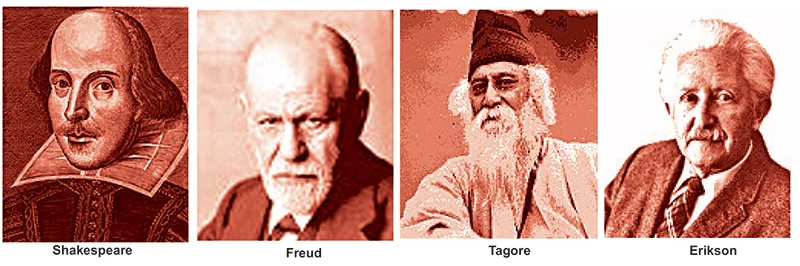
My early medical education and training familiarised me with the concept of biological ageing: that every living organism inevitably undergoes progressive degeneration of its tissues over time. Old age is often associated with disease, disability, cognitive decline, and dependence. There is an inkling of futility, alienation, and despair as one approaches death. Losses accumulate. As Shakespeare wrote in Hamlet, “When sorrows come, they come not single spies, but in battalions.” Doctors may experience difficulty in treating older people and sometimes adopt an attitude of therapeutic nihilism toward a life perceived to be in decline.
Categorical assignment of symptoms is essential in medical practice when arriving at a diagnosis. However, placing an individual into the box of a “geriatric” is another matter, often resulting in unintended age segregation and stigmatisation rather than liberation of the elderly. Such labelling may amount to ageism. It is interesting to note that etymologically, the English word geriatric and the Sanskrit word jara both stem from the Indo-European root geront, meaning old age and decay, leading to death (jara-marana).
Even Sigmund Freud (1875–1961), the doyen of psychoanalysis, who influenced my understanding of personality structure and development during my psychiatric training, focused primarily on early development and youth, giving comparatively little attention to the psychology of old age. He believed that instinctual drives lost their impetus with ageing and famously remarked that “ageing is the castration of youth,” implying infertility not only in the biological sense. It is perhaps not surprising that Freud began his career as a neurologist and studied cerebral palsy.
Potential for Growth in Old Age
The model of human development proposed by the psychologist Erik Erikson (1902–1994), which he termed the “eight stages of man,” is far more appealing to me. His theory spans the entire life cycle, with each stage presenting a developmental task involving the negotiation of opposing forces; success or failure influences the trajectory of later life. The task of old age is to reconcile the polarity between “ego integrity” and “ego despair,” determining the emotional life of the elderly.
Ego integrity, according to Erikson, is the sense of self developed through working through the crises (challenges) of earlier stages and accruing psychological assets through lived experience. Ego despair, in contrast, results from the cumulative impact of multiple physical and emotional losses, especially during the final stage of life. A major task of old age is to maintain dignity amidst such emotionally debilitating forces. Negotiating between these polarities offers the potential for continued growth in old age, leading to what might be called a “meaningful finish.”
I do not dispute the concept of biological ageing. However, I do not regard old age as a terminal phase in which growth ceases and one is simply destined to wither and die. Though shadowed by physical frailty, diminishing sensory capacities and an apparent waning of vitality, there persists a proactive human spirit that endures well into late life. There is a need in old age to rekindle that spirit. Ageing itself can provide creative opportunities and avenues for productivity. The aim is to bring life to a meaningful close.
To generate such change despite the obstacles of ageing — disability and stigmatisation — the elderly require a sense of agency, a gleam of hope, and a sustaining aspiration. This may sound illusory; yet if such illusions are benign and life-affirming, why not allow them?
Sharon Kaufman, in her book The Ageless Self: Sources of Meaning in Late Life, argues that “old age” is a social construct resisted by many elders. Rather than identifying with decline, they perceive identity as a lifelong process despite physical and social change. They find meaning in remaining authentically themselves, assimilating and reformulating diverse life experiences through family relationships, professional achievements, and personal values.
Creative Living in Old Age
We can think of many artists, writers, and thinkers who produced their most iconic, mature, or ground-breaking work in later years, demonstrating that creativity can deepen and flourish with age. I do not suggest that we should all aspire to become a Monet, Picasso, or Chomsky. Rather, I use the term “creativity” in a broader sense — to illuminate its relevance to ordinary, everyday living.
Endowed with wisdom accumulated through life’s experiences, the elderly have the opportunity for developmental self-transformation — to connect with new identities, perspectives, and aspirations, and to engage in a continuing quest for purpose and meaning. Such a quest serves an essential function in sustaining mental health and well-being.
Old age offers opportunities for psychological adaptation and renewal. Many elders use the additional time afforded by retirement to broaden their knowledge, pursue new goals, and cultivate creativity — an old age characterised by wholeness, purpose, and coherence that keeps the human spirit alive and growing even as one’s days draw to a close.
Creative living in old age requires remaining physically, cognitively, emotionally, and socially engaged, and experiencing life as meaningful. It is important to sustain an optimistic perception of health, while distancing oneself from excessive preoccupation with pain and trauma. Positive perceptions of oneself and of the future help sustain well-being. Engage in lifelong learning, maintain curiosity, challenge assumptions — for learning itself is a meaning-making process. Nurture meaningful relationships to avoid disengagement, and enter into respectful dialogue, not only with those who agree with you. Cultivate a spiritual orientation and come to terms with mortality.
The developmental task of old age is to continue growing even as one approaches death — to reap a late harvest. As Rabindranath Tagore expressed evocatively in Gitanjali [‘Song Offerings’], which won him the Nobel Prize:: “On the day when death will knock at thy door, what wilt thou offer to him?
Oh, I will set before my guest the full vessel of my life — I will never let him go with empty hands.”
by Dr Siri Galhenage
Psychiatrist (Retired)
[sirigalhenage@gmail.com]
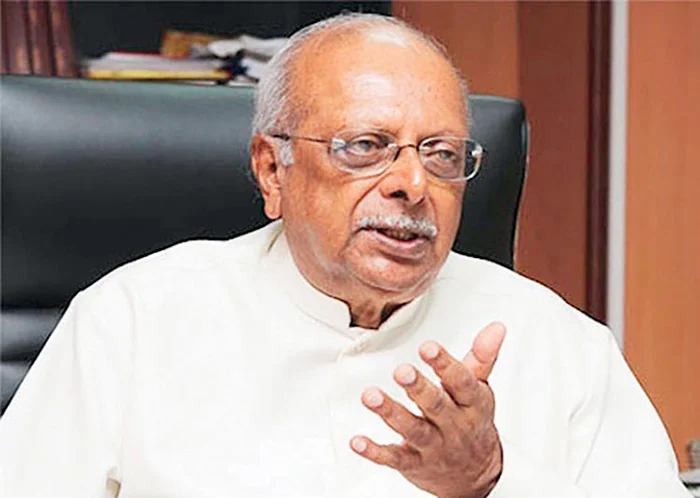
Multi-gifted Prof. Tissa Vitarana in passing,
Leaves a glowing gem of a memory comforting,
Of him putting his best foot forward in public,
Alongside fellow peace-makers in the nineties,
In the name of a just peace in bloodied Sri Lanka,
Caring not for personal gain, barbs or brickbats,
And for such humanity he’ll be remembered….
Verily a standard bearer of value-based politics.
By Lynn Ockersz

England limp to 146-9 against Sri Lanka

Advisory for Heavy Rain issued for the Central, Uva, Sabaragamuwa, Eastern and North-central provinces and in Galle and Matara districts

Sri Lanka opt to chase against England in Pallekele

More than 1,500 Venezuelan political prisoners apply for amnesty

Six races, six golds – Klaebo’s historic Olympics

India, South Africa meet in the final before the final

‘Dates have the highest sugar content to fight Coronavirus’

Sunday Island 27 December – Headlines

#SundayIsland 17th December – Headlines

Sunday Island – 28th March

Sunday Island Headlines – 21 March

Sunday Island – 21st February – Headlines
-

 Business7 days ago
Ministry of Brands to launch Sri Lanka’s first off-price retail destination
-
 Features16 hours ago
Why does the state threaten Its people with yet another anti-terror law?
-

 Features16 hours ago
Victor Melder turns 90: Railwayman and bibliophile extraordinary
-
 Features16 hours ago
Reconciliation, Mood of the Nation and the NPP Government
-
 Latest News2 days ago
New Zealand meet familiar opponents Pakistan at spin-friendly Premadasa
-
 Latest News2 days ago
Tariffs ruling is major blow to Trump’s second-term agenda
-

 Latest News2 days ago
ECB push back at Pakistan ‘shadow-ban’ reports ahead of Hundred auction
-
 Features7 days ago
Giants in our backyard: Why Sri Lanka’s Blue Whales matter to the world