
Sports
Malinga on Pathirana: ‘I somehow want to make this guy even better than me’

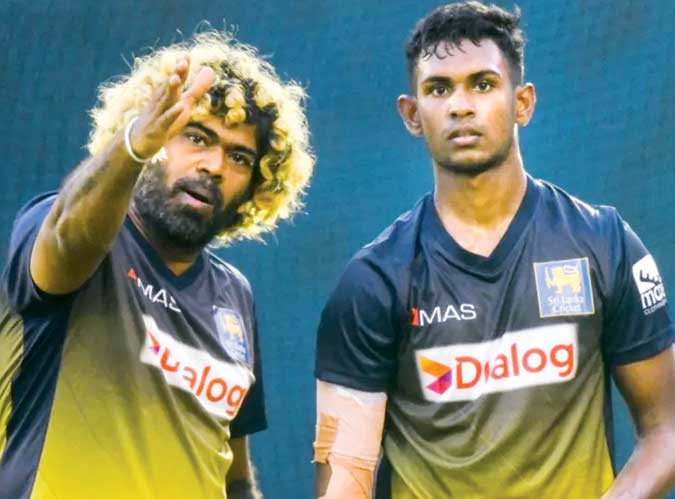
Lasith Malinga, now a bowling consultant with Rajasthan Royals, has been watching Chennai Super Kings’ games with particular interest. Matheesha Pathirana, CSK’s death-overs specialist, not only bowls with the same, unusual round-arm action with which Malinga dominated the IPL for many years, but is also in a sense a protege. Over the last three years, Malinga has worked sporadically with Pathirana in Sri Lanka’s high performance centre, and has advised him on what he needs to do to build a career.
In this interview with ESPNcricinfo, Malinga shares his insights on the 20-year-old’s technique and progress. And he couldn’t disagree more vehemently with MS Dhoni’s suggestion that Pathirana “shouldn’t even get close” to red-ball cricket.
When did you first hear about Matheesha?
I found out about Matheesha Pathirana after the Under-19 World Cup [in 2020], when I got a call from Mahela Jayawardene, who was working as a consultant with SLC (Sri Lanka Cricket). He said: ‘Mali, there’s a boy from Kandy, who bowls just like you, and he bowls fast. But it’s hard to play him in a match because he bowls two sides of the wicket and doesn’t have the control. Can you do something with him?’
So he sent Matheesha to me, and we met at Khettarama. He didn’t have a lot of experience. But I knew straight away that he’s a fearless and strong cricketer. That’s really important. I started off very simply with him, and I told him this: ‘Don’t think about picking formats yet. You have to play whatever Sri Lanka needs you to play. If you get injured and then have to pick formats, that’s a different thing. But you’ve been bowling with this action since you were little and you haven’t had problems. So I don’t think it’ll be that difficult for you.’
You know this action better than anyone. What did you think about the way he was bowling?
In terms of skill, I told him he needs to learn how to bowl with the new and old ball, not just one. With this kind of action, you need the same skillset for Tests, ODIs, and T20s. It’s just that the way you use different skills varies for each format. He doesn’t really swing the ball, because his wrist is too straight as the arm comes around. I told him he has to raise that wrist about an inch-and-a-half. That’ll take him about two or three years, because he has bowled the way he’s bowling for 19 years.
For now, he can manage with what he has. He can bowl good yorkers, but he didn’t have a lot of consistency. I told him how to bowl the slower one as well. Because he bowls with my action, it’s easy for him to dip his slower balls. So I told him: ‘Let’s work on the dipping slower one.’ Now he bowls it pretty well. Still, he needs a bit more control, but it’s in a good place.
What do you think of his success this season? (Pathirana has 15 wickets from 10 matches for CSK, with an economy rate of 7.56, having bowled mostly at the death.)
He’s bowling well in the IPL, but he needs to improve a bit to be ready for international cricket. You don’t get to play 12 players in internationals, like you can in the IPL this year. They use him as a death bowler only at CSK. But if you play for the national team you’re definitely going to have to bowl some powerplay overs. That’s where he needs the swing, which he doesn’t have right now.
It goes back to his wrist position. The advantage of that wrist position is that you get good dip, and you can swing balls into the ground. But you won’t swing balls from side to side. You won’t get it to tail into the batter’s legs. He needs to start creating that angle with the seam, where it comes out diagonally, rather than horizontally. If he fixes that, he can do some great things.
He needs bowling intelligence too, because after a few matches the opposition will work out who you are, and you need to learn how to survive from that point onwards. I think the best thing for that is playing 10 Tests. That’s how you build your bowling fitness. I’ve played 30 Tests, and that was vital to me building up bowling fitness for ODIs and T20s, because when you’re bowling 25-30 overs an innings, you have to sustain your skill through all those spells.
CSK have asked him to do one job, and do it well…
He got a great opportunity because of the Impact Player rule. He can start bowling in the 12th or 13th over. So the weakness he has – bowling with the new ball – gets minimised. He’s also bowling when batters really have to take him on. When you bowl with this action, batters have trouble picking up the ball. And with the control he has for now, and because he’s mentally strong, he’s been able to do well. He’s also got a good captain who will set good fields for him.
His yorker is 145kph and is fantastic. But he needs more control. If he bowls five yorkers, he’ll only land two correctly. But I’m sure if he keeps working on it as he is, he’ll nail it in about a year or two.
You used to reverse-swing the ball into the ground, because of the way the ball came out of your hand. Is that how Pathirana is dipping it too?
Actually, he’s got an advantage over me there, because his arm comes even lower than mine. It’s really tough to hit a six off him, especially off the front foot. That’s his natural advantage. Especially in the subcontinent – and when there’s low bounce in the track – he’ll be really effective.
What have you thought of the way MS Dhoni captains him?
MS has figured out that he can’t bowl with the new ball yet. He also uses him against local Indian batters at the crease – players who don’t play international cricket. With the 145kph pace, and his action, it’s hard for them to play him. That’s just MS’ 20 years of experience at work. He also gets him to lower his pace against batters who are purely power players. Against batters who use the pace – like a Rohit Sharma, or a Mahela Jayawardene, or a Virat Kohli – those players Matheesha might struggle against for now.
Dhoni has said Matheesha shouldn’t play Test cricket, but it sounds like you seriously disagree with Dhoni on that.
MS Dhoni is saying he should just play ICC tournaments. I wonder if he’s just saying that for fun (laughs). It’s hard to do that when you’re playing for the national team.
I think anyone who tells him not to play red-ball cricket is doing that because they think he will get injured. I played red-ball cricket first. No one said anything like that to me. I played red-ball cricket between 2004 to 2010, but I had a 16-year international career, and I played a lot of IPL, plus Big Bash and all the other leagues. In all that time I never left the field after injuring a hamstring, or a groin, or my back, or my calf. Maybe a lot of people will oppose me, but I don’t think we should just presume that he will get injured. I’ve played cricket this way and bowled like him, so I know what the challenges are.
But you did have major ankle and knee injuries…
You can get bone injuries, but that is down to the effort you put in every ball. But I would tell him: get your Test cap. Maybe you’ll play just one. Maybe you’ll play 10. Maybe you will play 100 – who knows? When he plays 15-20 Tests, he will develop not just his bowling fitness and his skill, but also figure out how to set batters up for dismissals, and how to put a spell together. That’s not something you can just tell him about. He has to do it to understand it properly. If when he starts playing Tests, his body starts reacting badly, then you can reassess.
How should he be developed over the next little while?
I somehow want to make this guy even better than me. I think in the next Test tour, try to get him involved, and give him some ODIs as well. See how he plays in the next three years, and then see what the future course needs to be. If he plays 10 or 15 Tests in the next three years, that will be invaluable to his development.
As an example: you know, I only learned that you can dip and reverse the ball at the same time in the last Test that I played, in 2010. Usually they bowl me from the Fort End at Galle, and it’s really easy to reverse the ball from that end with the wind coming across the ground. After six years, I finally got a good spell from the Pavilion End, and I learned how to dip and reverse a cricket ball. No one can tell when Matheesha will get those important revelations about his game.
We’re talking about protecting him from playing for Sri Lanka, before he’s even properly played for Sri Lanka. He’s only 20 years old.
(cricinfo)






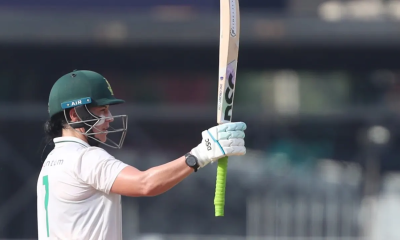

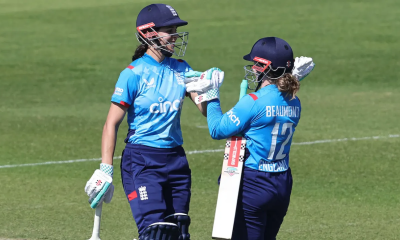


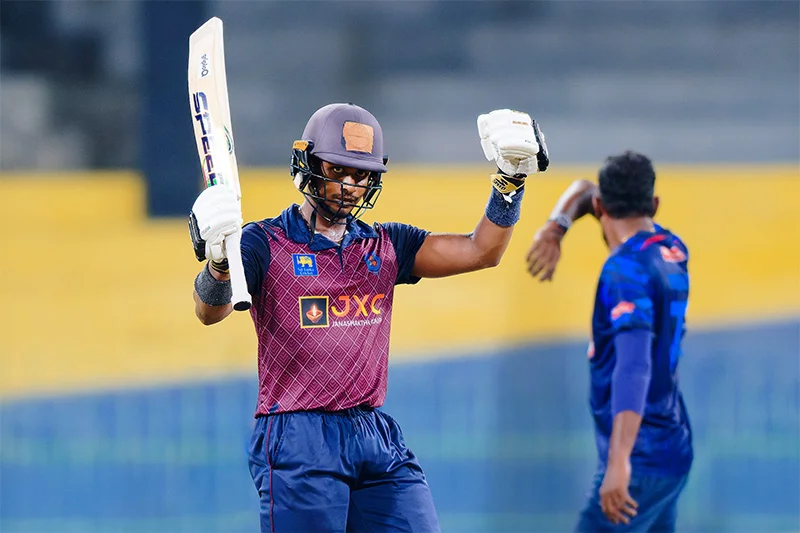
Sri Lanka will begin their three match T20I series against Pakistan in Rawalpindi on Friday with an opportunity for several youngsters to stake their claims, although the absence of Pathum Nissanka leaves a sizeable hole at the top of the order.
Nissanka, Sri Lanka’s highest-ranked batter in the ICC T20I rankings, has been one of the side’s most consistent performers in recent years and his absence deprives the tourists of a proven match-winner against a Pakistan attack that will still carry plenty of firepower despite resting several senior players.
The three T20Is will be played in Rawalpindi on October 9, 11 and 13 before attention switches to the seven match ODI tri-series involving hosts Pakistan, Sri Lanka and England.
While Sri Lanka will miss Nissanka, his absence opens the door for highly rated Sineth Jayawardene, who has been earmarked as one for the future. The former Sri Lanka Under-19 captain now has an opportunity to show that he can make the considerable jump from domestic and age group cricket to the international stage. Sineth skippered Royal College, Colombo with distinction.
There will also be considerable interest in leg-spinner Vijayakanth Viyaskanth, another player Sri Lanka have invested in with an eye on the future. With Wanindu Hasaranga out of the equation, Viyaskanth has an opportunity to make a strong case for a regular berth rather than remain on the fringes.
Sri Lanka will be encouraged by the fact that Pakistan too have opted to look beyond some of their established names for the T20I leg of the tour.
Sahibzada Farhan will captain Pakistan after leading them at the recently concluded Asian Games in Japan, taking over from Salman Ali Agha, who has been left out of the T20I squad. Salman remains part of Pakistan’s ODI plans.
Pakistan have also rested Babar Azam and Shaheen Shah Afridi for the T20Is, although both return for the ODI tri-series, where Shaheen will continue as captain.
The hosts have named uncapped all-rounders Razaullah and Mohammad Imran Randhawa in their 15-member T20I squad, while Maaz Sadaqat and Hasan Nawaz have been rewarded for impressive performances at the Asian Games.
Hasan finished the tournament as Pakistan’s leading run scorer with 123 runs, including a blistering 96 off 51 balls against India in the final, although Pakistan had to settle for silver.
Fast bowler Naseem Shah returns to Pakistan’s T20I squad having last played the format against Sri Lanka in February, while Shadab Khan, Fakhar Zaman, Saim Ayub and Abrar Ahmed provide experience.
For Sri Lanka, while Nissanka’s runs will be sorely missed his absence means someone else has the chance to put his hand up. Sri Lanka will hope one or two of their young guns grab that opportunity with both hands.
The ODI tri-series will follow the T20Is, with the first three matches being played in Rawalpindi before the tournament moves to Lahore for the remaining league games and the final.
Pakistan have retained a more experienced core for the 50-over competition, with Babar, Salman, Haris Rauf and Faheem Ashraf among those included.
Former Pakistan Under-19 captain Saad Baig has earned his maiden ODI call-up after scoring more than 1,000 runs in the 2025-26 Quaid-e-Azam Trophy, while left-arm wrist-spinner Sufiyan Moqim is another notable inclusion.
Pakistan have also strengthened their backroom staff, bringing back former Australian fast bowler Shaun Tait as bowling consultant. Tait previously served as Pakistan’s bowling coach in 2022-23 and replaces Ashley Noffke, who left after the Asian Games to take over as Netherlands head coach.
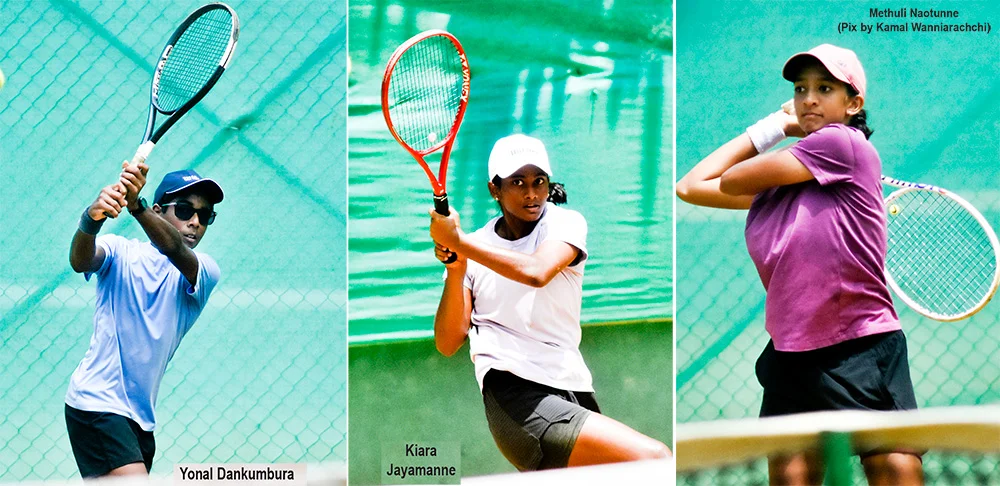
ATF Under-16 Colombo Week 1 Tennis
Sri Lanka’s junior players delivered a series of impressive performances on Wednesday, with the girls claiming all four semi-final places at the ATF Under-16 Colombo 2026 Week 1 tournament, held at the Sri Lanka Tennis Association courts.
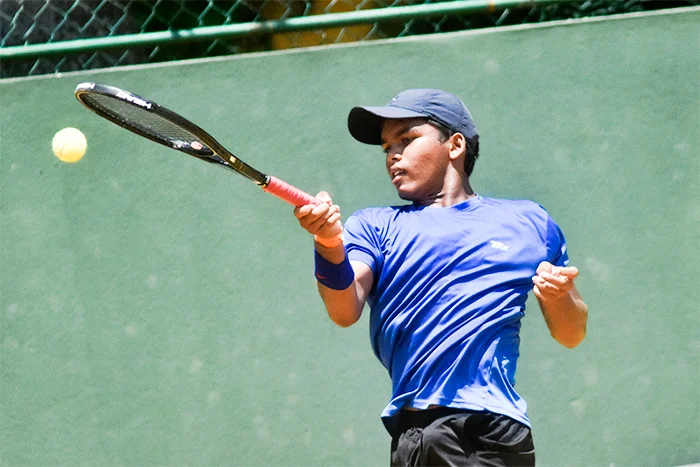
Damsath Peiris
Methuli Naotunne led the charge with a notable quarter-final win over India’s Yashmitha Santhosh, recovering from a set loss to prevail 4-6, 7-5, 6-1. Kiara Jayamanne also came from behind to beat India’s Ahnavi Shaw 5-7, 6-4, 6-2.
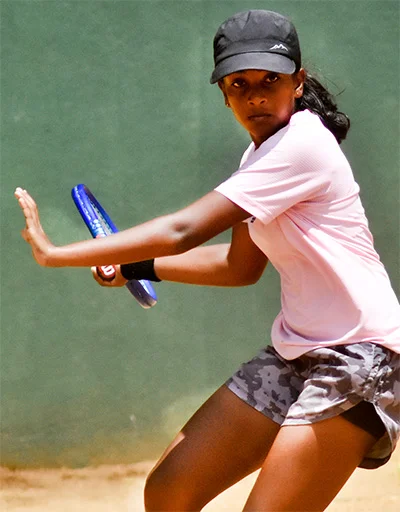
Risindi
Hewawasam
In an all-Sri Lankan quarter-final, Risindi Hewawasam overcame Desandi Peiris 4-6, 6-2, 6-3, while Disini Samaraweera defeated Sayli Basnayake 3-6, 6-2, 6-0.
The Sri Lankan boys also impressed. Damsath Peiris beat Buvindu Jayawardhana 8-2, 7-6, and Yonal Dankumbura battled to a 4-6, 6-3, 6-3 victory over Jayan Sebastian.
The visiting players, however, proved tough to beat. The Philippines’ Anthony Castigador defeated Sri Lanka’s Dehan Wickramasinghe 6-2, 6-4, and India’s Gurshaan Chahal fought back to overcome Udeera Gunasinghe 2-6, 7-5, 7-5.
(RF)
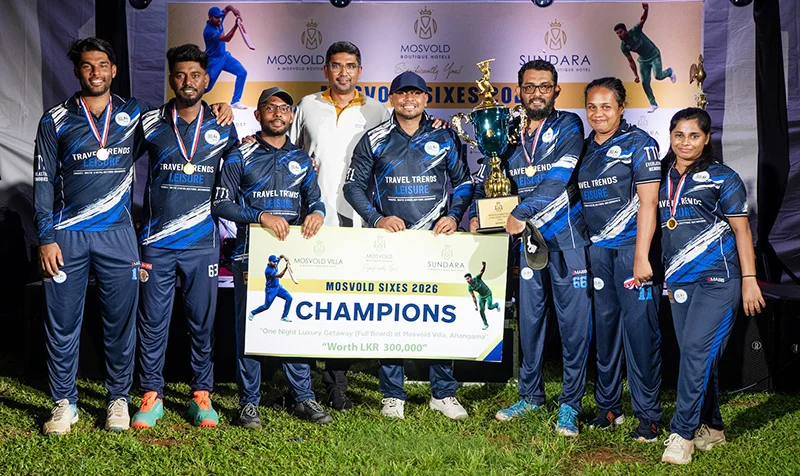
Mosvold Sixes 2026 concluded on Sunday at the Colombo Malay Cricket Club with Travel Trends Leisure crowned champions after a closely fought final against last year’s winners, Connaissance De Ceylan Sri Lanka, who finished as runners-up. Transco Travels were second runners-up.
Twenty three destination management companies took part in the six-a-side softball cricket tournament, organised by Mosvold Sri Lanka.
The Mosvold Martinus Challenge Trophy 2026 was presented to the champions by Nilanka Martinus, Co-Founder and Managing Director, Mosvold Boutique Hotels. Chief Guest Farveez Maharoof, the former Sri Lanka all-rounder, presented the runners-up award to Connaissance De Ceylan Sri Lanka.
This year’s twenty three competing DMCs were Tangerine Tours, Sri Lanka Tailormade, Olanka Travels, Antiquity Sri Lanka, Travel Trends Leisure, House of Travels & Tourism, NKAR Travels & Tours, Jetwing Travels, Walkers Tours, Connaissance De Ceylan Sri Lanka, Delux Holidays, Ceylon Roots, Spiceland Holidays, Infinity Vacations, Tropiculture, Serene Travels, Authenticities, Red Apple Travel & Holidays Lanka, DTH Travel Lanka, Hayleys Travels, We stay Ceylon, Transco Travels and Ceylon Tours.

Showers above 100 mm are likely at some places in the Western, Sabaragamuwa, Central, Uva and Southern provinces and in Anuradhapura district

PSTA worse than PTA: FSP

Shiranthi R remanded until 13 Oct.

Former NSB Chairman Kariyawasam granted bail

Katchatheevu row: India SC urges fishermen to avoid Sri Lankan waters

Remembering Juvenal, Coke, Acton and Machiavelli

‘Dates have the highest sugar content to fight Coronavirus’

Sunday Island 27 December – Headlines

#SundayIsland 17th December – Headlines

Sunday Island – 28th March

Sunday Island Headlines – 21 March

Sunday Island – 21st February – Headlines
-

 Editorial7 days ago
Colombo Port drug bust: The plot thickens
-

 Features5 days ago
The first woman in the foreign service or Ceylon Overseas Service it was then called
-

 Editorial6 days ago
Fuelling discontent and protest
-

 News4 days ago
Geneva takes up Sallay’s case and govt. ignores opportunity to answer accusations
-

 Foreign News6 days ago
Ten injured after car crashes into rugby supporters in Australia
-

 Latest News6 days ago
Tharindu Rathnayake, bowlers secure Asian Games Bronze for Sri Lanka
-

 News5 days ago
Nearly 20 Iranian tankers stranded off Lanka amid US sanctions
-

 Features4 days ago
Sri Lanka Cricket Bill: Governance reform is not yet a cricket strategy