
Latest News
Louis 97, Athanaze 90 give West Indies slight edge after day one

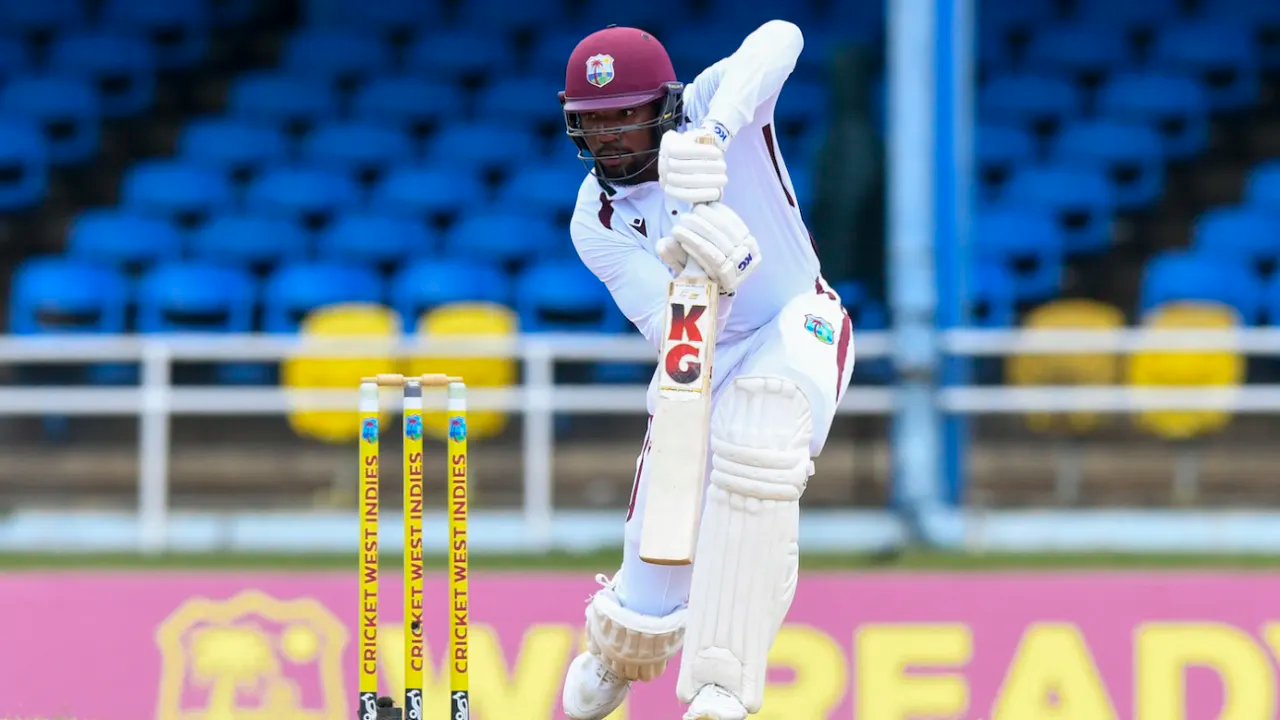
Mikyle Louis and Alick Athanaze both suffered the heartbreak of falling in the nineties on the first day of the Antigua Test against Bangladesh. Otherwise, the West Indies pair did enough to make the opening day of the series theirs. The 140-run fourth wicket stand between the pair revitalised West Indies’ innings, adding pace to the overall scoring. It led to West Indies dominating proceedings for more than two sessions.
Louis came agonizingly close to his maiden Test century, but fell on 97. Despite showing great restraint throughout his 218-ball stay, Louis spent 27 balls in the nineties before falling to Bangladesh stand-in captain Mehidy Hasan Miraz. Athanaze fell to Taijul Islam a few overs later, the second time he got out in the nineties in his short Test career.
The Bangladesh bowlers would be disappointed that they couldn’t hold back the Louis-Athanaze partnership after keeping West Indies’ scoring rate in check in the first 54 overs. Taksin Ahmed took two wickets, while Taijul and Mehidy took one each, average returns overall despite Bangladesh choosing to bowl first at the toss.
After the Louis-Athanaze pair fell to the spinners, Justin Greaves and Joshua Da Silva scored freely against the second new ball towards the end of the day. Play was called off after 84 overs when a drizzle started, while the light was not great either.
Bangladesh’s fast-bowling trio of Hasan Mahmud, Shoriful Islam and Taskin challenged West Indies early in the day, but Louis held his own. Hasan kept beating him outside the offstump. Shoriful tested him around the off-stump with the delivery always threatening to shape in. Taskin used the wobble seam, sometimes bowled the odd yorker, and pressing Louis to fish outside off-stump.
Shoriful, who got more swing from the Sir Curtly Ambrose end than the Andy Roberts end, was playing his first Test since mid-August. He missed the previous five Tests but looked in tune with the red ball. He troubled Kraigg Brathwaite, who tried to dig in despite the runs not flowing from his bat. Louis meanwhile waited for the short ball, which got him two fours with the pull shot.
Taskin then removed Brathwaite, trapping him lbw with a hint of inward movement that beat his bat. Taskin then had Keacy Carty caught at mid-on when he couldn’t keep his wristy whip down, ending up as a tame dismissal. Brathwaite made four runs in 38 balls, while Carty ended on a eight-ball duck.
Louis then found Kavem Hodge a little more forthcoming as they tried to rebuild the innings. The pair struck four boundaries before the lunch break, but then consolidated in the second session.
Louis brought up his fifty when he struck Taskin with a punch down the ground for a boundary. Hodge then slapped Taskin with a square cut, but he wouldn’t last too much longer. Attempting a second run off Mehidy’s bowling, Hodge was run out for 25 after Taijul’s throw from long leg had him well short despite a dive.
Athanaze made efforts to push the run-rate but he was met with Bangladesh’s continued discipline. In the afternoon, it was the spinners Mehidy and Taijul who kept things tight. Athanze skied a couple of balls that fell slightly away from the fielder’s reach. One of them, a top edge towards mid-on could have become a catch had Taskin moved slightly faster from mid-on. Athanaze struck Mehidy with a sweep for four, but couldn’t quite connect with his several reverse sweeps in the second session. Louis, who lifted Taskin for a four over the bowler’s head towards the end of the second session, remained mostly quiet in his approach.
Athanaze took the initiative to raise West Indies’ scoring rate after tea. He started the the final session with two square-cut boundaries, before he finally got a four with a reverse sweep, off Mehidy.
Louis then lofted Mehidy for the first six of the day, which took him into the eighties. Then, Mehidy dropped Louis at slip when he reached 90. Louis picked up Mahmud for his ninth boundary as he edged closer to his maiden century, while Athanaze opened up at the other end too.
He swept Taijul before hitting Taskin for consecutive fours in the 71st over, cut and flicked away. Athanaze then slog-swept Taijul for his first six, and then came another reverse-swept boundary.
Against the run of play, Mehidy removed Louis, charging at him, caught at slip where Shahadat Hossain took a good catch. Three overs later, Taijul had Athanaze caught behind. In the space of four runs, both batters were gone, allowing for a small opening come day two.
Brief scores:
West Indies 250 for 5 in 84 overs (Mikyle Louis 97, Alick Athanaze 90, Kavem Hodge 25; Taskin Ahmed 2-46) vs Bangladesh
[Cricinfo]


Dasun Shanaka clobbered 34 off 9 balls, Kusal Mendis, Kamil Mishara, Dhananjaya de Silva, Charith Asalanka and Janith Liyanage all chipped in with quick runs, and Sri Lanka raced to 160 for 6 in 12 overs, but Pakistan still made them sweat.
The match had been shortened to 12-overs-a-side after rain forced a delay of two hours and 20 minutes. A wet outfield also made bowling significantly more difficult, with both spinners and seamers struggling to grip the ball.
But in any conditions, this was a run-fest, Sri Lanka traveling at 13.3 an over across their innings, while Pakistan’s run rate was 12.25. In the end, Sri Lanka’s bowlers made frequent-enough incisions to slow the opposition. Wanindu Hasaranga was chief among the destroyers, taking 4 for 35 in his three overs.
Salman Agha layed the most daring innings in the chase, thumping 45 off 12 balls. Had he survived for two further overs, Pakistan might have had the momentum to get over the line. In the end, they fell 14 short.
Sri Lanka’s captain was under a little pressure to impose himself after recently reclaiming the leadership. To this match he brought his best big-hitting self, and transformed a good total into a daunting one. Shanaka came in with only 19 balls left in the innings, then smoked his second and third balls for six. Then, in the final over bowled by Mohammad Wasim, Shanaka thumped three sixes off the first three balls, depositing two of those over the deep cover boundary. He holed out off the third-to-last ball of the innings, but he had produced a gem.
The stage had been set for him by a top order that had already prospered, however. By he time Shanaka arrived, Sri Lanka were already 100 for 5 after 8.5 overs.
Although the ball was difficult to grip, this Dambulla surface still took decent turn. And Hasaranga can be devastating on such tracks, particularly when the opposition has no choice but to target him. Although often Hasaranga gets plenty of bowled and lbw dismissals with his googly, all four of his victims on Sunday were caught attempting big shots. His speed through the air and degree of turn created most of those dismissals.
Of the 12 he faced, the only ball Agha didn’t score off was the one he got out to. Agha hit three sixes, five fours, one three, and two twos in his innings. He took a particular liking to the bowling of Maheesh Theekshana, who went for 22 runs in the third over. His most spectacular shot was an over-the-shoulder scoop against Matheesha Pathirana in the fourth over, which sailed over the boundary. But then Pathirana wised up, bowled fuller, and Agha sent a catch to short fine leg to end his innings.
Brief scores:
Sri Lanka 160 for 6 in 12 overs (Kamil Mishara 20, Dasun Shanaka 34, Kusal Mendis 30, Dhananjaya de Silva 22, Charith Asalanka 21, Janith Liyanage 22*; Naseem Shah 1-35, Mohammad Wasim 3-54, Mohammad Nawaz 1-08, Faheem Ashraf 1-09) beat Pakistan 146 for 8 in 12 overs (Salman Agha 45, Mohammed Nawaz 28, Khawaja Nafay 26; Eshan Malinga 127, Matheesha Pathirana 2-34, Wanidu Hasaranga 4-35) by 14 runs
(Cricinfo)

One person has died and 300 properties have been destroyed in bushfires that have torn across south-east Australia.
The fires have raged in dozens of locations across the country for several days, mostly in the state of Victoria, but also in New South Wales, burning through land almost twice the size of Greater London.
A state of emergency has been declared in Victoria as thousands of firefighters and more than 70 aircraft battle the blaze. Residents in more than a dozen communities have been advised to leave their homes.
Authorities fear the fires, which are being fuelled by very hot, dry and windy conditions, could burn for several weeks.
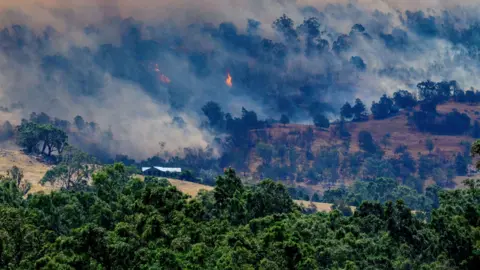
Victoria’s Premier Jacinta Allan said 30 active fires were burning across the state, 10 of which were of particular concern.
She said 350,000 hectares had been burnt across the state as of 08:00 local time on Sunday (23:00 GMT on Saturday).
“We will see fires continue for some time across the state and that is why we are not through the worst of this by a long way,” she told Australian media.
“There are fires that are continuing right now that are threatening homes and property.”
Human remains were found in the village of Gobur, near the town of Longwood, some 110km (70 sq miles) north of the state capital Melbourne, police said. The victim has not yet been identified.
Allan praised the emergency workers who worked to retrieve the body. “This is difficult and confronting work, and it takes a heavy toll.”
“The Gobur community is grieving,” she said.
Bushfire smoke is impacting air quality in many areas across Victoria, including metropolitan Melbourne.
Authorities said the fires were the worst to hit the south-east of Australia since the 2019-2020 blazes that destroyed an area the size of Turkey and killed 33 people.
(BBC)
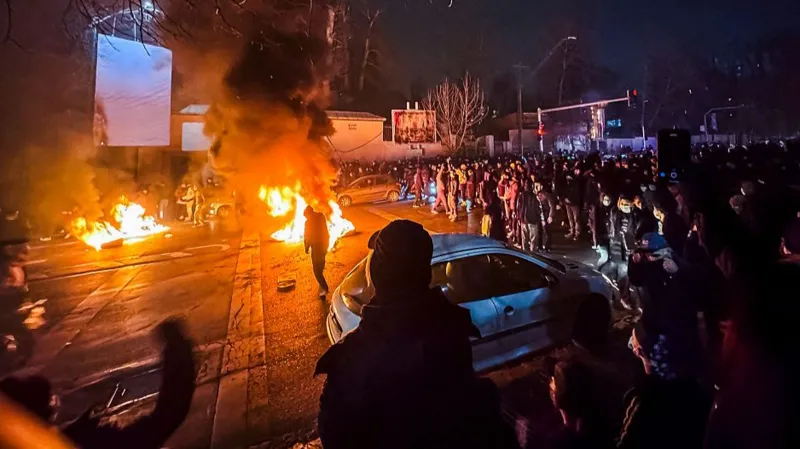
Iran has warned it will retaliate if attacked by the US, as protesters defied a deadly government crackdown on Saturday night.
Videos verified by the BBC and eyewitness accounts appeared to show the government ramping up its response to the protests, which have spread to more than 100 cities and towns across every province in Iran.
Medics at two hospitals have told the BBC that more than 100 bodies had been brought in over a two day period. The nationwide death toll is feared to be far higher.
The US has threatened to strike Iran over the killing of protesters. Iran’s parliament speaker warned that if the US attacked, Israel along with US military and shipping centres in the region would become legitimate targets.
The protests were sparked in the capital, Tehran, by soaring inflation, and are now calling for an end to the clerical rule of Iran’s Supreme Leader Ayatollah Ali Khamenei.
Iran’s attorney general said anyone protesting would be considered an “enemy of God” – an offence that carries the death penalty – while Khamenei has dismissed demonstrators as a “bunch of vandals” seeking to “please” Trump.
US President Donald Trump said on Saturday that the US “stands ready to help” as Iran “is looking at FREEDOM”.
Iran’s President Masoud Pezeshkian has blamed the US and Israel for the unrest.
“They have trained certain individuals inside the country and abroad, brought terrorists into the country from outside, set mosques on fire, and attacked markets and guilds in Rasht, setting the bazaar ablaze,” he said without providing evidence.
As protests intensify, the number of deaths and injuries recorded by human rights monitors continues to rise.
Footage authenticated by BBC Persian and BBC Verify shows security officers shooting at gatherings of protesters in Tehran, in the western Kermanshah province and the southern Bushehr region.
Multiple verified videos filmed in the centre of the western city of Ilam last weekend show security forces firing shots towards Imam Khomeini Hospital, where a group of protesters had been holding a rally.
Staff at several hospitals have since told the BBC they have been overwhelmed with the injured and dead.
BBC Persian has verified that 70 bodies brought to one hospital in the city of Rasht on Friday night, while a health worker reported around 38 people dying at a Tehran hospital.
Sources inside Iran have told BBC Persian that plain-clothes officers have been targeting people filming and on their own at the protests.
Iran’s police chief said on state TV that the level of confrontation with protesters had been stepped up, with arrests on Saturday night of what he called “key figures”. He blamed a “significant proportion of fatalities” on “trained and directed individuals”, not security forces, but did not give specific details.
More than 2,500 people have been arrested since protests began on 28 December, according to a human rights group.
The BBC and most other international news organisations are unable to report from inside Iran, and the Iranian government has imposed an internet shutdown since Thursday, making obtaining and verifying information difficult.
Nonetheless, some footage has emerged.
Several videos, confirmed as recent by BBC Verify, show clashes between protesters and security forces in Mashhad, Iran’s second-largest city.
Masked protesters can be seen taking cover behind bins and bonfires, while a row of security forces is seen in the distance. A vehicle that appears to be a bus is engulfed in flames.
Multiple gunshots and what sounds like banging on pots and pans can be heard.
A figure standing on a nearby footbridge appears to fire multiple gunshots in several directions as a couple of people take cover behind a fence.
In Tehran, a verified video from Saturday night shows protesters also taking over the streets in the Gisha district.
Other verified videos from the capital show a large group of protesters and the sound of banging on pots in Punak Square, and a crowd of protesters marching on a road and calling for the end of the clerical establishment in the Heravi district.
Internet access in Iran is largely limited to a domestic intranet, with restricted links to the outside world. But during the current round of protests, authorities have for the first time severely restricted that too.
An expert told BBC Persian the shutdown is more severe than during the “Women, Life, Freedom” uprising in 2022.Alireza Manafi, an internet researcher, said the only likely way to connect to the outside world was via Starlink satellite, but warned users to exercise caution as such connections could potentially be traced by the government.
Trump did not elaborate on what the US was considering. However, he has been briefed on options for military strikes on Iran, an official told the BBC’s US news partner CBS.
The Wall Street Journal reports these were “preliminary discussions” and that there was no “imminent threat” to Iran.
US Secretary of State Marco Rubio also spoke to Israeli Prime Minister Benjamin Netanyahu on Saturday about the possibility of US intervention in Iran, they told CBS.
On Sunday, Reza Pahlavi , the exiled son of Iran’s last Shah, who lives in the US and whose return protesters have been calling for, told demonstrators that Trump had “carefully observed your indescribable bravery” in a social media post.
“Your compatriots around the world are proudly shouting your voice,” he wrote, pledging: “I know that I will soon be by your side.”
Pahlavi claimed the Islamic Republic was facing a “severe shortage of mercenaries” and that “many armed and security forces have left their workplaces or disobeyed orders to suppress the people”. The BBC could not verify these claims.
He encouraged people to continue protesting on Sunday evening, but to stay in groups or with crowds and not “endanger your lives”.
(BBC)

Bride and groom killed by gas explosion day after Pakistan wedding

Shanaka, Mendis star in 12-over run-fest to square series for Sri Lanka

One person dead and 300 buildings destroyed in Australia bushfires

Iran warns it will retaliate if US attacks as protesters defy crackdown

GENERAL WEATHER FORECAST FOR NEXT 36 HOURS

National Communication Programme for Child Health Promotion (SBCC) has been launched. – PM

‘Dates have the highest sugar content to fight Coronavirus’

Sunday Island 27 December – Headlines

#SundayIsland 17th December – Headlines

Sunday Island – 28th March

Sunday Island Headlines – 21 March

Sunday Island – 21st February – Headlines
-

 News23 hours ago
Sajith: Ashoka Chakra replaces Dharmachakra in Buddhism textbook
-

 News6 days ago
Interception of SL fishing craft by Seychelles: Trawler owners demand international investigation
-

 Business23 hours ago
Dialog and UnionPay International Join Forces to Elevate Sri Lanka’s Digital Payment Landscape
-

 Features23 hours ago
The Paradox of Trump Power: Contested Authoritarian at Home, Uncontested Bully Abroad
-

 News6 days ago
Broad support emerges for Faiszer’s sweeping proposals on long- delayed divorce and personal law reforms
-

 Features23 hours ago
Subject:Whatever happened to (my) three million dollars?
-

 News23 hours ago
65 withdrawn cases re-filed by Govt, PM tells Parliament
-

 Opinion3 days ago
The minstrel monk and Rafiki, the old mandrill in The Lion King – II