
Latest News
Long queues and confusion mar first day of India’s landmark AI summit


India’s AI Impact Summit, billed as a landmark gathering of global leaders and technology executives, was overshadowed by logistical chaos on its opening day in Delhi on Monday.
Participants complained about long queues, overcrowding and confusion at the venue, saying they had to wait for hours. Some also reported limited access to food and water and said their products were stolen from their stall.
The five-day summit, inaugurated by PM Narendra Modi, is being promoted as the first major international AI meeting hosted in the Global South.
More than 100 countries are taking part, with technology leaders including Sam Altman of OpenAI and Sundar Pichai of Alphabet Inc expected to attend.

Speaking at the inauguration, Modi said the summit showcased “the extraordinary potential of AI, Indian talent and innovation”, adding that India aimed to shape solutions “not just for India but for the world”.
India’s Information Technology Minister Ashwini Vaishnaw said the summit intended to look at both the benefits and harms of AI.
In the next few days, “we are basically looking at and measuring what [AI’s] impact on human society is going to be”, he said.
But the opening day was marred by complaints of poor crowd management at the summit venue Bharat Mandapam. By Monday afternoon, social media was flooded with complaints from founders, exhibitors and delegates who said security sweeps and last-minute closures left them stranded outside exhibition halls.
Maitreya Wagh, co-founder of voice AI start-up Bolna, wrote on X that he was unable to access his company’s booth after gates were closed. Punit Jain, founder of tech platform Reskill, described “7 AM queues” followed by hours of waiting and a “full evacuation” before the prime minister’s arrival.
Reuters reported that some speakers were still awaiting confirmation of their session timings, adding to concerns over mismanagement.
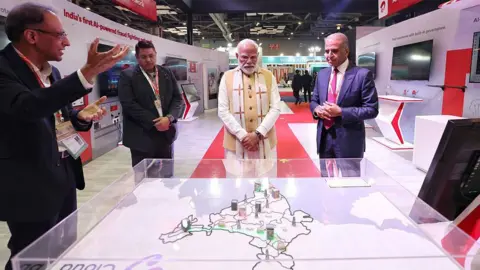
Dhananjay Yadav, founder of wearable AI start-up NeoSapiens, alleged that products from his company’s stall were stolen at the venue. Writing on X, he said the firm had spent heavily on travel, accommodation and exhibition space, “only to see our wearables disappear inside a high-security zone”.
Several attendees also complained about payment arrangements at food stalls inside the venue, saying food counters were accepting only cash and not digital payments, adding to the inconvenience, particularly for international visitors.
Soumya Sharma, founder of healthcare-focused Livo AI, said several discussions were held behind closed doors and that security shut down sessions because of overcrowding, preventing many delegates from taking part.
The closures, he suggested, undercut the summit’s ambition to showcase India’s AI ecosystem to a global audience.
While he said he attended some “excellent sessions”, Sharma added that operational lapses risked overshadowing the substance of the event. “Unless we get the basics right, we cannot claim to be utilising AI to its fullest,” he wrote on X. “AI is only part of the system. We must solve basic on-ground issues first.”
Organisers and the government have yet to respond publicly to the complaints. The BBC has reached out to the Ministry of Electronics and Information Technology for a comment.
[BBC]

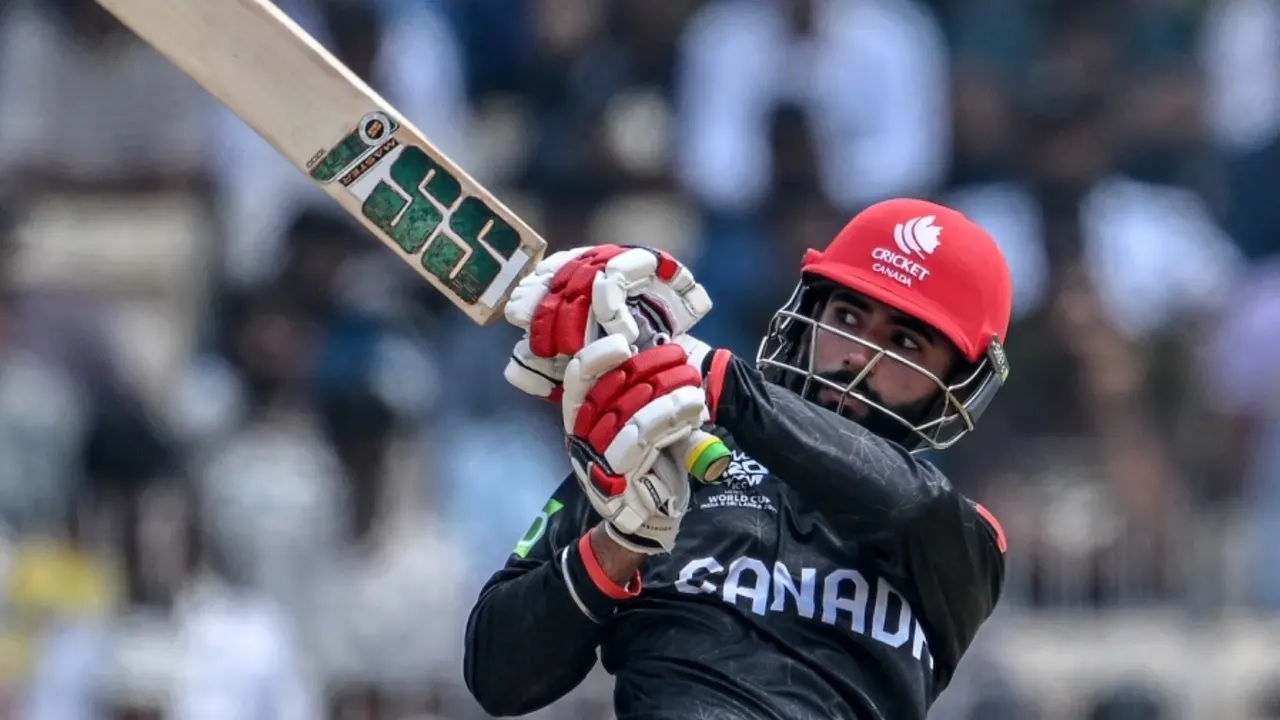
Yuraj Samra’s record-breaking hundred went in vain as New Zealand beat Canada by eight wickets in Chennai to qualify for the Super Eight stage of the 2026 T20 World Cup.
Batting first, Canada posted a competitive 173 for 4, thanks to Samra’s 110 off 65 balls, the highest score by an Associate batter against a Full Member in the tournament’s history. At 19 years and 141 days, the left-hand opener also became the youngest to cross 50 in a men’s T20 World Cup match.
Canada’s bowlers and fielders, though, let them down. They did send back Tim Seifert and Finn Allen inside the first four overs, but Glenn Phillips and Rachin Ravindra snatched the game away from them and ran away with it.
Phillips smashed 76 not out off 36 balls and Ravindra 59 not out off 39. The two added 146 off just 73 balls for the third wicket and took New Zealand home with 4.5 overs to spare.
Matt Henry started the proceedings with four dots to Samra but the opener got going with back-to-back fours off the last two deliveries. Samra faced only five balls in the next four overs but took James Neesham down in the final over of the powerplay. With Neesham operating from around the wicket, he pulled to fine leg, muscled over midwicket, drilled down the ground, and slashed over the covers after coming down the ground. The first three went for fours, the last carried all the way.
Samra kept the scoreboard ticking even after the powerplay. He smashed Kyle Jamieson’s slower ball through extra cover before pulling Cole McConchie for a flat six. Soon, he reached his fifty, off 36 balls.
Brief scores:
New Zealand 176 for 2 in 15.1 overs (Finn Allen 21, Glenn Phillips 76*, Rachin Ravindra 59*, Dilon Heyliger 1-42, Saad Bin Jaffar 1-29) beat Canada 173 for 4 in 20 overs (Yuraj Samra 110, Dilpreet Bajwa 36, Navneet Dhaliwal 10; Matt Henry 1-28, Jacob Duffy 1-25, Kyle Jamieson 1-41, James Neesham 1-38) by eight wickets
[Cricinfo]
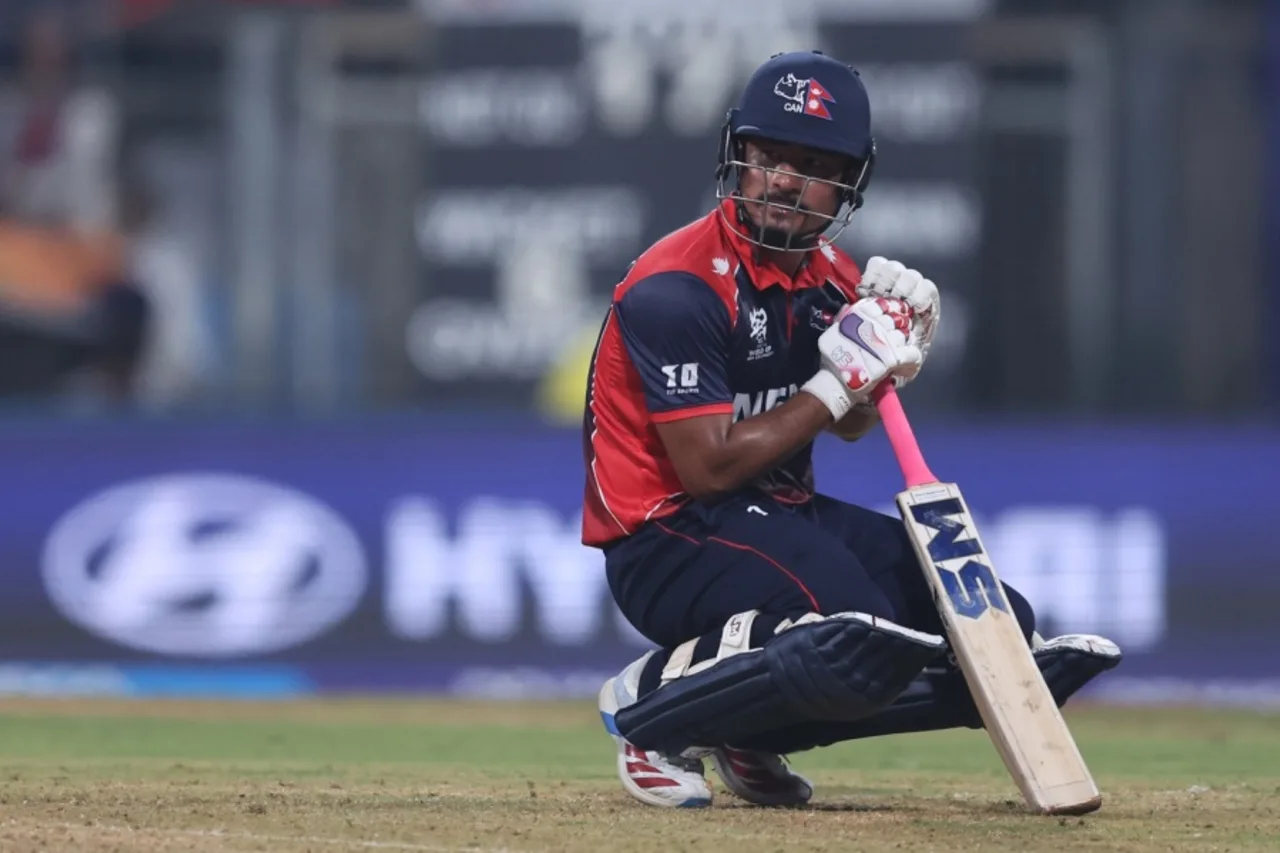
Regrets. Scotland and Nepal will have a few.
They arrived at the 2026 T20 World Cup with little to lose. Scotland’s 11th-hour entry after Bangladesh’s expulsion was an unexpected boost. Nepal, meanwhile, are a nation on the cusp of nailing the big time, and what better way to signal that intent by bloodying a few noses and perhaps even sneaking out of Group C?
And yet, both will go into their meeting in Mumbai wondering what could have been. Nepal were 11 runs from 8 balls away from victory in their opening against England, while Scotland spurned 30 runs in their innings against the same opponents, which might have afforded them more room to cash in the nerves they elicited in an ultimately unsuccessful defense of 152.
A comprehensive defeat to West Indies on Sunday closed all mathematical avenues for Nepal’s progression, before England’s second number on their Auld enemy was to come through another sketchy situation against Italy on Monday to secure their own Super Eights spot. And so, what might have been a genuine winner-takes-all bout is anything but. Regardless of the result, both teams will be heading home.
Of course, there is pride to play for, but perhaps a bit more on Nepal’s side of the ledger. Captain Rohit Paudel called for more opportunities against Full Member teams going forward, after making England sweat. Signing off with a maiden T20 World Cup win can further their push for more of a look-in. Their fans have made a compelling case in the stands.
The mullering at the hands of Italy felt like a blow to that cause, even though that should not be the case. It is counter-productive to pit Associate nations against one another to deem who is worthy of a bigger slice of pie, be that funding or opportunities against major sides, particularly when the deck is stacked against them on those grounds in the first place.
These are issues Scotland know plenty about, even if their surprise entry into this tournament is their sixth visit to a T20 World Cup. Between the 2024 T20 World Cup and this one, they had played just seven T20Is outside of qualification tournaments, and only three against a Full Member (a series against Australia in September 2024). They themselves have a statement to make on Tuesday.
Scotland’s initial three-match residence in Kolkata featured a 73-run win against Italy, as they became the first side at this World Cup to breach 200. That was sandwiched by losses to West Indies and England, though the latter did play out in front of a crowd of more than 40,000. This will be similarly well-attended.
One of these teams will take the lead after a 1-1 head-to-head established during a tri-series Scotland hosted and won last summer, with an emphatic win over Nepal. Their first meeting three days earlier was a low scoring shootout which Sandeep Lamichanne seized; the legspinner taking 4 for 11 then bagging the winning run off the penultimate delivery.
As such, there is plenty of familiarity on the ground for this encounter, which will been played out on what has been a game Wankhede track. Nepal’s three matches at this venue to Scotland’s none gives them a sizable advantage, but their batting has not come close to replicating the heights Kushal Bhurtel, Dipendra Singh Airee and Lokesh Bam threatened to take them to against England over a week ago.
They were tentative against Italy (who chased down 124 without loss and with ease) and overawed by Group C leaders West Indies. It spoke to the standards expected that consultant coach Nic Pothas used his pre-match press conference to lament the team for “not learning fast” and making familiar errors.
Scotland, too, have errors to learn from, particularly their leg-side missteps against England when it came to the sweep shot. “The nature of the wicket [at the Wankhede] probably looks even slower than Kolkata and might take more turn,” Tom Bruce said on Monday. We shall see.
It has been a peculiar tournament for Sandeep Lamichane. Nepal’s greatest cricketing export has just one wicket at an average of 94.00, with an economy rate of 9.4 – galling numbers for a seasoned wristspinner. The 25-year-old has shown no verve, and was bullied by Anthony Mosca in the defeat to Italy, with the opener carting him for three sixes, finishing with 28 off the 13 deliveries he faced from the leggie. As mentioned further up, Lamichanne has good recent form against Scotland which he could do with replicating to save what has otherwise been an abject tournament.
Mark Watt, meanwhile, will be keen to bounce back from the shellacking he received against England. His 0 for 43 from three overs contributed to Scotland’s inability to fully turn the screw against their neighbours to the south, hammered over the fence three times by Tom Banton in a first over that went for 22 – an exchange that got Banton out of a funk and on his way to a match-winning 63*. Watt is a canny enough operator to not let that aberration dull his shine.
Nepal have been relatively consistent with their selections, sticking by 10 players and shuffling between Sher Malla (offbreak), Lalit Rajbanshi (left arm orthodox) and Sompal Kami (medium-pace) for the final spot. The suggestion on the ground is they may go in unchanged from the West Indies match after Kami provided some handy but ultimately moot lower-order runs with an unbeaten 26. Should they err towards spin, Malla may get the nod over Rajbanshi, whose single over against Italy went for 19.
Nepal (probable): Aasif Sheikh (wk), Kushal Bhurtel, Rohit Paudel (capt), Dipendra Airee, Aarif Sheikh, Lokesh Bam, Gulsan Jha, Karan KC, Sompal Kami/Sher Malla, Nandan Yadav, Sandeep Lamichhane.
Scotland have called up seamer Jack Jarvis as a replacement for Safyaan Sharif, who has been nursing a groin strain picked up in training. But the sense is they will go in with the same XI they played against England.
Scotland (probable): George Munsey, Michael Jones, Brandon McMullen, Richie Berrington (capt), Tom Bruce, Michael Leask, Matthew Cross (wk), Mark Watt, Oliver Davidson, Brad Wheal, Brad Currie.
[Cricinfo]
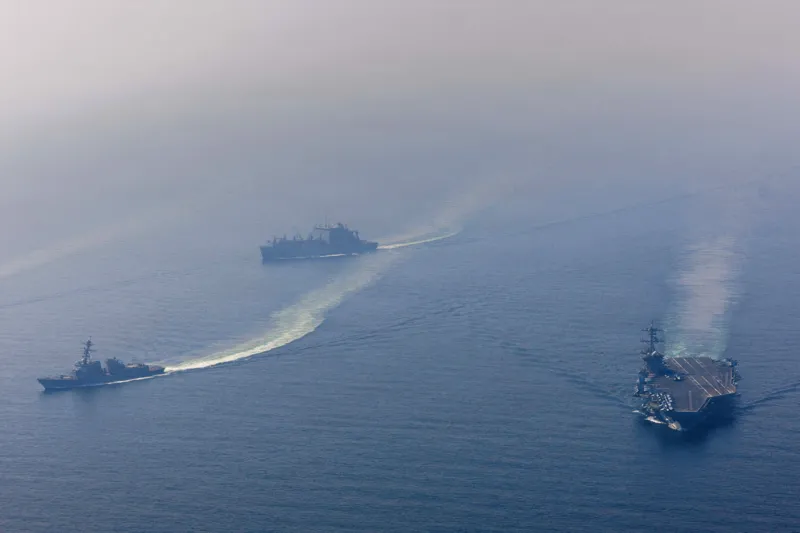
BBC Verify has confirmed the location of US aircraft carrier the USS Abraham Lincoln near Iran using satellite imagery, as Washington continues to put pressure on the country over its military program and recent deadly crackdown on protesters.
US and Iranian officials are set to meet in Swizerland on Tuesday for a second round of talks. Iran says the meeting will focus on its nuclear programme and the potential lifting of economic sanctions imposed by the US. Washington has previously indicated it wants to discuss other issues as well.
The Abraham Lincoln, which leads a strike group with three guided missile destroyers, carries 90 aircraft including F35 fighters, and 5,680 crew, was reportedly deployed to the Gulf region in late January but has not been seen in satellite imagery until now. It has been located off the coast of Oman, around 700km from Iran.
The US has also reportedly sent the USS Gerald R Ford, the world’s largest warship, to the Middle East, which could arrive in the region within the next three weeks.
The Abraham Lincoln’s arrival adds to what we know about the current US military build-up in the Middle East over the past few weeks, where BBC Verify has tracked an increase of US destroyers, combat ships and fighter jets in the region.
Publicly available images from the European Sentinel-2 satellites show Abraham Lincoln in the Arabian Sea around 150 miles (240km) off the coast of Oman.
It had not been seen since it reportedly entered the region in January but it had been crossing the open sea where satellite coverage is limited. Military assets on land are more visible and frequently captured on satellite.
It means we have now tracked 12 US ships in the Middle East through satellite imagery: the Abraham Lincoln, a nuclear-powered Nimitz-class carrier, which together with three Arleigh Burke class destroyers forms a carrier strike group; plus two destroyers capable of carrying out long-range missile strikes and three specialist ships for combat near to the shore that are currently positioned at Bahrain naval station in the Gulf. Two other destroyers have been seen in the eastern Mediterranean near the Souda Bay US base, and one more in the Red Sea.
We have also been following the movements of US aircraft in the region, where we have seen an increase of F-15 and EA-18 fighter jets stationed in Muwaffaq Salti military base in Jordan, and an increase in US cargo planes and refuelling and communications aircraft moving towards the Middle East from the US and Europe.
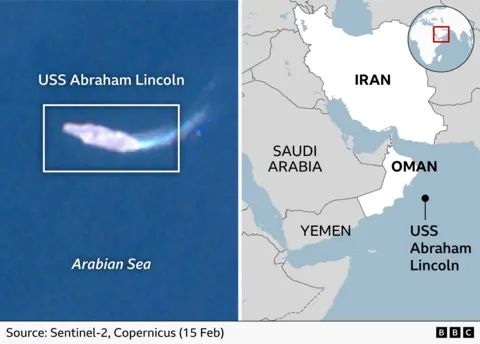
The US Central Command released images of the Abraham Lincoln flanked by destroyers, fighter jets, surveillance aircraft and coastguard vessels in the Arabian Sea in an apparent show of military prowess on 6 February, which Iran has met with its own show of force.
On Monday the Islamic Revolutionary Guard Corps (IRGC) launched a maritime drill in the Strait of Hormuz, located in the Gulf between Oman and Iran. The drill saw IRGC Commander‑in‑Chief Maj Gen Mohammad Pakpour inspecting naval vessels at a harbour before missiles are seen launching from a ship, the IRCG-linked Tasnim News Agency reported.
The Strait is considered one of the world’s most important shipping routes and a vital oil transit choke point. Around a fifth of the world’s oil and gas flows through the Strait, including from Kharg Island, Iran’s main oil export terminal. Pakpour was seen flying over the island in a helicopter in the report showing Iran’s latest military manoeuvres.
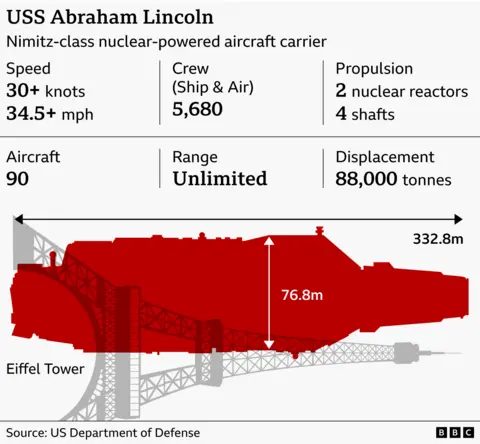
Military intelligence expert Justin Crump told BBC Verify that the current US military preparations in the Middle East show “more depth and sustainability” than its manoeuvres ahead of the seizure of former Venezuelan president Nicholas Maduro in January, or the operation carrying out air strikes on Iran’s nuclear facilities last June.
They all feature a carrier strike group and several destroyers operating independently. However, the US deployed its assets in Venezuela and Iran last year under quite different circumstances.
The US deployed the Gerald R Ford to the Caribbean ahead of its strikes on Venezuela, one of eight warships we tracked in the region at the time, though it used fewer aircraft as it could easily send jets from surrounding US bases on America’s mainland or from its base in Puerto Rico instead. The US also deployed amphibious assault ships within the Caribbean, which can be used as launch platforms for helicopter operations as was seen with the capture of Maduro. But Venezuela’s military is generally seen as less capable of defending itself or retaliating against the US.
When the US struck Iran last year in Operation Midnight Hammer, which targeted Iran’s nuclear facilities, it was attacking a country with a much more powerful military than Venezuela. Iran’s military is capable of hitting US bases across the Middle East.
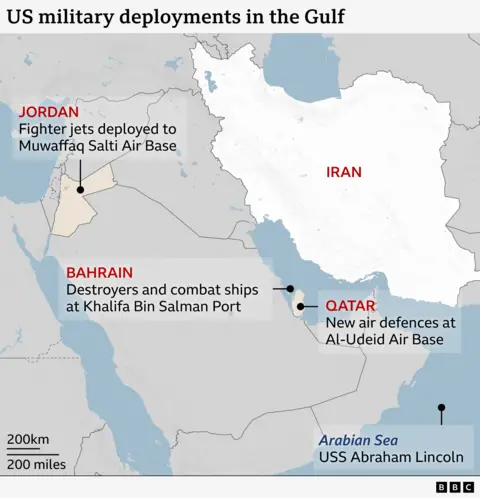
During Midnight Hammer the US had two aircraft carrier strike groups in the region, five destroyers placed in the Mediterranean and Red Seas, and three combat ships in the Gulf. It had also moved squadrons of fighter jets and refuelling aircraft from the US to Europe, but the B2 stealth bomber flights that were used to hit the Fordo, Isfahan and Natanz nuclear sites actually took off from US bases in Missouri.
Crump, chief executive of risk and intelligence company Sibylline, said the build-up of US warships and aircraft, as well as eight existing airbases in the region would allow it to conduct a “fairly intensive and sustained strike rate” of about 800 sorties a day, with the aim of rendering any Iranian responses “ineffective”.
“What we are seeing isn’t just strike preparation, but rather a broader deterrent deployment capable of being scaled up or down,” he said. “This means it has more depth and sustainability than the force packages arranged for either Venezuela or Midnight Hammer last year. It’s designed to sustain an engagement and counter all potential responses against US assets in the region and, of course, Israel.”
[BBC]

Samra’s record 110 in vain as Phillips and Ravindra put New Zealand in Super Eights

Canada reacts as cheating row rocks curling superpower

Long queues and confusion mar first day of India’s landmark AI summit

Ancient bone may prove legendary war elephant crossing of Alps

Nepal, Scotland chase win to close out what-if tournament

How dark web agent spotted bedroom wall clue to rescue girl from years of harm

‘Dates have the highest sugar content to fight Coronavirus’

Sunday Island 27 December – Headlines

#SundayIsland 17th December – Headlines

Sunday Island – 28th March

Sunday Island Headlines – 21 March

Sunday Island – 21st February – Headlines
-

 Life style2 days ago
Marriot new GM Suranga
-

 Business1 day ago
Ministry of Brands to launch Sri Lanka’s first off-price retail destination
-

 Features2 days ago
Monks’ march, in America and Sri Lanka
-

 Midweek Review6 days ago
A question of national pride
-

 Business6 days ago
Autodoc 360 relocates to reinforce commitment to premium auto care
-
 Opinion5 days ago
Will computers ever be intelligent?
-

 Features2 days ago
The Rise of Takaichi
-
 Features2 days ago
Wetlands of Sri Lanka: